- English
- Español
- Português
- русский
- Français
- 日本語
- Deutsch
- tiếng Việt
- Italiano
- Nederlands
- ภาษาไทย
- Polski
- 한국어
- Svenska
- magyar
- Malay
- বাংলা ভাষার
- Dansk
- Suomi
- हिन्दी
- Pilipino
- Türkçe
- Gaeilge
- العربية
- Indonesia
- Norsk
- تمل
- český
- ελληνικά
- український
- Javanese
- فارسی
- தமிழ்
- తెలుగు
- नेपाली
- Burmese
- български
- ລາວ
- Latine
- Қазақша
- Euskal
- Azərbaycan
- Slovenský jazyk
- Македонски
- Lietuvos
- Eesti Keel
- Română
- Slovenski
- मराठी
- Srpski језик

Waterproof Daypack: Why Rain Covers and DWR Fail on a Wet Hike, and When a Roll-Top Is the Better Pack
A waterproof daypack is a 15 to 30 litre hiking pack whose body keeps water out on its own, without a separate rain cover or liner. Most "waterproof" daypacks on the market are actually water-resistant: coated fabric with sewn seams and a rain cover that stows in the base. A genuinely waterproof daypack has high-frequency welded seams and either a roll-top or a waterproof zipper, so its contents stay dry in sustained rain, river crossings and spray. For most day hikes, 20 to 28 litres carries the ten essentials, water, food and a spare layer. This guide explains where conventional rain protection fails, how to choose between roll-top and zipper daypacks, and the waterproof daypacks we manufacture.
Rain protection is one of the most common worries hikers have about a daypack. The usual answers, a rain cover, a coated fabric or a dry bag inside, all work up to a point. Knowing where each one stops working is what makes the case for a pack that is waterproof in itself.
Why Do Rain Covers and DWR Coatings Let Water In?
A DWR (durable water repellent) finish makes water bead on the fabric, but it wears off with use and abrasion and does nothing at the seams or the zipper. A coated fabric is waterproof as a sheet, but a sewn pack has needle holes along every seam, and over hours of rain the water works through them. Reviewers regularly report packs described as waterproof soaking through in moderate rain, because a coating is not the same as a sealed construction.
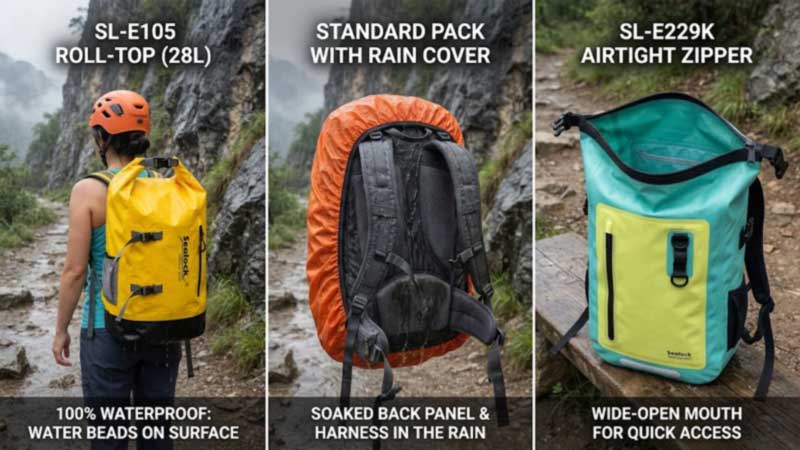
A rain cover keeps rain off the top and front of the pack, but it leaves the back panel exposed. Water runs down your back, soaks the padding and wicks into the pack from behind. Covers also catch the wind on exposed ridges, fill with water at the base and get left at home on the one day it rains. A pack liner or a dry bag inside the pack is far more reliable, which is why many hiking guides recommend one, but it means the pack itself, its pockets and anything stowed outside the liner still get wet.
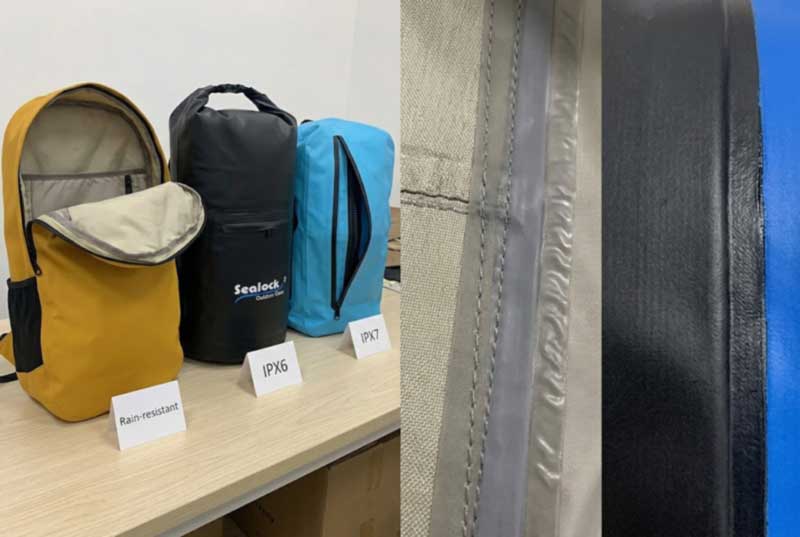
A welded pack removes the problem at the source. With no stitching in the shell there are no needle holes for rain to find, and the closure, roll-top or waterproof zipper, seals the last gap. The ratings these packs carry are explained in our guide to waterproof ratings for bags.
Roll-Top or Zipper Daypack?
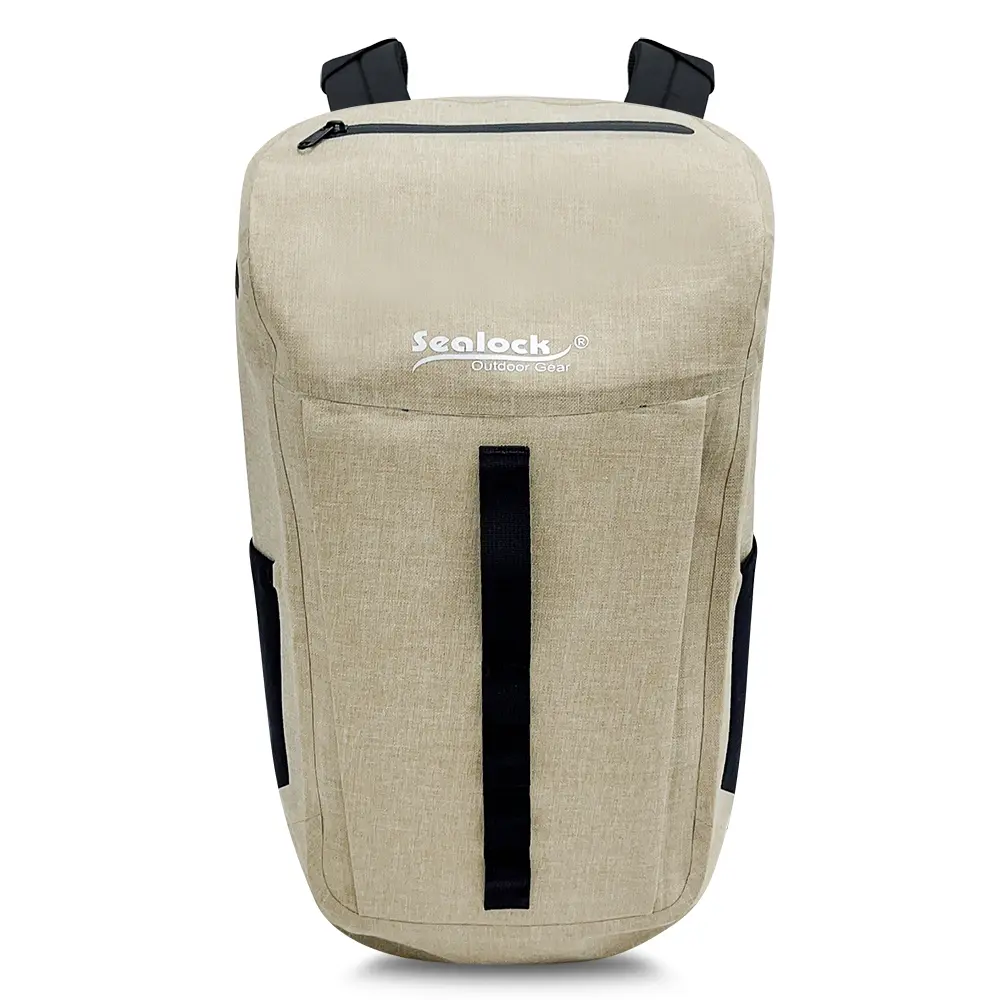
A roll-top is the most waterproof closure there is for a pack, and the most adjustable. Rolled three times and buckled, it keeps out sustained rain; on several of our designs it passes full immersion. It also changes size: roll it down for a light morning walk, roll it less for a full day with extra layers. The trade-off is access, since everything comes out of the top. Our SL-E229K adds a wrap-around waterproof zip to a roll-top, so the pack also opens like a suitcase.
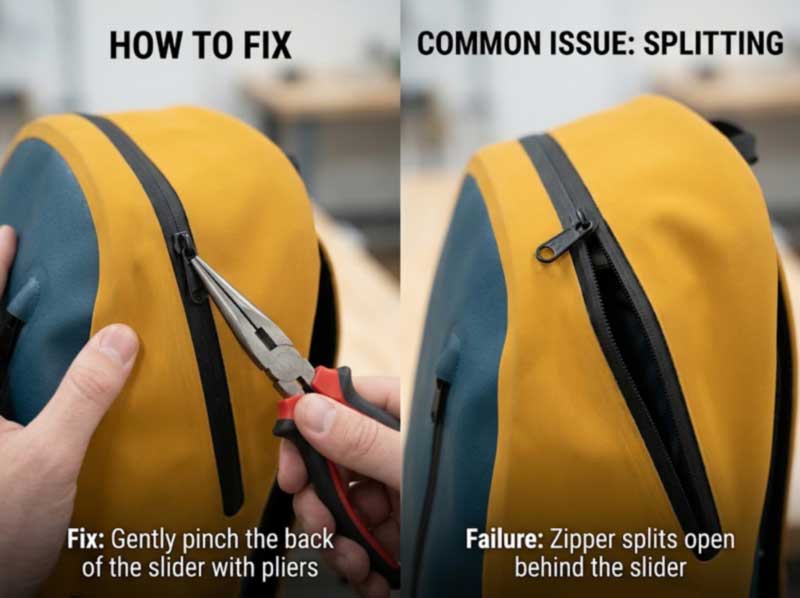
A waterproof zipper is quicker to open and easier to pack around, and a curved zipper path such as the one on our SL-E328 opens the pack wider than a roll-top. A laminated waterproof zipper keeps out heavy rain, rated IPX6. It needs to be kept clean and lubricated, as our article on why waterproof zippers fail explains, and it is not designed to go under water.
What Size Daypack Do You Need?
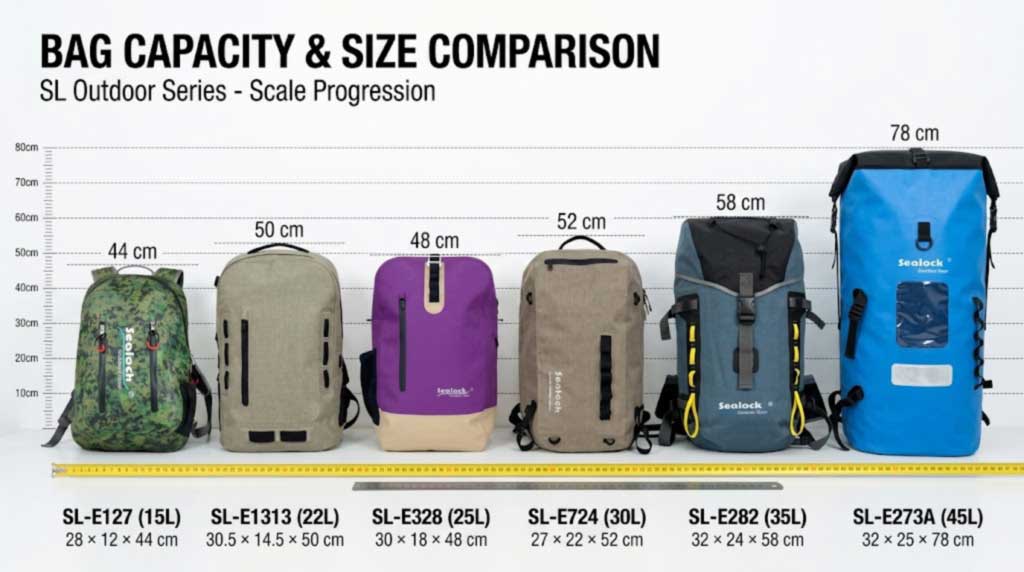
The ten essentials (navigation, headlamp, sun protection, first aid, fire starter, knife and repair kit, emergency shelter, extra food, water and clothing) fit comfortably in 20 to 25 litres. A 15 litre pack suits short hikes, scrambles and trail runs where you carry only water, a shell and a snack. Go towards 28 to 30 litres if you hike in cold or changeable weather and carry more layers, or if you carry a camera. Our article on standard backpack sizes shows what those litres look like in real dimensions.
Fit matters as much as size. Under about 20 litres, shoulder straps and a sternum strap are usually enough. Above that, a padded hip belt takes weight off the shoulders on a long day. A ventilated or grooved back panel keeps the back cooler and stops sweat soaking the padding, which matters as much as rain on a hot climb.
Waterproof Daypacks We Manufacture
| Image | Model | Capacity | Dimensions (H × W × D) | Weight | Construction | Use |
|---|---|---|---|---|---|---|
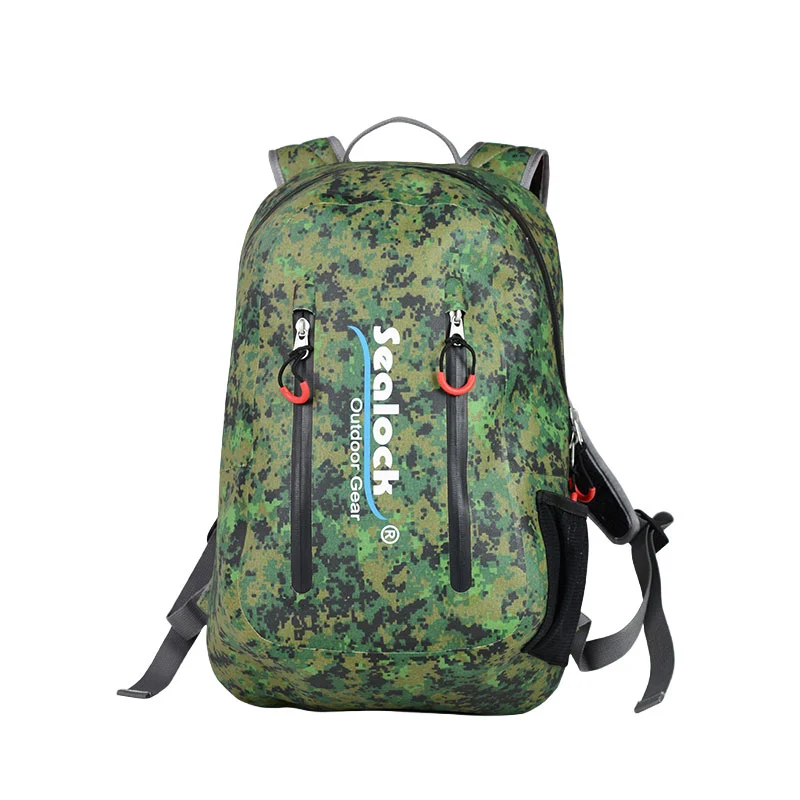
|
SL-E127 | 15 L |
44 × 28 × 12 cm 17.3 × 11 × 4.7 in |
0.65 kg | Welded 900D TPU, waterproof zippers, airflow back panel, two front zip pockets, IPX6 | Rugged daypack; short hikes and scrambles |
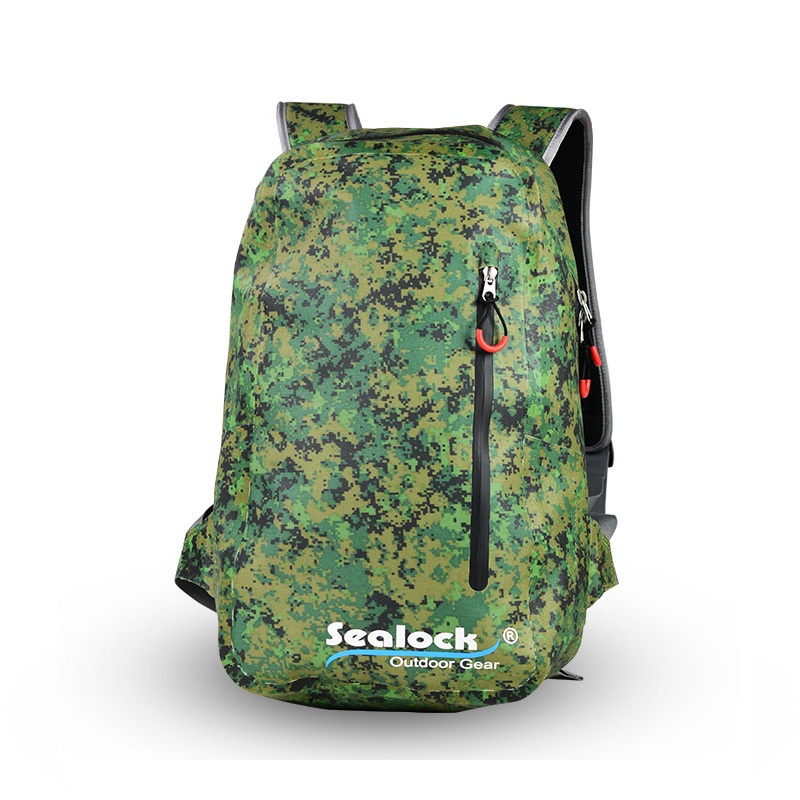
|
SL-E061 | 15 L |
44 × 28 × 12 cm 17.3 × 11 × 4.7 in |
0.8 kg | Welded 420D TPU, airtight waterproof zipper, waterproof front pocket, mesh bottle pockets, IPX6 | Hiking and cycling backpack; light day hikes |
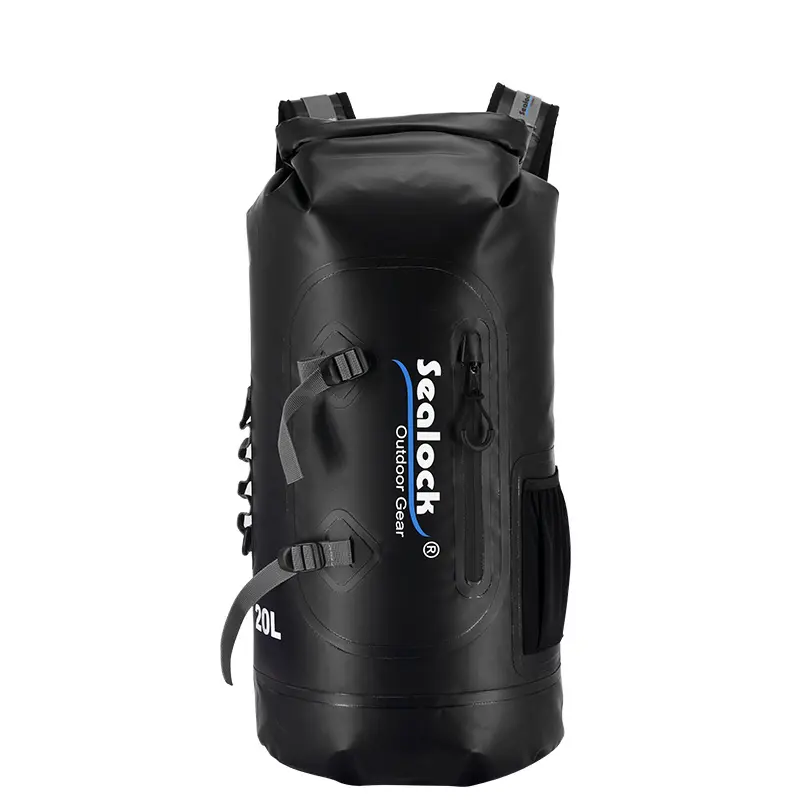
|
SL-E105 | 20 / 28 L |
48 × 23 × 18 / 54 × 26 × 20 cm 18.9 × 9.1 × 7.1 / 21.3 × 10.2 × 7.9 in |
0.65 / 0.9 kg | Welded 500D PVC tarpaulin, roll-top, front waterproof zip pocket, chest and waist straps, IPX7 | Roll-top backpack; full-day hikes in wet weather |

|
SL-E229K | 23 L |
48 × 30 × 16 cm 18.9 × 11.8 × 6.3 in |
0.9 kg | Welded TPU laminate, roll-top plus wrap-around waterproof zip, ventilated mesh back, IPX6 | Roll-top backpack with suitcase-style access |

|
SL-E328 | 25 L |
48 × 30 × 18 cm 18.9 × 11.8 × 7.1 in |
0.9–1.1 kg | Coated PVC laminate, welded and reinforced, curved-top waterproof zip, grooved back panel, hip belt, IPX6 | Zipper hiking backpack; longer days with a heavier load |
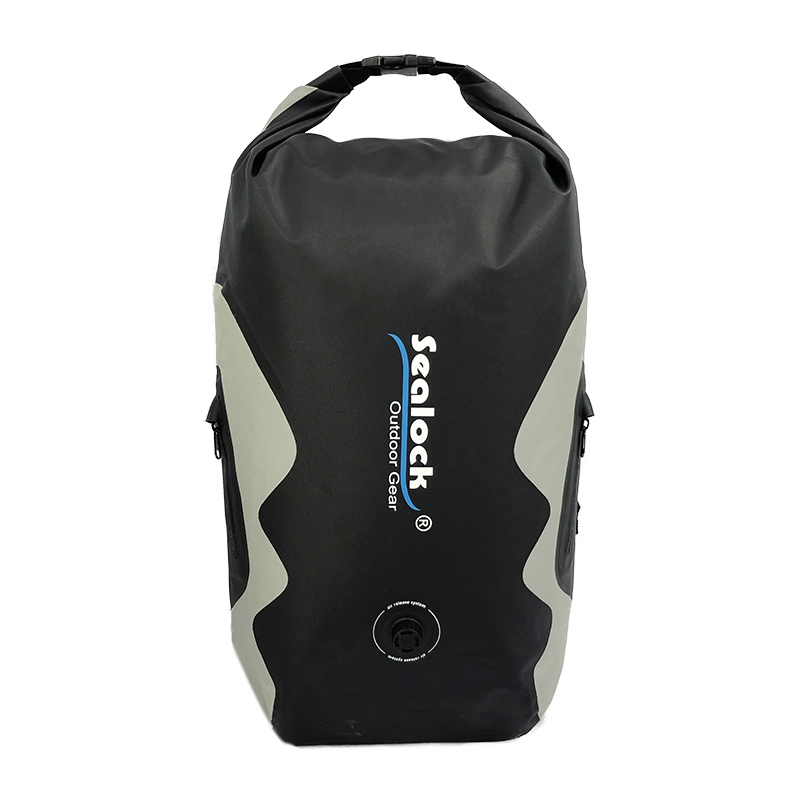
|
SL-E070 | 25 L |
50 × 28 × 18 cm 19.7 × 11 × 7.1 in |
0.9 kg | Welded 420D TPU-laminated nylon, roll-top with air valve, waterproof side pockets, reflective panels, IPX8 | Roll-top dry backpack; river trails, canyons and paddling days |
The full range is in our waterproof backpack category.
Developing a Waterproof Daypack for Your Brand
The daypack market is crowded, and genuine waterproofing is one of the few features that is easy to explain and hard to copy without the right equipment. Brands should decide the closure first (roll-top, waterproof zipper or both), then the fabric (500D PVC tarpaulin for toughness and price, TPU-laminated nylon for lighter weight and flexibility, recycled TPU for sustainability ranges), then the carry system: back panel ventilation, hip belt, sternum strap and hydration port. External attachments such as daisy chains, trekking pole loops and bottle pockets can be welded to the shell without puncturing it. We also make sewn daypacks for brands that want a fabric-led look with a welded inner liner. The MOQ is 300 pieces per design (500 on the SL-E127), samples take 7 to 15 days and bulk production 30 to 45 days, quoted FOB Guangdong with Vietnam origin available. Sealock has over 20 years of experience making hiking and outdoor packs.
Frequently Asked Questions
Is a waterproof daypack worth it over a rain cover?
If you hike in regular rain, yes. A cover leaves the back panel exposed and can blow off; a welded pack stays dry all round.
What size daypack do I need for a day hike?
20 to 25 litres for most day hikes; 15 litres for short, light outings; 28 to 30 litres for cold or changeable weather.
Are roll-top daypacks waterproof?
A welded roll-top rolled three times keeps out sustained rain. Some, like our SL-E105 and SL-E070, are rated for immersion as well.
Why does my daypack's back get soaked in the rain?
Rain runs down your back behind the pack and into the back panel, especially with a rain cover. A welded pack with a waterproof back panel stops it reaching the contents.
Does a daypack need a hip belt?
Under about 20 litres, not usually. For heavier loads and longer days, a padded hip belt makes a clear difference.
Can I use a waterproof daypack for cycling and commuting?
Yes. Several of our daypacks, such as the SL-E061, are designed for both hiking and cycling.
Request a Quote
Tell us the capacity, closure, fabric, carry system, colours and quantity you need, and we will reply within 24 hours with suitable base models, an FOB price and a sample timeline. Contact Sealock, or email info@sealock.com.hk.
Send Inquiry
Related Products




News Recommendations