
- English
- Español
- Português
- русский
- Français
- 日本語
- Deutsch
- tiếng Việt
- Italiano
- Nederlands
- ภาษาไทย
- Polski
- 한국어
- Svenska
- magyar
- Malay
- বাংলা ভাষার
- Dansk
- Suomi
- हिन्दी
- Pilipino
- Türkçe
- Gaeilge
- العربية
- Indonesia
- Norsk
- تمل
- český
- ελληνικά
- український
- Javanese
- فارسی
- தமிழ்
- తెలుగు
- नेपाली
- Burmese
- български
- ລາວ
- Latine
- Қазақша
- Euskal
- Azərbaycan
- Slovenský jazyk
- Македонски
- Lietuvos
- Eesti Keel
- Română
- Slovenski
- मराठी
- Srpski језик

Waterproof Ratings for Bags: What IPX4 to IPX8 Really Promise, and How to Check a Bag Yourself
Waterproof ratings for bags are usually written as IPX numbers, from IPX4 (splashes from any direction) to IPX8 (continuous submersion beyond one metre). The numbers come from IEC 60529, a standard written for electrical enclosures, which bag makers borrow because there is no dedicated international waterproof standard for bags. This guide explains what each rating means in practice, which ratings a roll-top, a zipper bag and an airtight zipper bag can honestly carry, how the tests are run, and how a buyer or retailer can check a sample without a laboratory. Every example comes from bags we manufacture in Dongguan, China and Ho Chi Minh City, Vietnam.
The number on the label matters more than most buyers think. A customer who reads IPX7 expects the bag to survive a capsize. A customer who reads waterproof with no number has no idea what to expect, and that gap is where most returns and one-star reviews come from: the bag was fine in rain and failed in the river, or it was fine in the river and the zipper leaked after six months. A rating that matches the construction is the single best protection a brand has against that kind of complaint.
What Do the IPX Ratings Mean?
An IP code has two digits. The first covers dust and solid objects, the second covers water. When a product has only been tested for water, the first digit is replaced with an X, which is why bags are marked IPX6 or IPX7 rather than IP66 or IP67. The water digit runs from 0 to 8, and for bags only the upper half of the scale is meaningful.
IPX4 means the product resists water splashed against it from any direction, tested with an oscillating spray tube or a hand spray nozzle for at least ten minutes. In bag terms, that is light rain and the occasional splash, the level of a coated daypack with standard zippers.
IPX5 means resistance to water jets from a 6.3 mm nozzle delivering 12.5 litres per minute from about three metres away, for at least three minutes. IPX6 steps up to a 12.5 mm nozzle delivering 100 litres per minute, again for at least three minutes. These two ratings describe what a bag meets on a bike in a downpour, on a boat deck taking spray, or under a heavy tropical storm. They say nothing about being held under water.
IPX7 means the product survives temporary immersion: 30 minutes with its lowest point one metre below the surface. IPX8 means continuous immersion under conditions the manufacturer specifies, which must be more severe than IPX7. That is why an IPX8 claim should always come with a depth or a duration. Our IPX8 phone pouch is specified to 30 metres and our SL-E119 airtight zipper backpack to 20 metres. An IPX8 label with no figure attached tells the buyer very little.
One detail catches out even experienced buyers. Under IEC 60529, the immersion ratings do not automatically include the jet ratings. A bag that passes IPX7 has not necessarily passed IPX6, because a powerful jet hitting a zipper from the outside is a different load from still water pressing evenly on all sides. Products tested for both are marked with both, for example IPX6/IPX7. In practice a fully welded bag with an airtight zipper handles both well, but the distinction explains why the label wording matters.
| Rating | Test in IEC 60529 | What it means for a bag | Typical construction |
|---|---|---|---|
| IPX4 | Splashing from all directions, 10 minutes | Light rain, occasional splashes | Coated fabric, sewn seams, standard zippers |
| IPX5 | 6.3 mm nozzle, 12.5 L/min, 3 minutes minimum | Steady rain, spray | Coated fabric, rain flap over a water-resistant zipper |
| IPX6 | 12.5 mm nozzle, 100 L/min, 3 minutes minimum | Heavy rain, road spray, deck spray | Welded seams with a roll-top or waterproof zipper |
| IPX7 | Immersion, 1 m, 30 minutes | Dropped in water, short capsize | Welded seams with an airtight zipper |
| IPX8 | Continuous immersion beyond 1 m, conditions stated by the maker | Held under water, deep or long submersion | Welded seams with an airtight zipper or a sealed pouch closure, stated depth |
Which Rating Can Each Type of Bag Honestly Carry?
The rating is decided by the weakest point of the bag, and that is almost never the fabric. A good 500D PVC tarpaulin or TPU-laminated nylon will hold back far more water pressure than any bag will ever meet. What fails is the seam, the closure or the place where a strap is attached.
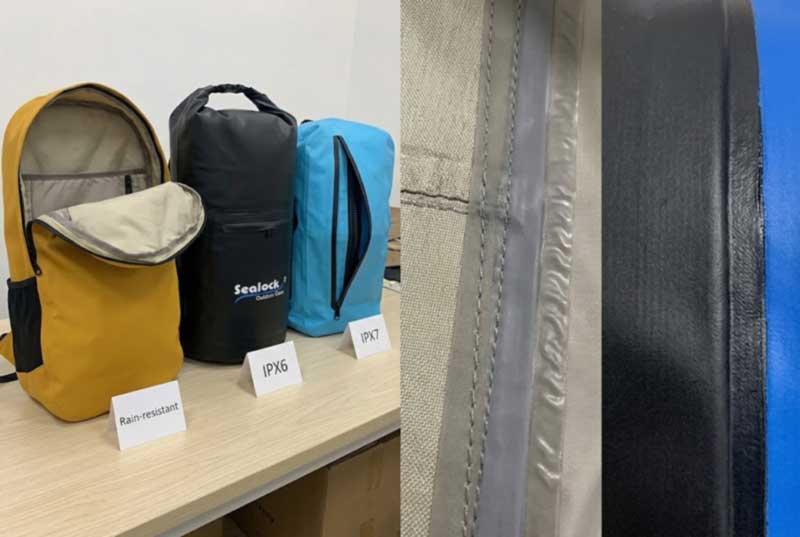
A sewn bag has a needle hole every few millimetres along every seam. Seam tape can cover them, and a well-taped sewn bag can be genuinely rain-proof, but tape is a layer that can lift with flexing and age. That is why we rate sewn and taped bags such as our SL-E1176 slim laptop backpack as rain- and splash-resistant rather than giving them an immersion number. A bag with high-frequency welded seams has no needle holes in its shell at all, because the panels are fused together. The seams then stop being the weak point and the closure takes over.
A roll-top closure, rolled at least three times and buckled, is honestly an IPX6 closure. It keeps out sustained heavy rain and spray for hours, but under water the pressure slowly finds its way through the folds. Our roll-top bags such as the SL-C807 motorcycle tail bag and the SL-E036 30 litre dry backpack are rated IPX6 for that reason. Some roll-top designs pass immersion tests when they are rolled tightly and well made, and where a product has passed that test we state it, but a buyer should treat any roll-top marketed as submersible with care.
A standard waterproof zipper, with a polyurethane-coated tape, keeps out rain at speed and suits IPX5 to IPX6 bags. An airtight zipper, the same type of closure used on drysuits, is what takes a bag to IPX7 and IPX8. Our SL-E984 motorcycle bag, the SL-C594 travel duffel and the SL-C878 gym duffel all use airtight zippers and are rated IPX7, and the SL-J033 caving backpack uses a rubber-sealed closure and is rated IPX8.
Some products should carry no IPX number at all. Our vacuum compression packing bags have a one-way valve and a waterproof zipper, and they resist splashes, dust and damp very well, but a valve is not built to be held under water. We describe them as splash-resistant and say plainly that they are not submersible. A clear description is worth more than a number that the product cannot back up.
Examples from Our Range at Each Rating
The table below shows one or two bags from our own production at each level, so the construction behind each rating can be seen side by side.
| Image | Model | Rating | Seams and Closure | Capacity |
|---|---|---|---|---|
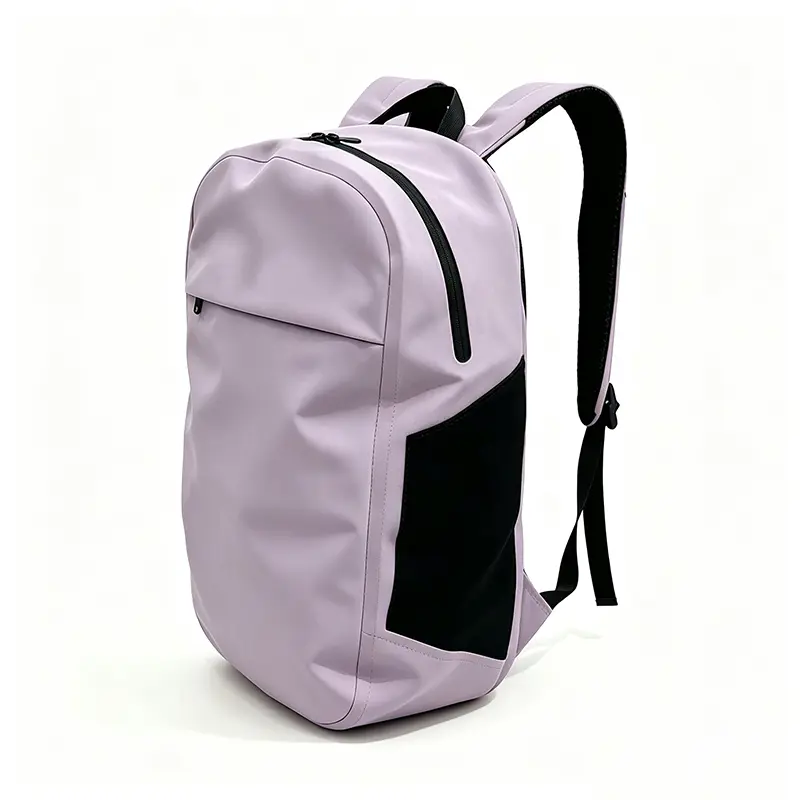
|
SL-E1176 | Rain and splash resistant | Sewn and bar-tacked, laminated YKK zipper | 16 L |
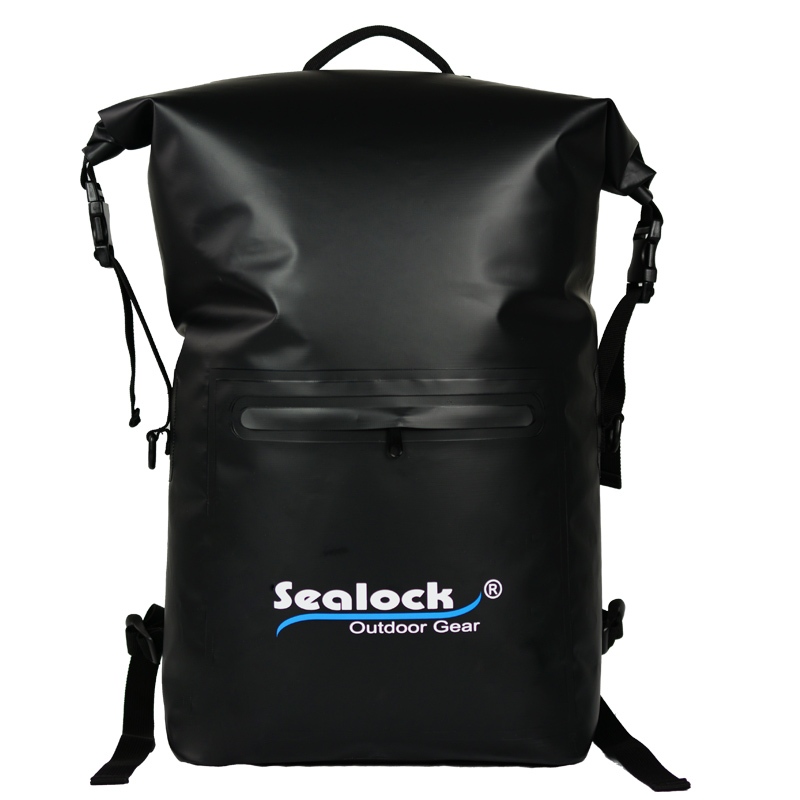
|
SL-E036 | IPX6 | High-frequency welded, roll-top | 30 L |
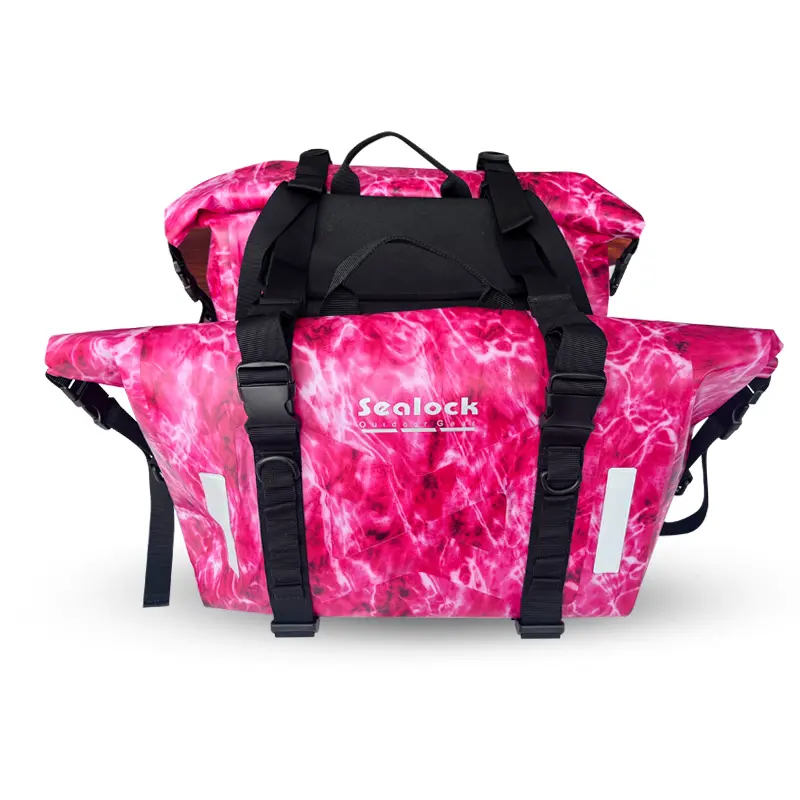
|
SL-C807 | IPX6 | High-frequency welded, roll-top | 45 L |
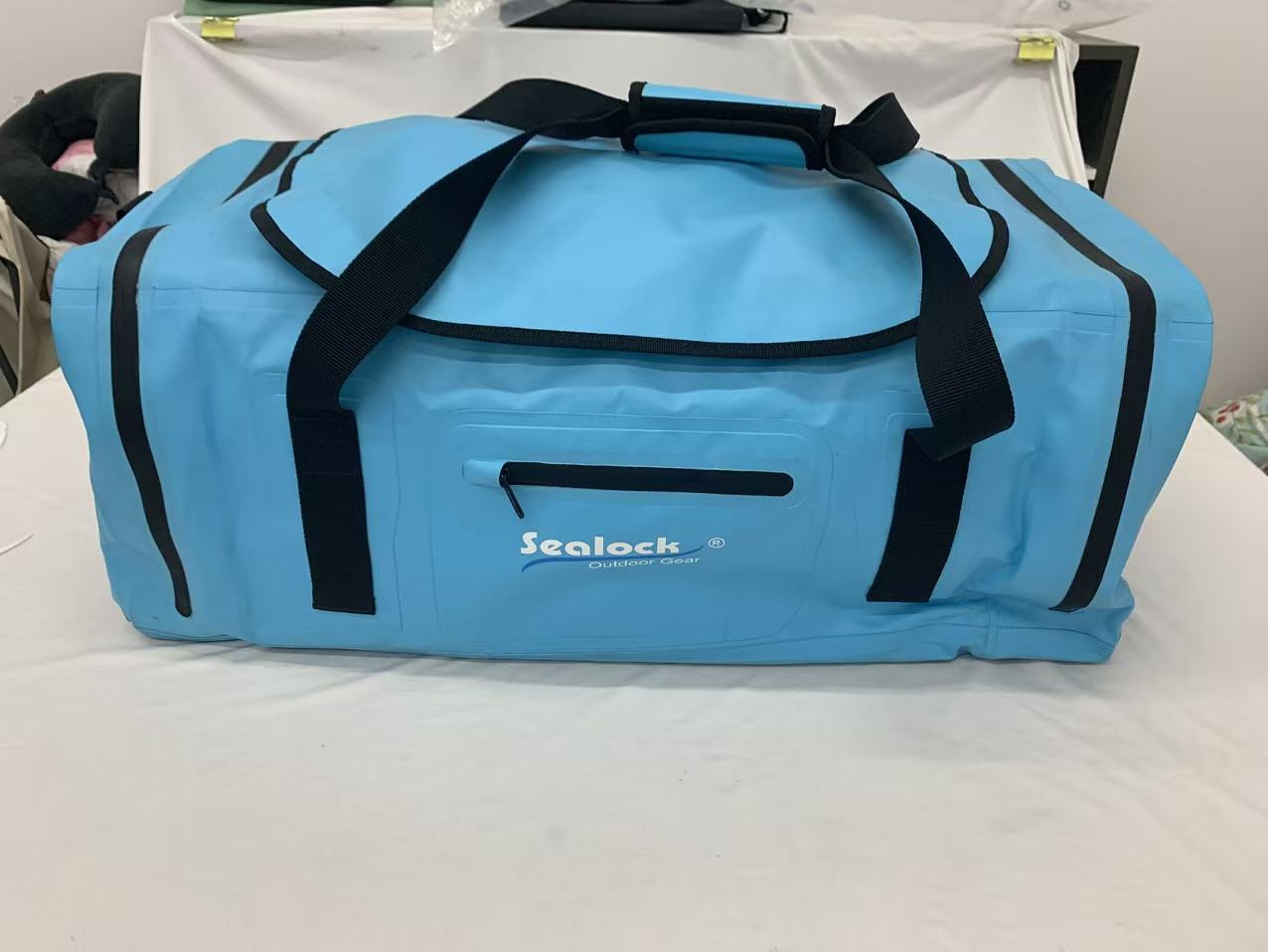
|
SL-C594 | IPX7 | High-frequency welded, three airtight zippers | 55 L |
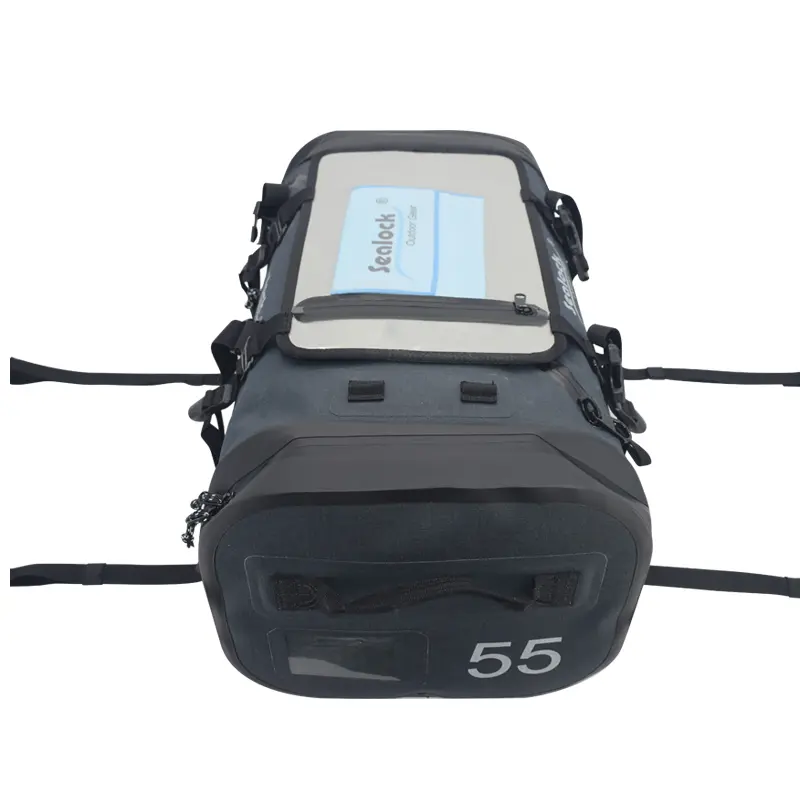
|
SL-E984 | IPX7 | High-frequency welded, airtight zipper | 55 L |

|
SL-E119 | IPX8, to 20 m | High-frequency welded, airtight zipper | 20 L |
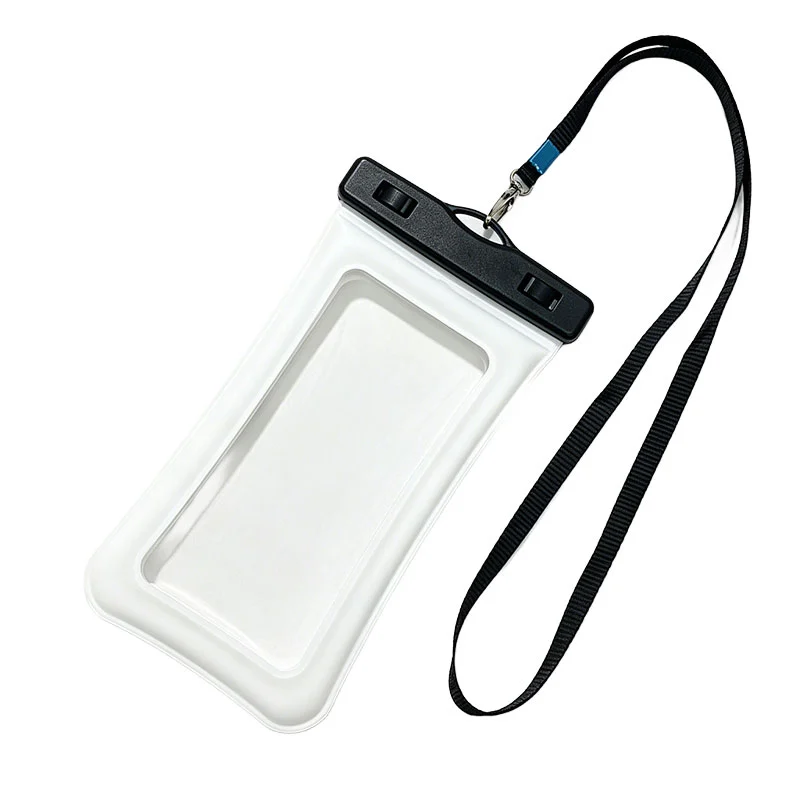
|
SL-A082 / A083 | IPX8, to 30 m | Heat-sealed, double slide lock and fold seal | Phones up to 6.9" |
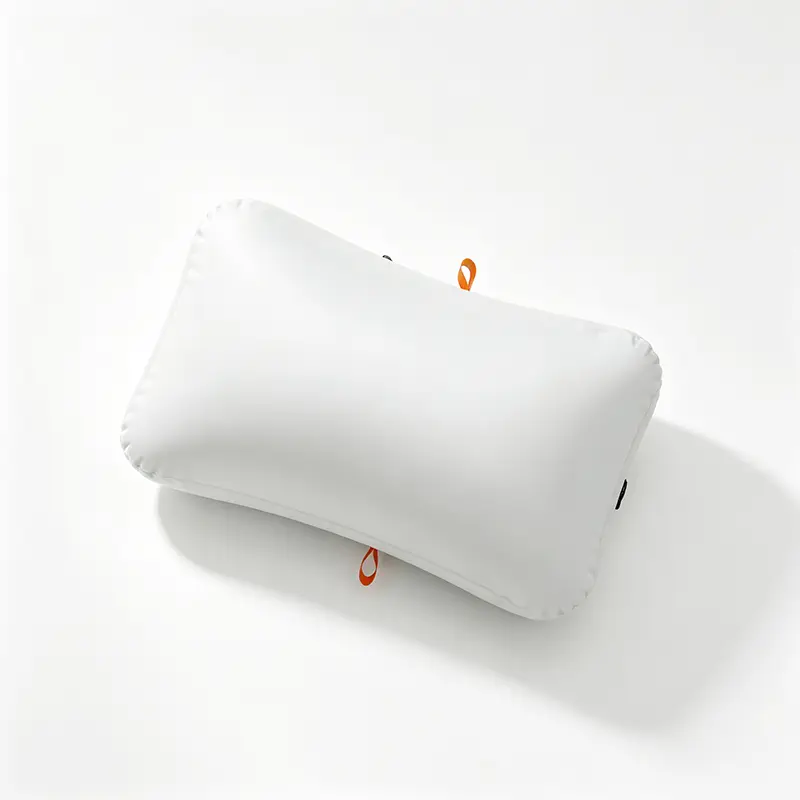
|
SL-P1133 | No IPX rating: splash, dust and damp resistant | Welded body, waterproof zipper, one-way valve | 25 to 30 L of clothing |
How Are Bags Tested for Waterproofness?
There are two layers of testing, the fabric and the finished bag. Fabric is tested for hydrostatic head: a sample is clamped over a column of water and the pressure is raised until water comes through, with the result given in millimetres of water column. A rain jacket fabric might be rated at 10,000 mm. The coated and laminated fabrics used for dry bags are far above that, which is one more reason the fabric is rarely the weak point. Hydrostatic head tells a buyer about the material. It says nothing about the seams, the closure or the finished product.
The finished bag is what actually has to keep water out, so that is where our production testing focuses. Bags rated IPX5 and IPX6 go through a heavy rain and water-jet test, with the jet worked along every seam, the closure and the strap attachment points. Bags rated IPX7 and IPX8 go through a full water-immersion test of two hours or more, which is four times the 30 minutes IEC 60529 asks for at IPX7. Phone pouches are inflated, sealed and held under water to check for any stream of bubbles. Behind those finished-bag tests sit the checks that predict long-term performance: the bonding strength of the welds, zipper fatigue to 3,000 cycles, load testing to more than 1,500 cycles, abrasion, salt spray and colour fastness. Third-party testing by SGS or QIMA can be arranged for buyers who need an independent report.
For large retail programmes, some of our customers inspect with their own protocol: the cartons are opened, the air is extracted from each sample, the bag is left to stand for 24 hours, and then it is checked for any air leak. A bag that holds its vacuum overnight has no path for water either.
How Can You Check a Sample Without a Lab?
A buyer evaluating samples can learn a lot with a bath, a sheet of newspaper and an hour. For a bag claimed as IPX7 or IPX8, put dry newspaper or paper towels inside, close it exactly as a customer would, weigh it down with a sealed bottle of water so it sinks, and leave it fully submerged for at least 30 minutes. Then open it and look for any damp patch on the paper. Damp along one edge usually points to the closure, a single spot to a pinhole or a weak weld.
For a bag claimed as IPX5 or IPX6, fill it with paper, close it, and hold it under a strong shower or a garden hose for several minutes, aiming at the seams, the closure, the corners and every point where a strap or D-ring meets the shell. Turn the bag so the water hits the closure from below as well as from above, because rain driven by wind does not only fall from the top.
For a roll-top, repeat the test with the top rolled only once and then with it rolled three times. The difference shows the customer exactly why the instruction card matters, and our guide on how to close a roll-top dry bag covers what that card should say. If a bag also needs to float, test it with a realistic load, as described in our article on floating dry bags.
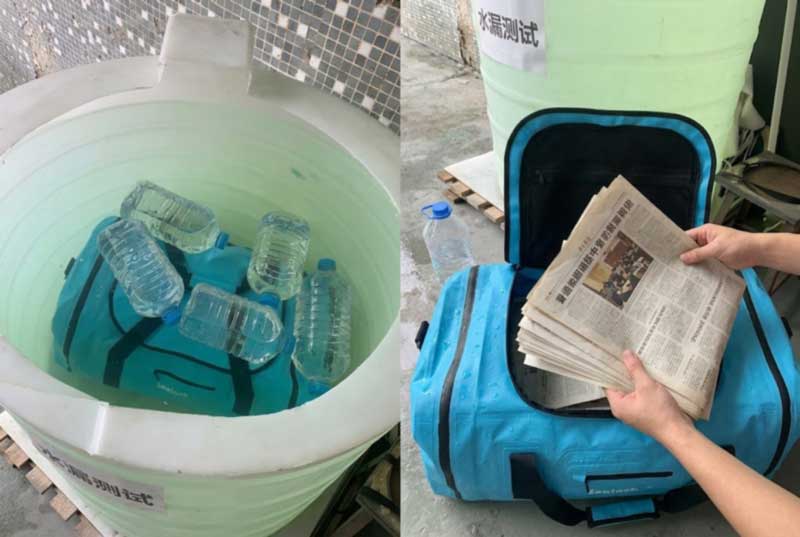
What Should a Brand Put on the Label?
A rating, a sentence of plain English and, for IPX8, the depth and time. IPX6 with the line "keeps out heavy rain and spray, not for submersion" sets expectations exactly. IPX7 with "survives temporary immersion, close the zipper fully" does the same. Retailers in Europe and North America increasingly ask for the test basis behind the claim, so it is worth keeping the test reports on file for every rated product, along with any third-party reports.
For brands developing their own range, the rating should be decided at the specification stage, because it decides the construction and the cost. Moving a design from a waterproof zipper to an airtight zipper, or from sewn to welded seams, changes the price per unit and the lead time. We can build to any of these levels in both of our factories, and our custom dry bags range and the custom logo roll-top dry bag OEM programme show where most branded orders start. The standard MOQ is 300 pieces per design, samples take 7 to 15 days and bulk production 30 to 45 days, with prices quoted FOB Guangdong and Vietnam origin available. Sealock has over 20 years of experience making both sewn and welded waterproof bags.
Frequently Asked Questions
Is IPX7 better than IPX6?
For submersion, yes. For powerful jets of water, not necessarily, because the two tests are different and an IPX7 test does not include the jet test. A bag marked IPX6/IPX7 has passed both.
My bag says waterproof but it leaked in the rain. Why?
Usually through the zipper or the seams rather than the fabric. A bag with sewn seams and a standard zipper is water-resistant at best. Look for welded seams and a stated IPX rating.
Can I swim with an IPX7 bag?
An IPX7 bag will survive being dropped in the water or a short capsize. For being held under water for long periods or at depth, choose IPX8 with a stated depth.
Why did my roll-top dry bag let water in when it went under?
Roll-tops are designed for rain and spray. Under water, pressure works through the folds, especially if the top was rolled fewer than three times. Use an airtight zipper bag for anything that may be submerged.
Do waterproof ratings wear off?
The fabric and welded seams last for years, but closures need care. Keep airtight zippers clean and lubricated, and do not overfill a roll-top so that it cannot be rolled three times.
Is a waterproof rating the same as a certification?
No. Many IPX ratings on bags are declared by the maker based on its own testing. Buyers who need proof should ask for the test report, or for an independent test by a lab such as SGS.
Request a Quote
Tell us the bag type, the rating you need, the quantity and your logo, and we will reply within 24 hours with a construction recommendation, an FOB price and a sample timeline. Contact Sealock, or email info@sealock.com.hk.