
- English
- Español
- Português
- русский
- Français
- 日本語
- Deutsch
- tiếng Việt
- Italiano
- Nederlands
- ภาษาไทย
- Polski
- 한국어
- Svenska
- magyar
- Malay
- বাংলা ভাষার
- Dansk
- Suomi
- हिन्दी
- Pilipino
- Türkçe
- Gaeilge
- العربية
- Indonesia
- Norsk
- تمل
- český
- ελληνικά
- український
- Javanese
- فارسی
- தமிழ்
- తెలుగు
- नेपाली
- Burmese
- български
- ລາວ
- Latine
- Қазақша
- Euskal
- Azərbaycan
- Slovenský jazyk
- Македонски
- Lietuvos
- Eesti Keel
- Română
- Slovenski
- मराठी
- Srpski језик

Standard Backpack Size: Real Dimensions and Litres, Measured on 12 Waterproof Backpacks
A standard everyday backpack holds about 20 to 25 litres and measures roughly 45 to 50 cm tall, 28 to 32 cm wide and 13 to 18 cm deep, or about 18 × 12 × 6 inches. Daypacks run from 10 to 20 litres, travel and hiking packs from 30 to 50 litres, and expedition packs from 50 litres up. There is no official standard size, so this guide uses the measured dimensions of twelve waterproof backpacks we manufacture, from 15 to 65 litres, to show what each size really looks like, how capacity is measured, and which size fits which job.
Size charts online tend to give one tidy figure per category. Real packs are less tidy, and the differences matter. Two bags sold as 25 litres can carry quite different loads depending on whether the figure includes the pockets, whether the top is a zipper or a roll-top, and how much space the padding takes up. Buyers and brands who understand where the numbers come from make far better choices, and get far fewer returns marked "smaller than expected".
What Is the Standard Size of a Backpack?
The closest thing to a standard is the everyday pack used for school, work and short trips: 20 to 25 litres, tall enough for a 15.6 inch laptop, and slim enough to sit comfortably on a commuter's back. Around that core, the market has settled into five rough tiers.
| Tier | Capacity | Typical size (H × W × D) | Typical use |
|---|---|---|---|
| Mini and sling | Under 10 L | about 35 × 22 × 10 cm | Phone, wallet, water bottle, light layer |
| Daypack | 10 to 20 L | about 44 × 28 × 12 cm | Short hikes, cycling, light commuting |
| Everyday standard | 20 to 25 L | about 48 × 30 × 15 cm | School, office, laptop, gym kit |
| Travel and hiking | 30 to 50 L | about 52 to 63 × 27 to 32 × 22 to 25 cm | Weekend trips, carry-on travel, full-day hikes, paddling |
| Expedition | 50 L and above | about 68 to 78 × 34 × 23 to 28 cm | Multi-day trips, caving, heavy kit |
How Big Are Real Backpacks? Measured Dimensions from Our Range
The table below lists twelve of our waterproof backpacks with their capacity, measured outside dimensions and weight. Dimensions are height × width × depth. Roll-top packs are measured with the top rolled for normal use.
| Image | Model | Capacity | Dimensions (H × W × D) | Weight | Construction | Use |
|---|---|---|---|---|---|---|
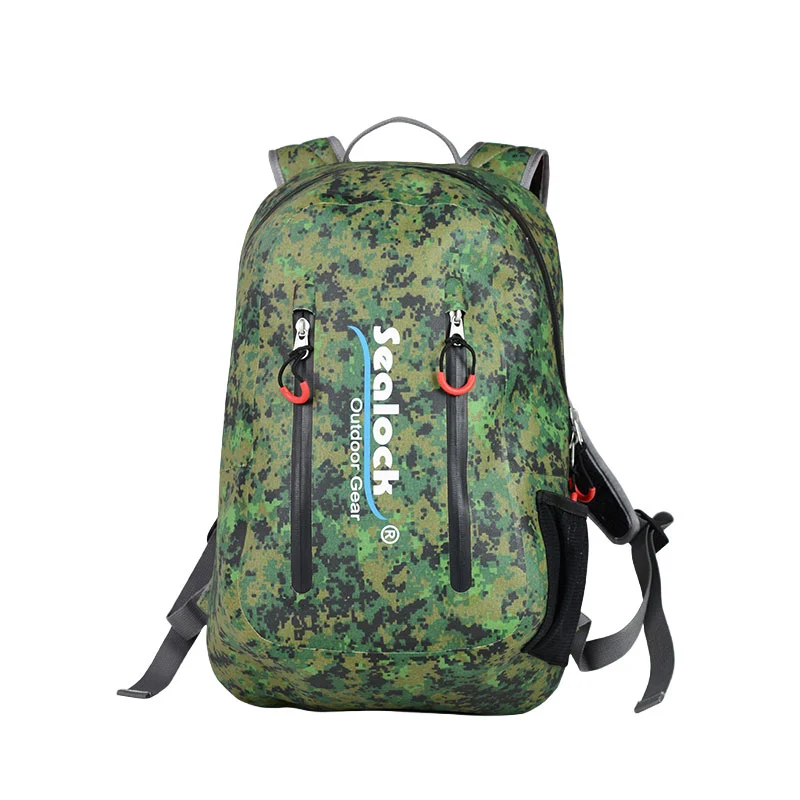
|
SL-E127 | 15 L |
44 × 28 × 12 cm 17.3 × 11 × 4.7 in |
0.65 kg | Welded, waterproof zipper, IPX6 | Rugged daypack |
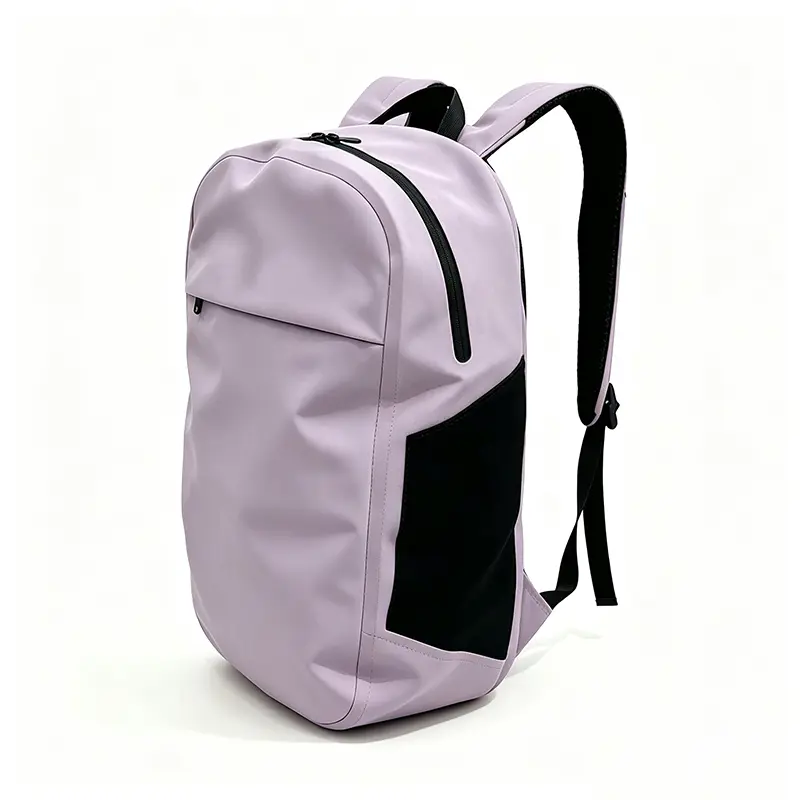
|
SL-E1176 | 16 L |
47 × 28 × 12 cm 18.5 × 11 × 4.7 in |
0.65 kg | Sewn, water-resistant, 15.6 in laptop | Slim commuter |
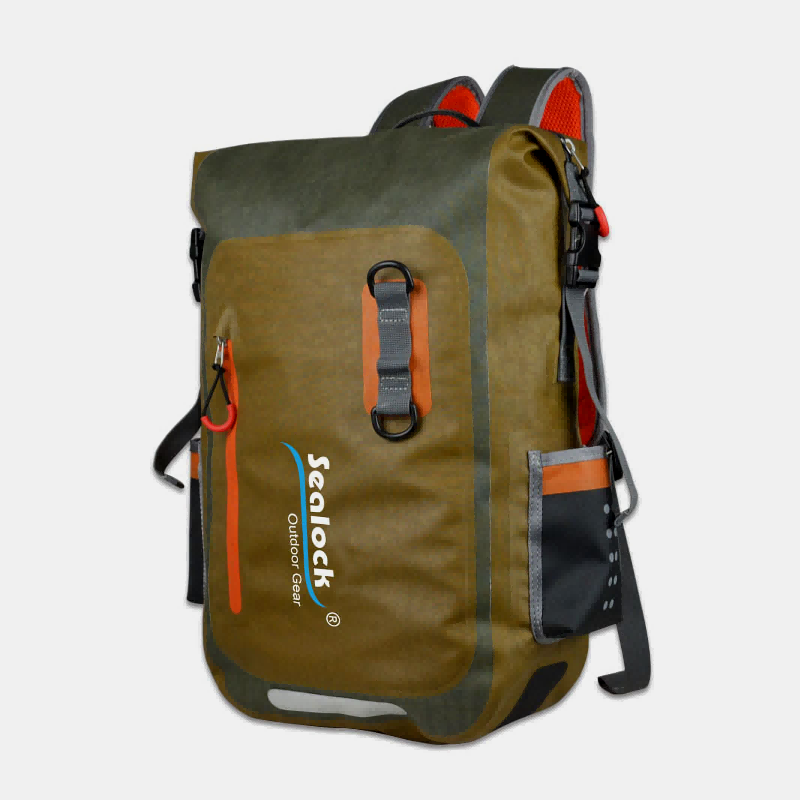
|
SL-E029 | 20 L |
50 × 30 × 13.5 cm 19.7 × 11.8 × 5.3 in |
0.85 kg | Welded roll-top, IPX6, laptop sleeve | Roll-top commuter |

|
SL-E119 | 20 L |
47 × 31.5 × 14.5 cm 18.5 × 12.4 × 5.7 in |
0.86 kg | Welded, airtight zipper, IPX8 | Submersible laptop pack |
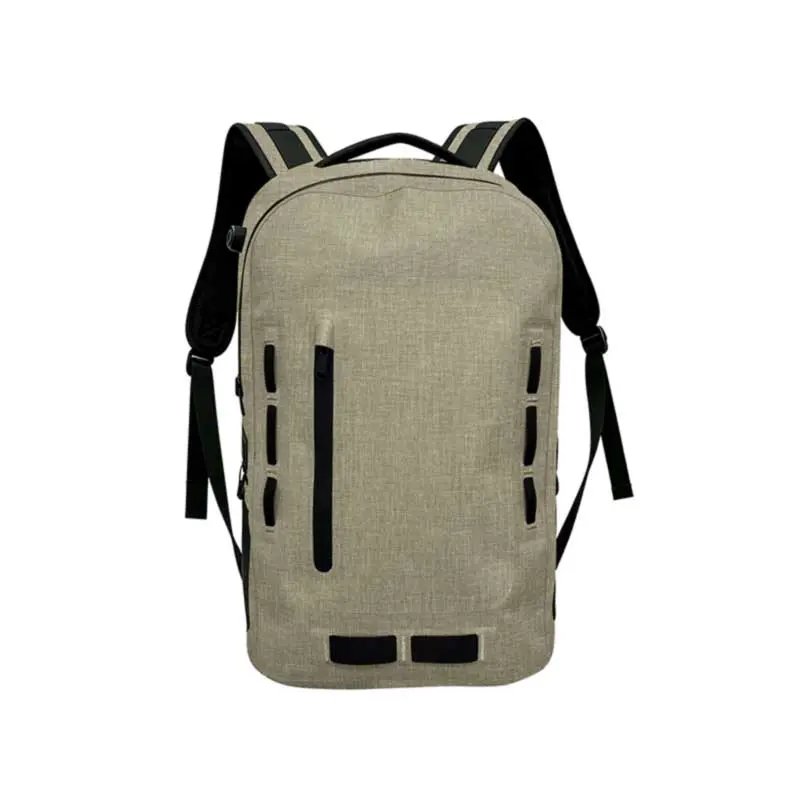
|
SL-E1313 | 22 L |
50 × 30.5 × 14.5 cm 19.7 × 12 × 5.7 in |
0.85 kg | Welded, waterproof zipper, IPX6, 16 in laptop | Laptop backpack |
|
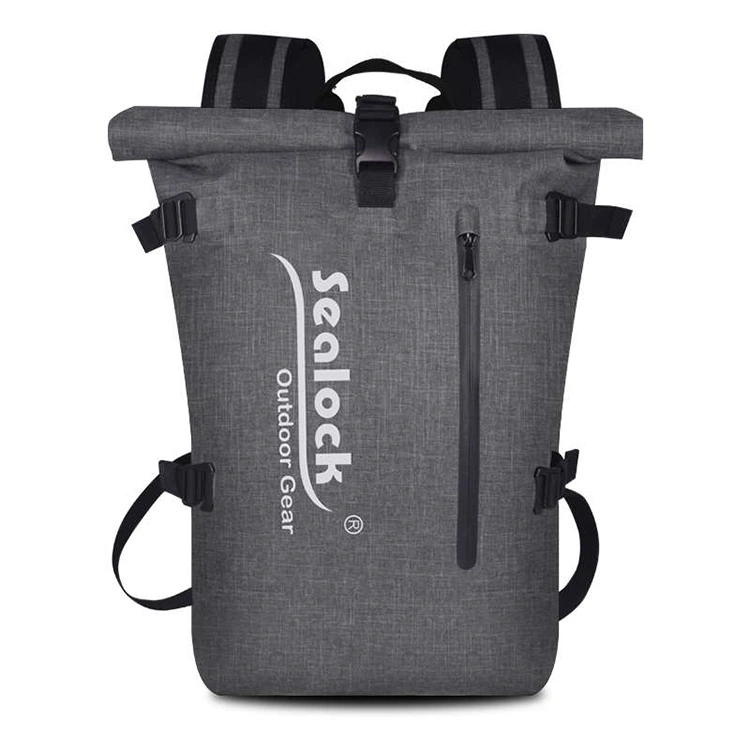
SL-E980 | 22 L |
48 × 30 × 15 cm 18.9 × 11.8 × 5.9 in |
0.95 kg | Welded roll-top, IPX6, removable laptop sleeve | Cycling commuter |

|
SL-E328 | 25 L |
48 × 30 × 18 cm 18.9 × 11.8 × 7.1 in |
0.9–1.1 kg | Welded, waterproof zipper, IPX6 | Day hiking |
|
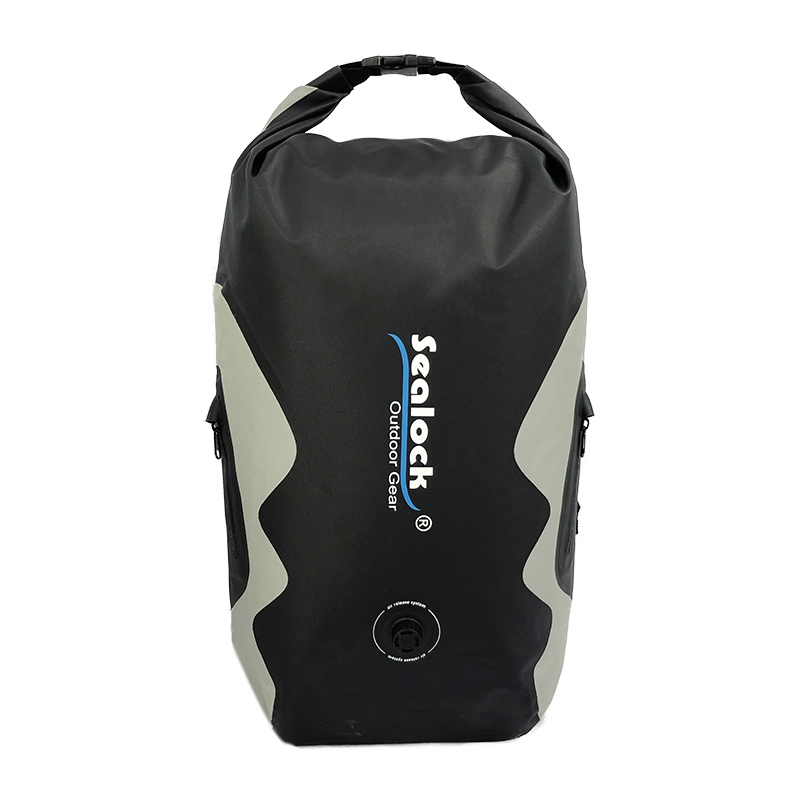
SL-E070 | 25 L |
50 × 28 × 18 cm 19.7 × 11 × 7.1 in |
0.9 kg | Welded roll-top with air valve, IPX8 | Paddling dry backpack |
|
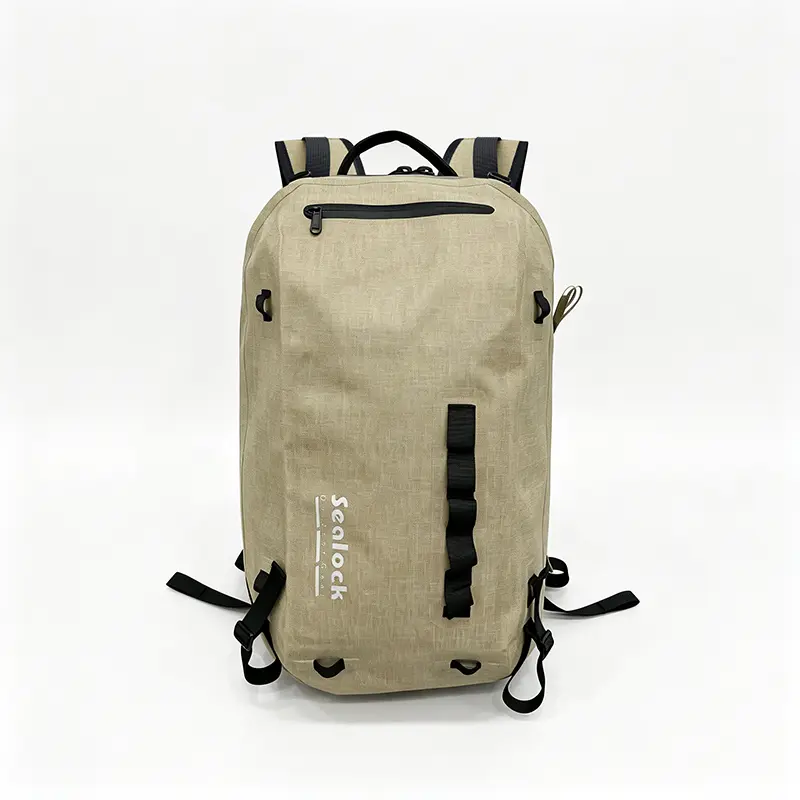
SL-E724 | 30 L |
52 × 27 × 22 cm 20.5 × 10.6 × 8.7 in |
1.0 kg | Welded, clamshell YKK zipper, IPX6 | Travel and photo |

|
SL-E282 | 35 L |
58 × 32 × 24 cm 22.8 × 12.6 × 9.4 in |
1.4 kg | Sewn with welded panels, roll-top flap, IPX5–6 | Technical hiking |
|
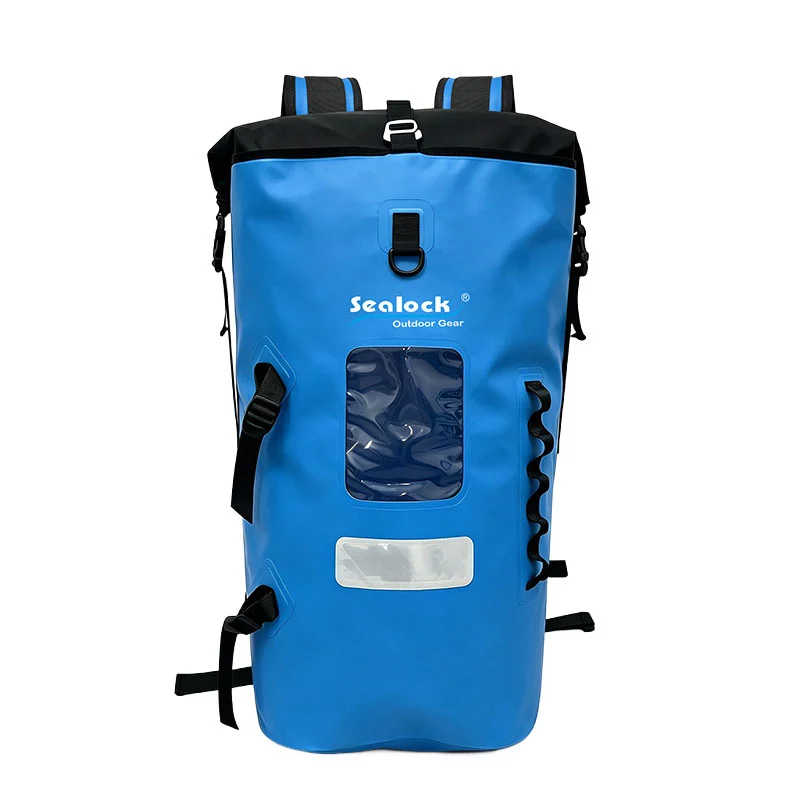
SL-E273A | 45 L |
63 × 32 × 25 cm 24.8 × 12.6 × 9.8 in |
1.1 kg | Welded roll-top, IPX6 | Kayaking and canyoning |

|
SL-J033 | 45 / 55 / 65 L |
58 / 68 / 78 × 34 × 23 cm 23 / 27 / 31 × 13.4 × 9.1 in |
1.92–2.04 kg | Welded, rubber-sealed closure, IPX8 | Caving expedition |
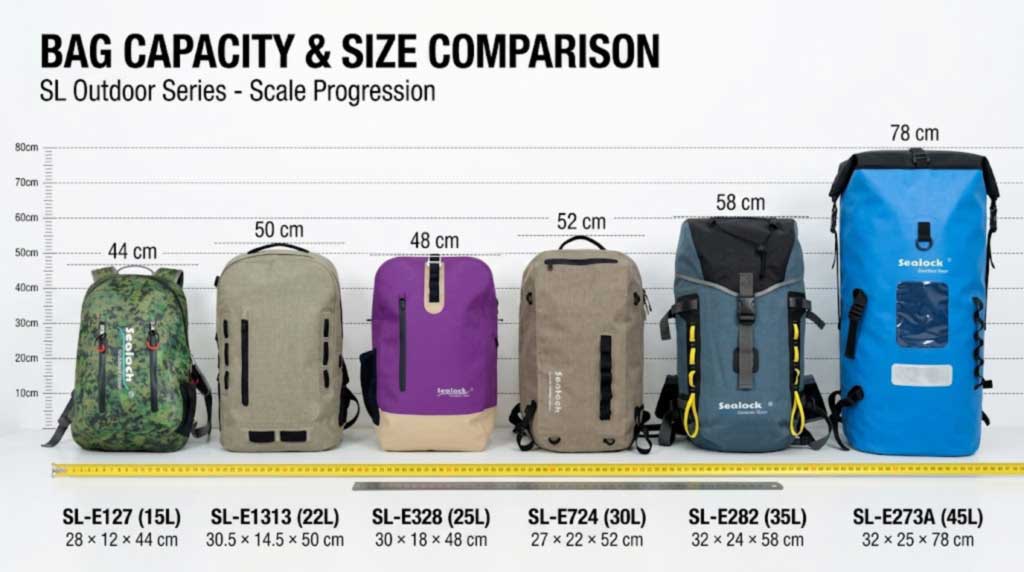
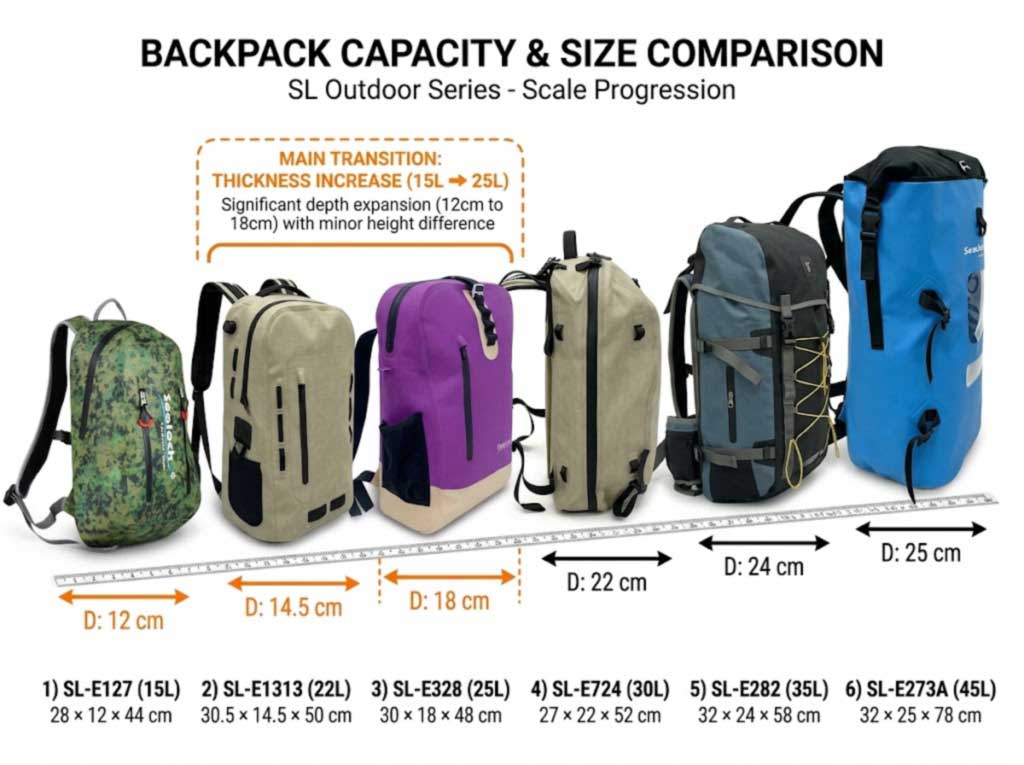
One pattern stands out. Between 15 and 25 litres the height barely changes, from about 44 to 50 cm, because height is set by the length of a person's back and by the laptop it has to hold. The extra litres come almost entirely from depth and width: a 15 litre pack is about 12 cm deep, a 25 litre pack about 18 cm. Above 30 litres, height starts to climb again, to 52 cm at 30 litres and 58 to 63 cm at 35 to 45 litres, which is why bigger packs need a proper hip belt to carry well. Our SL-J033 caving pack takes this to its logical end: all three sizes share the same 34 × 23 cm base, so they still fit through narrow cave passages, and only the height changes.
How Is Backpack Capacity Measured?
Capacity is usually given in litres, and the most common method is to fill the pack with small plastic balls or pellets of known volume and measure how much it holds. ASTM F2153 describes a standard way of doing this for backpacks. The method is sound, but the result depends on what is filled. Some brands quote the main compartment only, others add every pocket, including stretch mesh side pockets that only count when they are full. A 25 litre figure that includes 4 litres of external pockets is a 21 litre main compartment.
Roll-top packs add another variable. A roll-top has to be rolled at least three times to be waterproof, and each roll takes up volume. The same bag carries noticeably more when it is half-rolled for a dry walk than when it is rolled tightly for a river crossing. Our figures for roll-top packs assume a normal three-roll closure, which is the honest way to state them. Dry bags work the same way, and our dry bag size guide explains it in more detail.
Padding matters too. A laptop compartment with thick foam, a padded back panel or a removable insert takes space from the inside without changing the outside dimensions. Two 22 litre packs can feel very different inside for that reason.
Which Backpack Size Do You Need?
For commuting and school, 18 to 25 litres covers a 15.6 inch laptop, a lunch, a jacket and a water bottle. Go towards 16 litres for a slim office pack, like our SL-E1176 at only 12 cm deep, and towards 25 litres if gym kit or a change of clothes goes in every day. Check the laptop compartment as well as the litres: our SL-E1313 takes a 16 inch laptop in a 22 litre body. Our article on waterproof laptop backpacks covers the commuter category in more depth.
For day hiking and cycling, 15 to 25 litres is enough for water, food, layers and a first-aid kit. Lighter is better, so look at weight as well as size: our 15 litre SL-E127 weighs 0.65 kg. For paddling, choose a waterproof pack in the 20 to 45 litre range depending on whether it is a day trip or an overnight, and remember that a submersible closure matters more on the water than the extra litres.
For travel, 30 to 40 litres is the usual carry-on backpack size. Many US airlines allow carry-on bags up to about 22 × 14 × 9 inches (56 × 36 × 23 cm), but personal-item limits are much smaller and vary between airlines, and budget carriers in Europe and Asia are often stricter, so always check the airline's current rules before buying for a specific trip. A clamshell pack like our 30 litre SL-E724, which opens flat like a suitcase, is easier to pack and unpack in a hotel room than a top-loader.
For multi-day hiking and expeditions, 45 litres and up, with a hip belt that transfers most of the weight to the hips. Torso length matters more than litres at this size, and a pack that fits badly will hurt however big it is.
What Brands Should Specify When Developing a New Size
For a brand launching its own backpack, the size is the first specification and it shapes everything else. Decide the capacity and how it will be stated, main compartment only or including pockets. Decide the laptop size, because it fixes the minimum height. Set the depth to suit the use: slim for commuting, deeper for travel. And decide early whether the pack must meet a specific airline size, because a few centimetres of padding or a bulky front pocket can push it over.
Most of our backpack platforms can be scaled up or down. The SL-E1176 commuter can be built from 12 to 22 litres, the SL-E724 clamshell from 22 to 40 litres and the SL-E1313 from 18 to 30 litres, so a brand can offer a family of sizes from one tooled design. We produce both sewn and welded backpacks, with an MOQ of 300 pieces per design, samples in 7 to 15 days and bulk production in 30 to 45 days, quoted FOB Guangdong with Vietnam origin available. Sealock has over 20 years of experience making backpacks for outdoor and lifestyle brands. The full range is in our waterproof backpack category, and our guides to waterproof ratings for bags and preventing mold on a waterproof backpack cover the next questions buyers usually ask.
Frequently Asked Questions
What size backpack is good for school?
Most students need 20 to 25 litres, around 45 to 50 cm tall, with a padded laptop or tablet sleeve. Bigger packs tend to get overfilled, and a heavy bag is harder on the back than a full small one.
Is a 20 litre backpack big enough for travel?
For a weekend with light packing, yes, and it will fit almost any airline's personal-item limit. For a week, most people find 30 to 40 litres more comfortable.
Why does my backpack feel smaller than its stated litres?
Usually because the figure includes external pockets, or because padding and a laptop compartment take space inside. On roll-top packs, rolling the top three times also uses some of the volume.
What does 30L mean on a backpack?
It means the pack holds about 30 litres in total, roughly the volume of four shoeboxes. Check whether that includes the pockets.
Do waterproof backpacks come in the same sizes as normal backpacks?
Yes. Welded waterproof backpacks follow the same size tiers, from 15 litre daypacks to 65 litre expedition packs. The main difference is that roll-top versions lose a little volume to the rolled closure.
How do I measure my backpack's dimensions?
Measure height from the base to the top of the main body, width across the widest point and depth from the back panel to the front, all with the pack loaded normally. Straps and handles are usually left out of the figures.
Request a Quote
Tell us the size range, the laptop size, the construction and the quantity you need, and we will reply within 24 hours with suitable base models, an FOB price and a sample timeline. Contact Sealock, or email info@sealock.com.hk.