- English
- Español
- Português
- русский
- Français
- 日本語
- Deutsch
- tiếng Việt
- Italiano
- Nederlands
- ภาษาไทย
- Polski
- 한국어
- Svenska
- magyar
- Malay
- বাংলা ভাষার
- Dansk
- Suomi
- हिन्दी
- Pilipino
- Türkçe
- Gaeilge
- العربية
- Indonesia
- Norsk
- تمل
- český
- ελληνικά
- український
- Javanese
- فارسی
- தமிழ்
- తెలుగు
- नेपाली
- Burmese
- български
- ລາວ
- Latine
- Қазақша
- Euskal
- Azərbaycan
- Slovenský jazyk
- Македонски
- Lietuvos
- Eesti Keel
- Română
- Slovenski
- मराठी
- Srpski језик

MOQ Requirements for Waterproof Backpack Manufacturing
Sealock manufactures waterproof backpacks for OEM and wholesale buyers at an MOQ of 300 pieces per model, and the minimum order quantity is where most first-time backpack briefs run into trouble. A waterproof backpack MOQ is not one number a sales manager chose — it is the point where several separate supplier minimums, tooling costs, and line economics all clear at once. Understanding which of those is driving the figure is what lets a buyer bring it down intelligently instead of simply asking for less.
1. Why a Backpack MOQ Sits Above a Simple Bag's
Different bag types carry different minimums because each triggers a different mix of material minimums, labour minutes, and supplier dependencies. A flat tote is quick to build from few components. A waterproof backpack has structured foam, a laptop or padded compartment, a harness, multiple binding steps, welded seams, and a long list of hardware — which means more operator time, more skill, and more purchased parts. Factories allocate line capacity around stable, repeatable steps, and a complex design is harder to run profitably in a small lot. That complexity pushes the minimum upward before any customization is discussed.
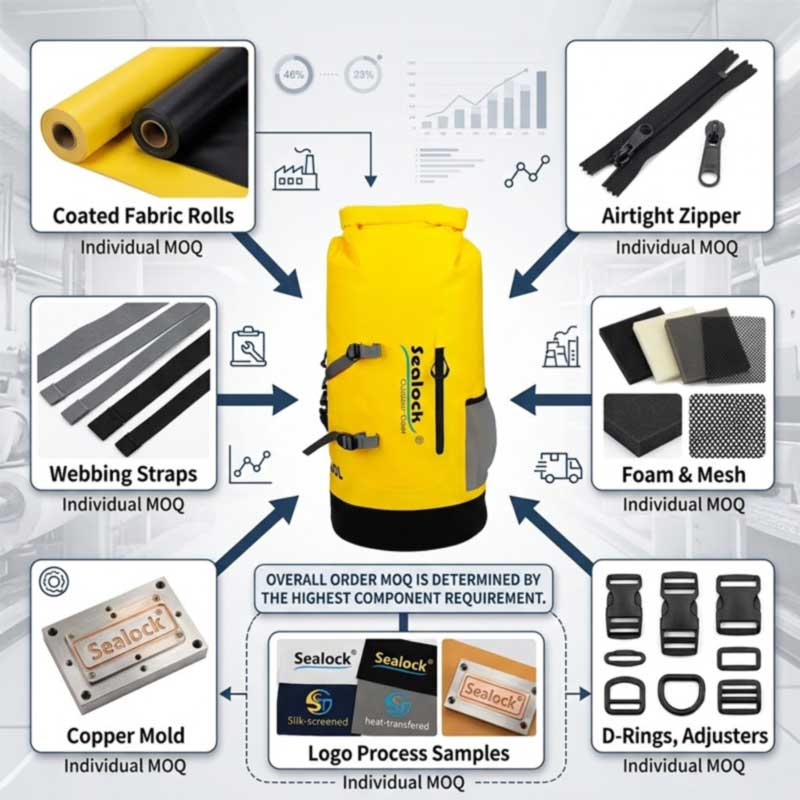
2. The Real Driver: Component Minimums Stack
This is the point most buyers miss. A backpack MOQ is not set by one input — it is set by whichever component minimum lands highest, and a waterproof pack has many:
| Component | Why it carries its own minimum |
|---|---|
| Coated fabric (TPU / PVC) | Mills have minimums per colour and construction; a custom colour means a dedicated dye lot |
| Rated waterproof zipper | A specialised component ordered per type and length, with its own supply lead time |
| Buckles, D-rings, adjusters, hooks | Hardware suppliers have minimum runs per type and plating; custom branded parts may also need a mould |
| Webbing | Minimum runs per width, type, and dye lot |
| Foam and mesh | Purchased by sheet or roll for straps and back panels |
| Branding | Screens, moulds, tooling, and setup charges that amortise better at volume |
| Welding die | A custom bag geometry needs its own machined die — a one-time tooling cost |
The consequence is counter-intuitive: even when a buyer only wants a few hundred packs, a single custom-branded metal fitting can force the whole order's minimum up, because the hardware supplier will not run below its own threshold. On a waterproof pack, the rated zipper and the welding die play the same role. The same stacking logic sits behind dry bag MOQ, but with fewer components in the stack.
3. MOQ Applies Per SKU, Not Per Order
In backpack sourcing the minimum can apply to the style, each colour, each material, the zipper, the logo method, the packaging, and any custom accessory. A 300-unit order split across six colours behaves like six 50-unit orders — harder to schedule and far more likely to trip supplier minimums on fabric dye lots and trims. The practical rule for a first order is to concentrate volume: one or two best-selling colourways rather than a wide matrix. If the budget is fixed, more units of fewer SKUs buys more leverage than fewer units of many styles.
4. Price Falls in Steps, Not a Slope
Buyers often expect unit price to decline smoothly with volume. It does not, because each key input has its own threshold — fabric mill minimums, hardware runs per plating or dye lot, printing setup charges, and line batch sizes that reduce changeovers. The result is discrete tiers rather than continuous scaling, so the cost difference between 200 and 500 units can be larger than between 500 and 700. When a target quantity sits just below a tier, moving up slightly sometimes lowers total cost rather than raising it — worth asking the factory to quote two quantities and compare.
5. What Raises a Waterproof Backpack MOQ
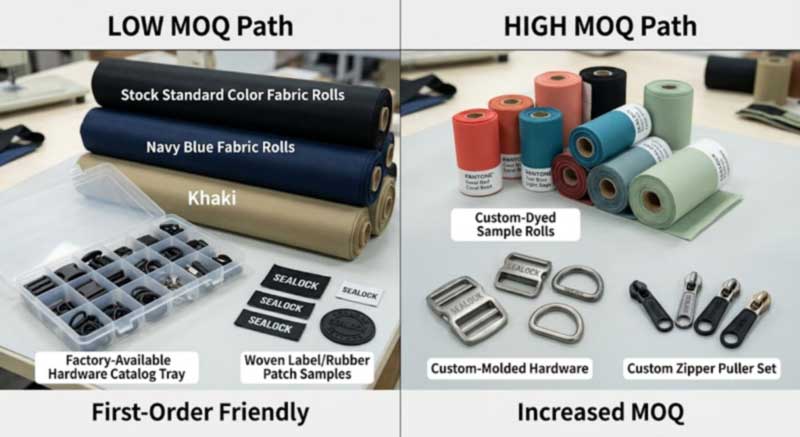
- Custom dyed fabric — a Pantone-matched colour requires a minimum fabric purchase in that dye lot. This is the most common cause of an inflated first-order minimum, and the easiest to avoid.
- Custom moulded hardware — branded buckles, proprietary fittings, and custom zipper pulls carry tooling costs the factory recovers through quantity.
- Custom zipper tape and puller sets — ordered as a set with their own minimum run.
- A new silhouette — a shape outside existing tooling needs a machined welding die before sampling can start.
- Structural complexity — more compartments, padding, and binding steps mean more operator minutes per unit, which is harder to justify in a small lot.
- A wide colour or size matrix — as above, each variant carries its own minimum.
6. Six Ways to Bring It Down
Each of these works by removing a cost driver rather than asking the factory to absorb a loss:
- Use stock fabric and standard colours. The single most effective lever — it removes the dye lot minimum that usually sets the floor. Save custom Pantone for the reorder once the line proves out.
- Use the factory's existing hardware catalogue. Standard buckles and pulls eliminate tooling cost entirely and lower the threshold; custom moulded fittings add fixed cost that has to be recovered.
- Choose MOQ-friendly branding. Woven labels, rubber patches, standard zipper pulls, and a single embroidery or screen placement look premium without moulds or multi-process setup.
- Share components across styles. If launching two models, ask whether they can share lining, webbing, hardware, or base fabric — pooled purchasing is a real reason factories accept lower minimums.
- Start from an existing platform. Modifying a proven construction avoids new die tooling; a genuinely new silhouette does not.
- Accept a higher unit price. Some factories will run below standard MOQ at a premium that covers the setup. Present it as a packaged proposal rather than a request.
A forward commitment to repeat orders also helps, because it lets the factory buy materials with confidence. What does not help is pressing on the number alone — a supplier that drops its MOQ without any change to the specification is telling you something about how it buys materials.
7. Sealock MOQ and Terms
Standard MOQ is 300 pcs per model, with a small number of models at 500. Samples run 7–15 days and bulk 30–45 days, FOB Guangdong, with production available from Dongguan, China or Ho Chi Minh City, Vietnam on any model so a buyer can route origin to suit a tariff position. Payment is 30% deposit with the 70% balance against a passed pre-shipment inspection.
Because the range spans capacities and closure types, a buyer can also reach volume across a coordinated line under one logo and colourway rather than over-committing to a single variant — several models sharing one base fabric is easier to schedule than one model in six colours. Ground-up development from a sketch, sample, or target spec is supported, with tooling and lead time scheduled against the launch date, as set out in the guide to OEM waterproof backpack manufacturing.
8. Platforms Available at Standard MOQ
Models across closures, materials, and capacity bands, organized by type rather than priority:
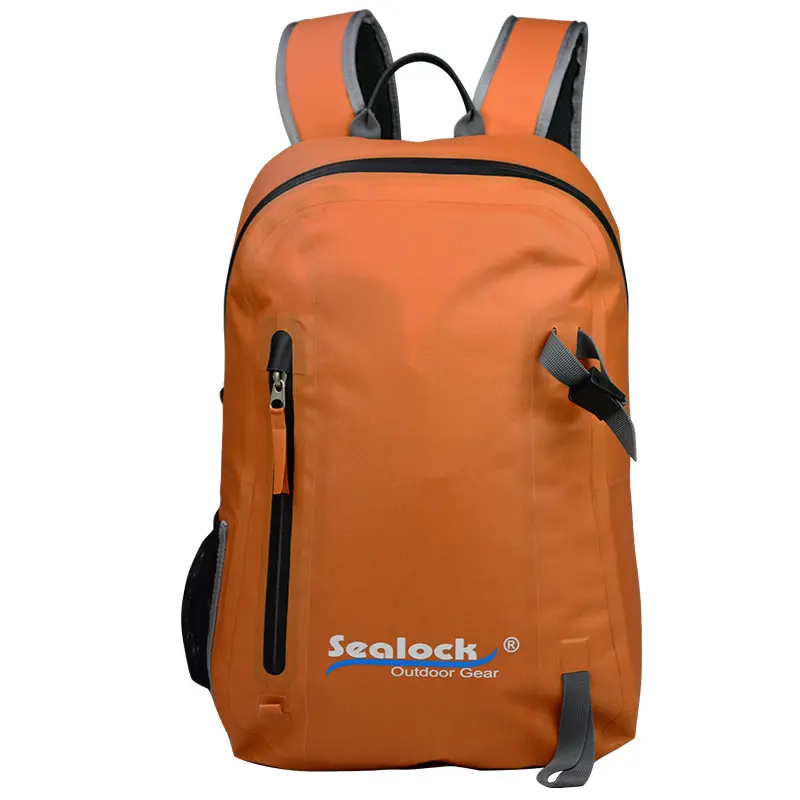
| Image | Model | Capacity | Material | Closure / rating | MOQ | Product Page |
|---|---|---|---|---|---|---|
|
SL-E216 | 20L | 420D TPU | Zipper · IPX6 | 300 pcs | View |
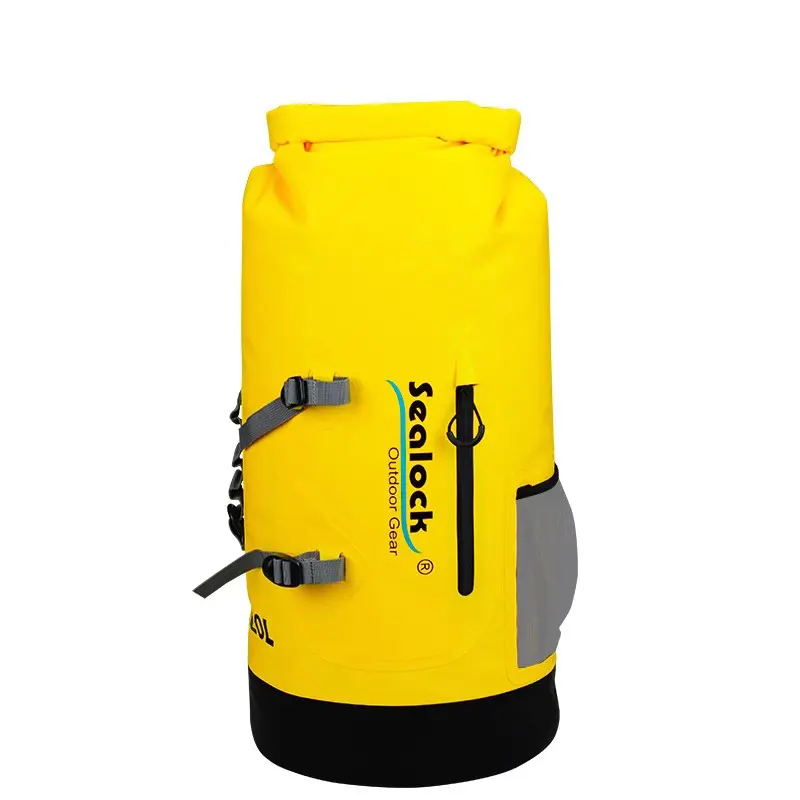
|
SL-E105 | 20 / 28L | 500D PVC | Roll-top · IPX7 | 300 pcs | View |
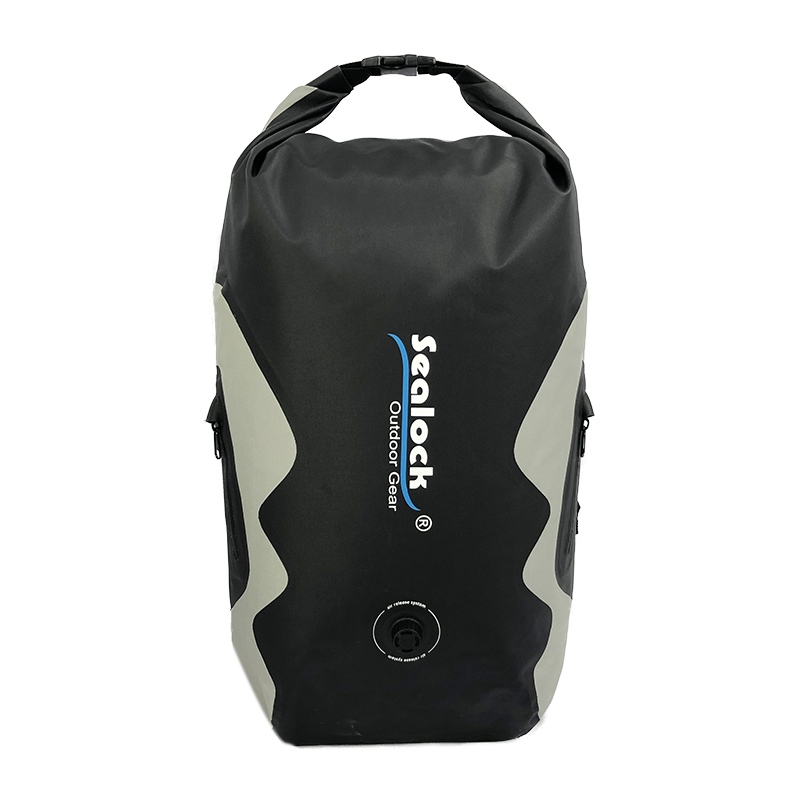
|
SL-E070 | 25L | 420D TPU | Roll-top · IPX8 · purge valve | 300 pcs | View |

|
SL-E282 | 35L | Coated poly + welded TPU | Roll-top · suspended back | 300 pcs | View |
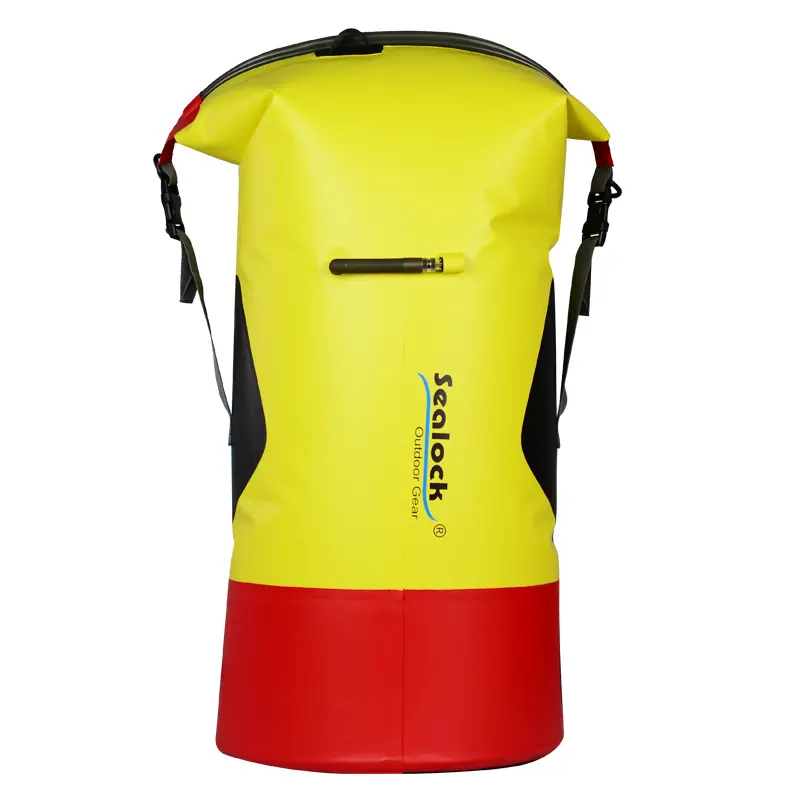
|
SL-E090 | 40L | 500D PVC (TPU option) | Airtight zipper · IPX7 | 300 pcs | View |

|
SL-E119 | 20L | Cationic TPU composite | Airtight zipper · IPX8 · laptop | 500 pcs | View |
Full categories sit under dry backpacks, dry bags, and duffels. Assortment planning across SKUs for a bulk programme is covered in the wholesale waterproof backpack guide.
9. Quality Does Not Scale Down With Quantity
Whatever the order size, every batch runs the same three-stage control: IQC on incoming fabric, zippers, and hardware; IPQC on welds and stitching in line, including peel tests at run start; and OQC with AQL sampling, batch immersion testing, and signed gold-sample comparison. For airtight verification the full customer inspection procedure applies — unboxing, vacuum extraction, a 24-hour static rest, and air-leak determination — witnessable by the buyer or their inspector, alongside load testing over 1,500 cycles at strap anchors and 3,000 sealed-zipper cycles on zippered models. Standards and defect classifications are set out in the quality control standards for waterproof production.
10. FAQ
Q: Why is the backpack MOQ higher than for a simple tote or dry bag?
A: More components and more labour. A waterproof backpack has foam, padding, a harness, welded seams, and a long hardware list — each purchased part carrying its own supplier minimum, and each assembly step adding operator minutes. A tote triggers few of those; a backpack triggers all of them.
Q: I only need 300 packs — why is the quoted minimum higher?
A: Usually one component, not the pack itself. A custom Pantone fabric needs a dedicated dye lot, and a custom moulded buckle or branded zipper pull carries its own supplier minimum and tooling. Switching to a stock colour and catalogue hardware typically brings the number back down.
Q: Does the MOQ apply per colour or to the whole order?
A: Generally per SKU — style, colour, material, and sometimes logo method and packaging. A 300-unit order across six colours behaves like six 50-unit orders and is likely to trip fabric and trim minimums. Concentrate the first order on one or two colourways.
Q: If I double the quantity, does the unit price halve?
A: No — prices move in steps, not a smooth curve, because fabric, hardware, printing, and line batching each have their own thresholds. Ask the factory to quote two quantities; a target sitting just below a tier can sometimes cost more in total than one slightly above it.
Q: Can I get a lower MOQ by paying more per unit?
A: Often, yes. A modest per-unit premium can cover the setup that the quantity would otherwise amortise. Present it as a proposal with your forward volume commitment rather than as a request for a discount on the minimum.
Q: Is a supplier with a very low MOQ the better choice?
A: Not necessarily. MOQ is a diagnostic signal about how a supplier buys materials and runs its line. A very low minimum can mean small-lot workshop production rather than the consistent welded, pressure-tested manufacturing a waterproof pack needs — and unit cost will be higher. Match the MOQ to your stage, from a factory that can build the pack correctly.
Request a Quote at Your Target Quantity
For MOQ confirmation, tiered pricing at two quantities, samples, or an OEM proposal, submit an inquiry. Sealock responds to procurement enquiries within 24 hours, with production from Dongguan, China or Ho Chi Minh City, Vietnam.