
- English
- Español
- Português
- русский
- Français
- 日本語
- Deutsch
- tiếng Việt
- Italiano
- Nederlands
- ภาษาไทย
- Polski
- 한국어
- Svenska
- magyar
- Malay
- বাংলা ভাষার
- Dansk
- Suomi
- हिन्दी
- Pilipino
- Türkçe
- Gaeilge
- العربية
- Indonesia
- Norsk
- تمل
- český
- ελληνικά
- український
- Javanese
- فارسی
- தமிழ்
- తెలుగు
- नेपाली
- Burmese
- български
- ລາວ
- Latine
- Қазақша
- Euskal
- Azərbaycan
- Slovenský jazyk
- Македонски
- Lietuvos
- Eesti Keel
- Română
- Slovenski
- मराठी
- Srpski језик

Wholesale Waterproof Backpacks from China Manufacturers
Sealock supplies wholesale waterproof backpacks in bulk to importers, distributors, and retail buyers, shipping FOB from factories in China and Vietnam. Buying backpacks in bulk is harder than buying dry bags, because a backpack has more parts that can vary batch to batch — welds, zippers, straps, foam, and a whole harness — and because a wholesale order usually spans a matrix of sizes and colours rather than one SKU. This is how to run a waterproof backpack wholesale order so consistency, cost, and compliance all hold across the container.
1. Why Backpacks Are Harder to Buy in Bulk Than Dry Bags
A dry bag is essentially one welded body. A waterproof backpack adds a harness, a back panel, foam, multiple zippers, internal organisation, and reinforcement — every one of which is a point that can drift between the sample and the container, or between the first carton and the last. Bulk backpack buying is therefore less about finding the lowest price and more about controlling variation: strap stitching strength, zipper consistency, foam density, weld integrity, and colour accuracy all have to hold across the run. A supplier structured for consistent, welded, pressure-tested production is worth more than one quoting a slightly lower unit price, because inconsistency across a bulk backpack order is where the real cost hides.
2. MOQ Is Per SKU, Not Per Order
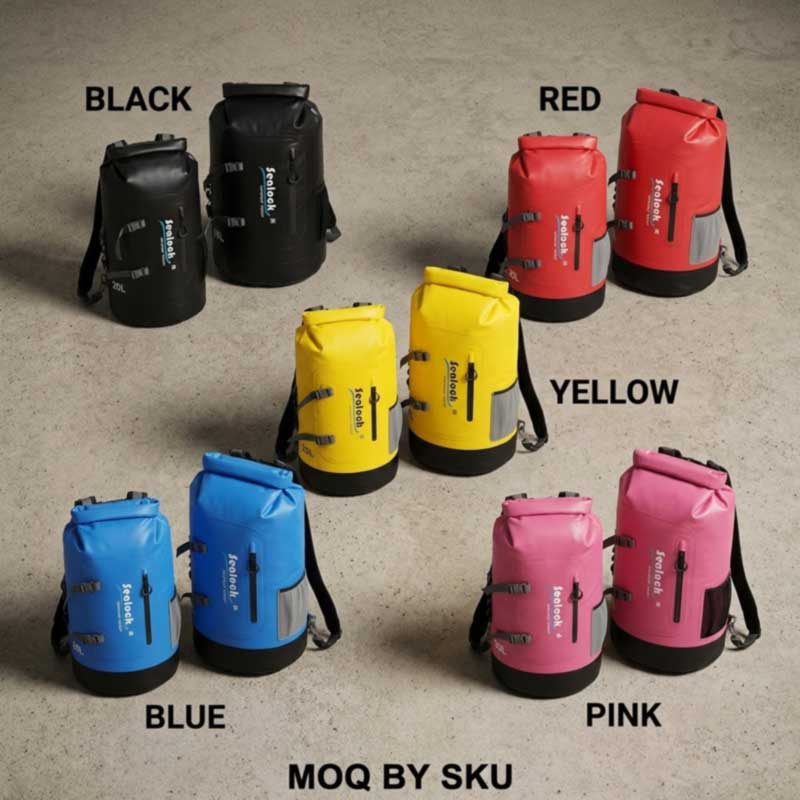
The single most misunderstood point in backpack wholesale: minimum order quantity applies per SKU — each colour, size, and design — not to the order as a whole. A brand wanting one model in three colours and two sizes is planning six SKUs, each of which must meet the minimum. This is why an assortment plan matters before the enquiry:
- Concentrate volume on the sizes and colours most likely to sell, rather than spreading a bulk order thin across a wide matrix that forces every variant to its own minimum.
- Share a base material across SKUs so one fabric buy serves several variants, which is the most effective way to keep the effective MOQ workable.
- Confirm whether the MOQ is per colour or per style before assuming a mixed order qualifies.
Sealock's standard MOQ is 300 pcs per model, with a small number of models at 500. Because the range spans categories and capacities, a buyer can also build volume across a coordinated line under one logo rather than over-committing to a single variant. The mechanics of why minimums land where they do are covered in the guide to dry bag MOQ.
3. Match the Assortment to the Destination Market
Regional buyers expect different things, and a wholesale assortment sells through faster when it is planned to the market rather than shipped generic:
- US market — reflective detailing and ergonomic, comfortable carry are expected on outdoor and commuter packs; laptop protection sells the commuter segment.
- EU market — eco-certifications such as OEKO-TEX are increasingly a purchase prerequisite rather than a bonus, and TPU's phthalate-free profile helps here.
- All markets — reinforced construction, sealed or water-resistant coatings, and organised tech compartments have shifted from premium features to baseline expectations.
Confirm any required certification before production, because it drives material choice; a fabric decision made for cost can fail a channel's compliance requirement after the goods are made.
4. Control Consistency With Two Inspection Points
On a backpack order, one final inspection is not enough, because a harness or weld problem found at 100% packed is expensive to remedy. The disciplined approach uses two checkpoints:
- During production inspection (DPI) — booked when roughly 20–30% of units are complete, to catch fundamental flaws early, while the run can still be corrected: weld integrity, strap anchor construction, zipper seating, and colour against the standard.
- Final random inspection (FRI) — when 80–100% is packed, using ANSI/ASQ Z1.4 AQL sampling, commonly 2.5 for major and 4.0 for minor defects, tied to the balance payment.
Both should be run by a third party such as SGS or QIMA for objectivity, or by the buyer's own inspector. Sealock runs its own three-stage control ahead of any third-party visit — IQC on incoming fabric and hardware, IPQC on welds in line including peel tests at run start, and OQC with AQL sampling, immersion testing, and gold-sample comparison — so a buyer's inspector is confirming a result rather than discovering a problem, under the quality control standards for waterproof production.
5. Get the Waterproof and Load Claims Right Before Listing
Wholesale buyers inherit the warranty exposure of whatever the listing claims. Two specification traps are worth closing on a bulk backpack order. First, the waterproof rating must match the construction: an IPX6 rain-rated pack should not be listed like an IPX8 submersible one, and the honest rating depends on whether the body is welded and the zipper rated. Second, load-bearing performance is a separate problem from waterproofing — a fully sealed pack can still fail at a strap, so strap anchor strength, foam density, and zipper grade belong in the spec and the inspection, not just the waterproof test. Warranty spikes on wholesale backpacks trace overwhelmingly to weak strap stitching and cheap zippers, both of which are preventable at the specification stage.
6. Packaging and Freight for a Backpack Order
Backpacks are volumetric, so freight and packaging planning affect landed cost materially:
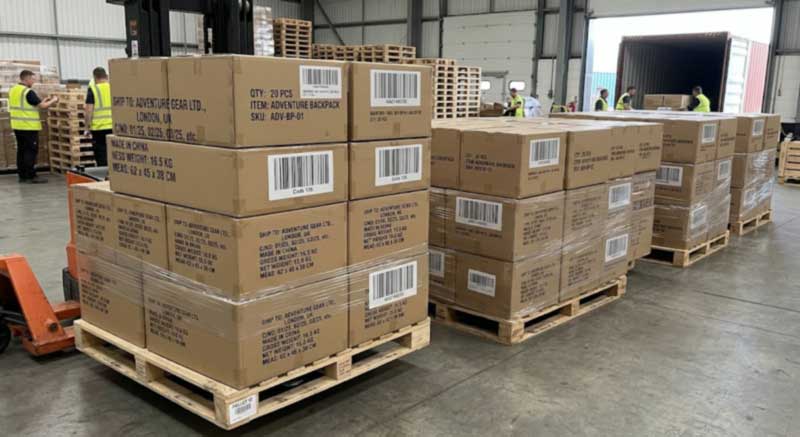
- Carton configuration — confirm units per carton and carton dimensions and weight up front; they determine cubic volume, which drives sea-freight cost more than weight does for bags.
- Channel-ready packaging — polybag and carton marks for pure wholesale, or retail hangtags, care labels, barcodes, and colour boxes for shelf resale.
- Amazon FBA prep — cartons can be prepared to marketplace labelling and packaging requirements, including FNSKU labels and carton dimension and weight limits, when the shipment plan is shared at order confirmation.
- Origin flexibility — production from China or Vietnam lets a buyer route country of origin to suit a tariff position, an option a single-country supplier cannot offer.
The broader landed-cost and Incoterms discipline that applies to any bulk order is set out in the bulk purchasing guide for importers.
7. Wholesale Backpack Range
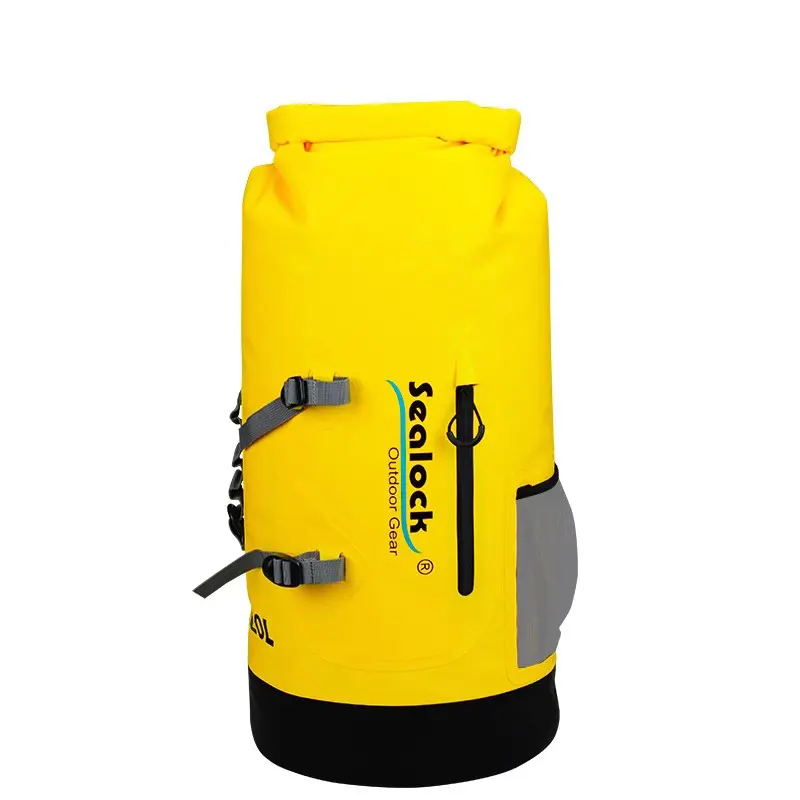
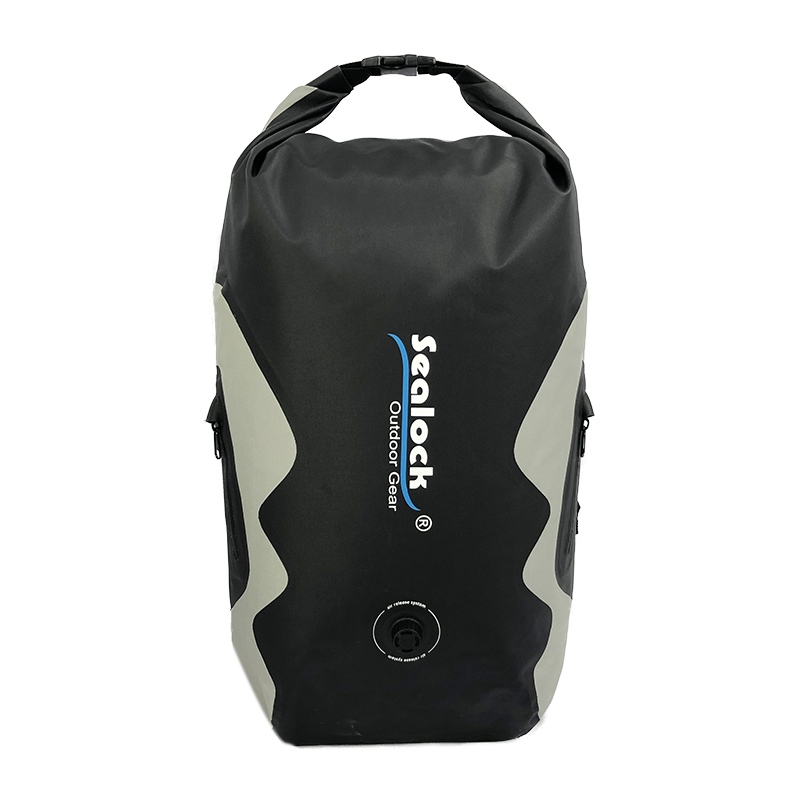
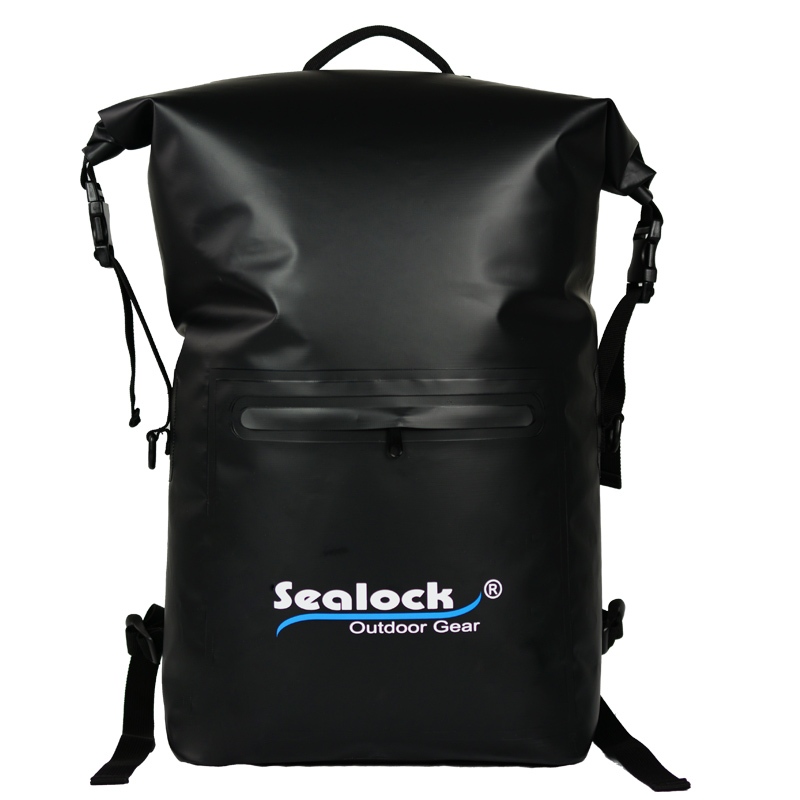
High-turnover models across closures, back systems, and capacity bands, organized by type rather than priority:
| Image | Model | Capacity | Material | Closure / rating | Product Page |
|---|---|---|---|---|---|
|
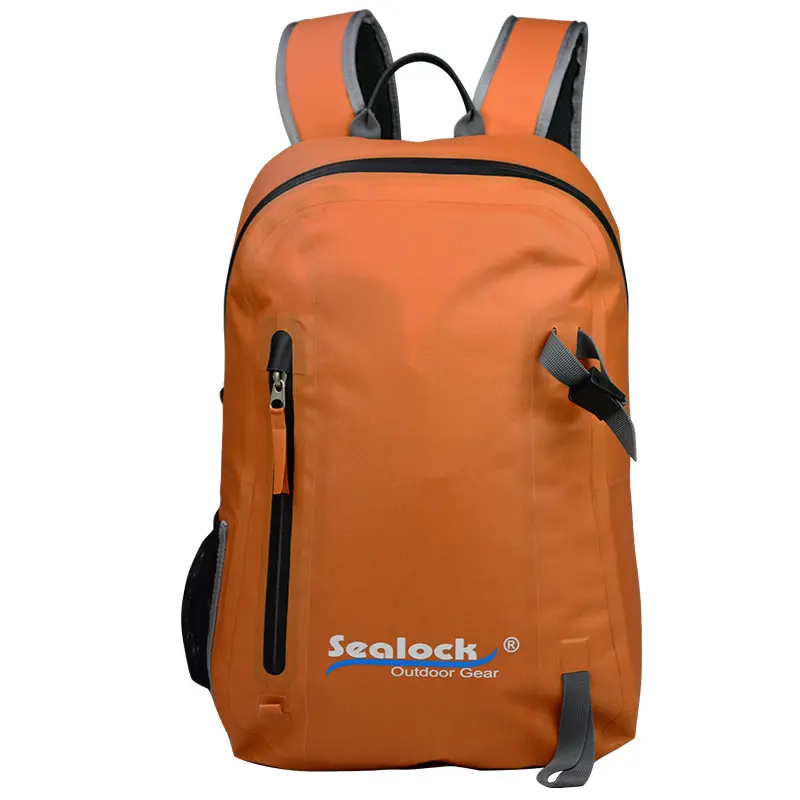
SL-E216 | 20L | 420D TPU | Zipper · IPX6 · commuter | View |
|
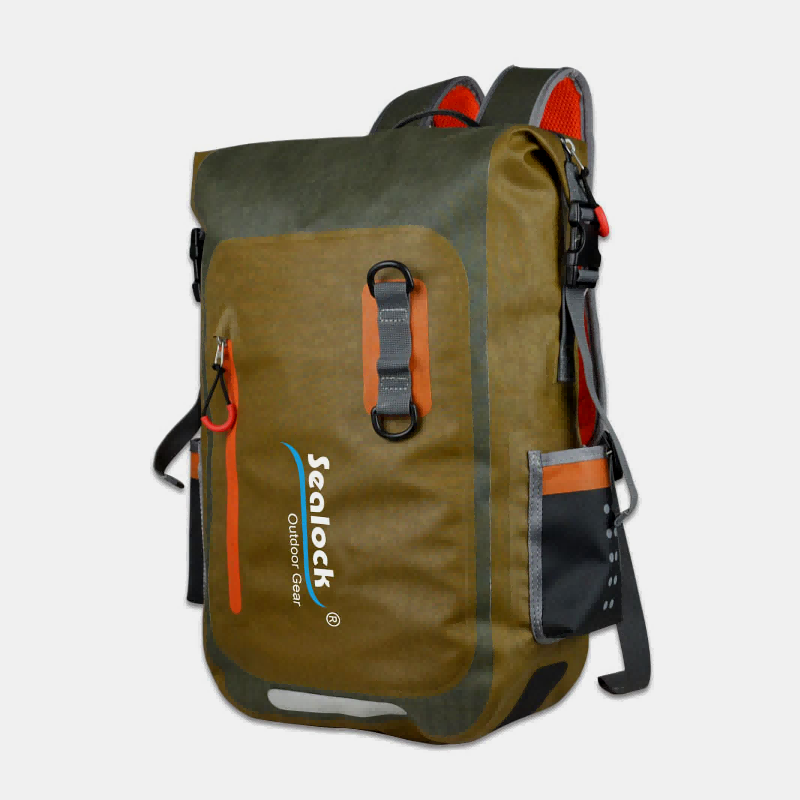
SL-E029 | 20L | 500D PVC | Roll-top · IPX6 · laptop | View |
|
SL-E105 | 20 / 28L | 500D PVC | Roll-top · IPX7 · air-mesh back | View |
|
SL-E070 | 25L | 420D TPU | Roll-top · IPX8 · purge valve | View |
|
SL-E036 | 30L | 500D PVC | Roll-top · IPX6 | View |

|
SL-E282 | 35L | Coated poly + welded TPU | Roll-top · suspended back · hip belt | View |
The range spans 15L to 65L across roll-top, zipper, and hybrid closures in PVC and TPU, so a wholesale buyer can assemble an assortment under one identity. Full categories sit under dry backpacks, dry bags, and duffels. Custom colour and logo are supported across the range, and ground-up development is available for a proprietary model.
8. Standard Wholesale Terms
MOQ 300 pcs per model (a small number at 500), samples in 7–15 days, bulk in 30–45 days, FOB Guangdong, with production from Dongguan, China or Ho Chi Minh City, Vietnam. Payment is 30% deposit with the 70% balance against a passed pre-shipment inspection. Compliance is backed by ISO 9001, BSCI, SMETA, HIGG, GRS, and SCAN, with test documentation available for vendor approval. Consistent, welded, pressure-tested production applies at every order size — quantity changes the economics, not the standard.
9. FAQ
Q: Does the MOQ apply to my whole order or to each colour and size?
A: Per SKU — each colour, size, and design counts separately. Plan the assortment before enquiring: concentrate volume on the variants most likely to sell, and share one base material across variants so a single fabric buy serves several SKUs and keeps the effective minimum workable.
Q: The sample was perfect but the bulk backpacks varied — how do I prevent that?
A: Backpacks have more parts to drift than dry bags, so use two inspection points, not one: a during-production inspection at 20–30% complete to catch harness, weld, and zipper problems early, and a final random inspection at 80–100% packed tied to the balance payment. Hold a signed gold sample as the reference for both.
Q: My wholesale packs keep coming back under warranty — why?
A: Warranty spikes on backpacks trace overwhelmingly to weak strap stitching and cheap zippers, not the waterproofing. Both are specification choices: put reinforced strap anchors, foam density, and a rated zipper into the spec and the inspection criteria, and they stop being a problem.
Q: Can you ship directly to Amazon FBA?
A: Cartons can be prepared to marketplace labelling and packaging requirements — FNSKU labels, carton dimension and weight limits — when you share the shipment plan at order confirmation. Confirm the destination market's requirements early, since they affect packaging and labelling.
Q: How do I keep colour consistent across a multi-colour, multi-size order?
A: With a signed gold sample per colour and colour-difference and colour-fastness testing against a Pantone standard, so variants match the approved reference and repeat orders don't drift. Specify the Pantone codes rather than describing colours.
Q: Should I choose the supplier with the lowest wholesale price?
A: Not on price alone. On backpacks, inconsistency across a bulk run — variable strap strength, zipper quality, weld integrity — costs far more than a small unit-price saving. Weigh the supplier's ability to hold consistency and pass a third-party inspection above the headline number.
Request a Wholesale Quotation
For bulk pricing, an assortment plan, FBA-ready packaging, or an origin recommendation for your tariff position, submit an inquiry. Sealock responds to procurement enquiries within 24 hours, with production from Dongguan, China or Ho Chi Minh City, Vietnam.