
- English
- Español
- Português
- русский
- Français
- 日本語
- Deutsch
- tiếng Việt
- Italiano
- Nederlands
- ภาษาไทย
- Polski
- 한국어
- Svenska
- magyar
- Malay
- বাংলা ভাষার
- Dansk
- Suomi
- हिन्दी
- Pilipino
- Türkçe
- Gaeilge
- العربية
- Indonesia
- Norsk
- تمل
- český
- ελληνικά
- український
- Javanese
- فارسی
- தமிழ்
- తెలుగు
- नेपाली
- Burmese
- български
- ລາວ
- Latine
- Қазақша
- Euskal
- Azərbaycan
- Slovenský jazyk
- Македонски
- Lietuvos
- Eesti Keel
- Română
- Slovenski
- मराठी
- Srpski језик

Waterproof Backpack Production Process Explained
Sealock manufactures waterproof backpacks for OEM and wholesale buyers across factories in China and Vietnam, and the production process is worth understanding before placing an order rather than after. Brands that know how a pack is actually built waste fewer revisions, catch quality risks earlier, and set timelines that match how factories really work. This walks the full sequence in order — what happens at each stage, where the buyer's decision points sit, and which steps cannot be undone once passed.
1. Definition and Specification
Production begins before any material is bought, with a clear definition of how the pack will be used. A commuter pack and a technical hiking pack can look similar in photos and behave completely differently once loaded and worn daily, so use case, target load, market, and sales channel are agreed first. That definition then becomes a specification: capacity and dimensions, fabric and denier, closure architecture, harness requirements, internal layout, hardware, logo method, colourway, and packaging.
This is also where the waterproof claim is fixed. IPX6 rain protection, IPX7 brief immersion, and IPX8 continuous immersion each demand different construction, and the rating chosen here dictates every downstream decision — welded body, rated zipper or roll-top, and the test the finished pack must pass.
2. Pattern Making and Marker Development
The specification is translated into technical drawings, then into paper or digital patterns for every panel. This stage decides dimensional accuracy, symmetry, and how the pack holds its shape when loaded — a backpack's cut components can run to dozens or more on a complex design, and each has to fit its neighbours precisely.
Once the pattern is finalised, a marker is developed on computer: the arrangement of all panels across the fabric width, optimised to reduce waste and stabilise per-unit cost. Pattern engineering is what keeps shapes consistent across thousands of units; errors introduced here appear later as asymmetry and uneven stress, and cannot be corrected downstream.
3. Sampling and Approval
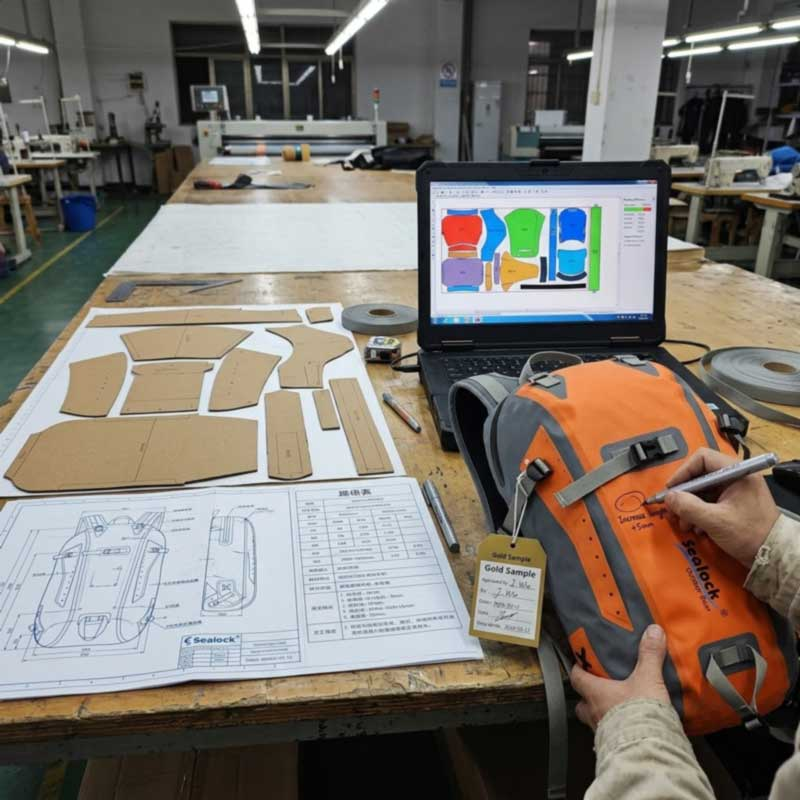
A physical sample is built to the pattern and specification. This is where structure, silhouette, and function are evaluated in the real world rather than on a drawing, and where the factory should flag manufacturability risks — a strap anchor that will not take load, a zipper curve that will not lie flat, a pocket layout that fights the welded seam line.
Samples should be assessed under realistic weight, not inspected on a table, and revised where needed. Structurally complex or multi-material packs take longer to sample than simple ones. The approved sample then becomes the production standard: the tech pack, pattern files, stitch density, reinforcement points, and approved materials are all locked against it, with one signed gold sample held by each side. Sealock quotes samples at 7–15 days; the full development sequence is set out in the guide to OEM waterproof backpack manufacturing.
4. Material Procurement and Incoming Inspection
With the sample approved, production materials are ordered: coated TPU or PVC fabric, rated zippers, buckles, webbing, foam, mesh, and lining. Lead time here depends on material readiness rather than factory speed — custom-dyed fabrics, special coatings, and custom hardware all extend it, which is why standard stock materials shorten a first order.
Every incoming material is inspected before it enters the line: coating consistency and thickness, shade against the approved standard, weave flaws, and hardware conformity. A fabric roll rejected here never becomes a rejected batch later.
5. Line Set-Up and Time Study
Before the run starts, the factory breaks the pack into its operations and balances them across the line, assigning each stage to the right machine and operator skill level. A backpack can run to thirty or more operations, more on complex designs. This planning step is what allows a consistent output rate and is one of the reasons a structured factory produces more evenly than a workshop taking the same order.
6. Cutting
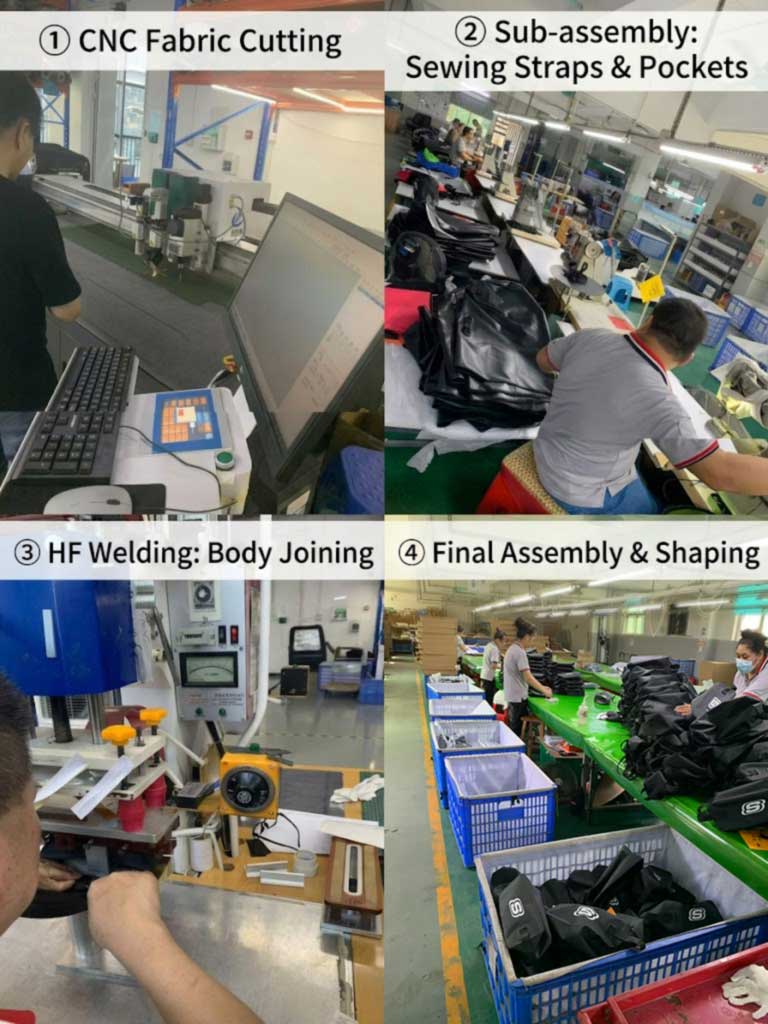
Fabric is spread in layers and panels are cut to the marker — by die cutting, which is common in backpack production, or by CNC, knife, or laser cutting depending on the material and shape. Precision matters more than speed and the errors are irreversible: a millimetre of drift compounds across seams into misalignment, uneven stress distribution, and long-term seam distortion. Panels carrying the logo are separated at this point for printing or embroidery, applied while the panel is still flat and accessible.
7. Sub-Assembly
Small components are built before the main body: pockets, organisers, mesh panels, linings, webbing assemblies, and shoulder straps with their foam. Building these separately keeps complexity out of the later stages, where a mistake is far more expensive to correct. Sub-assemblies should be checked before the body is closed, because once panels are joined, an internal defect is effectively unreachable.
8. Structural Sewing and Reinforcement
Load-bearing elements are attached to the panels — harness anchors, D-ring patches, base reinforcement — with reinforcement following the load paths rather than applied evenly. Written construction standards govern this stage: stitch length, seam allowance, zipper installation method, and reinforcement placement, all locked against the approved sample.
The sequence here is the defining rule of waterproof backpack production: all stitching is completed before the waterproof seal exists, so no needle ever pierces the finished membrane. Anything that must attach afterwards is welded onto reinforcement patches instead.
9. High-Frequency Welding
The body is welded at 27.12 MHz, fusing the coated layers into one continuous, needle-hole-free skin. Window panels and rated waterproof zippers are welded in as part of the same sealed structure. Weld parameters — power, dwell, pressure, and cooling — are qualified to the material and thickness in use, and peel tests are pulled on sample welds at the start of every run to confirm full fusion before the batch proceeds. The technical detail behind this stage is covered in the manufacturing process from cutting to RF welding.
10. Final Assembly and Finishing
Closures, buckles, valves, straps, and remaining hardware are fitted, threads trimmed, and the pack turned and shaped. Finishing determines much of the perceived quality: symmetry, zipper straightness, stitch consistency, and clean edges are what a customer notices first, and they are checked here before anything is packed.
11. Quality Control Across the Run
Control is applied at each handoff rather than only at the end, because most visible defects come from early-stage drift — cutting variation, pattern mismatch, or unclear alignment references:
- IQC — incoming fabric, zippers, buckles, webbing, and foam against specification.
- IPQC — in-line monitoring of cutting accuracy, symmetry, zipper straightness, stitch consistency, stress-point reinforcement, and weld quality, with peel tests at run start. When a defect appears, the line is stopped and corrected rather than allowed to propagate.
- OQC — AQL sampling against the agreed defect classification, batch immersion testing, dimensional and colour checks, and comparison against the signed gold sample.
For airtight verification, the full customer inspection procedure is executed and can be witnessed end to end: unboxing of sealed cartons in the inspector's presence, vacuum extraction to put the closure and welded seams under differential pressure, a 24-hour static rest, and air-leak determination against the batch record — a test that surfaces slow leaks a brief dunk cannot detect. Laboratory testing covers full water immersion, load cycling over 1,500 cycles at strap anchors and handles, 3,000 sealed-zipper cycles on zippered models, tensile and bonding strength, salt spray, friction resistance, colour fastness, and colour difference. Standards and defect classification are set out in the quality control standards for waterproof production.
12. Packing and Shipment
Packs are folded or shaped to protect form in transit, then packed to the order's specification — polybag, hangtags, care labels, barcode or FNSKU labels, carton marks, and carton quantity. Third-party pre-shipment inspection through SGS or QIMA can be arranged before the balance payment and release.
13. Where the Timeline Actually Goes
Lead time depends on material readiness, sampling revisions, and production complexity — not simply factory speed. The three things that most often extend a schedule are custom-dyed fabric or special coatings, multiple sample revisions that force patterns and specs to be re-synchronised, and complex constructions with many sub-assemblies. Sealock quotes samples at 7–15 days and bulk production at 30–45 days, with MOQ at 300 pcs per model (a small number at 500), FOB Guangdong, and production available from Dongguan, China or Ho Chi Minh City, Vietnam on any model.
14. Products Built on This Process
Models across closures, materials, and capacities, organized by type rather than priority:
| Image | Model | Capacity | Material | Closure / rating | Product Page |
|---|---|---|---|---|---|

|
SL-E144 | 15L | TPU | Zipper · IPX6 · floating vented back | View |
|
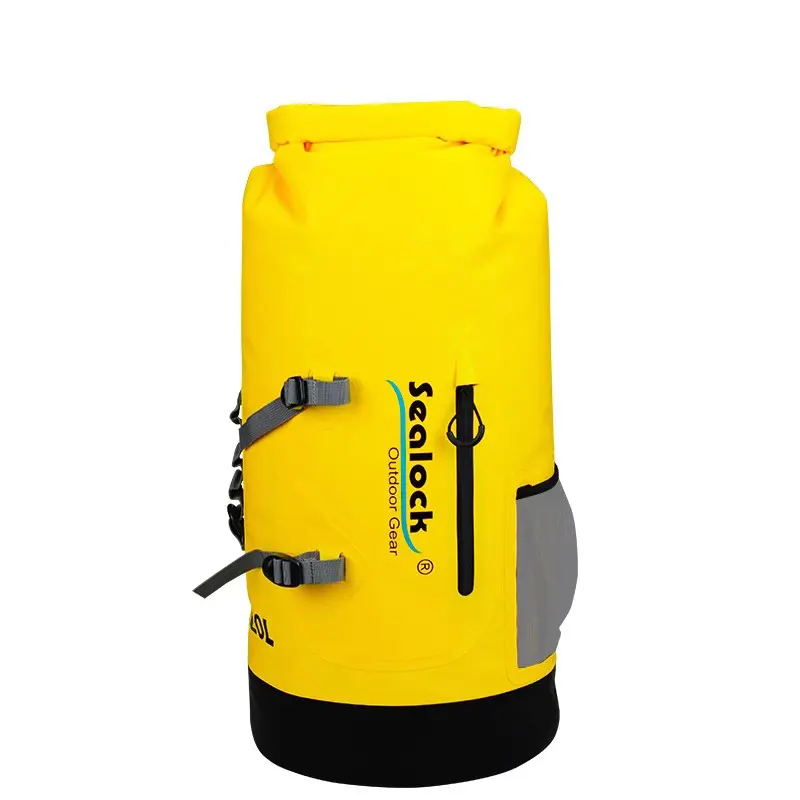
SL-E105 | 20 / 28L | 500D PVC | Roll-top · IPX7 | View |

|
SL-E328 | 25L | PVC laminate | Curved-top zipper · IPX6 | View |

|
SL-E282 | 35L | Coated poly + welded TPU | Roll-top · suspended back · hip belt | View |

|
SL-E119 | 20L | Cationic TPU composite | Airtight zipper · IPX8 · laptop | View |
|
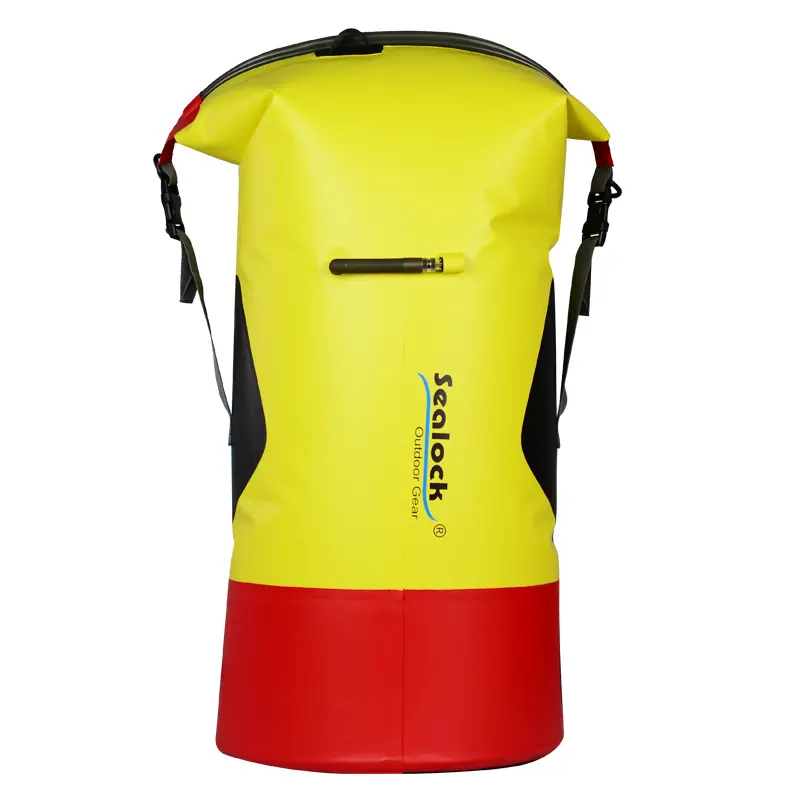
SL-E090 | 40L | 500D PVC (TPU option) | Airtight zipper + fold-over · IPX7 | View |
Full categories sit under dry backpacks, dry bags, and duffels. How to assess a factory running this process is covered in the supplier selection guide.
15. FAQ
Q: At which stage is quality actually decided?
A: Earlier than most buyers expect. Pattern accuracy and cutting precision determine symmetry and stress distribution, and those errors cannot be corrected later — most visible defects trace back to early-stage drift rather than to sewing or welding. The sample approval is the last point where the design itself can change cheaply.
Q: Why is stitching done before welding on a waterproof pack?
A: Because every needle hole is a leak path. All load-bearing sewing is completed on flat panels before the waterproof seal exists; anything attached to the sealed body afterwards is welded onto reinforcement patches instead of sewn through the membrane.
Q: Can I change the design after sampling is approved?
A: Minor adjustments can sometimes be absorbed, but structural changes require a new sample, because patterns, specs, and materials are re-synchronised against the approved reference. Multiple revision rounds are one of the main causes of schedule slippage, so resolve structure during sampling rather than after.
Q: What actually determines the lead time?
A: Material readiness, sampling revisions, and construction complexity — not just factory speed. Custom-dyed fabric, special coatings, and custom hardware extend procurement; complex builds with many sub-assemblies need more scheduling and QC. Standard materials on a proven platform ship fastest.
Q: Where can I intervene as a buyer?
A: Four points: the written specification, the sample approval, in-line inspection during production, and pre-shipment inspection. Requiring written construction standards for stitch length, seam allowance, zipper installation, and reinforcement placement gives the inspection something objective to check against.
Q: How do you keep bulk matching the sample?
A: By locking the tech pack, pattern files, stitch density, reinforcement points, and approved materials against a signed gold sample after approval, then controlling at IQC, IPQC, and OQC with in-line correction rather than end-of-line discovery.
Request a Production Walkthrough
For a video walk of the line, sample development, test documentation, or an OEM proposal, submit an inquiry. Sealock responds to procurement enquiries within 24 hours.