
- English
- Español
- Português
- русский
- Français
- 日本語
- Deutsch
- tiếng Việt
- Italiano
- Nederlands
- ภาษาไทย
- Polski
- 한국어
- Svenska
- magyar
- Malay
- বাংলা ভাষার
- Dansk
- Suomi
- हिन्दी
- Pilipino
- Türkçe
- Gaeilge
- العربية
- Indonesia
- Norsk
- تمل
- český
- ελληνικά
- український
- Javanese
- فارسی
- தமிழ்
- తెలుగు
- नेपाली
- Burmese
- български
- ລາວ
- Latine
- Қазақша
- Euskal
- Azərbaycan
- Slovenský jazyk
- Македонски
- Lietuvos
- Eesti Keel
- Română
- Slovenski
- मराठी
- Srpski језик

Waterproof Backpack, Duffel or Dry Bag: Choosing the Right Format
Sealock manufactures waterproof backpacks, duffels, and dry bags for OEM and wholesale buyers from factories in China and Vietnam, with an MOQ of 300 pieces and samples in 7–15 days. Brands entering the category often start from a format they already like rather than from the problem the product solves — and format is the decision that constrains everything downstream: cost, waterproof ceiling, how much organisation is possible, and who will buy it. This is the framework for choosing, before any specification work begins.
1. The Three Formats Are Not Interchangeable
Each solves a different carrying problem, and each has a structural consequence:
|
|
Dry bag | Duffel | Backpack |
|---|---|---|---|
| Carried by | Shoulder strap, lashed, or stowed | Hand, shoulder, occasionally two people | Worn on the body |
| Load path | Minimal — it is a container | Entirely through handles and anchors | Through a harness onto the wearer's frame |
| Waterproof ceiling | Highest — simple sealed envelope | High | High, but the harness adds attachment points |
| Organisation possible | Minimal by design | Moderate | Extensive |
| Construction cost | Lowest | Middle | Highest |
| Typical failure point | Closure, if under-rolled | Handles and strap anchors | Strap anchors and back panel comfort |
The pattern worth noticing: as you move left to right, waterproofing gets harder to hold and the product gets more expensive to build, because every feature a user wants is another thing attached to a sealed body.
2. Start From the Journey, Not the Product
The most reliable way to pick a format is to describe how the end user actually moves, then let the answer fall out:
- Does the bag get carried on the body for more than a few minutes? If yes, it needs a harness — that is a backpack, and the carry system will be the largest engineering and cost item. If no, a duffel or dry bag is lighter and cheaper to build.
- Does the user need to reach things while moving? Backpacks are the worst format for this, which is why professional users pair them with a chest or sling element. If access frequency is high and the load is small, consider a sling or waist format instead of any of the three.
- Is the bag lashed to something — a deck, a rack, a boat? That points to a dry bag or a duffel with proper lash points, not a backpack.
- Will the contents get soaked if the closure fails? If a single failure is unacceptable — electronics, documents, sleeping kit on a multi-day trip — specify the simplest sealed envelope that will do the job rather than the most featured product.
- How long is the trip? Duration drives volume more than anything else, and volume then constrains which format is comfortable to carry.

3. Volume Points to Format
Capacity and format are linked more tightly than most briefs assume:
| Volume | Natural format | Why |
|---|---|---|
| Under 10L | Dry bag, sling, or waist pack | Too small to justify a harness; usually a protective container inside something else |
| 10–25L | Backpack or dry backpack | Day loads that are carried, so comfort starts to matter |
| 25–45L | Backpack, or duffel if not carried far | The crossover zone — carry distance decides it |
| 40–70L | Duffel | Beyond comfortable back-carry for most users unless the harness is substantial |
| Over 70L | Duffel or large dry bag | Transport rather than carry |
The crossover zone between roughly 25 and 45 litres is where most format mistakes happen. The deciding question is not volume but distance: a bag carried twenty feet from a vehicle to a boat deck should be a duffel, and the same volume carried two miles into a campsite should be a backpack with a real hip belt.
4. Waterproof Rating Interacts With Format
Formats differ in how easily they hold a rating, which affects both cost and what you can honestly claim:
- Dry bags reach the highest ratings most cheaply, because a roll-top on a welded envelope has no moving parts and nothing to fail. The 5–63L platform runs IPX7.
- Duffels hold high ratings well, with the closure driving the cost — a rated airtight zipper is a specialised component, while a roll-top duffel achieves a similar rating for less.
- Backpacks can reach IPX8 — the 20L airtight-zipper model is sealed to 20 m — but every pocket, harness anchor, and vent panel is a potential compromise, which is why waterproof backpacks tend to have fewer external pockets than their non-waterproof equivalents.
A practical consequence for brands: if your customer genuinely needs submersion protection and heavy organisation, that is two products rather than one — a sealed core plus accessible outer storage, or a pack paired with dry bags inside. The construction implications are set out in the guide to sewn versus welded construction.
5. Format Decides Where the Product Can Fail
Each format has a characteristic failure mode, and knowing it in advance tells you where to spend:
- Dry bags fail at the closure, and almost always because the user rolled it fewer than three times. The design response is a stiffened collar that makes a correct seal intuitive, plus clear instructions.
- Duffels fail at handles and strap anchors, because there is no harness to spread the load — everything runs through a few attachment points while the bag is swung, dropped, and dragged. Spend on reinforcement and load testing there.
- Backpacks fail at strap anchors and, commercially, at comfort — a sealed shell does not breathe, so a pack without an engineered ventilated back panel generates complaints even when nothing breaks.
6. Commercial Considerations Beyond the Product
Format also affects the business case, which briefs rarely account for:
- Cost and price point. Dry bags are the cheapest to build and the easiest entry product; backpacks carry the most labour and hardware. A range that leads with a dry bag and adds a pack later spreads development cost.
- Freight. All three are volumetric, and ocean freight is charged on cube rather than weight. Duffels and large dry bags occupy the most container space per unit, which belongs in the landed-cost model — covered in the guide to what drives the cost of a waterproof bag.
- SKU count. Dry bags sell as size ladders from one construction, so several SKUs come from one pattern. Backpacks rarely do — each size tends to need its own harness work.
- Cross-selling. The three formats complement rather than compete: a customer buying a pack often buys dry bags to line it. A range covering formats sells multiple units to the same buyer.
7. Format Range
Models organized by format rather than priority:
| Image | Model | Format | Capacity | Material / rating | Product Page |
|---|---|---|---|---|---|
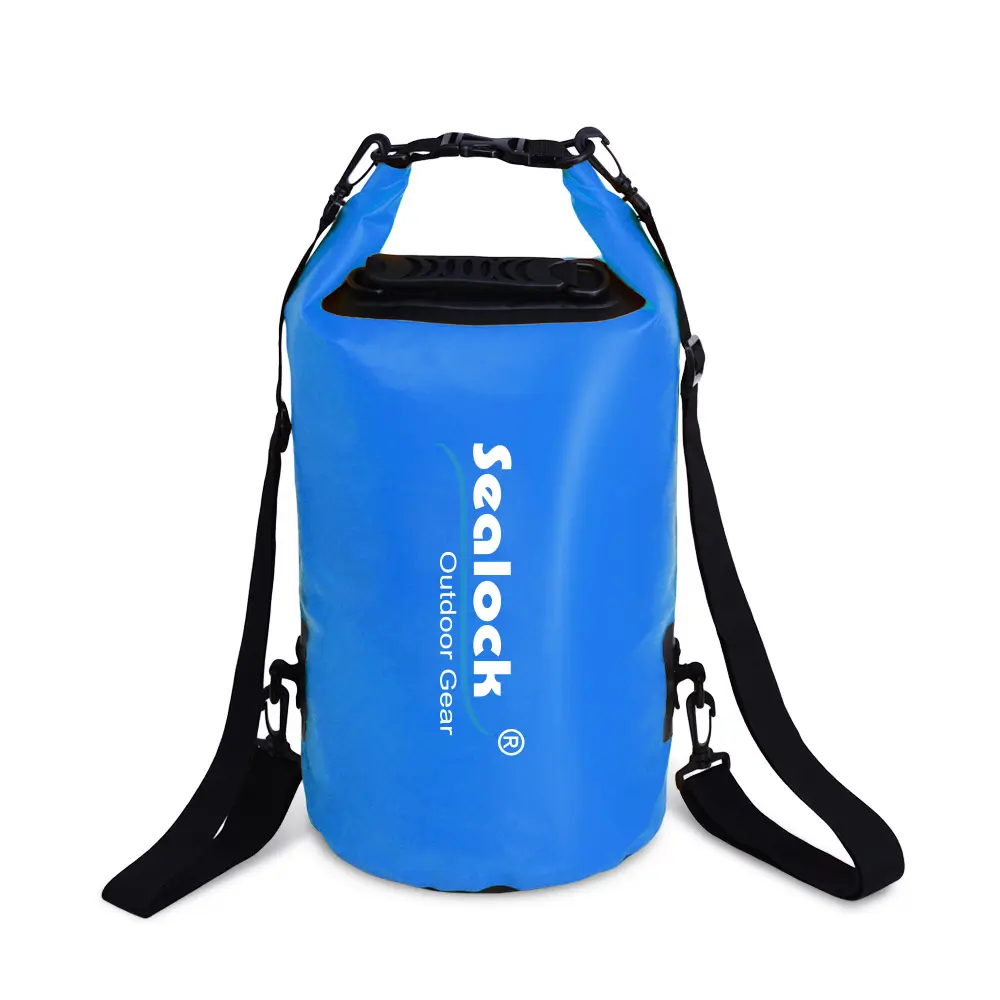
|
SL-D002 | Dry bag, size ladder | 5 / 10 / 15 / 20 / 63L | 500D PVC · IPX7 | View |
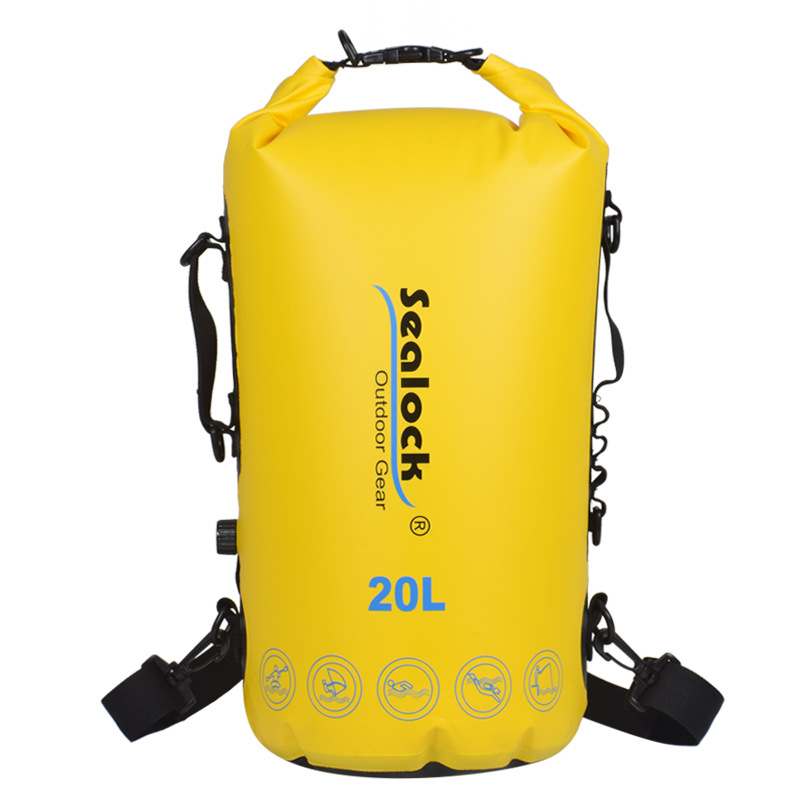
|
SL-E102 | Dry bag with back-carry | 15 / 20L | 500D PVC · IPX7 | View |
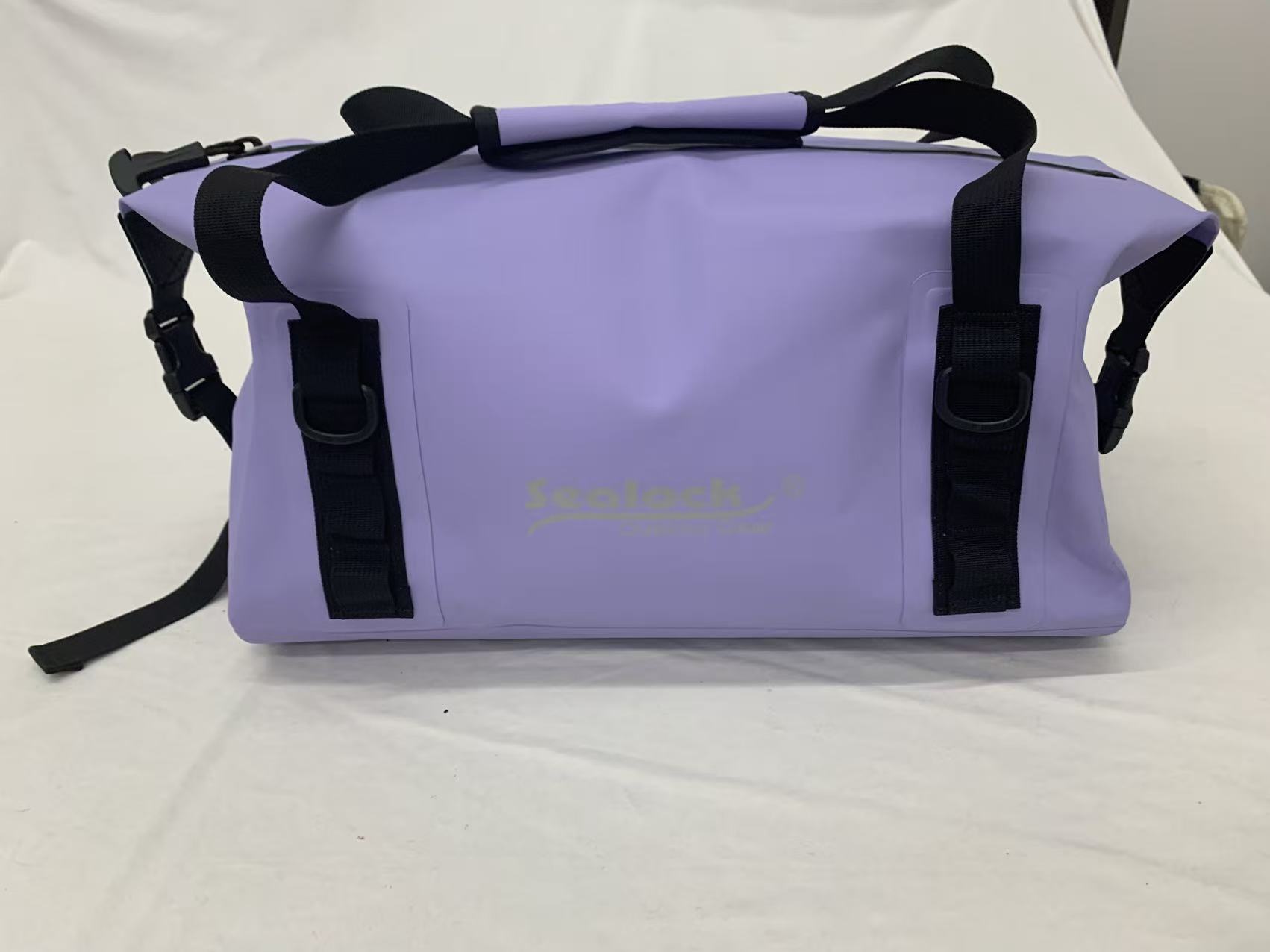
|
SL-C878 | Duffel, compact | 20L | 840D TPU · IPX7 | View |
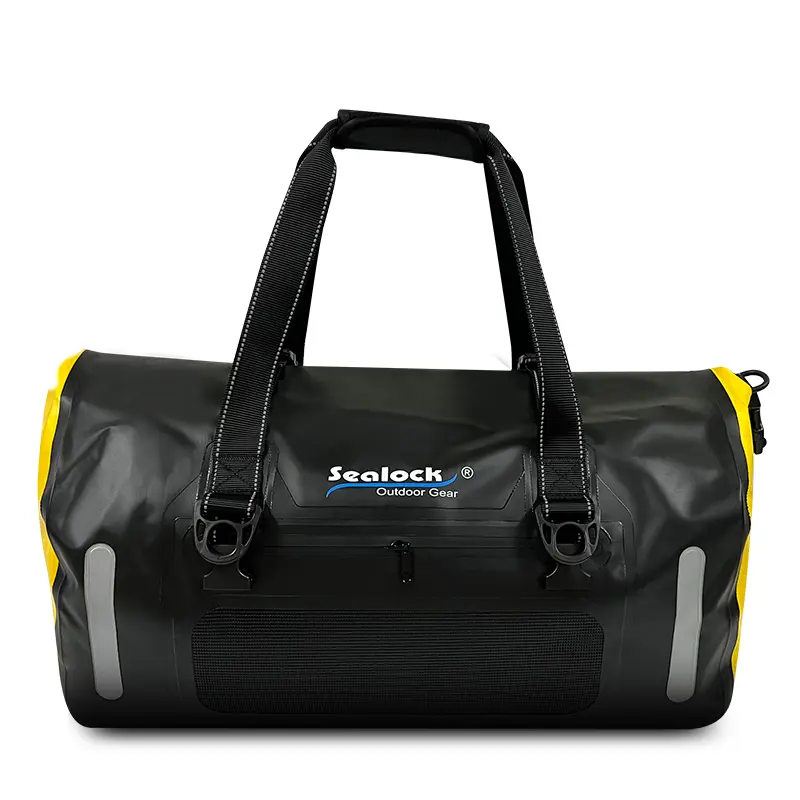
|
SL-K099 | Duffel, main-bag size | 40 / 60L | 840D TPU · IPX7 | View |

|
SL-C689 | Convertible duffel-pack | 25L | TPU · roll-top / zipper | View |

|
SL-E119 | Backpack, sealed | 20L | Cationic TPU · IPX8 to 20 m | View |

|
SL-E282 | Backpack, full harness | 35L | Coated poly + TPU · IPX5–6 | View |
|
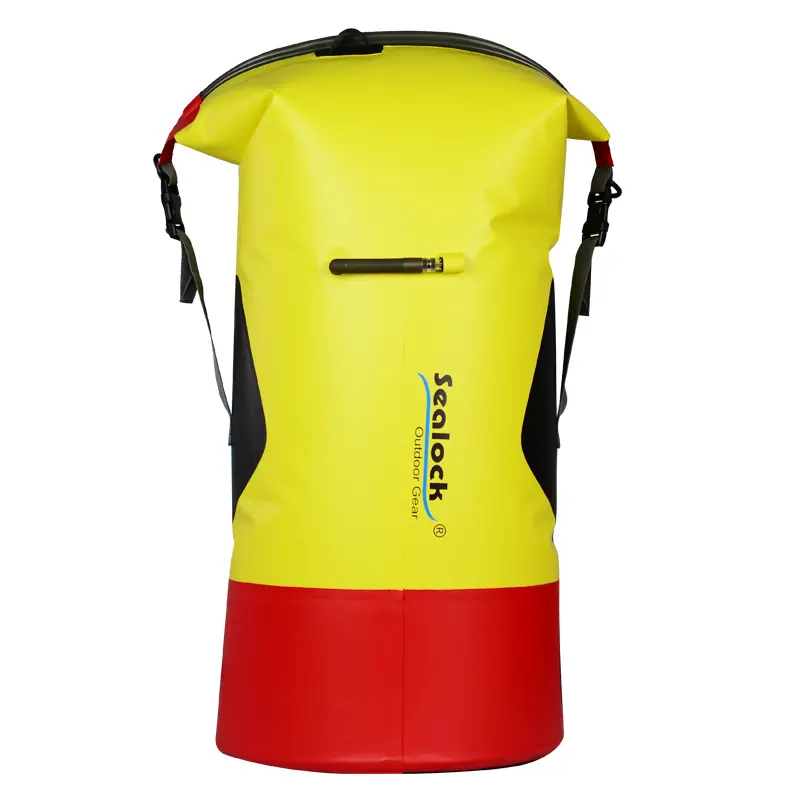
SL-E090 | Dry backpack, convertible | 40L | 500D PVC · IPX7 | View |
Full categories sit under dry bags, duffels, and dry backpacks. Sampling any format is covered in the guide to getting a waterproof bag sample.
8. Hybrids Exist, and Sometimes They Are the Answer
The three formats are poles rather than boxes, and the products between them often outsell the pure versions:
- Dry bags with backpack straps — the sealed simplicity of a dry bag with hands-free carry, at 15–20L a common commuter and paddling choice.
- Convertible duffel-packs — hand-carry for transfers, back-carry for the walk, which suits travel and multi-sport customers.
- Dry backpacks with air valves — a sealed envelope with a harness and a purge valve so the load compresses without unrolling.
The trade-off is honest: a hybrid does two jobs adequately rather than one job perfectly, and it usually costs more than the simpler format. Whether that is right depends on whether the customer genuinely switches modes or simply likes the idea of it.
9. Manufacturing and Terms
Sealock (YiFuLong Outdoor Gear Co., Ltd.) has built waterproof bags for over 20 years, producing for international outdoor brands including OSPREY, KAILAS, Helly Hansen, SIMMS, ORVIS, and West Marine. All three formats run on the same lines — 27.12 MHz high-frequency welding and industrial sewing as separate workshops on the same production floor — so a coordinated range across formats ships in one production run under one logo and colourway.
- MOQ: 300 pcs on most models | Samples: 7–15 days | Bulk: 30–45 days
- Facilities: Dongguan, China | Ho Chi Minh City, Vietnam — either origin on any model
- Certifications: ISO 9001, BSCI, SMETA, Sedex, HIGG, GRS, SCAN
Every batch runs IQC on incoming materials, IPQC in process on both welding and sewing lines including peel tests at run start, and OQC with AQL sampling, batch testing to each model's stated rating, and signed gold-sample comparison, under the quality control standards for waterproof production.
10. FAQ
Q: We are launching one product. Which format should it be?
A: Usually a dry bag or a simple duffel. They are the cheapest to develop, the easiest to hold a high waterproof rating on, and they sell as a size ladder from one construction — several SKUs from one pattern. Backpacks carry the most development cost and are better as a second-phase product once the line proves out.
Q: At 35 litres, should it be a duffel or a backpack?
A: Decide by carry distance, not volume. Twenty feet from a vehicle to a boat deck is a duffel; two miles into a campsite is a backpack with a real hip belt. The 25–45 litre band is where format mistakes cluster.
Q: Why do waterproof backpacks have fewer pockets than normal ones?
A: Because every pocket on a sealed body is a potential leak path. If your customer needs both full submersion and heavy organisation, that is genuinely two products — a sealed core with accessible outer storage, or a pack used with dry bags inside.
Q: Which format is cheapest to manufacture?
A: Dry bags, by a clear margin — simple geometry, minimal hardware, fewest labour minutes. Duffels sit in the middle, with closure choice driving much of the cost. Backpacks carry the most labour and hardware because the harness is a substantial piece of engineering in its own right.
Q: Are convertible designs worth it?
A: When the customer genuinely changes carry mode — a traveller who walks between transfers, a paddler who hikes to the put-in. They do two jobs adequately rather than one perfectly, and cost more than the simpler format, so the question is whether the switching is real or aspirational.
Q: Can one order cover all three formats?
A: Yes. All three run on the same lines here, so a coordinated range under one logo and colourway ships in a single production run, with MOQ applying per model at 300 pieces.
Request a Format Recommendation
Describe how your customer carries the bag, for how far, and what has to stay dry — and we can recommend the format, quote it, and sample it — submit an inquiry. Sealock responds to procurement enquiries within 24 hours, with production from Dongguan, China or Ho Chi Minh City, Vietnam.