
- English
- Español
- Português
- русский
- Français
- 日本語
- Deutsch
- tiếng Việt
- Italiano
- Nederlands
- ภาษาไทย
- Polski
- 한국어
- Svenska
- magyar
- Malay
- বাংলা ভাষার
- Dansk
- Suomi
- हिन्दी
- Pilipino
- Türkçe
- Gaeilge
- العربية
- Indonesia
- Norsk
- تمل
- český
- ελληνικά
- український
- Javanese
- فارسی
- தமிழ்
- తెలుగు
- नेपाली
- Burmese
- български
- ລາວ
- Latine
- Қазақша
- Euskal
- Azərbaycan
- Slovenský jazyk
- Македонски
- Lietuvos
- Eesti Keel
- Română
- Slovenski
- मराठी
- Srpski језик

Sewn vs Welded Waterproof Bags: Which Construction Your Product Needs
Sealock manufactures waterproof bags for OEM and wholesale buyers using both high-frequency welding and industrial sewing, run as separate workshops on the same production floor in China and Vietnam. Buyers often arrive at a welded-bag specialist assuming welding is always the better answer and that stitching is what cheaper factories do. Neither is true. The two processes solve different problems, most serious products use both, and choosing wrongly costs either waterproof performance or the features customers actually buy the bag for.
1. What Each Process Actually Does
High-frequency welding bonds coated thermoplastic fabrics at the molecular level using a 27.12 MHz field, with heat generated inside the material rather than conducted in from outside. The result is a continuous seam with no needle penetration, and it can be stronger than the parent material. RF welded seams handle substantially more stress than sewn-and-taped equivalents — roughly twice as much by one established manufacturer's measure — which is why fully welded construction is the standard for products that must survive submersion.
Stitching joins fabric with needle and thread, usually reinforced with seam tape where waterproofing matters. It works across nearly every textile, handles complex three-dimensional geometry that welding tooling cannot, and is what builds padded harnesses, multi-pocket layouts, bartacked anchors, and structured panels. It is the versatile process, not the cheap one.
2. Where Each Wins
|
|
Welded | Sewn (with tape where needed) |
|---|---|---|
| Waterproof ceiling | Submersible — no holes to seal | Rain and splash reliably; immersion only as tape holds |
| Seam strength | Very high, can exceed the base fabric | Good, concentrated at stitch lines |
| Geometry | Favours shapes that decompose into flat welds | Handles complex 3D shapes and many panels |
| Pockets and organisation | Limited — every added pocket is a potential leak path | Unlimited |
| Harness and padding | Cannot build it | This is where it is built |
| Materials | Coated thermoplastics only — PVC, TPU, PU, EVA | Nearly any textile |
| Tooling | Custom die per geometry, quoted separately | Pattern only |
| SKU changeover | Slower — die change required | Faster |
| Field repair | Usually needs factory rework | Tape can be reapplied or seam sealer used |
| Feel | Stiffer panels | Softer, more flexible |

3. The Two Things Nobody Tells Buyers About Welding
Welding is the right answer often enough that its limitations get glossed over. Two matter commercially:
Repairability runs the other way. A delaminated weld generally requires factory rework or specialised equipment; peeling tape on a stitched seam can be re-taped or treated with seam sealer in the field. For a brand selling into markets with a strong repair culture, or running a warranty programme where returns are expensive to ship, that changes the calculation.
Welding constrains the design. Welding equipment presses material flat between dies, so it favours shapes that decompose into flat seams, and every welded geometry needs its own machined die quoted separately with lead time before sampling. A design with many small pockets, complex curves, or a padded suspension system is not a welding problem to be solved — it is a sewing job with welded elements.
4. Most Good Products Are Hybrids
The framing of welded versus stitched is a false choice for most categories. The productive question is which process does which job on which part of the bag. A well-built hybrid typically looks like this:
- Welded — the main body and any compartment that must stay dry, high-stress zones such as the base and roll-top collar, window panels, and rated zipper seats.
- Sewn — harness and padded straps, ventilated back panels, hip belts, internal organisation, external pockets, tool docks, bartacked reinforcement at load points, and frame or contact protection panels.
- The sequencing rule — all load-bearing stitching is completed on flat panels before the waterproof seal exists, so no needle ever passes through a finished membrane. Anything attached afterwards is welded onto reinforcement patches instead.
That last point is the difference between a hybrid and a compromise. Done in the wrong order, stitching becomes the leak path the welding was supposed to eliminate.
5. Choosing by Product Type
| Product | Construction | Why |
|---|---|---|
| Dry bags and dry sacks | Fully welded | Simple geometry, submersion required, minimal organisation needed |
| Water-sports duffels and backpacks | Welded body, sewn harness | Sealed core plus a carry system welding cannot build |
| Fishing and cycling packs | Hybrid, sewing-heavy | Pocket density, tool docks, and attachment matrices are the buying criteria |
| Commuter and laptop backpacks | Welded shell, sewn interior | Rain protection plus organisation and comfort |
| Small frame and accessory bags | Welded with sewn straps | Weather-rated rather than submersible; mounting is stitched |
| Structured or padded cases | Predominantly sewn | Complex geometry and padding that welding tooling cannot form |
6. What to Ask a Supplier
- Which processes are in house, and which are subcontracted? Subcontracting either one adds a handoff exactly where fit and waterproofing are decided. Both run in house here as separate workshops on the same floor, so a bag moves between them within one facility.
- Quote both constructions. A practical tactic: ask for the same model priced as a fully welded shell and as a stitched-and-taped shell, then compare the cost delta against the performance the product actually needs. Some programmes discover the welded premium buys a rating their customers will never use.
- Is the material weldable at all? Only coated thermoplastics weld — PVC, TPU, PU, and EVA among them. A buyer arriving with a favourite fabric that is not weldable will be steered to stitching whether or not anyone says so, and it is better to know at specification stage than at sampling.
- Can you produce a part sample showing both? Seeing the same model built both ways settles the argument faster than any specification sheet.

7. Production Capability
Sealock (YiFuLong Outdoor Gear Co., Ltd.) has built waterproof bags for over 20 years, producing for international outdoor brands including OSPREY, KAILAS, Helly Hansen, SIMMS, ORVIS, and West Marine.
- Welding: in-house 27.12 MHz high-frequency welding, with custom copper dies machined per geometry
- Sewing: industrial sewing lines in a separate workshop on the same production floor, covering harness construction, bartacked reinforcement, structured panels, and full organisation
- Facilities: Dongguan, China | Ho Chi Minh City, Vietnam — either origin available on any model
- MOQ: 300 pcs on most models | Samples: 7–15 days | Bulk: 30–45 days
- Certifications: ISO 9001, BSCI, SMETA, HIGG, GRS, SCAN
8. Products in Each Construction
Models organized by construction rather than priority:
| Image | Model | Construction | Material | Rating | Product Page |
|---|---|---|---|---|---|
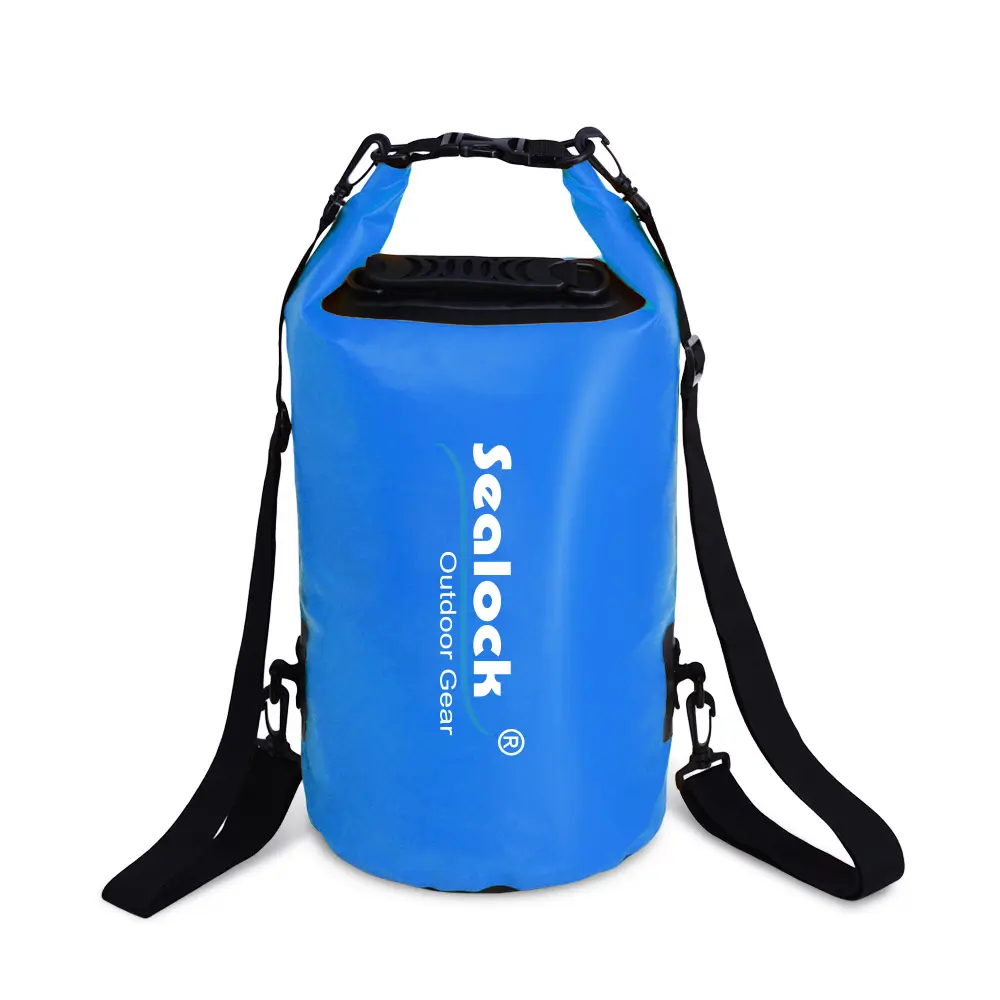
|
SL-D002 Dry Bag | Fully welded | 0.5 mm 500D PVC | IPX7 | View |
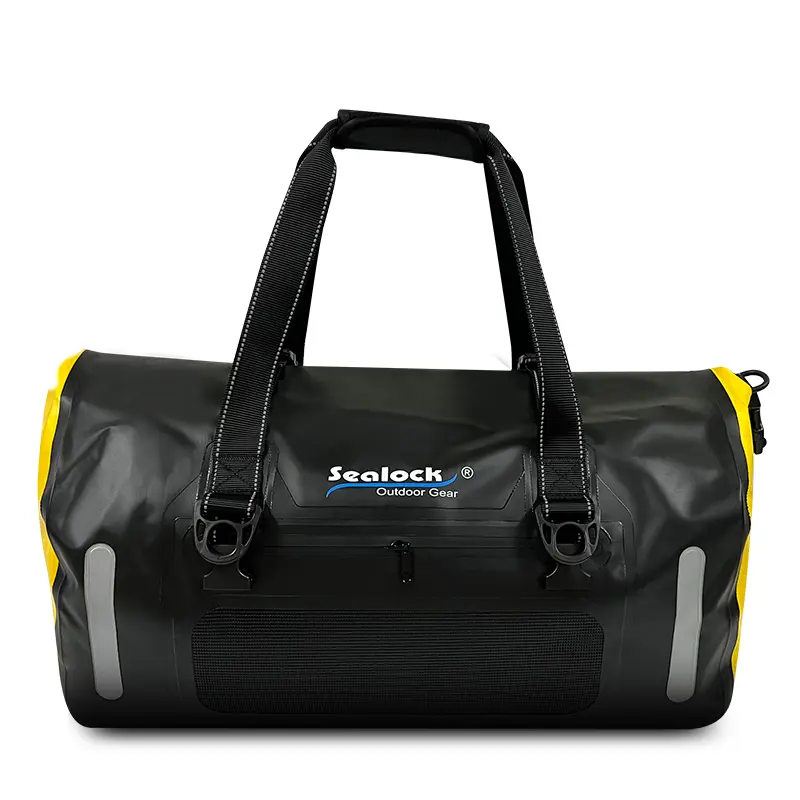
|
SL-K099 Duffel | Welded, seamless | 840D TPU | IPX7 | View |
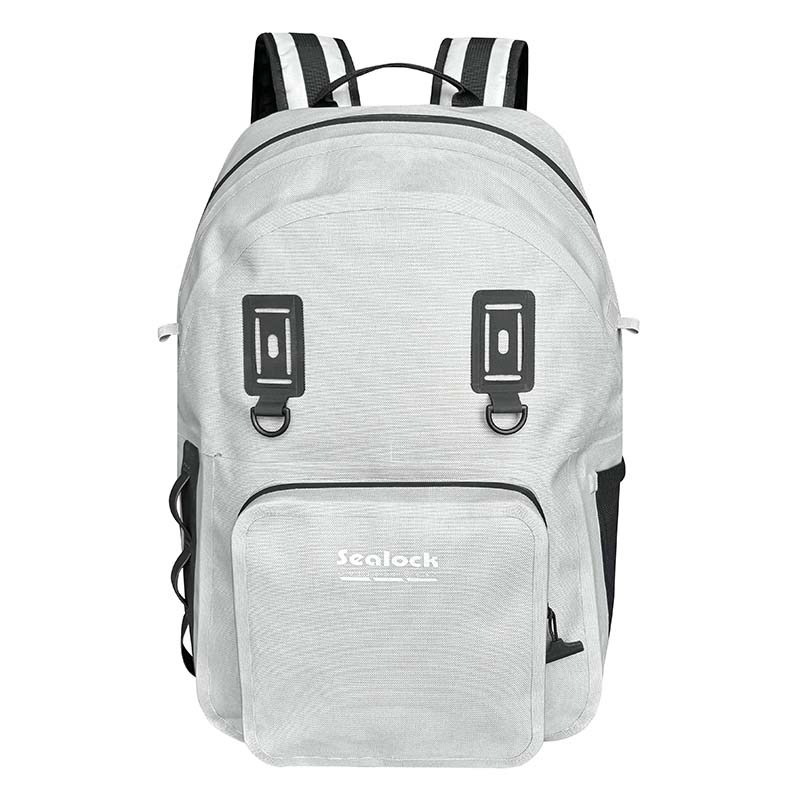
|
SL-E1144 Fishing Backpack | Stitchless RF-welded panels with sewn harness | Melange TPU laminate | Weather-rated | View |

|
SL-E282 Hiking Backpack | Reinforced stitching with welded TPU panels | Coated poly + TPU | IPX5–6 | View |
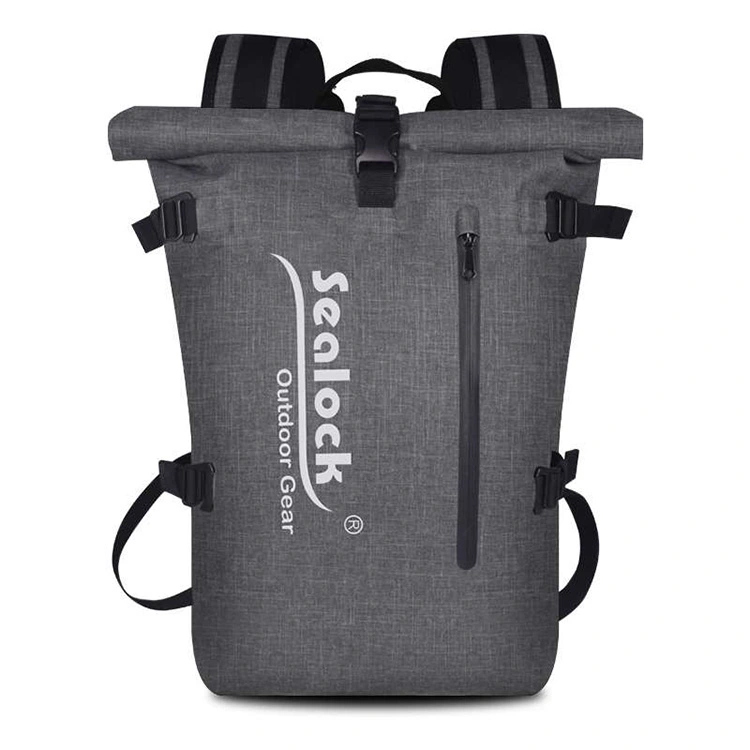
|
SL-E980 Commuter Backpack | Welded body with reinforced stress-point stitching | 600D TPU laminate | IPX6 | View |
|
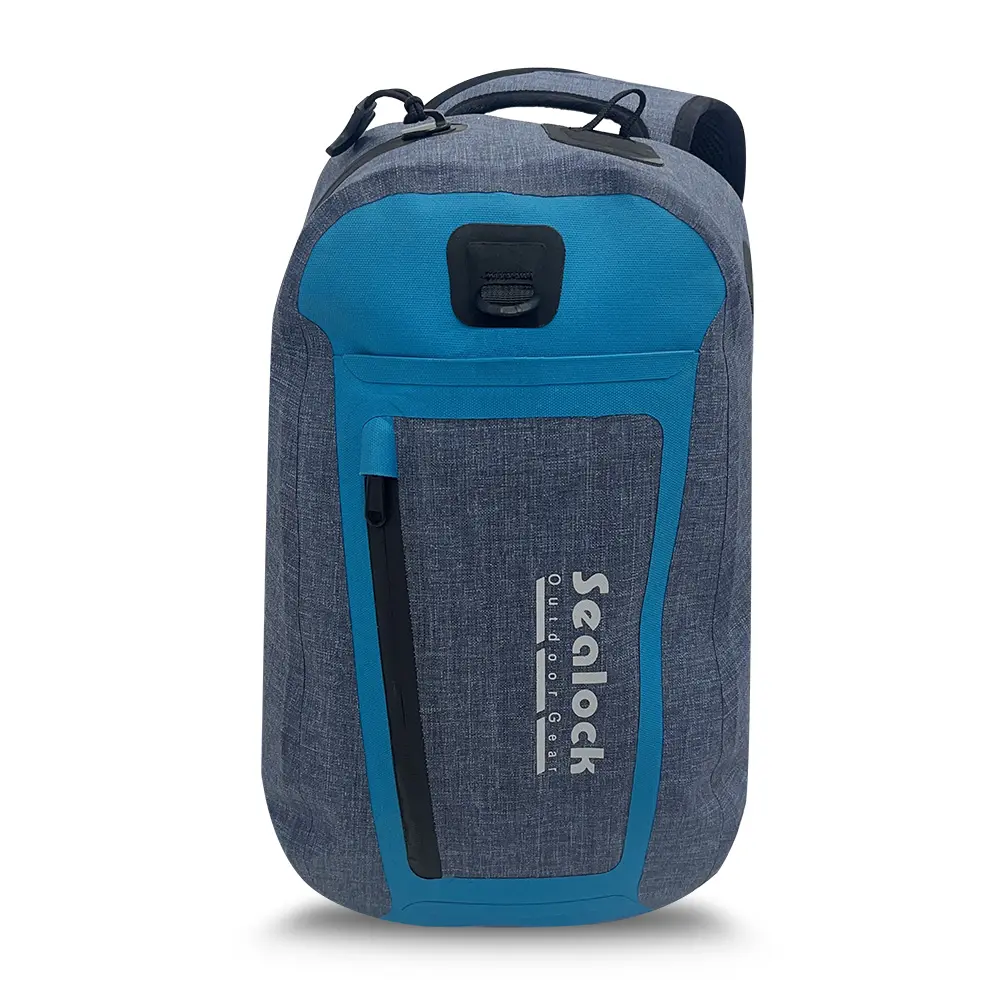
SL-E548 Fishing Sling | Welded body, sewn carry and back panel | 500D PVC laminate | IPX7 | View |
Full categories sit under waterproof bags, dry backpacks, and dry bags. The welding process itself is detailed in the guide to the manufacturing process from cutting to RF welding, and material weldability in the TPU material guide.
9. Quality Control Covers Both Processes
Every batch runs IQC on incoming fabric, zippers, and hardware; IPQC in process on both lines — peel tests on sample welds at run start, plus stitch density and tension checks on the sewing line; and OQC with AQL sampling, batch testing, and signed gold-sample comparison. Load cycling over 1,500 cycles targets the stitched load paths at straps, handles, and anchors, while immersion or rain testing verifies the welded seal against each model's stated rating. The full customer inspection procedure — unboxing, vacuum extraction, a 24-hour static rest, and air-leak determination — can be witnessed end to end, with SGS or QIMA inspection available. Standards are set out in the quality control standards for waterproof production.
10. FAQ
Q: Is welded always better than sewn?
A: No. Welded is better at sealing and seam strength; sewn is better at complex geometry, organisation, padding, and harness construction — and it is repairable in the field where a failed weld usually needs factory rework. Most good products use both, with each process doing what it is best at.
Q: Can any waterproof fabric be welded?
A: Only coated thermoplastics — PVC, TPU, PU, and EVA among them. Non-polar materials will not weld at 27.12 MHz. If a brand specifies its own fabric, weldability should be confirmed before sampling rather than discovered during it.
Q: Does a welded bag mean fewer pockets?
A: At a welding-only factory, yes — every stitched pocket on a sealed body is a leak path, so they get left off. With a sewing line alongside, organisation is built as sub-assemblies on flat panels before the shell is sealed and carry components attach at welded patches, so the pack keeps its pocket density without a needle through the membrane.
Q: How do we decide for our product?
A: Start from the rating the end user genuinely needs and the features they buy the bag for. Submersion required and organisation minimal points to fully welded; heavy organisation, padding, or a harness points to a sewing-led hybrid. Ask for the same model quoted both ways and compare the cost delta against real requirements.
Q: Does welded construction cost more?
A: Usually, because it needs specialised equipment, a custom die per geometry, and more production time. Whether it is worth it depends on whether the product's use case actually demands submersion. It often is on water-sports gear and often is not on urban or commuter lines.
Q: Do you only do welding?
A: No — this is a common assumption and it costs buyers options. High-frequency welding and industrial sewing both run in house as separate workshops on the same production floor, and fully stitched constructions are produced to the same standard as welded ones.
Request a Construction Recommendation
Send your product brief and target rating, and we can quote the same model as a fully welded shell and as a stitched construction, or produce a part sample showing both — submit an inquiry. Sealock responds to procurement enquiries within 24 hours, with production from Dongguan, China or Ho Chi Minh City, Vietnam.