
- English
- Español
- Português
- русский
- Français
- 日本語
- Deutsch
- tiếng Việt
- Italiano
- Nederlands
- ภาษาไทย
- Polski
- 한국어
- Svenska
- magyar
- Malay
- বাংলা ভাষার
- Dansk
- Suomi
- हिन्दी
- Pilipino
- Türkçe
- Gaeilge
- العربية
- Indonesia
- Norsk
- تمل
- český
- ελληνικά
- український
- Javanese
- فارسی
- தமிழ்
- తెలుగు
- नेपाली
- Burmese
- български
- ລາວ
- Latine
- Қазақша
- Euskal
- Azərbaycan
- Slovenský jazyk
- Македонски
- Lietuvos
- Eesti Keel
- Română
- Slovenski
- मराठी
- Srpski језик

How to Write a Tech Pack for a Waterproof Bag
Sealock develops OEM waterproof bags from buyer tech packs at factories in China and Vietnam, with an MOQ of 300 pieces and samples in 7–15 days. The tech pack decides more about a project than any conversation with a factory: it fixes what the quotation covers, what the sample will look like, and what bulk production is measured against. Sent incomplete, it hands the decisions you did not write down to someone else. This is what a waterproof bag tech pack needs to contain, including the sections general bag templates leave out.
1. What Happens to Every Gap You Leave
A factory receiving sketches alone has a visual reference but no production instructions, and it fills every unspecified detail with an assumption. That is not carelessness — the line has to keep moving, so someone decides.
The bill of materials is the clearest example. When it is missing, material sourcing becomes the factory's decision, and a factory sourcing independently chooses on availability and margin rather than on your brand specification. You receive a bag that matches the drawing and differs in every way the drawing could not show — coating weight, zipper grade, webbing thickness, thread.
The same principle explains the most common cause of a third sample round: not a weak factory, but a brief that left the zipper, denier, or hardware open. Closing those gaps before submission typically saves a full revision cycle.
2. The Core Sections
| Section | What it contains |
|---|---|
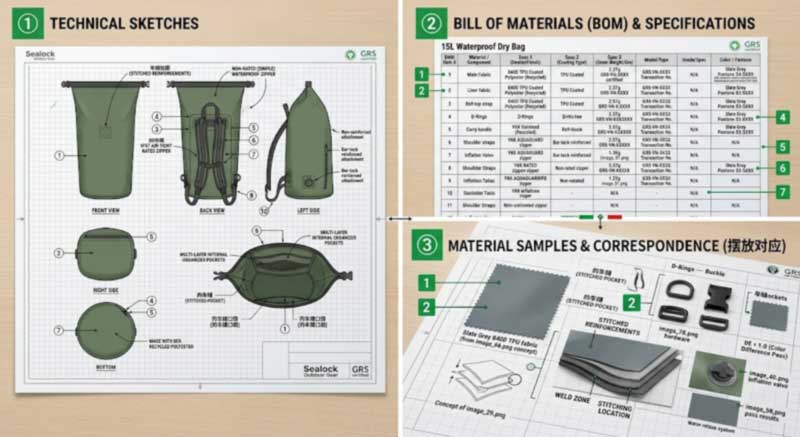
| Technical sketches | Front, back, both sides, base, and interior views, with numbered callouts |
| Bill of materials | Every material and component with specification, colour reference, and quantity per unit |
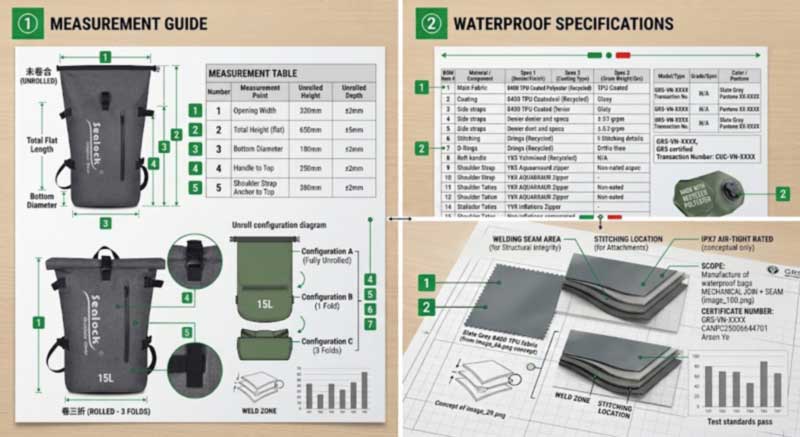
| Measurement specification | Numbered points of measure, base dimensions, and tolerances |
| Construction notes | How each seam is joined, reinforcement points, closure method |
| Waterproof and test specification | Target rating, test method, and acceptance criteria — the section generic templates omit |
| Branding | Logo artwork, method, size, placement, and colour |
| Colourways | One page per colourway with Pantone references for every component |
| Packaging and labelling | Polybag, hangtag, care label, barcode, carton spec |
| Revision log | Every change with date and version number |
3. Sketches: Show Every Side, Including Inside
Providing only the front view is the most common beginner mistake. A factory cannot cut a pattern from one angle, and a pattern maker needs to see how every panel meets its neighbour.
- Draw front, back, both sides, base, and interior. The interior matters on waterproof bags because liners, internal pockets, and laptop sleeves are where organisation meets the sealed body.
- Number the callouts and match those numbers to the measurement table and the BOM.
- Use one name per part. The same component should not be a "front strap" on one page and a "closure tab" on another — inconsistent naming is how a factory builds the wrong thing correctly.
- State which drawing controls if two views conflict, so a gusset depth shown differently in the side and base views does not become a guess.
- Add zoom details for anything a line drawing cannot explain quickly — a roll-top collar, a zipper end, an anchor patch.
4. The Bill of Materials
This is the section that most directly controls cost and quality. For a waterproof bag it should specify, for every line:
- Shell fabric — base material and denier, coating type (PVC, TPU, or PU), coating weight or total GSM, and finish. Denier alone is not a specification; two fabrics labelled "600D" can differ materially in coating.
- Reinforcement panels — base, corners, and anchor areas, often in a heavier denier than the body.
- Closure — zipper brand, type, and rating, or roll-top collar construction and stiffener.
- Hardware — buckles, D-rings, adjusters, and valves, with grade and whether corrosion resistance is required.
- Webbing and thread — width, material, and weight.
- Padding and foam — density rather than only thickness, since low-density foam compresses within a season.
- Labels, hangtags, and packaging components.
Include a colour reference and unit of measure on every line. Material options and their trade-offs are set out in the guides to TPU material advantages and PVC cost and performance.
5. Measurements: Say Exactly Where and How
"Width" is not a measurement when the top opening, widest point, and base all differ. Every dimension needs a defined point of measure:
- Number each measurement point on the drawing and match it to the table.
- State the condition — measured empty, filled, laid flat, or standing. A soft bag measures differently in each.
- For roll-top bags, specify three capacities: size before closure, size after rolling three times, and recommended usable volume. Rated capacity is measured open, and publishing it as usable produces "smaller than described" returns.
- Include strap and handle dimensions — drop length, adjustment range, and attachment spacing.
Set tolerances where they matter rather than everywhere. Logo position, paired handle attachments, and zipper alignment usually need tighter control than the overall width of a soft bag. Arbitrary tolerances added to make a document look technical tend to be ignored — agree realistic figures with the factory after the first sample.
6. The Waterproof Section Generic Templates Leave Out
Most tech pack templates are written for apparel or handbags, where waterproofing is not a performance requirement. For this category, it is the requirement, and it needs its own page:
- Target rating and what it means for the product. IPX6 for rain and spray, IPX7 for brief immersion, IPX8 for sustained submersion. State which, because it changes the closure, the construction, and the cost.
- Construction method per seam. Mark which seams are welded and which are stitched. Welded seams carry the waterproof claim; stitched seams build harnesses, pockets, and reinforcement. On a hybrid, the drawing should show both. The trade-offs are covered in the guide to sewn versus welded construction.
- Sequencing notes where they matter — load-bearing stitching completed before the waterproof seal exists, and hardware on the sealed body attached by welded patch rather than sewn through the membrane.
- Test method and acceptance criteria. The test the finished product must pass, its duration, and the condition — filled and sealed rather than empty.
- Material weldability. If you are specifying your own fabric, confirm it is a weldable coated thermoplastic before sampling rather than discovering it during.
7. Branding, Colour and Packaging
Logo instructions need artwork, method, size, placement, and colour — in vector format such as AI, PDF, or EPS so it scales without loss. On waterproof bags, specify placement on a flat, stable panel clear of seams, buckles, and roll-top fold zones, because a mark in a flex or abrasion path wears regardless of method.
Give each colourway its own page with a Pantone reference for every component, not only the shell, since webbing, zipper tape, and binding need matching too. And specify packaging per sales channel — plain polybag and carton marks for distribution, or hangtags, care labels, barcodes, and retail boxes for shelf and marketplace sale. Packaging options are covered in the guide to packaging and retail presentation.
8. Compliance and Version Control
Two final sections prevent problems that only appear later. Compliance requirements for the destination market — REACH for the EU, Proposition 65 for California, and any recycled-content claim that needs GRS documentation behind it — belong in the tech pack rather than in a follow-up email, because they affect material selection. The recycled-content requirements are covered in the guide to GRS recycled waterproof bags.
A revision log records every change with a date and version number. If a strap is lengthened by twenty millimetres after the first prototype, the log is what ensures bulk runs from the updated specification rather than an obsolete file — the difference between a correct container and thousands of units built to a superseded drawing.
9. You Do Not Have to Write It Alone
Many buyers arrive without a finished tech pack, and that is workable. A physical reference sample is the fastest brief of all, since a factory reads pocket layout, closure, and strap design directly from it. Full-service manufacturers also develop tech packs as part of sample development, and a capable one will review yours to flag production problems or suggest construction changes before anything is cut.
What matters is that the document exists and is agreed before bulk. Once the sample is approved, the tech pack and a signed gold sample together become the production standard every batch is measured against, as set out in the guide to reorder consistency.
10. Platforms to Build a Tech Pack Around
Starting from an existing construction avoids new tooling and shortens development. Organized by category rather than priority:
| Image | Model | Category | Material | Rating | Product Page |
|---|---|---|---|---|---|
|
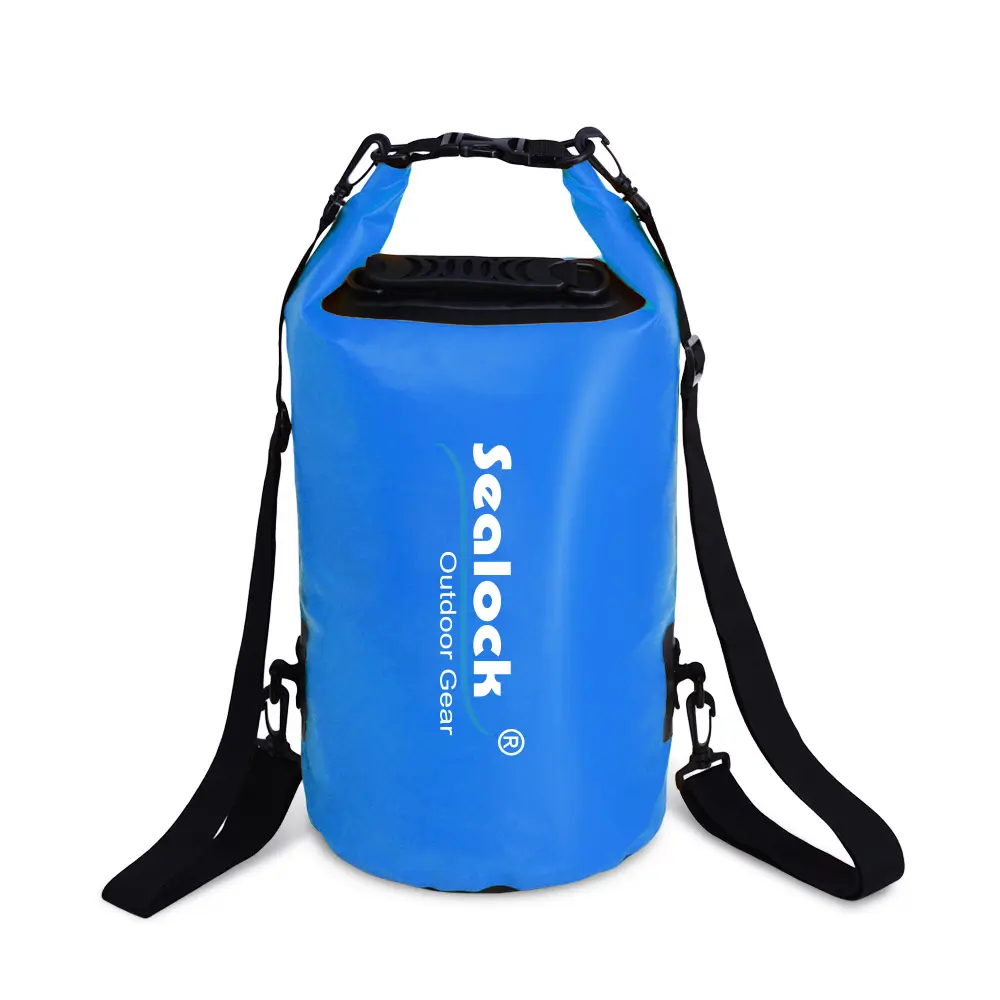
SL-D002 | Dry bag, 5–63L | 0.5 mm 500D PVC | IPX7 | View |
|
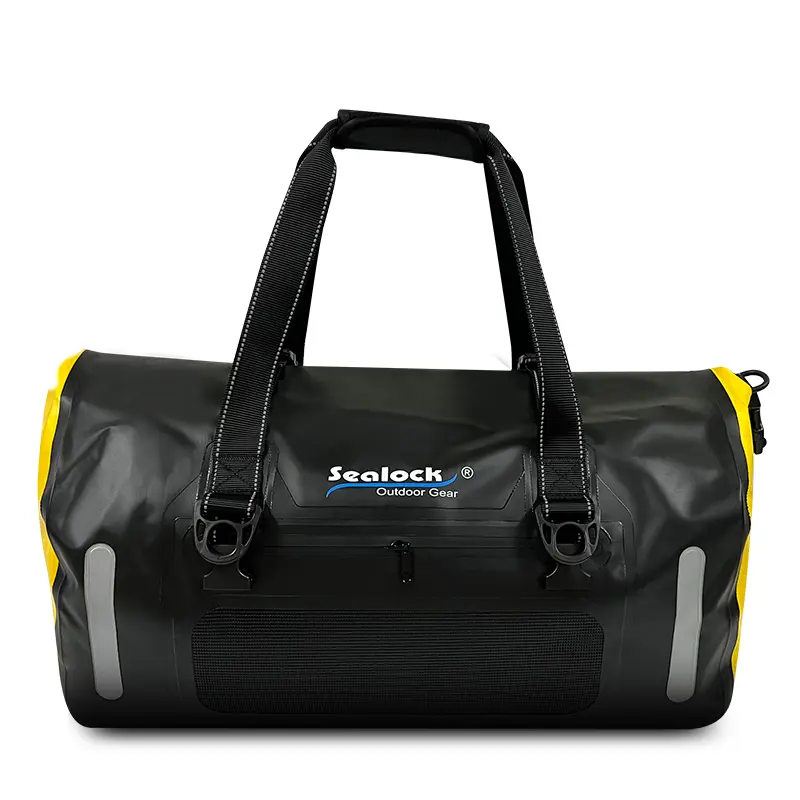
SL-K099 | Duffel, 40 / 60L | 840D TPU | IPX7 | View |
|
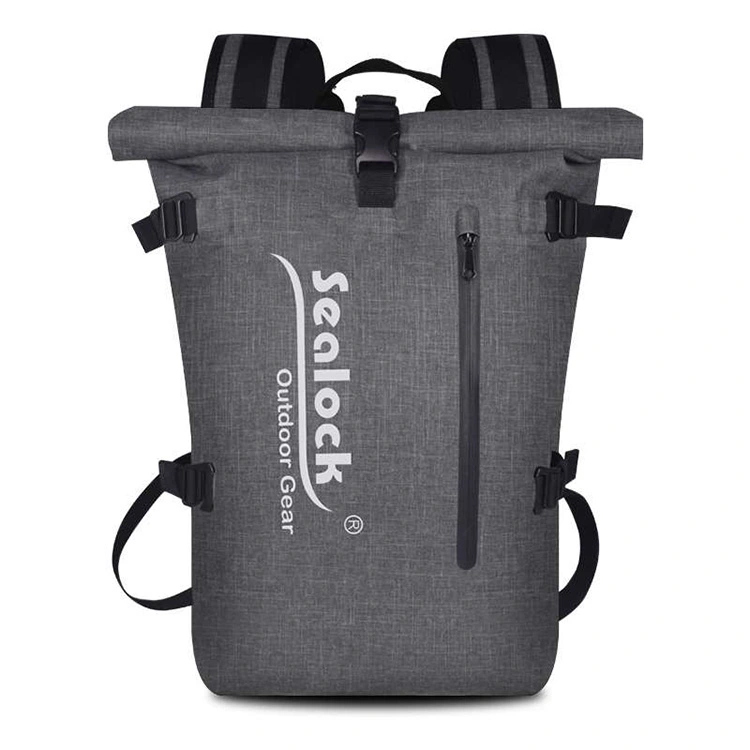
SL-E980 | Commuter backpack, 22L | 600D TPU | IPX6 | View |

|
SL-E119 | Backpack, 20L | Cationic TPU composite | IPX8 | View |
|
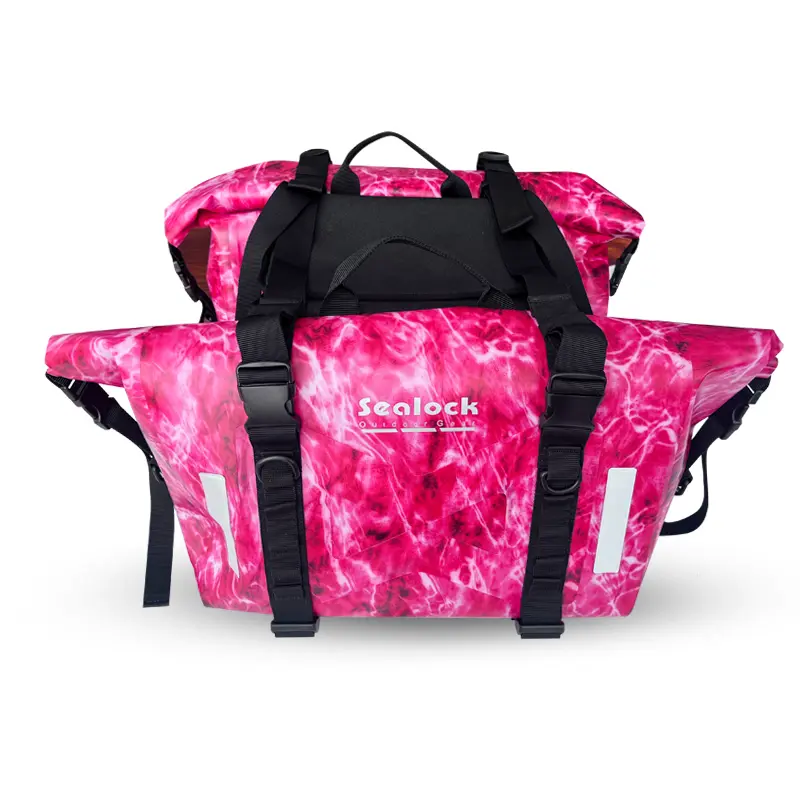
SL-C807 | Motorcycle, 45L | 500D PVC / 420D TPU | IPX6 | View |
|
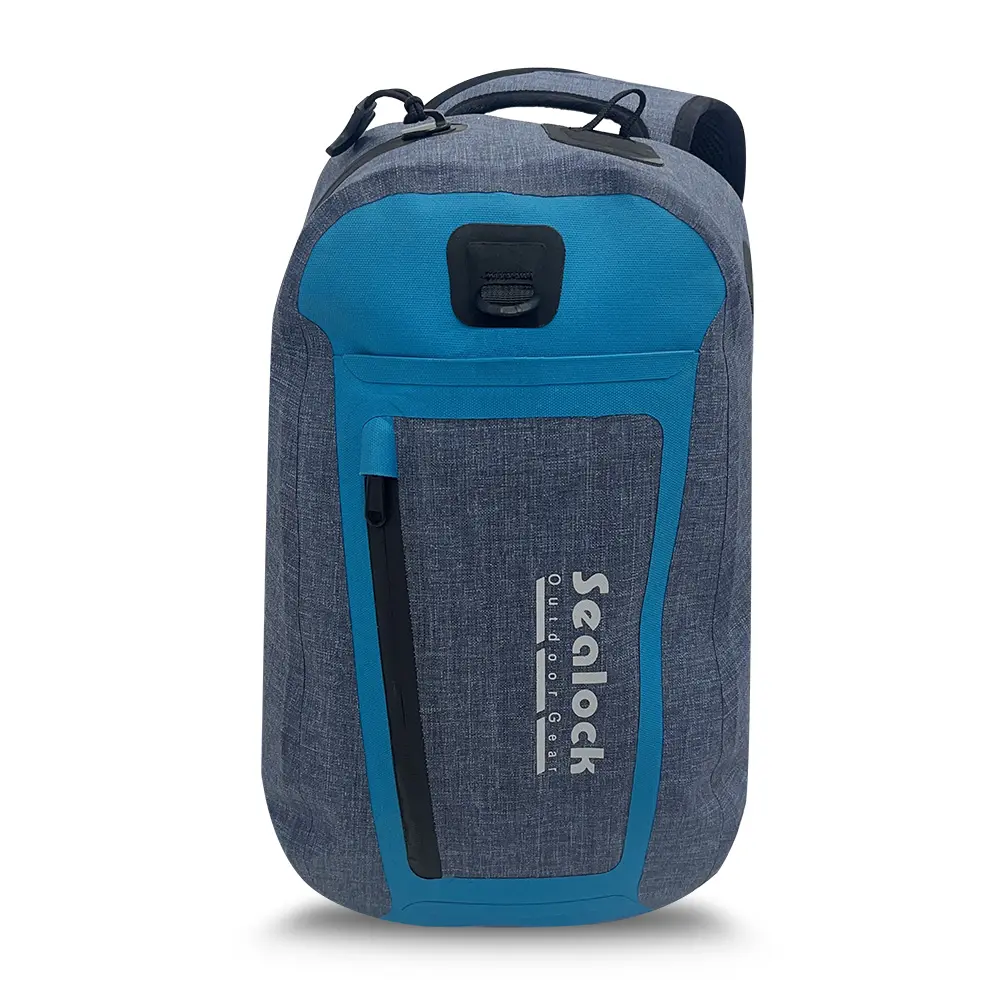
SL-E548 | Fishing sling, 8L | 500D PVC | IPX7 | View |
Full categories sit under waterproof bags, dry backpacks, and dry bags.
11. Standard Terms
Sealock (YiFuLong Outdoor Gear Co., Ltd.) has built waterproof bags for over 20 years, producing for international outdoor brands including OSPREY, KAILAS, Helly Hansen, SIMMS, ORVIS, and West Marine.
- MOQ: 300 pcs per model | Samples: 7–15 days | Bulk: 30–45 days
- Logo: silkscreen, heat transfer, welded patch, rubber patch, embroidery — vector artwork required
- Production: in-house 27.12 MHz high-frequency welding and industrial sewing, separate workshops on the same production floor
- Facilities: Dongguan, China | Ho Chi Minh City, Vietnam — either origin on any model
- Certifications: ISO 9001, BSCI, SMETA, Sedex, HIGG, GRS, SCAN
Every batch runs IQC, IPQC including peel tests on sample welds at run start, and OQC with AQL sampling and gold-sample comparison against the approved tech pack, under the quality control standards for waterproof production.
12. FAQ
Q: Can a factory quote from sketches alone?
A: Only indicatively. Sketches show what the bag looks like, not what it is made of or how it is joined, so the factory fills the gaps with its own assumptions. A bill of materials and a waterproof specification are what turn an estimate into an accurate quotation.
Q: What is the most important section for a waterproof bag?
A: The bill of materials and the waterproof specification together. The BOM controls cost and material quality; the waterproof page fixes the rating, which seams are welded, and the test the finished bag must pass. Generic bag templates usually have the first and omit the second.
Q: How should we specify capacity on a roll-top bag?
A: With three figures — size before closure, size after rolling three times, and recommended usable volume. Rated capacity is measured open, and listing it as usable is a common cause of returns.
Q: Do we need tolerances on every measurement?
A: No. Set them where variation matters — logo position, paired handle attachments, zipper alignment — and keep them realistic. Agree final figures with the factory after the first sample rather than inventing them upfront.
Q: We don't have a tech pack. Can we still start?
A: Yes. A physical reference sample is often the fastest brief, and tech pack development can be handled as part of sampling. What matters is that the specification is written down and agreed before bulk, so production is measured against a document rather than a memory.
Q: Why does a revision log matter?
A: Because every change made during sampling has to reach bulk. Without a versioned record, production can start from an earlier file — and thousands of units get built correctly to a drawing that was superseded weeks earlier.
Send Your Tech Pack for Review
Send a tech pack, sketches, or a reference sample, and we will review it for manufacturability, flag any gaps, and quote against it — submit an inquiry. Sealock responds to procurement enquiries within 24 hours, with samples in 7–15 days and production from Dongguan, China or Ho Chi Minh City, Vietnam.