
- English
- Español
- Português
- русский
- Français
- 日本語
- Deutsch
- tiếng Việt
- Italiano
- Nederlands
- ภาษาไทย
- Polski
- 한국어
- Svenska
- magyar
- Malay
- বাংলা ভাষার
- Dansk
- Suomi
- हिन्दी
- Pilipino
- Türkçe
- Gaeilge
- العربية
- Indonesia
- Norsk
- تمل
- český
- ελληνικά
- український
- Javanese
- فارسی
- தமிழ்
- తెలుగు
- नेपाली
- Burmese
- български
- ລາວ
- Latine
- Қазақша
- Euskal
- Azərbaycan
- Slovenský jazyk
- Македонски
- Lietuvos
- Eesti Keel
- Română
- Slovenski
- मराठी
- Srpski језик

Reorder Consistency: How to Keep Batch Five Matching Batch One
Sealock produces OEM and wholesale waterproof bag programmes from factories in China and Vietnam, with repeat-order control built around a signed gold sample and a version-controlled production record. Most buyers evaluate a supplier on the first order. The commercially important test arrives later — when the third or fifth container has to look identical to the first, months after the original approval, with different material lots and possibly different people on both sides. This is how drift happens and what prevents it.
1. Drift Is a Documentation Problem Before It Is a Manufacturing Problem
That framing is worth adopting because it changes where a buyer spends effort. Repeat orders diverge when fabric lots, dye batches, pattern files, hardware grades, or decoration settings are not carried forward exactly from the first approval — not usually because a factory became careless. Without records, a reorder relies on memory, and memory fails precisely when team members change, production lines change, or the next order lands months after the last.
The commercial cost is measurable. Industry reporting on repeat-order colour variation indicates buyers who notice a shade shift between reorders return product at rates materially higher than those who do not — and each return is a customer who now doubts the next purchase. For a brand running a multi-season line, a small drift compounds into a credibility problem long before it becomes a quality complaint.
2. The Five Places a Bag Programme Drifts
- Fabric lot and dye batch. The most common source. Even with the same specification, a new dye lot produces a different shade, and a new fabric lot can change hand-feel and how the bag holds its shape.
- Components. Zipper grade, webbing thickness, foam density, and buckle supplier all change how a finished bag looks and feels, and substitutions are easy to make quietly when a component is out of stock.
- Pattern and version. If bulk starts from a later revision than the one approved, or from an unlabelled file, the product changes without anyone deciding it should.
- Decoration. Logo size, placement, and print setup drift between runs unless the artwork file, position, and method are recorded rather than described.
- Reference point. Comparing a new batch with a photo, or with the previous batch rather than the original approved sample, allows small shifts to accumulate run after run.
That last one deserves emphasis, because it is the quiet killer. Every production run should be measured against the original approved sample, not against the batch before it. Comparing to the previous run means each batch is only as accurate as the last, and small deviations compound.
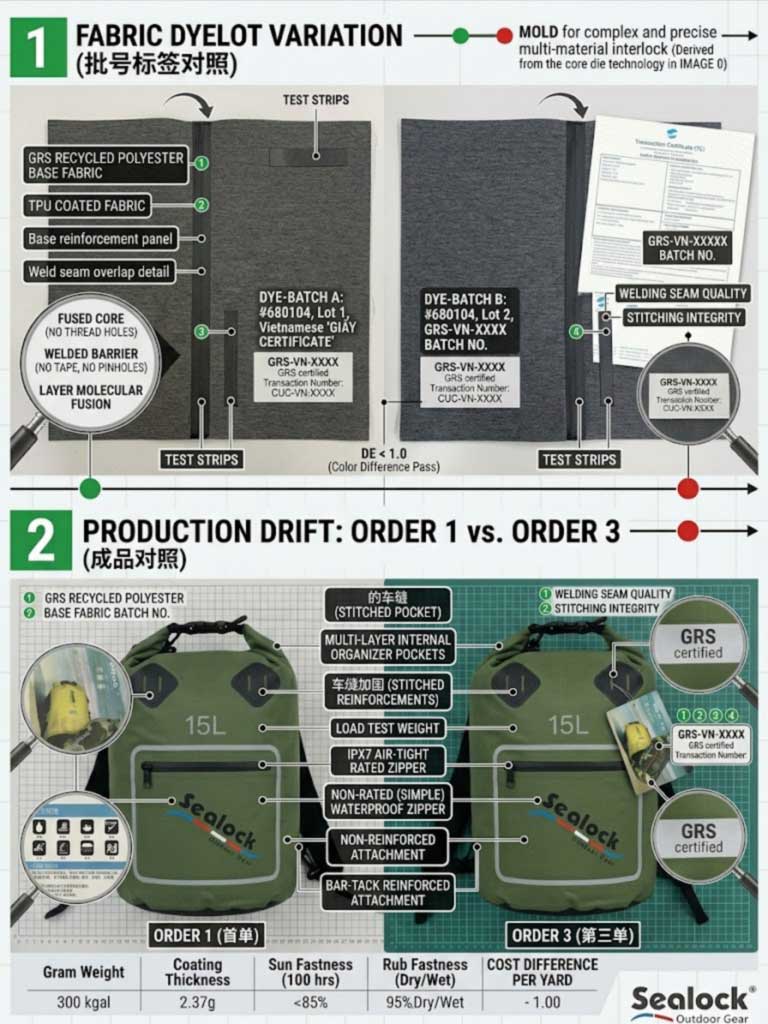
3. The Gold Sample Is a System, Not an Object
An approved sample only protects a programme if it functions as a controlled reference rather than a bag in a cupboard. A working gold sample system has four properties:
- Held by both sides. One with the buyer, one with the factory, so a dispute has a physical arbitration point rather than two opinions.
- Identified and dated. Sample ID, specification version, packaging version, and approval date recorded together, so everyone knows which revision is current.
- Used at every stage, not only final inspection — incoming material checks, first-article approval, in-process inspection, packing review, and final inspection all reference it.
- Re-approved when anything changes. If material, finish, or process is modified, the sample is reissued rather than quietly superseded. The same applies if the physical sample degrades — a faded reference is worse than none, because it legitimises drift.
A useful refinement for long programmes: keep the master sample stored away from light and handling, and use working duplicates for routine factory checks so the reference itself does not age.
4. What Belongs in the Standard Pack
The gold sample answers "does this look right." The standard pack answers "what exactly was approved." For a bag programme it should contain:
| Element | Why it prevents drift |
|---|---|
| Bill of materials with named suppliers | Stops silent component substitution |
| Measurement points with tolerances | Makes dimensional checks objective rather than visual |
| Colour standard — Pantone reference plus approved bulk swatch | The reference states the target; the swatch shows how it actually appeared on the real fabric base |
| Logo artwork, placement guide, and method | Decoration drift is otherwise invisible until goods arrive |
| Weld and stitch specifications | Seam width, stitch density, and reinforcement points |
| Packaging files and carton spec | Packaging changes are as visible to a customer as the product |
| Approved reference photographs | Fast visual check for inspectors who never saw the original |
| Version number and approval date | Ensures bulk starts from the right revision |
The colour standard point is worth separating out. A Pantone code alone is a target, not an outcome — the same target reads differently on a coated TPU face, a woven webbing, and a moulded buckle. Approving a bulk swatch on the actual material alongside the code is what makes the standard usable.
5. Colour Needs a Layered Reference, Not a Description
"The same as last time" is the single most common instruction behind reorder drift, and it fails as soon as a new merchandiser or production planner joins either side. A durable colour system has three layers:
- A code — Pantone or an internal brand colour ID, appearing consistently on the tech pack, purchase order, and factory production sheet so everyone uses the same language.
- A physical standard — the approved swatch on the actual production material, not a printed card.
- An agreed tolerance — a colour-difference measurement with an agreed acceptance limit, used alongside visual inspection rather than instead of it.
Sealock runs colour-fastness and colour-difference testing against the approved standard on every batch, and the difference measurement is what makes a borderline case decidable rather than arguable.
6. Questions to Ask Before the First Order, Not the Second
Reorder capability is screenable in advance, which is far cheaper than discovering it at replenishment. Worth asking any supplier:
- Can fabric lot, colour, and hardware be reserved or matched for repeat runs? Some programmes justify holding material against a forecast, which removes the highest-risk variable entirely.
- Do you hold a signed gold sample, and how is it stored and versioned?
- Is each batch compared to the original approval or to the previous batch? The answer tells you whether drift can compound.
- What happens if a specified component becomes unavailable? The correct answer is notification and re-approval, not substitution.
- Do you run colour-difference measurement, or visual comparison only?
- Can you show a repeat-production record from an existing programme?
Supplier verification more broadly is covered in the guide to selecting a manufacturing partner.
7. What the Buyer Should Do at Reorder
- Confirm the current version. Check the tech pack version and approved sample ID against what you are reordering, rather than referencing "the same as the last PO".
- Restate the colour standard by code and by approved swatch, not by description.
- Ask whether anything changed — fabric source, component supplier, or process — since the previous run, and require re-approval where it did.
- Keep the inspection criteria attached to the order, so the AQL level, defect classification, and reference sample travel with it.
- Inspect against the original approval, and where a third party is used, give them the gold sample reference rather than a photograph.
The best repeat orders are not the fastest to place. They are the ones that preserve the standard clearly enough for the factory to reproduce it without interpretation.
8. How Reorder Control Works Here
Sealock (YiFuLong Outdoor Gear Co., Ltd.) has built waterproof bags for over 20 years, producing for international outdoor brands including OSPREY, KAILAS, Helly Hansen, SIMMS, ORVIS, and West Marine.
- Signed gold sample held by both sides as the production reference, with every batch compared against it rather than against the previous run.
- Repeat-production record covering material names, colour codes, logo artwork and placement, hardware finish, packing method, and carton specification.
- Three-stage control — IQC on incoming fabric, zippers, and hardware; IPQC in process on both welding and sewing lines, including peel tests on sample welds at run start and stitch density and tension checks; OQC with AQL sampling, colour-difference testing, and gold-sample comparison.
- Consistent across both sites. The same approved sample and quality system govern production in Dongguan and Ho Chi Minh City, so a programme that moves origin for tariff reasons does not restart its standard.
- ISO 9001 alongside BSCI, SMETA, Sedex, HIGG, GRS, and SCAN — a documented quality management system is the baseline requirement for sample-to-bulk repeatability.
Standards and defect classification are set out in the quality control standards for waterproof production.
9. Programmes Running on This Control
Models organized by category rather than priority:
| Image | Model | Category | Material | Reorder note | Product Page |
|---|---|---|---|---|---|
|
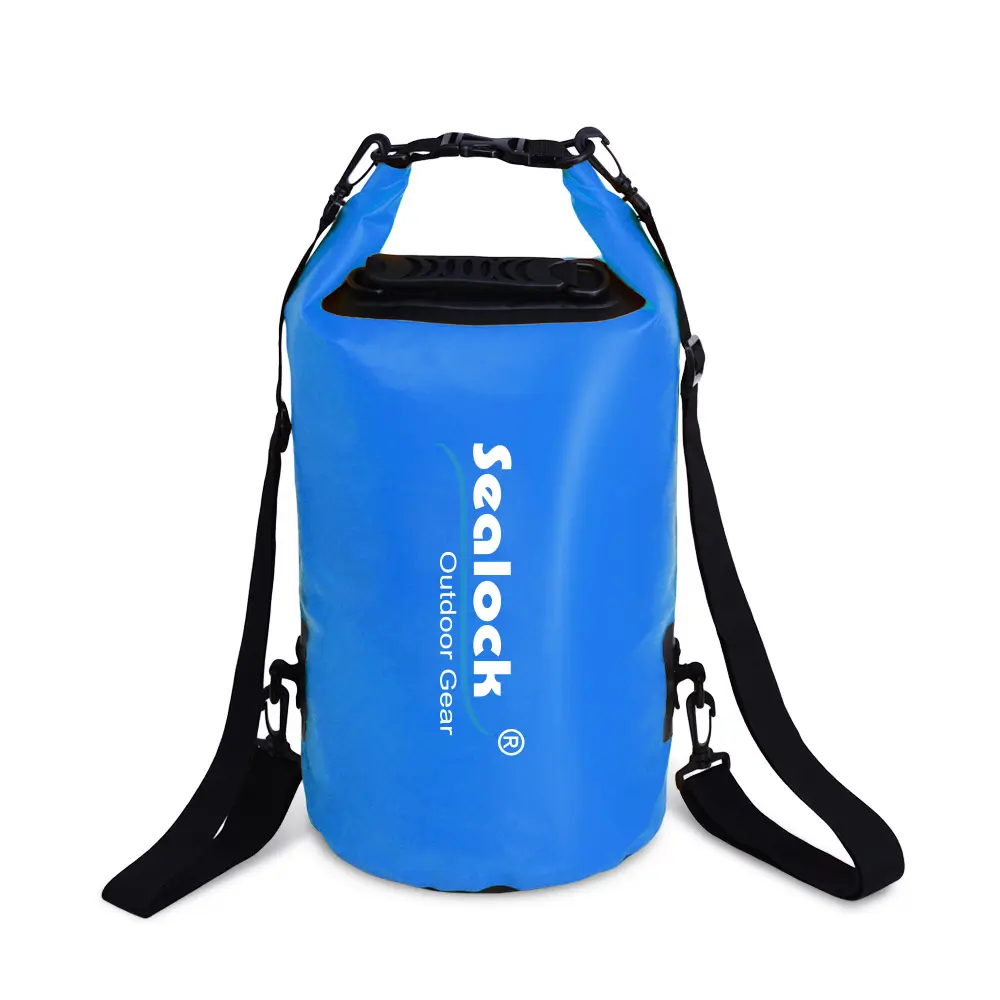
SL-D002 | Dry bag, 5–63L | 500D PVC | Size ladder from one construction — one colour standard covers all sizes | View |
|
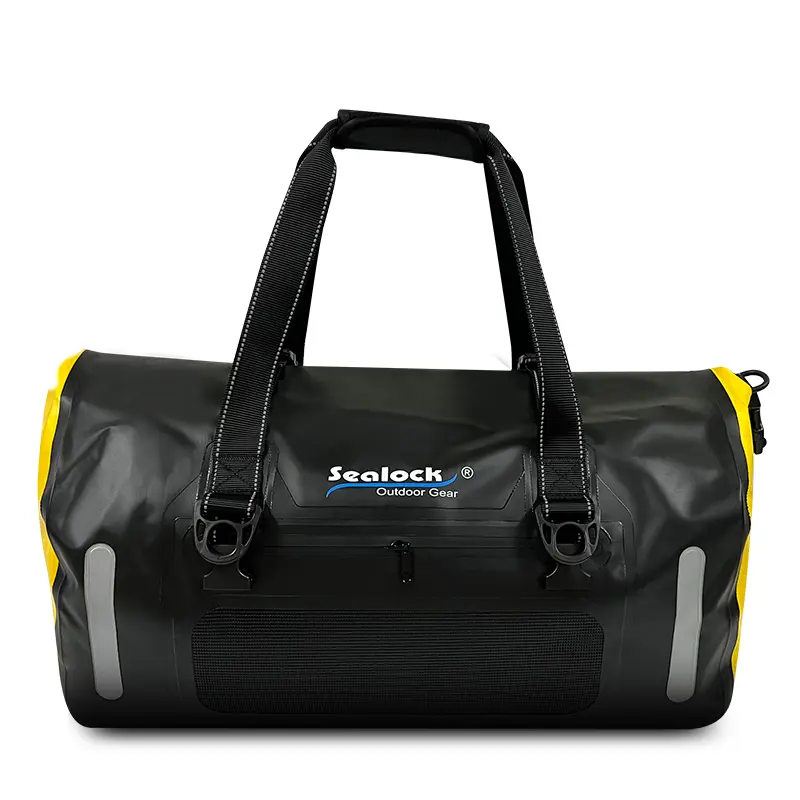
SL-K099 | Duffel, 40 / 60L | 840D TPU | Two sizes on one platform, shared material specification | View |
|
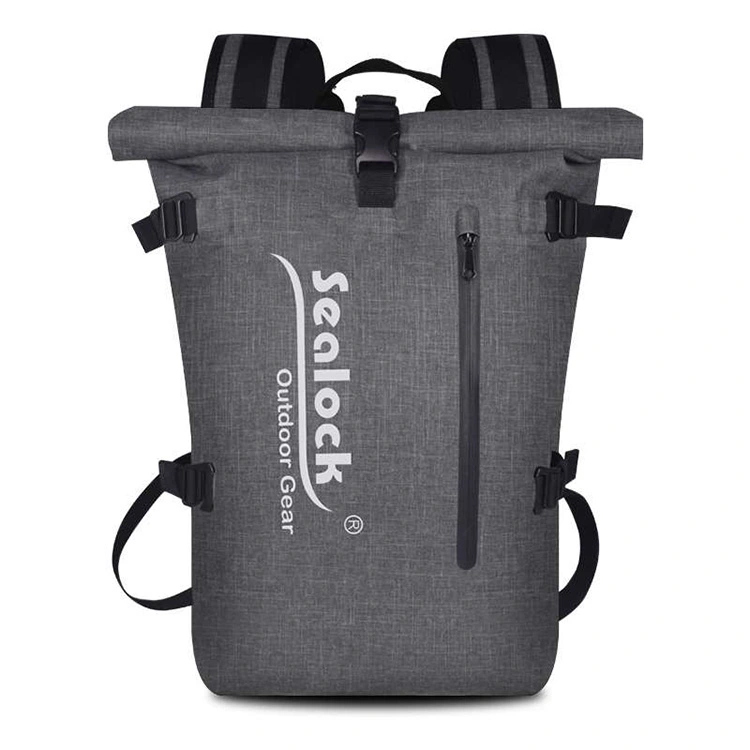
SL-E980 | Commuter backpack, 22L | 600D TPU | Heather grey stock colour reduces dye-lot exposure on repeats | View |
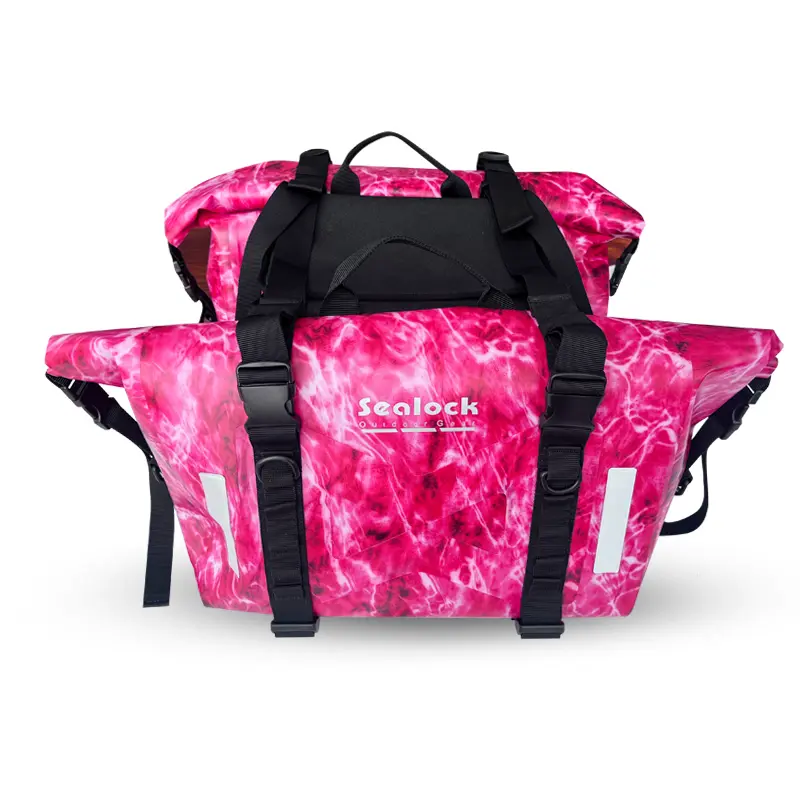
|
SL-C807 | Motorcycle, 45L | 500D PVC / 420D TPU | Material option locked in the standard pack per programme | View |
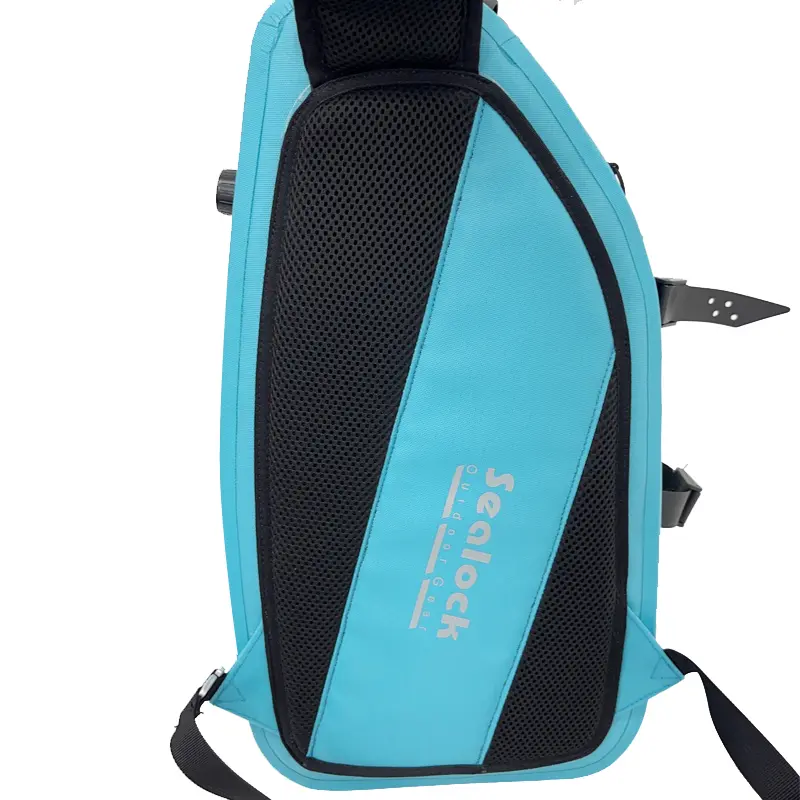
|
SL-E868A | Fishing sling, 12L | 840D TPU | Airtight zipper grade recorded by component, not by description | View |
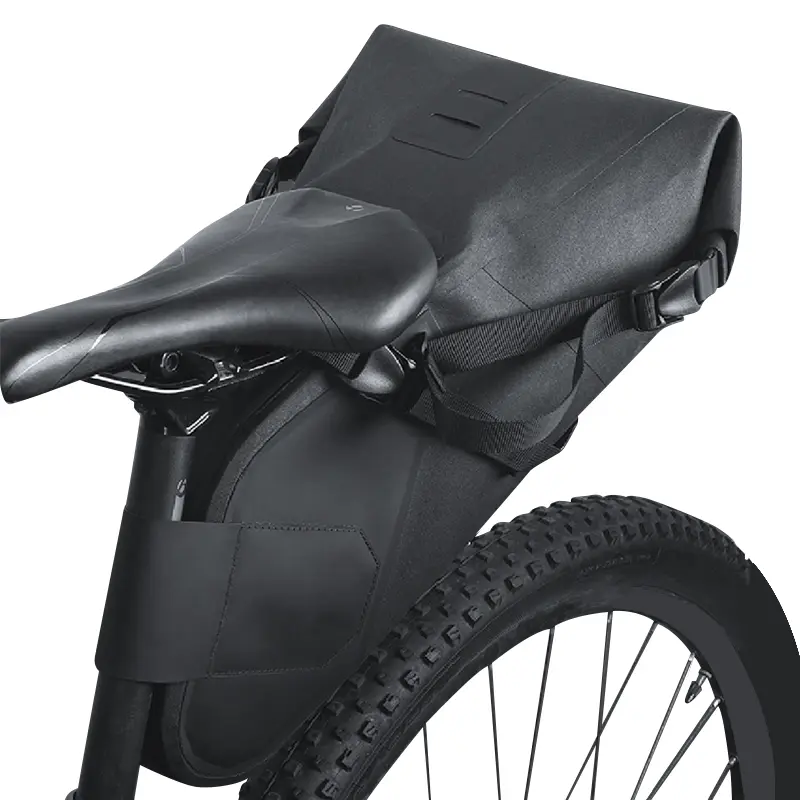
|
SL-K022 | Bike saddle bag, 10–14L | 420D / 600D TPU | Pattern version controlled — dimensional drift changes fit | View |
Full categories sit under waterproof bags, dry backpacks, and dry bags. Sampling and approval are covered in the guide to getting a waterproof bag sample.
10. FAQ
Q: Why did our second order look different when nothing was changed?
A: Usually because something was carried forward from memory rather than from a record — a new dye lot, a substituted component, or a later pattern revision. Drift is a documentation problem before it is a manufacturing one, which is why the fix is a version-controlled standard pack rather than more inspection.
Q: Should each batch be compared to the previous batch?
A: No — to the original approved sample. Comparing to the previous run means every batch is only as accurate as the one before it, and small deviations accumulate until the fifth order is visibly different from the first.
Q: Is a Pantone code enough for colour control?
A: Not on its own. A code states the target; an approved swatch on the actual production material shows the real outcome, since the same target reads differently on coated fabric, webbing, and moulded hardware. Add an agreed colour-difference tolerance so borderline cases are decidable rather than arguable.
Q: Can material be reserved so repeats match exactly?
A: Where a programme has a forecast, holding fabric and hardware against it removes the largest single variable. Raise it at the first order rather than at the reorder, since material held from an existing lot is the most reliable way to eliminate dye-batch variation.
Q: What should happen if a specified component is unavailable?
A: Notification and re-approval, never substitution. A component change that reaches production without the buyer seeing it is how a programme drifts in a single step rather than gradually.
Q: Does moving production between your China and Vietnam sites affect consistency?
A: It should not, because the same signed gold sample and the same quality system govern both. For buyers adjusting origin to manage duty exposure, that continuity is worth confirming explicitly at the point the move is planned.
Request a Repeat Programme Review
If an existing programme has drifted, or you are planning one that will run for several seasons, send the specification and we can set up the gold sample and standard pack to control it — submit an inquiry. Sealock responds to procurement enquiries within 24 hours, with production from Dongguan, China or Ho Chi Minh City, Vietnam.