
- English
- Español
- Português
- русский
- Français
- 日本語
- Deutsch
- tiếng Việt
- Italiano
- Nederlands
- ภาษาไทย
- Polski
- 한국어
- Svenska
- magyar
- Malay
- বাংলা ভাষার
- Dansk
- Suomi
- हिन्दी
- Pilipino
- Türkçe
- Gaeilge
- العربية
- Indonesia
- Norsk
- تمل
- český
- ελληνικά
- український
- Javanese
- فارسی
- தமிழ்
- తెలుగు
- नेपाली
- Burmese
- български
- ລາວ
- Latine
- Қазақша
- Euskal
- Azərbaycan
- Slovenský jazyk
- Македонски
- Lietuvos
- Eesti Keel
- Română
- Slovenski
- मराठी
- Srpski језик

Floating Dry Bags Wholesale: Buoyancy Design and Custom Orders from the Factory
Listen to this article
Sealock manufactures floating dry bags for wholesale buyers, water sports brands, rental operators and promotional distributors, with a standard MOQ of 300 pieces, custom colours and logo printing, and production in Dongguan, China and Ho Chi Minh City, Vietnam. This guide explains what actually makes a dry bag float, why some bags sold as floating still sink, how buoyancy can be designed into a bag rather than left to chance, and what a buyer should specify and test before putting the word floating on a product listing.
Floating is one of the most valuable claims a waterproof bag can carry, and one of the most misunderstood. A customer who drops a bag off a paddleboard expects it to be on the surface when they turn around. If it is not, the product has failed in the way that matters most to them, regardless of whether it stayed dry inside. For a brand or distributor, that makes buoyancy a design specification, not a side effect.
What Makes a Dry Bag Float?
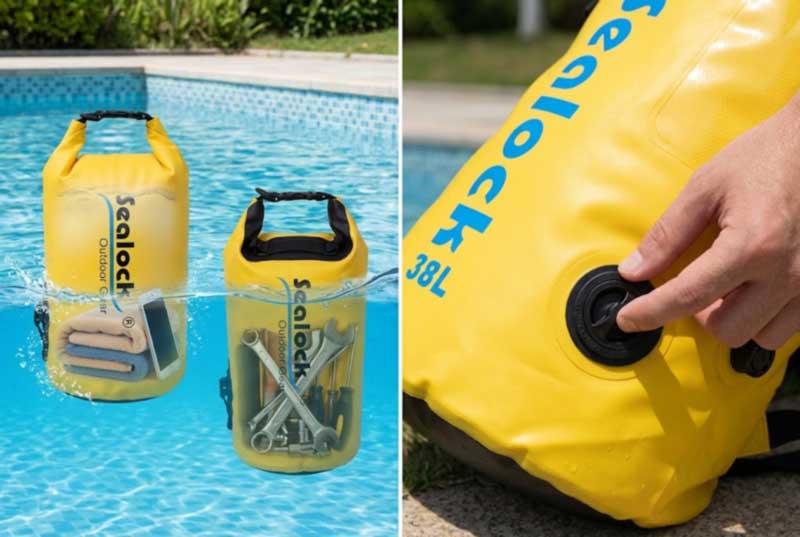
A sealed dry bag floats for the same reason a boat does. When it is pushed into the water, it displaces water, and the water pushes back with a force equal to the weight of the water displaced. Fresh water weighs about one kilogram per litre. So a sealed bag that encloses ten litres of volume can support up to about ten kilograms before it sinks, minus the weight of the bag itself. Sea water is slightly denser and gives a little more lift.
The practical rule is simple. A closed dry bag floats when its total weight, contents included, is less than the weight of water its closed volume would displace. Put another way, the bag floats when its average density is below that of water. That is why the same bag can float with a towel and a phone inside and sink with a set of tools and two full water bottles. The bag did not change. The ratio of weight to enclosed volume did.
This leads to the most common floating failure, which has nothing to do with the fabric. To close a roll-top properly, the user squeezes out air and rolls the top down at least three times. A user who squeezes out every last bit of air to make the bag compact has also removed most of its buoyancy. A bag sold as floating should be designed and labelled so that the user knows to leave some air inside. Several of our bags carry a printed instruction on exactly this point, because it prevents more lost bags than any change in material.
How Is Buoyancy Designed Into a Floating Dry Bag?
There are four levers a factory can use, and a good floating bag usually combines two or three of them.
The first is enclosed volume relative to the intended load. A floating phone bag or key bag should be sized generously for what it carries, so that there is always spare volume for air. A 3 litre bag holding a phone and keys has a large buoyancy margin. A 3 litre bag packed tight with a power bank, a multitool and a metal water flask may not.
The second is an air valve. A purge and inflate valve lets the user push air out to pack the bag tightly, then blow a little air back in before going on the water. Our SL-E978 38 litre roll-top backpack uses this approach, so it can be packed compactly for a hike and still float when it goes into a river or a lake. A valve is a sealed component in its own right, and on our bags it is welded into the panel and included in the leak test, not added afterwards.
The third is a closed-cell foam insert. A thin panel of closed-cell foam, welded into a pocket or built into the back panel, gives a fixed amount of buoyancy that does not depend on trapped air. Even if the bag is fully compressed, or a corner is punctured, the foam keeps it near the surface. For rental fleets, guided tour operators and any programme where the user cannot be relied on to leave air inside, this is the most dependable option, and we develop it to order.
The fourth is visibility. A floating bag only helps if someone can find it. High-visibility yellow, orange and fluorescent colours, reflective print and a contrasting top band make a floating bag easy to spot in waves or glare. This is a colour choice at the specification stage and costs almost nothing, yet it is the feature water sports retailers ask about most once they have seen a dark bag disappear into dark water.
Floating Is Not the Same as Life-Saving
A floating dry bag keeps gear on the surface. It is not designed or certified to keep a person afloat, and it should never be marketed in a way that suggests it can. In the United States, devices intended to keep a person afloat are regulated as personal flotation devices and must be approved by the Coast Guard. In the European Union, buoyancy aids and lifejackets fall under the Personal Protective Equipment Regulation and the ISO 12402 series of standards. A dry bag carries none of those approvals.
The safe wording for a listing is that the bag floats when sealed with air inside, within a stated load. We recommend buyers state the tested load, for example that the bag floats with up to three kilograms of contents when closed with air inside, rather than using the word floating on its own. For buyers who want a product aimed at swimmer visibility, we also produce inflatable swim buoys and tow floats as a separate line, and that product needs its own wording and testing.
What Is the MOQ and Price for Custom Floating Dry Bags?
The standard MOQ is 300 pieces per design, including your logo. Within that quantity, sizes of the same model can usually be split, and standard colourways can be mixed. Custom Pantone colours, including fluorescent shades, need their own material run and are quoted separately. A foam insert or a new valve position on an existing model is a modification rather than a new tool, and it is usually quoted as a small addition to the unit price. A completely new floating design with its own welding die takes longer to develop and the die is quoted separately.
On price, a standard roll-top floating dry bag in 500D PVC with a one-colour logo is at the entry level of our range. An air valve, a clear window or a foam insert each add a component and a weld step. A floating backpack with a valve, carrying system and window sits at the upper end. We send a firm FOB quote within 24 hours once we have the model or design, quantity, colour, logo file and packaging requirements. Our earlier guides to promotional dry bags with custom logo and custom waterproof phone pouches explain printing options that apply equally to floating bags.
How Are Floating Dry Bags Tested?
A floating dry bag is tested twice, once for keeping water out and once for staying on the surface. Roll-top bags rated IPX7 go through a full water-immersion test of two hours or more on sampled units from every batch, and weld peel tests run at the start of each production run. Valves are checked as part of the immersion test, since a valve that seeps slowly lets the bag take on water and lose buoyancy at the same time.
For the floating claim, we run a loaded float test to the buyer's specification. The bag is filled with a defined weight, closed with air inside the way the user instructions describe, and placed in water for a set time to confirm it stays on the surface. Agreeing that load figure at the sampling stage gives the buyer a number they can put on the listing and defend if a customer complains. Buckles, webbing and D-rings are pull-tested, and fabric is checked for abrasion and colour fastness. Incoming materials, in-line production and finished goods are inspected in turn, with SGS or QIMA inspection available on request.
Where a customer inspects the shipment, we follow the full leak procedure: unboxing, vacuum extraction, a 24-hour static rest, and then the air-leak determination. A bag that holds its air for 24 hours will hold its buoyancy on the water.
Origin and Compliance in 2026
For buyers selling into the United States, goods of both Chinese and Vietnamese origin have carried the 12.5 percent Section 301 baseline since 24 July 2026, and Chinese origin additionally carries the existing China-specific Section 301 duties. Every Sealock design can be produced at either factory, so floating dry bags for the United States market can be quoted with Vietnam origin at the same specification. PVC bags for the European Union must meet the REACH limit of 0.1 percent combined for the phthalates DEHP, DBP, BBP and DIBP, and California sales need a Proposition 65 warning if listed phthalates are present. Our PVC is phthalate-free, and TPU is available for buyers who prefer to avoid PVC.
Floating Dry Bag Models for Wholesale and OEM
The models below are organised by type rather than priority. Each can be produced in custom colours with your logo, and any of them can be adapted with a valve, window or foam insert.
| Image | Model | Type | Sizes | Material and Rating | Buoyancy Feature |
|---|---|---|---|---|---|
|
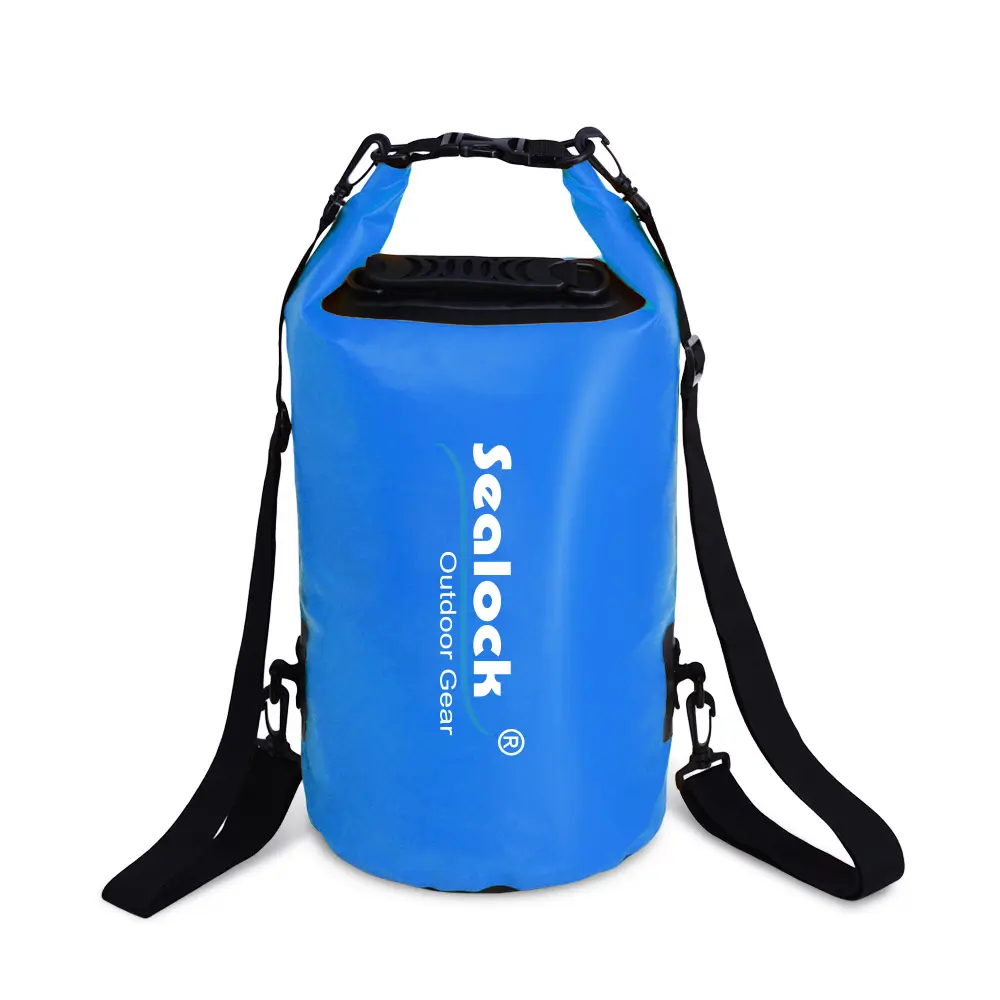
SL-D002 | Classic roll-top dry bag | 5, 10, 15, 20 and 63 litres | 500D PVC tarpaulin 0.5 mm, inner PVC sealing film, UTX buckles, IPX7 | Floats when properly sealed with air inside |
|
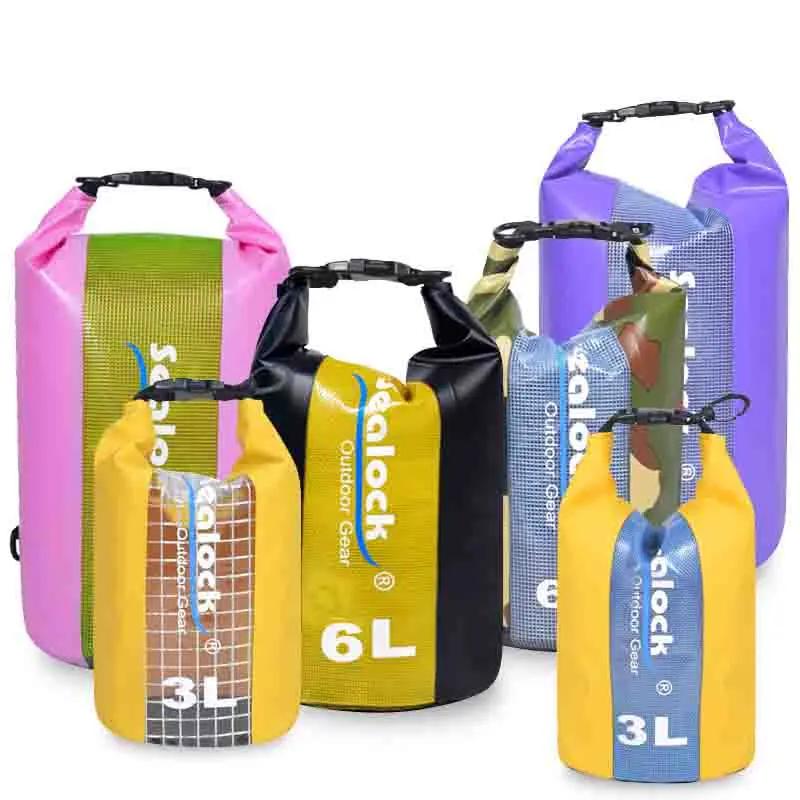
Clear Window Dry Bag | Small roll-top bag with transparent front window | 3, 6 and 10 litres, 190 to 300 grams | PVC with high-frequency welded seams, quick-release strap | Large air margin for phones, keys and wallets |
|
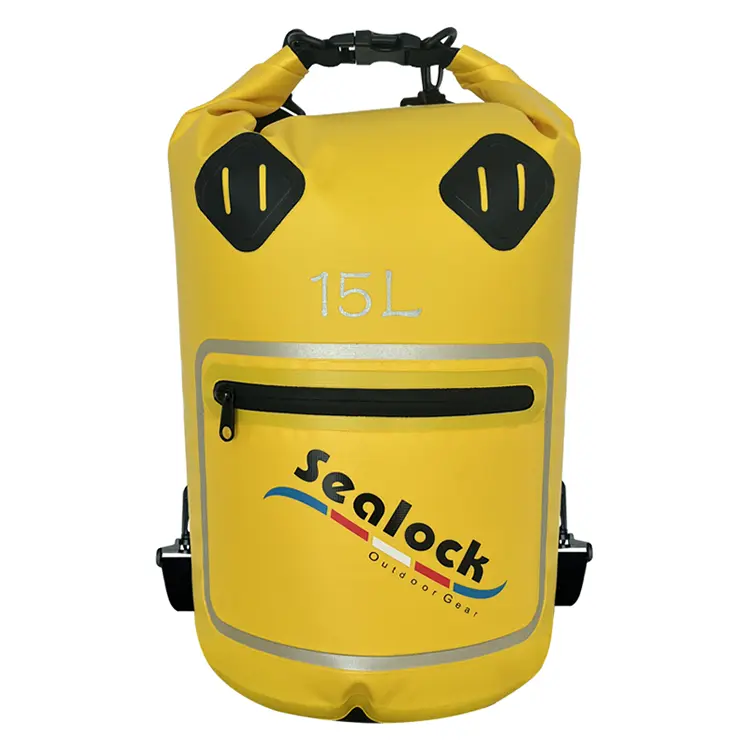
SL-D693 | Window dry bag with dry-wet separation | 15 and 20 litres | 500D PVC tarpaulin, IPX7, yellow or black | Floating capability confirmed on the product specification |
|
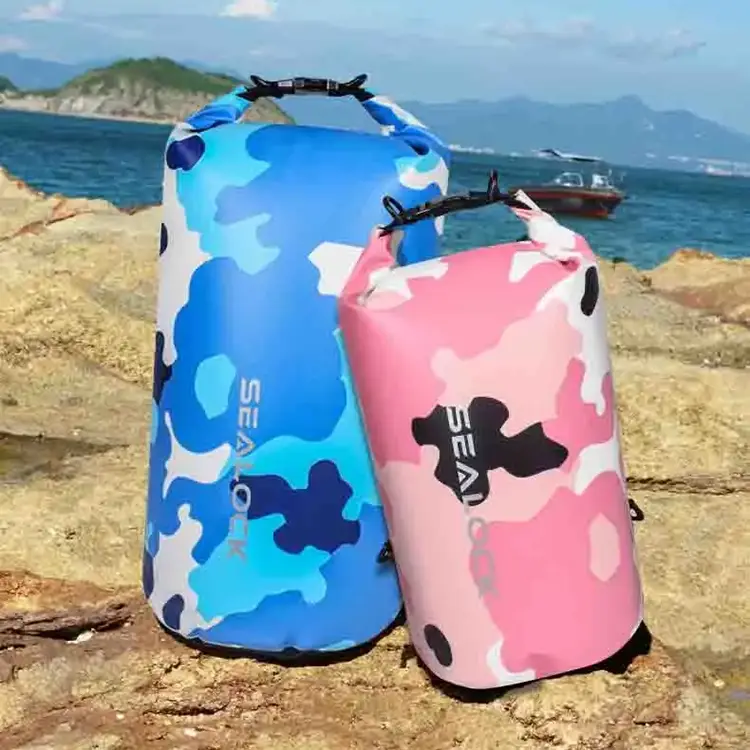
Dry-Wet Separation Dry Bag | Roll-top dry bag with removable inner pouch | 10 and 20 litres | Eco-friendly PVC, inner sealing film, IPX7 | Floats when properly sealed with air inside |

|
SL-E978 | Roll-top dry backpack with window | 38 litres, 0.58 kg | Welded 500D PVC tarpaulin 0.5 mm, three-roll closure with inner sealing strip, IPX7 | Inflate and purge valve for packing tight and floating on the water |
Standard Terms
The MOQ is 300 pieces per design. Printed samples take 7 to 15 days. Bulk production on the SL-D002 runs about 20 days for up to 500 pieces, 25 days up to 2,500 and 30 days up to 5,000, and 30 to 45 days on other models. Prices are quoted FOB Guangdong for China origin, with Vietnam origin quoted on request. Sealock has over 20 years of manufacturing experience, and marine and water sports brands we have produced for include West Marine, Helly Hansen and Musto. Floating dry bags can ship in the same container as waterproof waist packs, phone pouches and backpacks for a complete water sports range.
Frequently Asked Questions
Why did a dry bag sold as floating sink?
Usually because the contents were heavier than the bag's enclosed volume could support, or because the user pushed out all the air before rolling the top. Stating a tested load and printing a leave-some-air instruction on the bag prevents most of these cases.
How many times should the top be rolled?
At least three tight rolls before the buckle is closed. Fewer rolls can let water seep in, and the bag then takes on weight and loses buoyancy.
Will a floating dry bag keep floating if it is punctured?
An air-only bag will gradually lose buoyancy through a puncture. A bag with a closed-cell foam insert keeps a fixed amount of lift even when damaged, which is why we recommend foam for rental and guided-tour fleets.
Can a floating dry bag be used as a buoyancy aid?
No. It is designed to keep gear on the surface, not a person, and it carries no flotation device approval. Always wear an approved buoyancy aid or lifejacket on the water.
Why does a new PVC dry bag smell?
A mild odour straight out of a sealed carton is normal and fades after a day or two of airing. Phthalate-free PVC or TPU reduces it.
Can you make the bag in fluorescent colours?
Yes. Fluorescent yellow, orange and green are available as custom Pantone colours, and reflective print can be added for low-light visibility.
Request a Quote for Floating Dry Bags
Send us the model or your design, the quantity, the colour, the load the bag needs to float with, your logo file and your destination market, and we will reply within 24 hours with an FOB price, a buoyancy recommendation and a sample timeline. For United States orders, ask for China and Vietnam origin side by side. Contact Sealock about floating dry bags, or email info@sealock.com.hk.