
- English
- Español
- Português
- русский
- Français
- 日本語
- Deutsch
- tiếng Việt
- Italiano
- Nederlands
- ภาษาไทย
- Polski
- 한국어
- Svenska
- magyar
- Malay
- বাংলা ভাষার
- Dansk
- Suomi
- हिन्दी
- Pilipino
- Türkçe
- Gaeilge
- العربية
- Indonesia
- Norsk
- تمل
- český
- ελληνικά
- український
- Javanese
- فارسی
- தமிழ்
- తెలుగు
- नेपाली
- Burmese
- български
- ລາວ
- Latine
- Қазақша
- Euskal
- Azərbaycan
- Slovenský jazyk
- Македонски
- Lietuvos
- Eesti Keel
- Română
- Slovenski
- मराठी
- Srpski језик

EDC Backpack: What an Everyday Carry Pack Really Needs, and Why the Weather Is the Spec Most People Forget
An EDC backpack is an everyday carry pack: the bag you take out every working day, holding a laptop, charger, keys, wallet, water, a light layer and the handful of tools that suit your routine. Most good EDC backpacks hold 18 to 25 litres, stand 45 to 50 cm tall, keep their organisation close to hand and are built from abrasion-resistant fabric such as 500D nylon, Cordura, X-Pac or TPU-laminated fabric. This guide covers the size, layout, materials and closures that separate a pack you will still use in three years from one that sags, frays or soaks through, with measured examples from the waterproof EDC backpacks we make.
Most EDC buying advice concentrates on pockets. Pockets matter, but the things that actually end an EDC pack's life are wear at the base and corners, a zipper that gives out, and the first proper rainstorm that reaches a laptop. Those are construction questions, and they are where this guide spends most of its time.
What Makes an EDC Backpack Different from a Regular Backpack?
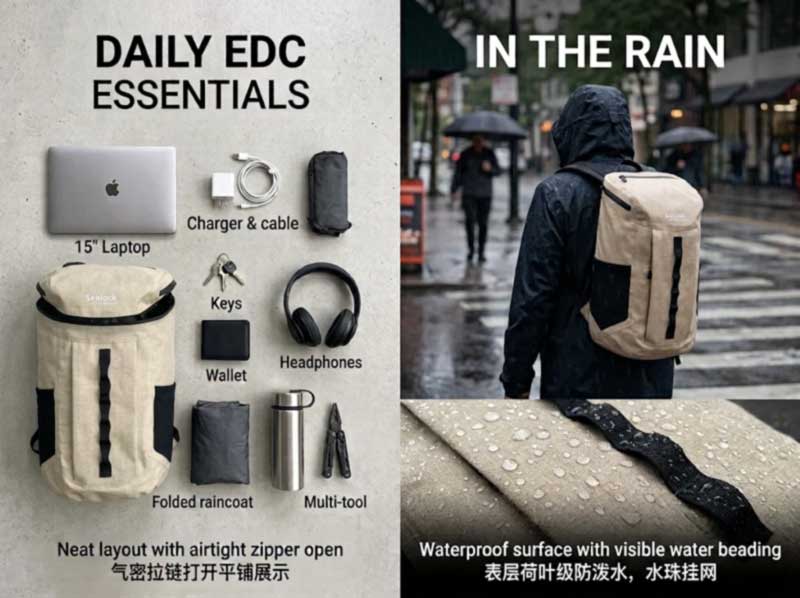
A regular backpack is built to carry a load from A to B. An EDC backpack is built for repetition: it is opened twenty times a day, put down on wet pavements and café floors, and carried every day of the year. That changes the priorities. Quick access matters more than total volume, so the things you reach for most need their own pocket that opens without unpacking the bag. The laptop needs a suspended, padded sleeve that keeps it off the ground when the pack is set down. The shape needs to stay neat when half-empty, because most days it is. And the materials need to cope with daily abrasion and weather year-round rather than a few weekends.
EDC packs also tend towards a low-profile, "grey man" look: plain colours, minimal branding and no tactical webbing, so they look as natural in an office as on a trail. At the other end, tactical-leaning EDC packs add MOLLE panels and external lash points for modular pouches. Both are valid; the choice depends on where the pack spends its days.
What Size Should an EDC Backpack Be?
For most people, 20 to 25 litres is the right size. It holds a 15 or 16 inch laptop, a charger and cables, a lunch, a water bottle and a light jacket without looking bulky on the train. Under 20 litres suits a minimal office carry with a slim laptop, and our 16 litre SL-E1176 is only 12 cm deep for that reason. From 25 to 30 litres a pack starts to double as a gym bag or an overnight bag, and a clamshell layout like our 30 litre SL-E724 lets it work as a one-bag travel pack too. Above 30 litres it is no longer really an everyday carry.
The depth matters more than the litre figure. Between about 15 and 25 litres, a backpack's height barely changes, because it is set by the length of the wearer's back and the laptop it must hold; the extra volume comes from depth. A shallow pack sits closer to the back, carries better and looks smaller. Our article on standard backpack sizes sets out the measured dimensions in detail.
Which Materials and Closures Last for Everyday Carry?
Abrasion is the first test. The base and lower corners of an EDC pack are dragged across concrete, car boots and floors every day. High-denier nylon such as 500D Cordura, laminated sailcloth fabrics such as X-Pac, and TPU-laminated nylon all handle this well. TPU and PVC tarpaulin have an extra advantage: their coating is the waterproof layer itself, so wear does not open a path for water the way a worn PU coating on the inside of a cheaper fabric eventually does.
Water is the second. A "water-resistant" EDC pack, sewn from coated fabric with a laminated zipper, sheds light rain and splashes and is fine for a short walk. But every sewn seam has needle holes, and over months of daily use, rain at the seams and zippers is what eventually reaches the laptop sleeve. A pack with high-frequency welded seams has no needle holes in its shell. Paired with a waterproof zipper it keeps out heavy rain, rated IPX6, and with an airtight zipper it survives being dropped in water, rated IPX7. For anyone who cycles, walks or rides a scooter to work in a wet climate, that difference matters more than any pocket. What the ratings mean is explained in our guide to waterproof ratings for bags.
The zipper is the third. It is the part that moves most, and on an EDC pack it can see thousands of cycles a year. Branded zippers with metal sliders on the main compartment, a gentle curve rather than a sharp corner in the zipper path, and a rain flap or a laminated tape all extend its life. Our article on broken backpack zippers explains why zippers fail and how to prevent it.
Waterproof EDC Backpacks We Manufacture
The table below shows the backpacks in our range that are built for everyday carry, from a slim sewn office pack to submersible airtight-zipper packs, plus an EDC sling for lighter days.
| Image | Model | Capacity | Dimensions (H × W × D) | Weight | Construction | Use |
|---|---|---|---|---|---|---|
|
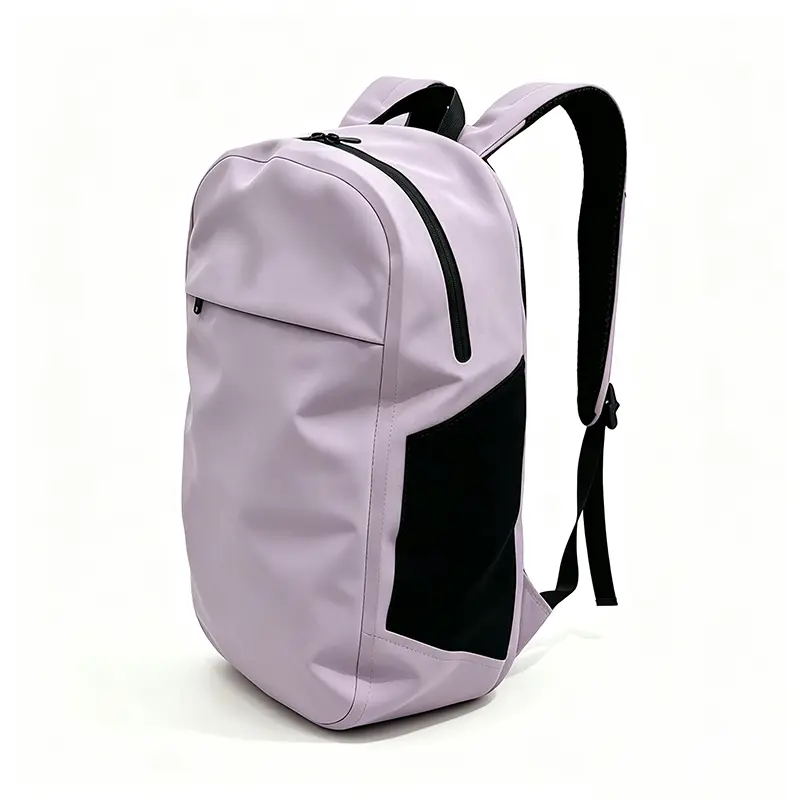
SL-E1176 | 16 L |
47 × 28 × 12 cm 18.5 × 11 × 4.7 in |
0.65 kg | Sewn PU-coated polyester, laminated YKK dual-slider zipper, 15.6 in laptop, rain and splash resistant | Compact office EDC, only 12 cm deep |
|
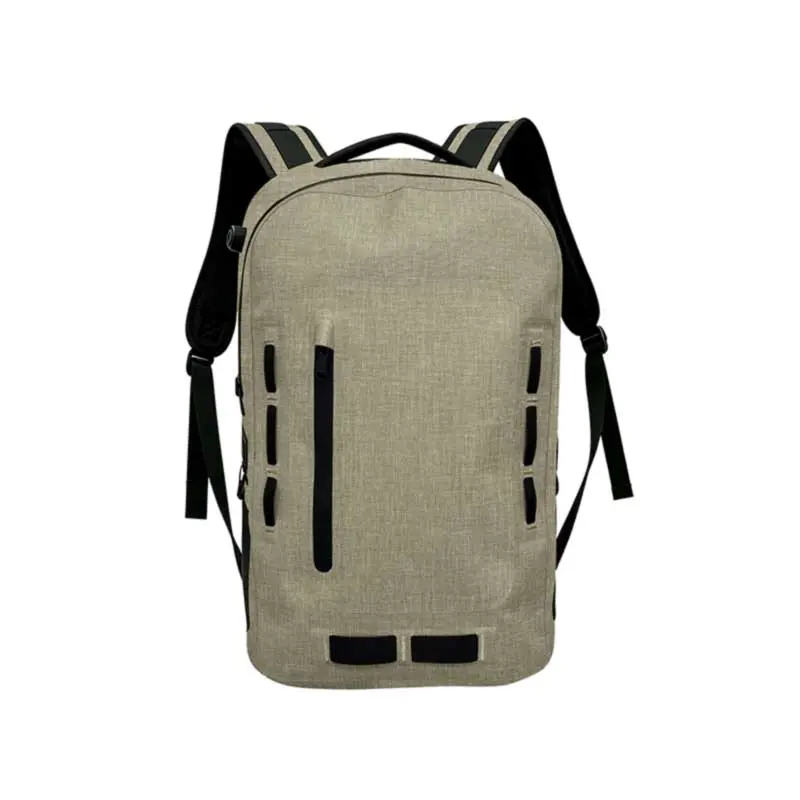
SL-E1313 | 22 L |
50 × 30.5 × 14.5 cm 19.7 × 12 × 5.7 in |
0.85 kg | Welded 500D TPU, clamshell waterproof zipper, pressure-relief valve, 16 in laptop, IPX6 | Laptop-first EDC for rainy commutes |

|
SL-E641 | 24 L |
54 × 27.5 × 16.5 cm 21.3 × 10.8 × 6.5 in |
1.0 kg | Welded TPU, single-slider airtight zipper, IPX7 | Minimal grey-man EDC that survives a downpour or a dunking |

|
SL-E698 | 25 L |
54 × 27.5 × 16.5 cm 21.3 × 10.8 × 6.5 in |
1.05 kg | Welded TPU, dual-slider airtight zipper with glove-friendly pull, external webbing, IPX7 | Outdoor and tactical-leaning EDC |
|
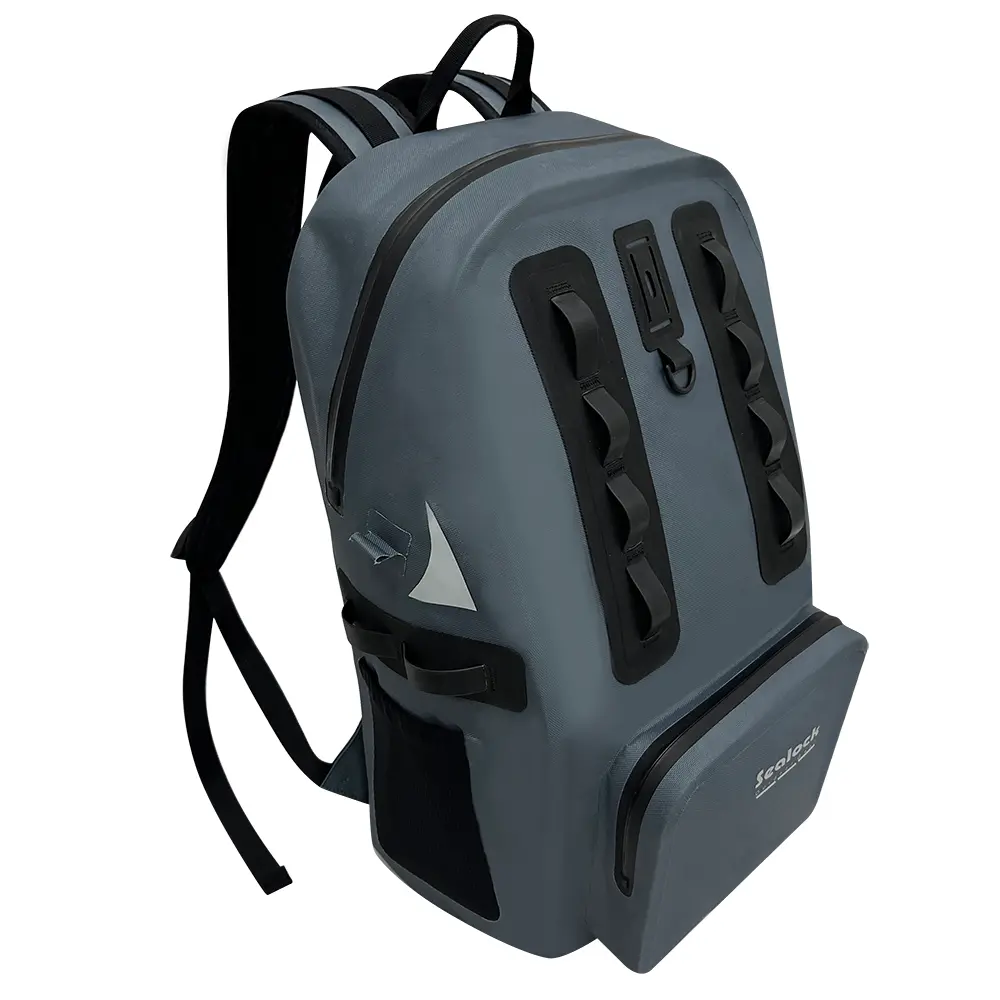
SL-E1145 | 25 L |
49 × 29 × 13 cm 19.3 × 11.4 × 5.1 in |
1.05 kg | Welded 600D TPU, waterproof zippers, MOLLE-compatible front panel, IPX6 | Modular EDC with add-on pouches |
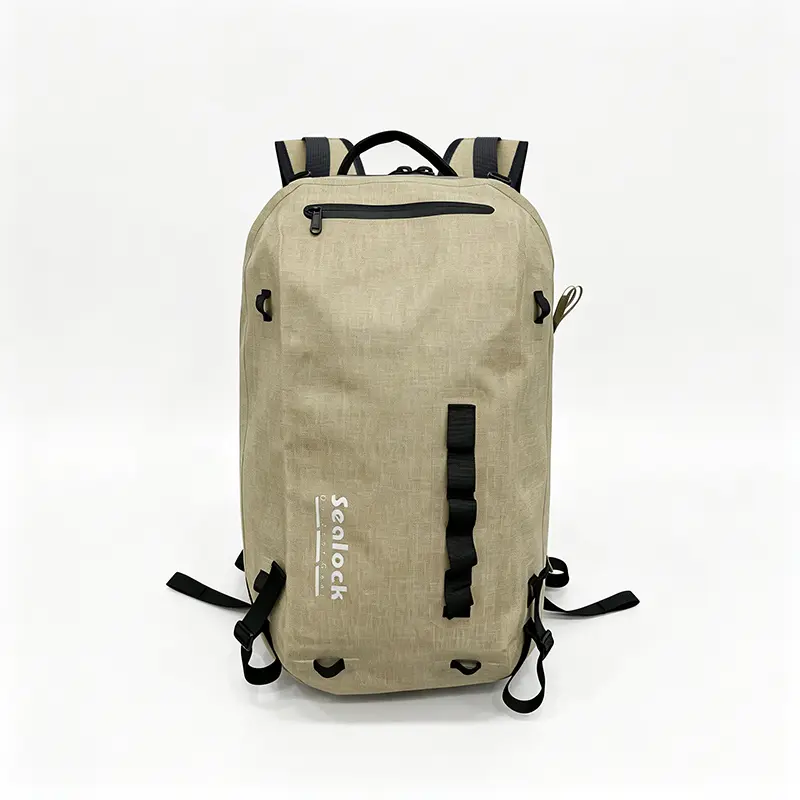
|
SL-E724 | 30 L |
52 × 27 × 22 cm 20.5 × 10.6 × 8.7 in |
1.0 kg | Welded TPU ripstop, 180° clamshell YKK waterproof zipper, Velcro module anchors, IPX6 | EDC that doubles as a one-bag travel pack |
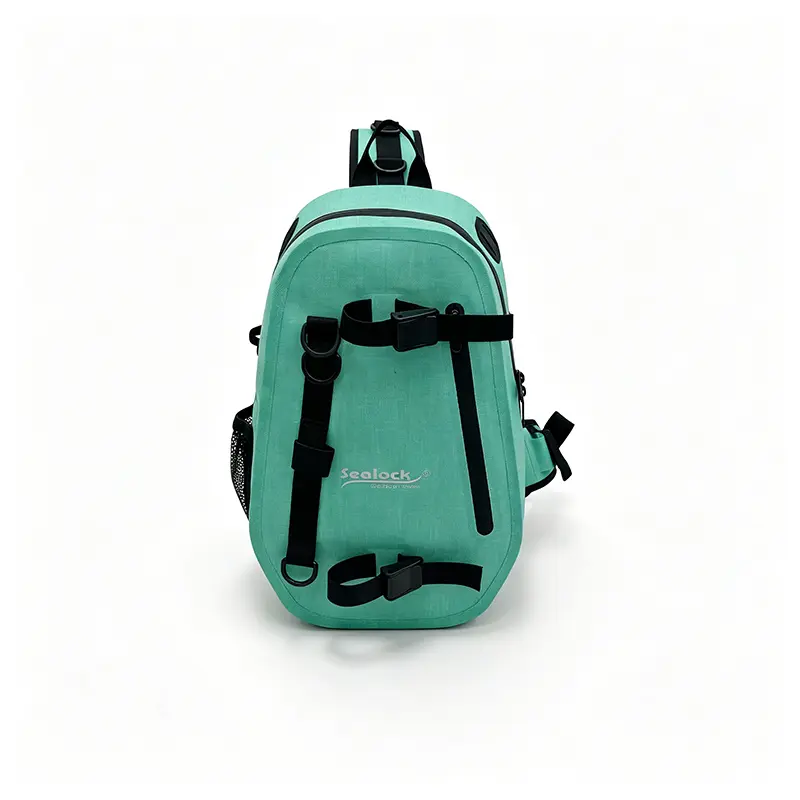
|
SL-E1314 | 8 L |
37.5 × 25 × 12.5 cm 14.8 × 9.8 × 4.9 in |
0.65 kg | Welded TPU-coated polyester, YKK waterproof zippers, tool docks, IPX6 | EDC sling for days without a laptop |
The full range is in our waterproof backpack category, and our waterproof laptop backpack article covers the commuter side in more depth.
What Should Brands Specify When Developing an EDC Backpack?
EDC is one of the most competitive backpack categories, and buyers in it read specifications closely. The details that tend to win reviews are a suspended laptop sleeve sized for the largest common laptop, a quick-access top or front pocket for keys and earbuds, a luggage pass-through for travel, and a shape that stays upright when set down. The details that cause returns are a base that frays, a zipper that fails within the year and a "water-resistant" claim that does not survive the first heavy rain.
Construction is where a manufacturer can make the biggest difference. We build EDC packs both sewn, for a soft, fabric-led look, and welded, for packs that must be genuinely waterproof, and most of our platforms can be scaled: the SL-E1176 from 12 to 22 litres, the SL-E1313 from 18 to 30 litres and the SL-E724 from 22 to 40 litres, so a brand can offer a family of sizes from one tooled design. Options include recycled fabrics, custom colours, USB pass-through ports on sewn models, MOLLE panels, reflective trims and branded zipper pulls. Logos can be embroidered, woven, printed or applied as welded or silicone badges. The MOQ is 300 pieces per design, samples take 7 to 15 days and bulk production 30 to 45 days, quoted FOB Guangdong with Vietnam origin available. Sealock has over 20 years of experience making backpacks for outdoor and lifestyle brands.
Frequently Asked Questions
What size is best for an EDC backpack?
20 to 25 litres suits most people, enough for a 15 or 16 inch laptop and a day's essentials. Go smaller for a minimal office carry, or towards 30 litres if the pack also carries gym kit or doubles as a travel bag.
Is a water-resistant EDC backpack enough?
For short walks in light rain, usually yes. For cycling or long walks in heavy rain, sewn seams and zippers eventually let water in. A welded pack with a waterproof or airtight zipper keeps a laptop dry in any weather.
Why does the bottom of my backpack wear through first?
The base takes daily abrasion from being set down. Look for a heavier base fabric or a TPU or PVC-laminated base, which resists wear and stays waterproof even when scuffed.
Can an EDC backpack be used for travel?
Yes, particularly 25 to 30 litre packs with a clamshell opening and a luggage pass-through. Check the airline's cabin size limits before you fly.
What is a grey man EDC backpack?
A low-profile pack in plain colours with minimal branding and no tactical webbing, designed not to stand out in a city or an office.
Should an EDC backpack have a hip belt?
Rarely. Most EDC loads are light enough for shoulder straps and a sternum strap. Hip belts become useful above about 30 litres or for heavy loads.
Request a Quote
Tell us the capacity, laptop size, construction, colours and quantity you need, and we will reply within 24 hours with suitable base models, an FOB price and a sample timeline. Contact Sealock, or email info@sealock.com.hk.