

Waterproof Backpack Manufacturer for OEM and Private Label Projects
Sealock is a waterproof backpack manufacturer producing OEM and private label packs for outdoor brands, importers, and retail programmes. Sourcing a waterproof backpack is a harder brief than sourcing a dry bag, because the supplier has to be good at two different disciplines at once — waterproof construction and backpack ergonomics. Plenty of factories have one and not the other, and the result is a pack that stays dry but hurts to carry, or one that carries beautifully and leaks at the zip. This is what to look for, and where the engineering decisions actually sit.
1. The Seven Core Processes Behind a Waterproof Backpack
A waterproof backpack's performance is not delivered by one clever feature — it is the sum of seven distinct processes, each contributing a different share of the final waterproof integrity. Understanding which process carries the most weight is what lets a buyer specify and inspect intelligently rather than trusting a single "100% waterproof" claim. Ranked by their impact on waterproof performance:
1.1 RF High-Frequency Seamless Welding — critical
This is the single most decisive process. Radio-frequency welding at 27.12 MHz generates heat inside the material and fuses the coated layers into one continuous skin with no needle penetration. It is what determines whether the pack is genuinely needle-hole-free and leak-proof, or merely water-resistant. A stitched-and-taped seam has thousands of micro-perforations and relies on tape that lifts with age and flexing; a welded seam has no holes to cover. If this process is wrong, nothing downstream saves the bag.
1.2 TPU / PVC Composite Fabric — critical
Equally fundamental, because the material decides whether the bag can be waterproof and weldable at all. TPU-laminated nylon and PVC tarpaulin are both inherently impermeable and, critically, both are RF-weldable — non-polar fabrics like untreated polyethylene cannot be welded this way. The fabric choice sets the waterproof ceiling and the entire construction method that follows. Denier and coating are specified against weight, cold flexibility, and abrasion, but the baseline requirement is a coated, weldable, impermeable composite.
1.3 Sealing Structure — high
The closure is where a well-built body most often leaks in real use. A roll-top's fold-over collar, an inner sealing membrane, or a rated closure system determines how well the opening actually holds water out — the body can be perfect and the pack still leaks if the closure structure is poorly engineered. A stiffening strip that keeps the fold flat, or a patented inner membrane that presses into a second seal, is what turns a theoretical seal into a reliable one.
1.4 Waterproof Zipper (e.g. AquaSeal) — high
Where a design needs zippered access rather than a roll-top, the waterproof zipper becomes a core process in its own right. A rated airtight zipper — YKK AquaSeal or an equivalent — provides a submersible seal in a form that opens fast and clean, but it must be welded into the panel correctly and specified to the right rating (IPX7 immersion, IPX8 continuous). An unrated or badly seated zipper is one of the most common leak points on an otherwise waterproof pack.
1.5 Die and Welding Parameters — high
Welding is only as consistent as its tooling and settings. A custom die defines the exact seam geometry, and the four welding parameters — RF power, dwell time, pressure, and cooling time — determine weld strength and, just as importantly, consistency across thousands of units. The same material welds differently as colour, thickness, or plasticizer content changes, so parameters are re-qualified at run start rather than assumed. This process is what separates a factory that welds reliably at volume from one whose seams vary bag to bag.
1.6 Bag Structural Design — high
The pack's structure has to balance load-bearing, waterproofing, and durability simultaneously. Strap anchors, base panels, and stress points must carry a loaded pack without tearing — yet on a waterproof body they cannot be sewn through the membrane, so they are pre-assembled onto panels or welded onto reinforcement patches. Good structural design distributes force to where the construction can take it, which is what stops a pack failing at the anchor points long before the fabric wears. This is also where backpack ergonomics — harness geometry, back panel, load transfer — is engineered in.
1.7 Finished-Product Quality Inspection — moderate
The final process verifies that the previous six delivered. It does not add waterproofing, but it confirms the pack meets the design requirement and catches the units that do not — through immersion testing, weld peel tests, load cycling, and dimensional and closure checks against a signed reference. Its impact on any single bag's waterproofing is indirect, but across a production run it is what keeps defects from reaching the customer.
The pattern is worth noting: the two processes that most determine waterproofing — welding and material — are decided before the pack is even assembled, while the carry system and inspection come later. A manufacturer has to be strong across all seven, because a five-star weld on the wrong fabric, or a perfect body with a poorly sealed zipper, still produces a bag that fails.
2. Why a Backpack Is Not Just a Dry Bag With Straps
A dry bag is a sealed container. A backpack is a sealed container that a person wears loaded, for hours, against their back. That second requirement introduces an entire set of engineering problems the dry bag never has: load transfer, shoulder strap geometry, back panel ventilation, torso fit, and access to contents without breaking the seal.
It also creates a genuine design tension. The most waterproof pack construction — a fully welded body, roll-top closure, no exterior pockets — sacrifices exterior access, ventilation, and some ergonomics for watertight integrity. Every waterproof backpack is a negotiated position between those two poles, and the right position depends entirely on what the pack is for. A manufacturer that understands this will ask what the pack is used for before quoting; one that does not will simply add straps to a dry bag.
3. Where Waterproof Backpacks Actually Fail
Evaluating a manufacturer is easier when you know the failure modes. Waterproof packs fail in seven recognisable ways:
- Weak welded seams — the waterproofing fails at the seam before the fabric shows any wear.
- Poorly designed shoulder straps — wrong angle, wrong width, or thin webbing that digs in under load.
- Uncomfortable back panels — no ventilation against a non-breathing shell, or padding that bottoms out.
- Stiff roll-top closures — a collar too rigid to fold cleanly, so users under-roll it and it leaks.
- Leaking zipper pockets — an unrated zipper or an unsealed pocket seam undermines an otherwise waterproof body.
- Unstable logo printing — print that cracks or peels after a season of flexing and UV.
- Wrong material for the use — a fabric chosen on price rather than on the abrasion, weight, and cold performance the application needs.
Notice how many of those are carry-system and finishing problems rather than waterproofing problems. That is the point: waterproof capability alone does not make a good backpack manufacturer.
4. The Carry System: Where Most Cost and Comfort Decisions Live
The harness is where an OEM backpack project is won or lost, and it is the part most buyers under-specify:
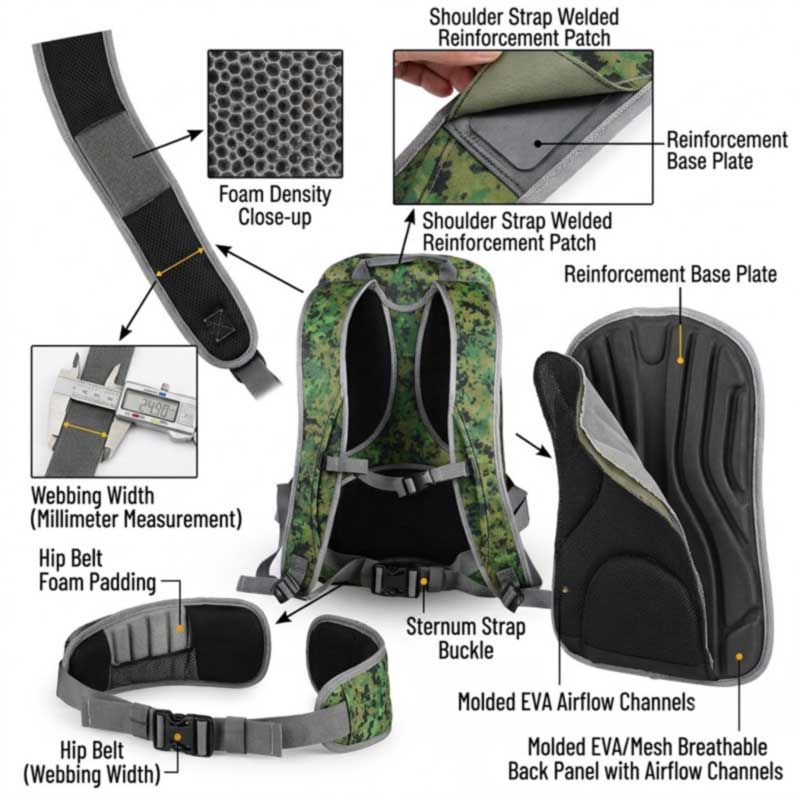
- Shoulder straps. Contoured S-shape straps follow the body better than straight cut, and width and padding should be specified to the load the pack carries. Strap foam density matters more than thickness — cheap foam compresses within a season and stops cushioning, which is a warranty issue disguised as a comfort complaint.
- Back panel. A sealed waterproof shell does not breathe, so airflow has to be engineered in. Moulded EVA panels with airflow channels, or a breathable mesh panel over padding, reduce heat and sweat build-up on a pack that cannot vent through the fabric.
- Load transfer. A sternum strap stabilises the load; a hip belt transfers weight from shoulders to hips. Above roughly 30–35L this stops being a nice-to-have — at 40L and above, back system design matters as much as waterproof performance, because a heavy pack with poor hip transfer is physically difficult to carry over distance.
- Structural reinforcement. Reinforced strap anchors and a rigid or reinforced bottom panel keep the pack's shape when fully loaded and stop the anchor points tearing — the failure that generates warranty claims.
On a welded waterproof pack, all of these have to be attached without piercing the waterproof membrane, which is a manufacturing constraint as much as a design one: load-bearing components are pre-assembled onto panels or welded onto reinforcement patches rather than stitched through the sealed body.
5. Closure Architecture: Roll-Top, Zipper, or Both
The closure defines both the waterproof rating and the daily user experience:
|
|
Roll-top | Rated waterproof zipper | Hybrid |
|---|---|---|---|
| Waterproof ceiling | Highest — IPX7/IPX8 achievable | High when properly rated | Depends on the weakest element |
| Access | Slower; unroll to open | Fast, clean, one-handed | Fast front access, sealed main |
| Volume | Adjustable by fold count | Fixed | Partly adjustable |
| Durability | No parts to wear out | Seal degrades; grit is the enemy | Mixed |
| Best for | Water sports, expedition, high-exposure | Commuting, urban, frequent access | Travel and everyday outdoor |
Most commuter and urban programmes need the speed of a zipper; most water-sports and expedition programmes need the resilience of a roll-top. Adding an air-release valve to a roll-top pack lets users compress the load without unrolling — a small feature that materially improves how a sealed pack packs down. The trade-off between sealing performance and storage flexibility is worth settling early, because it drives the whole structure.
6. Material Selection for Packs Specifically
Backpack material choice differs from dry bag material choice because the pack is carried on the body, so weight and flexibility carry more weight in the decision:
- 420D TPU laminate — the balanced choice for packs: light, flexible in cold, low odour against the back, and abrasion-resistant enough for daily outdoor and commuter use.
- 210D TPU — for ultralight and packable programmes where every gram is scrutinised.
- 840D TPU — heavy-duty packs and expedition duty where abrasion is constant.
- 500D PVC tarpaulin — rugged, structured, cost-effective; suits value lines and packs that benefit from a body that holds its shape.
- Mixed builds — a lighter body with heavier base and side panels puts weight only where abrasion demands it.
Material also affects how the pack feels against the wearer, not just how it survives — a stiffer shell is less comfortable against the back than a supple one, which is a factor that does not exist on a dry bag. The full comparison of material choices against weight targets is worth reviewing before locking a specification.
7. Capacity Planning for a Backpack Line
Capacity bands map to distinct customers, and a coherent line covers bands rather than stacking similar sizes:
| Capacity | User and use | Structural priority |
|---|---|---|
| 15–25L | Everyday, commuting, day use — laptop, essentials, a change of clothes | Laptop protection, fast access, comfortable straps |
| 25–40L | Travel and multi-day hiking, serious day pack with camera and layers | Load stability, ventilation, hip belt |
| 40L+ | Extended trips and expeditions | Back system and weight become as critical as waterproofing |
8. Sealock Waterproof Backpack Range
Models across closure types, materials, and capacity bands, organized by type rather than priority:
| Image | Model | Capacity | Material | Closure / rating | Product Page |
|---|---|---|---|---|---|
|
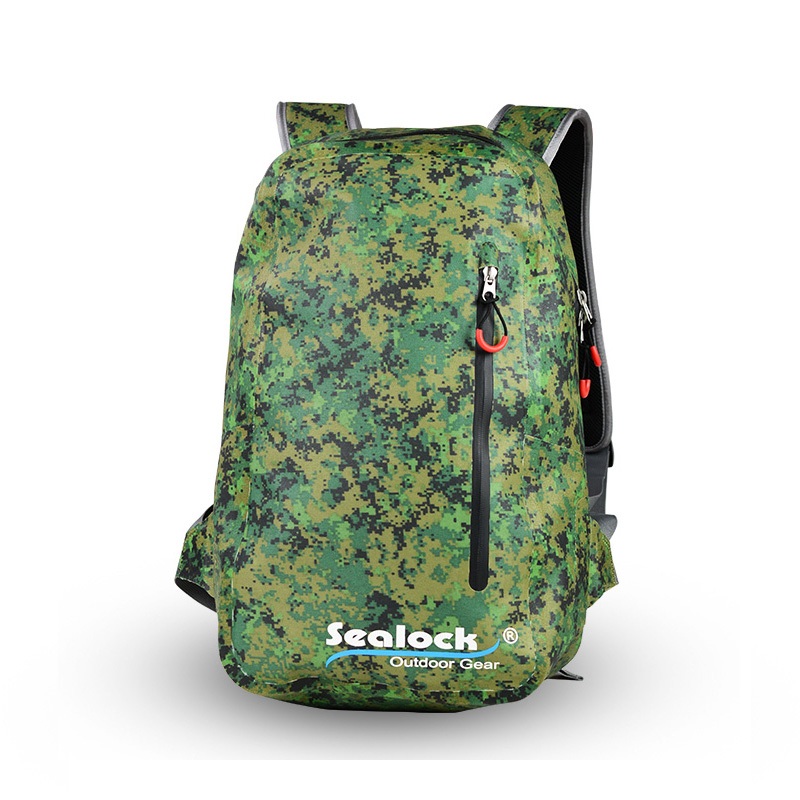
SL-E061 | 15L | 420D TPU | Airtight zipper · IPX6 | View |
|
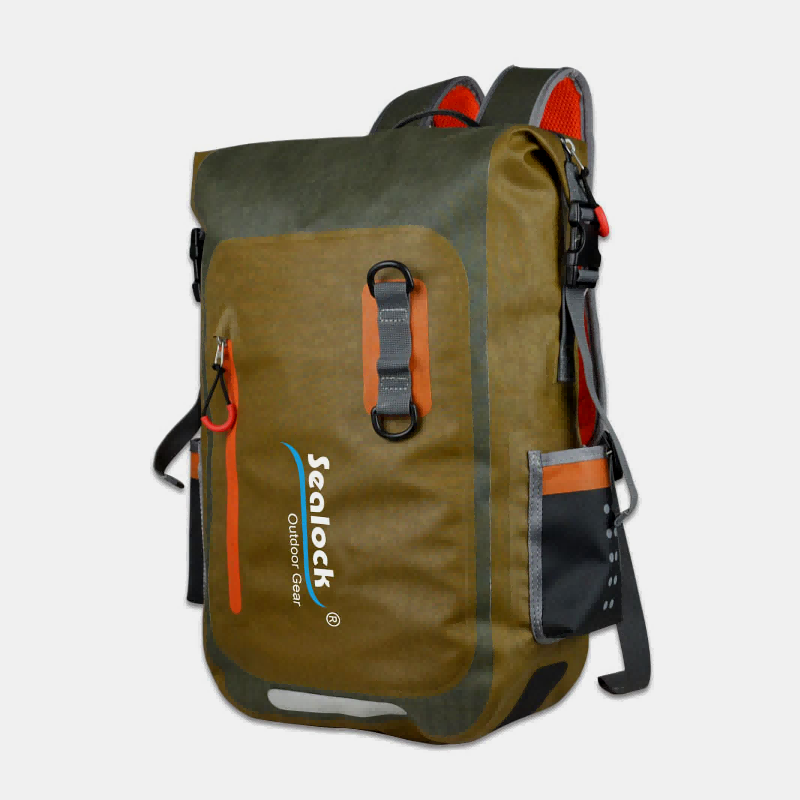
SL-E029 | 20L | 500D PVC | Roll-top · IPX6 · laptop sleeve | View |
|
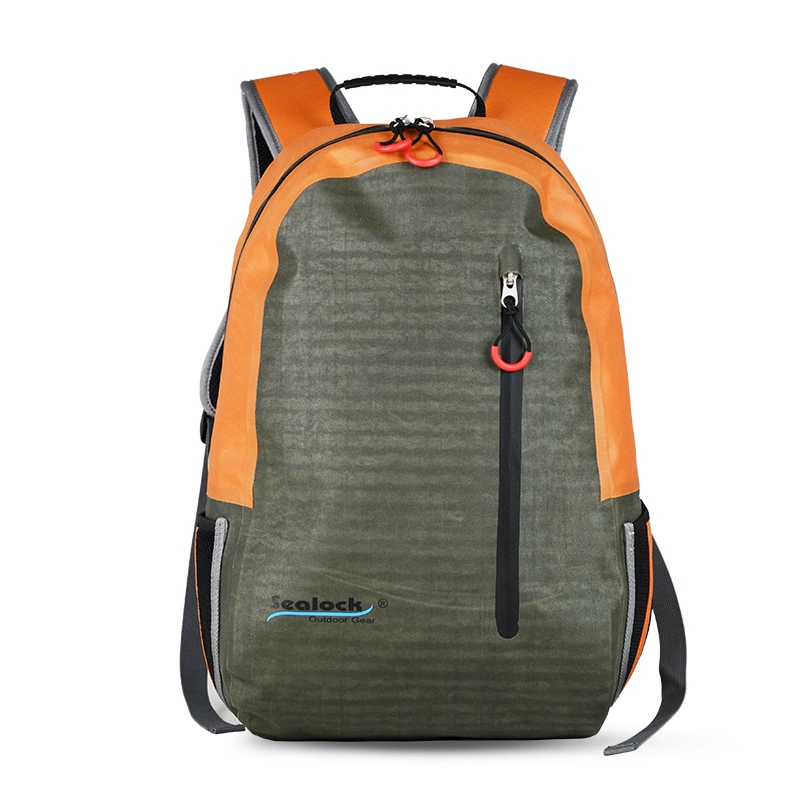
SL-E071 | 22L | 420D TPU | Waterproof zipper · IPX6 · 15.6" sleeve, mesh back panel | View |
|
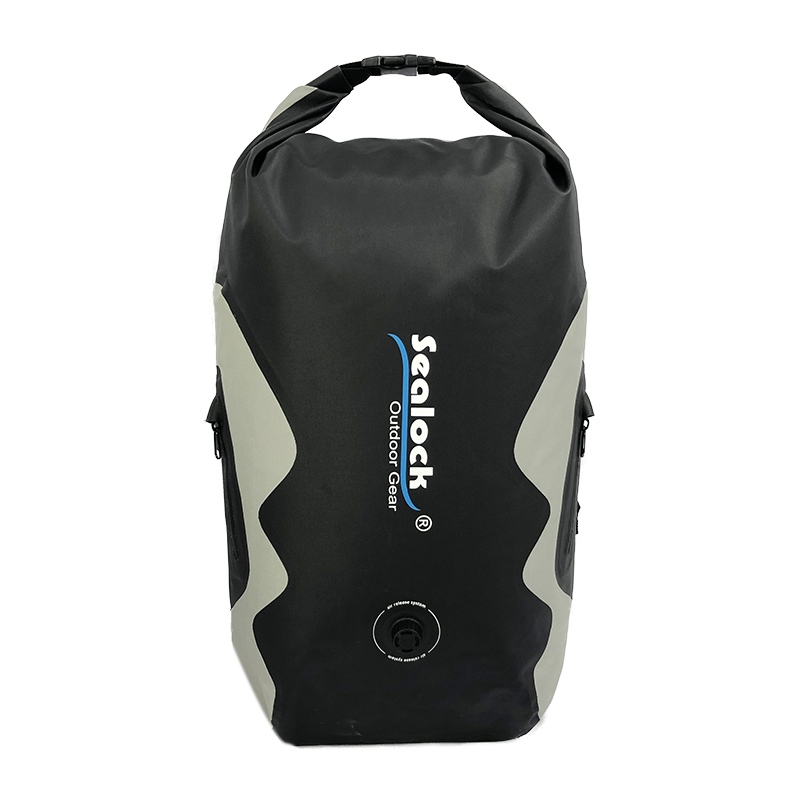
SL-E070 | 25L | 420D TPU | Roll-top · IPX8 · purge valve, reflective | View |
|
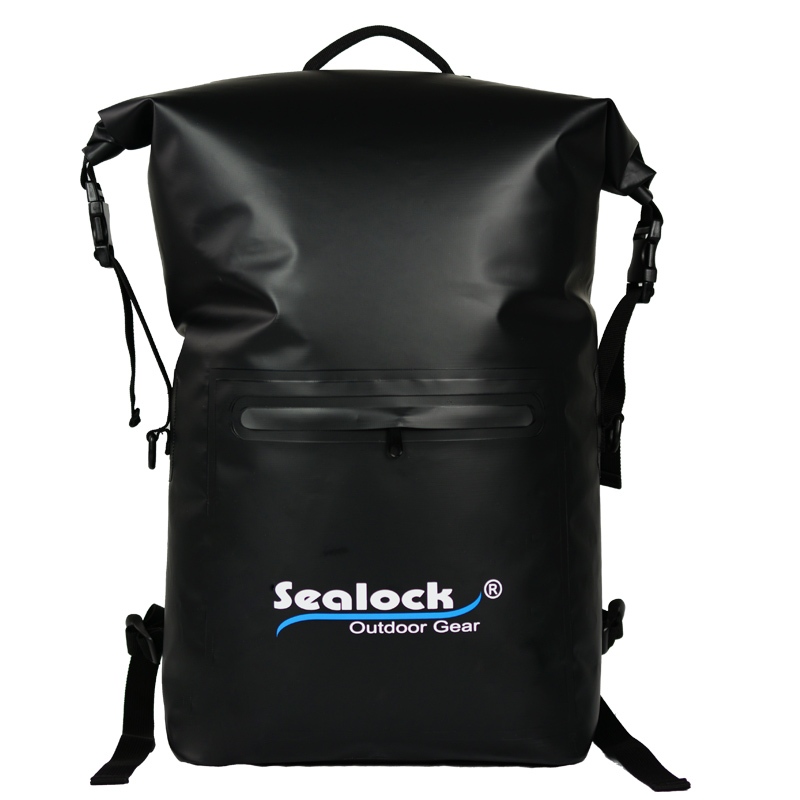
SL-E036 | 30L | 500D PVC | Roll-top · IPX6 | View |
|
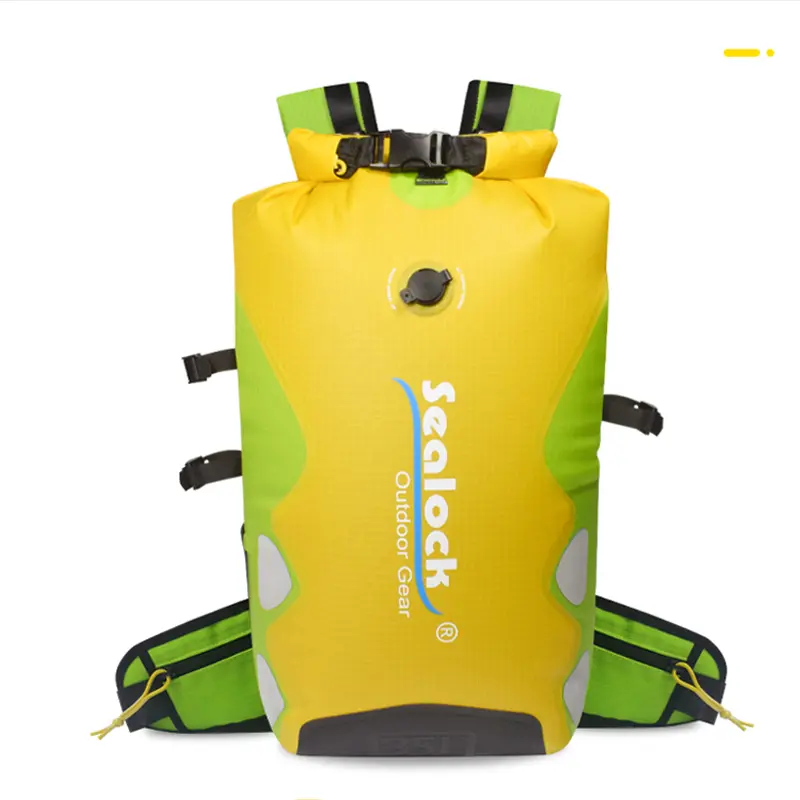
SL-E801 | 35L | 420D TPU | Roll-top · IPX7 · air valve, ergonomic harness | View |
|
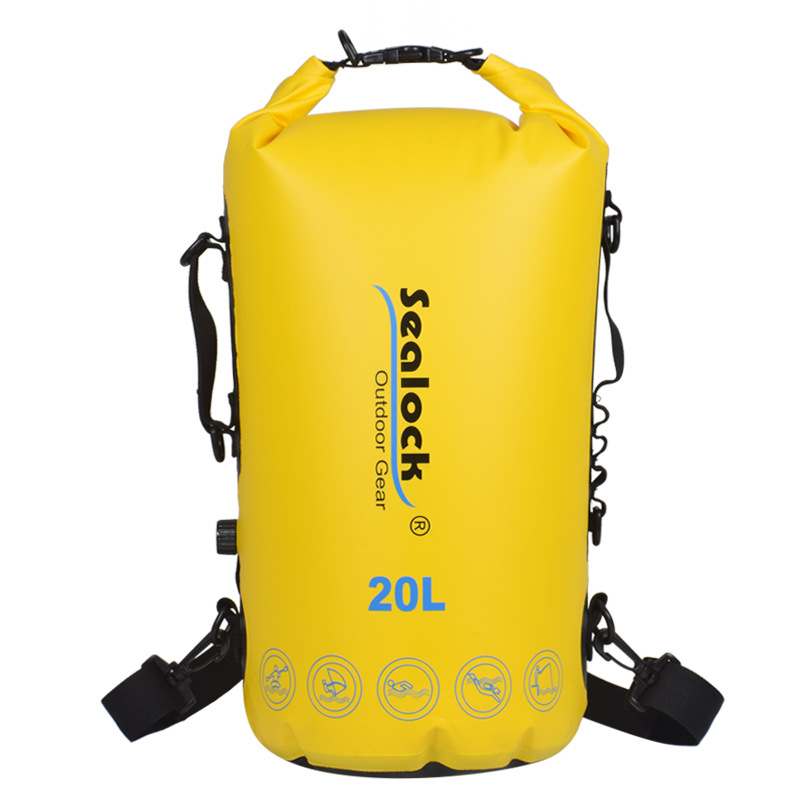
SL-E102 | 15 / 20L | 500D PVC | Roll-top · IPX7 · patented dual seal | View |
|
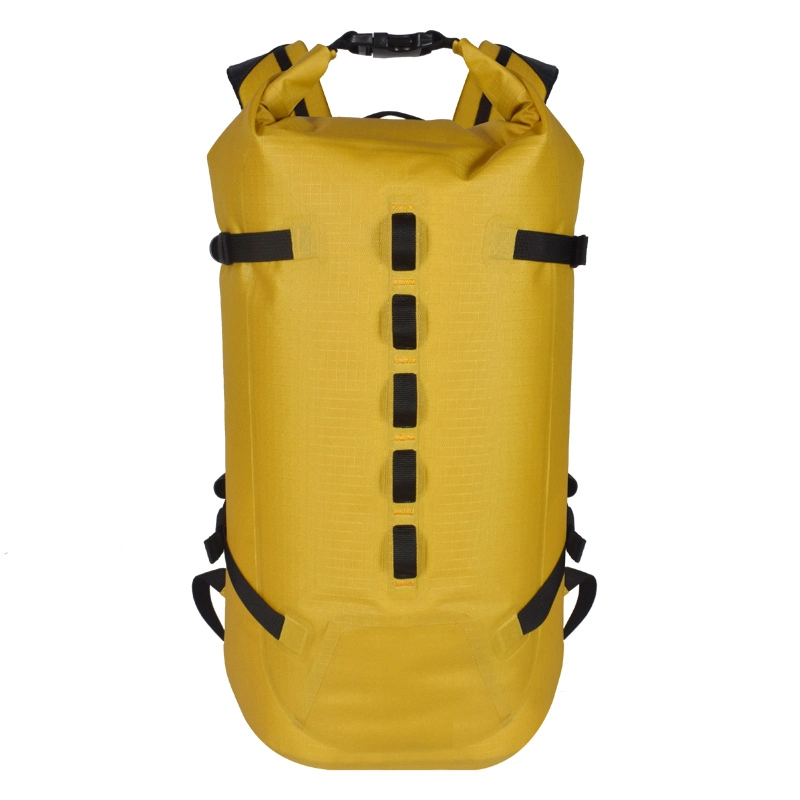
SL-E986 | 25L | 4-division TPU (~300g) | Roll-top · heavy-rain rated | View |
The line spans 15L to 65L across both closure architectures, in PVC and TPU, in commuter and expedition configurations — so a brand can build a coherent multi-model range under one logo and colourway rather than sourcing pieces from different factories. Full categories sit under dry backpacks, dry bags, and duffels.
9. OEM and Private Label Scope
Beyond logo and colour, an OEM backpack project can specify structure at every level: capacity and dimensions, closure architecture, harness geometry and padding density, back panel type, laptop and organiser layout, pocket configuration, zipper grade and placement, hardware, reflective detailing, and reinforcement. Ground-up development from a sketch, reference sample, or performance target is supported — the pack is engineered to the brief rather than assembled from a fixed platform.
Private label programmes that start from a proven construction move faster and cost less than ground-up development, then upgrade once the line proves out; the trade-offs are covered in the guide to private label programmes for outdoor brands, and the full development sequence in the OEM manufacturing process. Standard terms: MOQ 300 pcs per model, samples in 7–15 days, bulk in 30–45 days, FOB Guangdong, produced in Dongguan, China or Ho Chi Minh City, Vietnam.
10. Manufacturing and Quality Control
Bodies are welded at 27.12 MHz into seamless, needle-hole-free seams, with load-bearing components pre-assembled before sealing so the waterproof membrane is never pierced — the full sequence is set out in the manufacturing process from cutting to RF welding. Every batch runs three-stage control: IQC on incoming fabric, zippers, and hardware; IPQC on welds in line including peel tests at run start; and OQC with AQL sampling, batch immersion testing, and signed gold-sample comparison, with SGS or QIMA inspection available.
Backpack-specific testing matters here. Load cycling over 1,500 cycles targets strap anchors and handles — the components most likely to fail on a pack carried loaded — alongside 3,000 sealed-zipper cycles on zippered models, tensile and bonding strength, salt spray, friction resistance, colour fastness, and colour difference. The applicable standards and defect classification are covered in the quality control standards for waterproof production. Compliance is backed by ISO 9001, BSCI, SMETA, HIGG, GRS, and SCAN.
11. FAQ
Q: Can a factory that makes dry bags also make a good backpack?
A: Only if it has backpack structural development capability as well as welding capability. Ask to see existing backpack models with real harness systems, and ask how strap anchors are attached without piercing the waterproof body. A supplier that only shows dry bags with straps added is not a backpack manufacturer.
Q: Why do my waterproof packs get complaints about a sweaty back?
A: Because a sealed shell cannot breathe — no waterproof fabric will. The fix is structural: a moulded EVA panel with airflow channels or a mesh panel over padding to create space and airflow between the pack and the wearer. Specify it at sampling; it cannot be retrofitted.
Q: Customers say the straps went flat after a few months. Is that normal?
A: It is common but avoidable. Strap padding degrades faster than buyers expect when low-density foam is used — it compresses within a season and stops cushioning. Specify foam density rather than just thickness, and include strap padding in your inspection criteria.
Q: Roll-top or waterproof zipper for a commuter pack?
A: A zipper, in most cases. Commuters open a pack many times a day, and a roll-top's unrolling becomes friction. Reserve roll-top for water sports and expedition lines where exposure is higher and access is less frequent — or use a hybrid with a sealed main compartment and a zipped front pocket.
Q: My pack is waterproof but the front pocket leaks — why?
A: Because an exterior pocket is a hole in an otherwise sealed body unless it is separately sealed with a rated zipper and welded seams. Either specify the pocket as water-resistant only and label it accordingly, or pay for a rated zipper and sealed pocket construction. Ambiguity here generates returns.
Q: What should I send to get an accurate backpack quote?
A: Target capacity and dimensions, intended use and market, closure preference, material or weight target, harness requirements (hip belt, panel type), laptop and pocket layout, logo method, colourway, packaging, target quantity, and launch date. A reference sample or sketch shortens sampling considerably.
Request a Backpack OEM Proposal
For structural development, samples, harness specification, or a full OEM/private label proposal, submit an inquiry. Sealock responds to procurement enquiries within 24 hours.