
- English
- Español
- Português
- русский
- Français
- 日本語
- Deutsch
- tiếng Việt
- Italiano
- Nederlands
- ภาษาไทย
- Polski
- 한국어
- Svenska
- magyar
- Malay
- বাংলা ভাষার
- Dansk
- Suomi
- हिन्दी
- Pilipino
- Türkçe
- Gaeilge
- العربية
- Indonesia
- Norsk
- تمل
- český
- ελληνικά
- український
- Javanese
- فارسی
- தமிழ்
- తెలుగు
- नेपाली
- Burmese
- български
- ລາວ
- Latine
- Қазақша
- Euskal
- Azərbaycan
- Slovenský jazyk
- Македонски
- Lietuvos
- Eesti Keel
- Română
- Slovenski
- मराठी
- Srpski језик

Lightweight Waterproof Backpack: Material Choices and Weight Considerations
Sealock manufactures the lightweight waterproof backpack for wholesale and OEM buyers worldwide, and the brief is harder than it sounds: a pack has to keep water out and stay light enough to carry all day. Those two goals pull against each other, because the materials that seal best are often the heaviest. The sections below break down the material options, where the grams actually hide, and what gear testers report after real days on the trail — so a buyer can specify the right balance for a given product line.
1. Company Overview
Sealock (YiFuLong Outdoor Gear Co., Ltd.) has designed and produced welded waterproof bags for over 20 years, operating two facilities in Dongguan, China and Ho Chi Minh City, Vietnam, and produces for international outdoor brands including OSPREY, KAILAS, Helly Hansen, and CHUMS. Production is held to international compliance and social-audit standards.
- Established: 2003 (20+ years in waterproof bag manufacturing)
- Facilities: Dongguan, China | Ho Chi Minh City, Vietnam
- Certifications: ISO9001, BSCI, SMETA, HIGG, GRS, SCAN, CSR
- Services: OEM / ODM, custom logo, color, and capacity
2. The Core Trade-off: Waterproofing Versus Weight
It helps to separate two things that buyers often merge. Water resistance handles rain; full waterproofing survives sustained exposure or brief submersion. True waterproof construction needs three things at once: a fabric that does not absorb water, a sealed closure (roll-top or rated zipper), and welded — not stitched — seams, because needle holes leak no matter how good the fabric is.
Every one of those requirements tends to add mass. Sealed films are heavier than bare ripstop, welded construction needs slightly heavier fabric to weld cleanly, and a non-breathable shell pushes designers to add a ventilated back panel for comfort. This is why the lightest "waterproof" packs on the market are usually only water-resistant, and the genuinely submersible ones are usually heavier. The job in product design is to give up as little of either side as possible.
3. Material Choices Compared
The lightweight waterproof backpack material decides most of the weight, durability, and cold-weather behavior before a single strap is sewn. The main options:
| Material | Weight | Waterproofing | Strengths | Trade-offs |
|---|---|---|---|---|
| TPU-laminated nylon | Light | Fully waterproof (weldable) | Thin film, flexible in cold, low odor, long-lived, weld-sealable | Costs more than PVC; non-breathable |
| PVC-coated fabric | Heaviest of the sealed options | Fully waterproof (weldable) | Tough, rigid, holds shape, low cost, easy to weld | Stiffer, can crease/stiffen in cold, plasticizer odor |
| Coated / sil-nylon (40–70D) | Lightest | Water-resistant, not submersible | Very low weight, packs small | Coating wears; not for immersion |
| Dyneema / UHMWPE laminate | Very light | Waterproof, puncture-resistant | Strongest-for-weight, used on thru-hiking packs | Premium price; specialist supply |
A few details matter in practice. TPU films are thin — on the order of tens of microns — yet deliver full waterproofing, so for the same protection a TPU-laminated panel is meaningfully lighter than a PVC-coated one; on a mid-size pack that gap can be on the order of a hundred grams or more. TPU also stays pliable in the cold, where PVC tends to stiffen and can crease, and it carries far less of the "new plastic" odor that comes from PVC plasticizers — a frequent source of customer complaints on enclosed gear. For these reasons TPU-laminated nylon has become the default for performance waterproof packs, while PVC remains the value choice where ruggedness and price beat grams.
At the ultralight end, coated nylons and sil-nylons in the 40–70D range keep a 20L pack well under 700g, but they are rain-resistant rather than submersible and wear faster on rough terrain. Dyneema composite and newer fused laminates push weight even lower while staying waterproof and puncture-resistant, which is why they dominate thru-hiking packs — at a price that suits premium lines only.
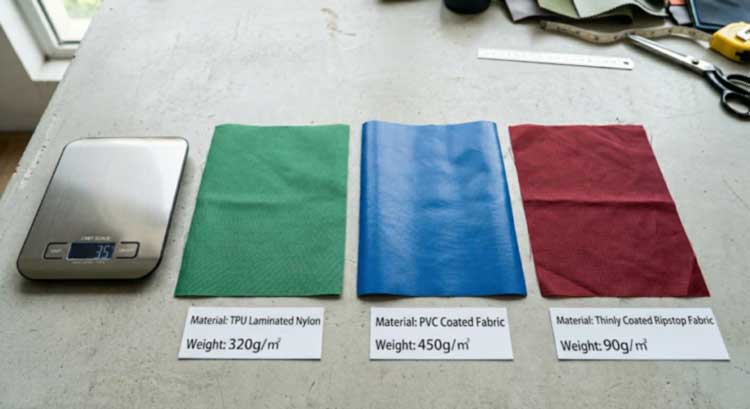
4. Where the Weight Actually Comes From
Fabric is the biggest lever, but it is not the only one. On a finished pack the waterproof backpack weight is spread across five areas, and trimming intelligently means knowing which cuts cost durability:
- Fabric denier and coating thickness: higher denier and thicker coating add abrasion resistance and grams together; lower denier saves weight but wears faster.
- Seam method: welded seams remove stitching, tape, and thread, and they seal better — a rare case where lighter is also more waterproof.
- Hardware: buckles, D-rings, and especially airtight zippers are dense; a roll-top with one buckle is lighter than a rated waterproof zipper.
- Back panel and frame: ventilation foam and any frame sheet add comfort and weight; ultralight packs drop the frame and lean on careful packing.
- Pockets and straps: every external pocket, compression strap, and padded panel is more fabric — useful, but additive.
Across tested 20L waterproof packs, real-world weights run roughly from the mid-400-gram range for stripped ultralight builds to well over a kilogram for heavy-duty roll-tops — a spread of more than double, almost entirely from these five choices rather than from capacity.
5. Sealock Lightweight Range
The range below leads with the lightweight 25L TPU pack and covers Sealock's current hiking models, with verified specifications and product pages.
| Model / Series | Capacity | Material | Weight | Highlight | Picture | Product Page |
|---|---|---|---|---|---|---|
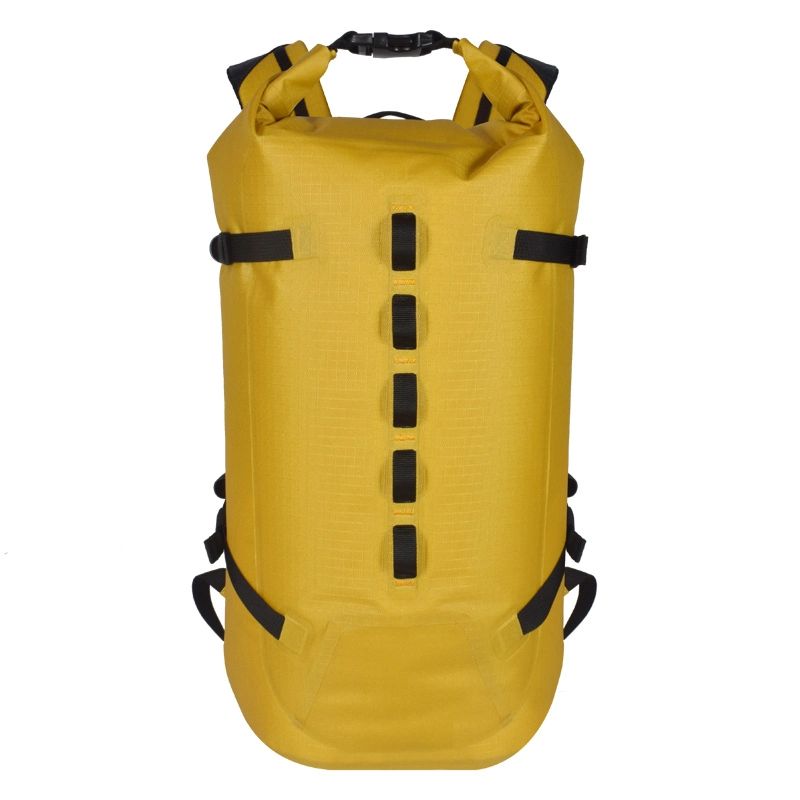
| TPU 25L Traceable Outdoor Waterproof Backpack | 25L | 4-division TPU | ~300g | Lightweight, heavy-rain rated |
|
View |
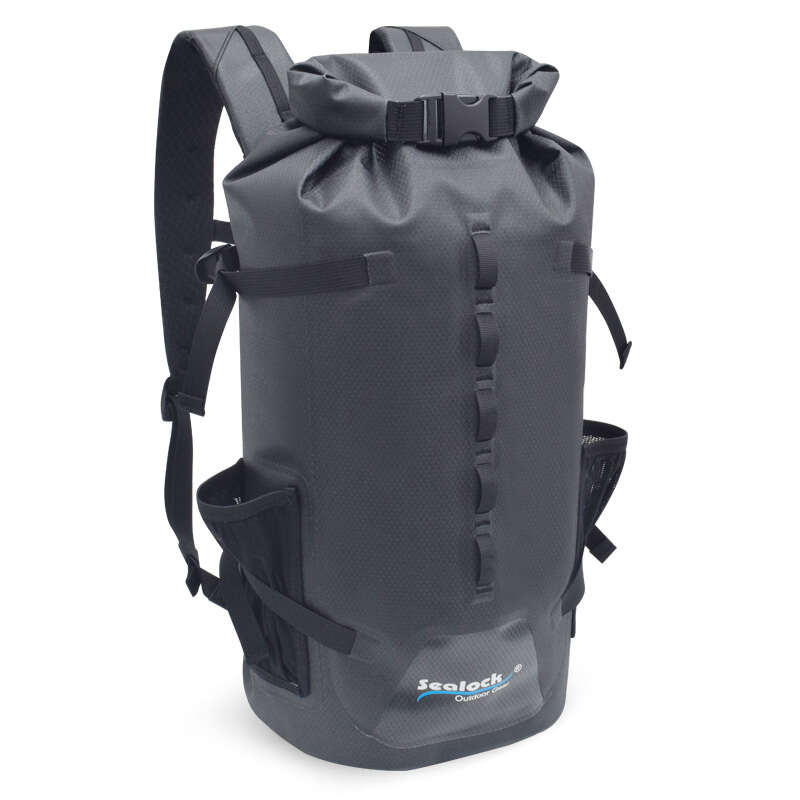
| 20L IPX6 TPU Waterproof Roll Top Backpack with Laptop Compartment | 20L | 420D TPU | 0.75KG | Sternum strap + hip belt |
|
View |
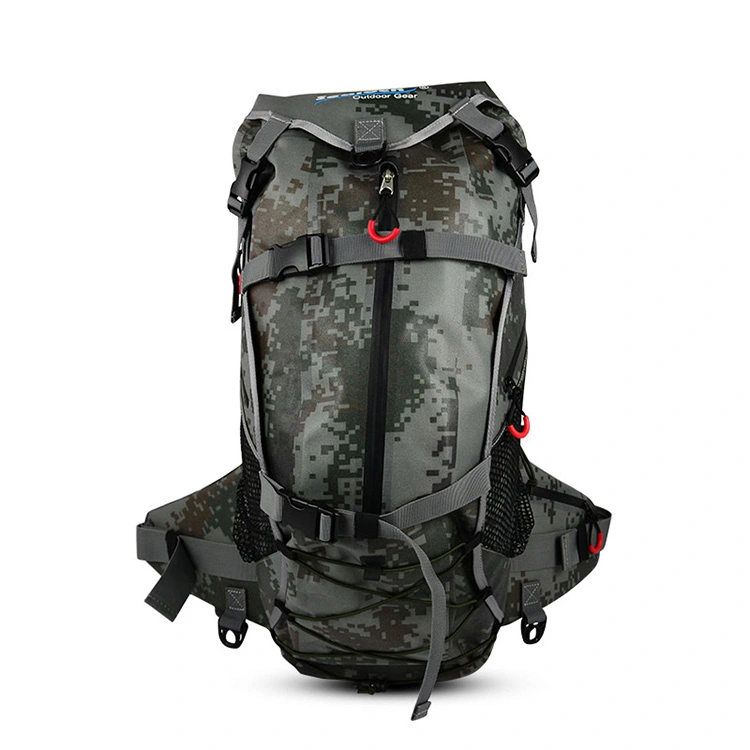
| Waterproof Hiking Backpack Camo 35L | 35L (30L + 5L) | TPU composite | Mid-weight | Dual mesh bottle pockets |
 |
View |
| Hiking Backpack 38L with Yellow Window | 38L | TPU composite | Heavier | Map/phone window, hip belt |
 |
View |
The 25L TPU pack sits at the light end of that spectrum at roughly 300g, achieved through a thin 4-division TPU laminate and a stripped, frameless build, while staying rated for heavy rain and stream crossings.
6. Weight and Comfort: What Testers Consistently Find
Material data only goes so far; the recurring lessons from independent gear testing are worth designing around.
- Non-breathable shells cause a sweaty back. Fully sealed TPU or PVC does not breathe, and reviewers repeatedly flag packs with no back panel as hot and damp against the spine. The fix is a ventilated or padded mesh back panel, which most modern dry-bag packs now add.
- Thin webbing straps dig in. Saving weight by using bare webbing for shoulder straps is comfortable empty and painful loaded; padded, contoured straps and a real hip belt move load onto the hips on long carries.
- Judge comfort at the end of the carry. Testers load packs to around 8kg and walk a couple of hours before scoring, because almost everything feels fine at the trailhead; problems appear at mile ten.
- Roll-tops trade access for sealing. A roll-top adjusts volume and seals reliably, but it is slower to open one-handed than a zipper — a fair trade for most hikers, worth noting for buyers.
- A common field hack: many hikers carry a light, non-waterproof pack and line it with small dry bags for electronics, which is itself an argument for offering matched dry-bag accessories alongside a pack.

7. Quality Control
Sealock applies a three-stage control to every batch before shipment. The laboratory test suite covers a load test of over 1,500 cycles, tensile strength, bonding strength, salt spray, friction resistance, color fastness, and color difference, plus a full water immersion test to confirm the body and closure keep the interior dry. Inspection runs in three stages: IQC checks incoming TPU fabric and hardware, IPQC samples welds and processes in line, and OQC performs AQL sampling, batch immersion testing, and signed gold-sample comparison, with optional SGS/QIMA third-party inspection on request.
8. OEM / ODM Customization and Cooperation
Sealock supports full customization for brand and distributor orders, including specifying a target weight against a target waterproof rating. Standard terms:
- MOQ: 300 pcs per model
- Customization: fabric and denier (TPU / PVC / coated nylon), capacity, carry system, color (standard high-visibility red, green, orange, plus camo), and logo
- Sampling: 7–10 working days
- Bulk lead time: confirmed at quotation, based on order quantity
- Trade terms: FOB Guangdong; other terms negotiable
Workflow: (1) inquiry and specification confirmation, including target weight and waterproof rating; (2) quotation and trade terms; (3) sampling and approval; (4) bulk production under the three-stage QC; (5) final inspection and shipment. See the OEM / ODM services page.
9. FAQ
Q: What is the lightest material for a lightweight waterproof backpack?
A: For full waterproofing, TPU-laminated nylon is the lightest mainstream option and Dyneema composite is lighter still at a premium price; coated sil-nylon is lighter again but only rain-resistant, not submersible.
Q: Does a lighter pack mean weaker waterproofing?
A: Not necessarily. Welded seams and a sealed roll-top keep a thin TPU pack fully waterproof; the real weight penalty for waterproofing comes from hardware and back-panel padding, not from the fabric being thicker.
Q: How much does a 20–25L waterproof backpack typically weigh?
A: Tested packs range from the mid-400-gram class for stripped ultralight builds to over a kilogram for heavy-duty roll-tops; a thin TPU pack like the 25L model sits near 300g.
Q: Why do waterproof packs feel sweaty, and can it be fixed?
A: Sealed fabric does not breathe, so without a vented back panel the back gets damp; specifying a padded mesh back panel resolves most of it without losing waterproofing.
Q: What is the minimum order quantity and sampling time?
A: MOQ is 300 pcs per model, with samples produced in 7–10 working days. Bulk lead time is confirmed at quotation based on quantity and customization scope.
Request a Quotation
For specifications, samples, or pricing on the 25L TPU lightweight backpack or any model in the range, submit an inquiry. Sealock responds to procurement enquiries within 24 hours.