- English
- Español
- Português
- русский
- Français
- 日本語
- Deutsch
- tiếng Việt
- Italiano
- Nederlands
- ภาษาไทย
- Polski
- 한국어
- Svenska
- magyar
- Malay
- বাংলা ভাষার
- Dansk
- Suomi
- हिन्दी
- Pilipino
- Türkçe
- Gaeilge
- العربية
- Indonesia
- Norsk
- تمل
- český
- ελληνικά
- український
- Javanese
- فارسی
- தமிழ்
- తెలుగు
- नेपाली
- Burmese
- български
- ລາວ
- Latine
- Қазақша
- Euskal
- Azərbaycan
- Slovenský jazyk
- Македонски
- Lietuvos
- Eesti Keel
- Română
- Slovenski
- मराठी
- Srpski језик

Starting a Waterproof Bag Order: MOQ, Pricing and Logo Customization Answered
Sealock manufactures waterproof bags for OEM and wholesale buyers from factories in China and Vietnam, at an MOQ of 300 pieces per model with samples in 7–15 days and full logo customization across the range. Three questions arrive in almost every first enquiry: what is the minimum order, what does it cost, and can you put our logo on it. All three have the same underlying answer — it depends on the specification, not the product category — so the fastest way to get a useful quotation is to understand what changes each one.
1. MOQ: Ask About Your Bag, Not the Factory
The most useful reframing for a first-time buyer is this: the question to ask is not "what is your MOQ" but "what is the MOQ for the bag I actually want." A minimum is not a fixed corporate policy — it moves with what the specification requires, and a good factory will explain what is driving it.
Our standard minimum is 300 pieces per model, with a small number of models at 500. What raises it:
- Custom Pantone-dyed fabric. A dedicated dye run has its own viable minimum, independent of the bag. This is the most common reason a quoted minimum comes back higher than expected, and the easiest to avoid on a first order.
- Custom moulded hardware — branded buckles, proprietary fittings, custom zipper pulls — each carrying supplier minimums and tooling.
- A new silhouette. A shape outside existing tooling needs its own machined welding die before sampling can start.
- Multiple colourways. Minimums generally apply per model and per colour, so 300 pieces split across four colours behaves like four small orders rather than one.
What keeps it low: stock fabric in a standard colour, catalogue hardware, an existing platform, and one or two colourways. Several models sharing a base fabric also quote more efficiently together than the same total spread across unrelated constructions. The mechanics behind minimums are covered in the guide to dry bag MOQ for OEM projects.
2. Price: Why No Factory Can Answer "How Much?"
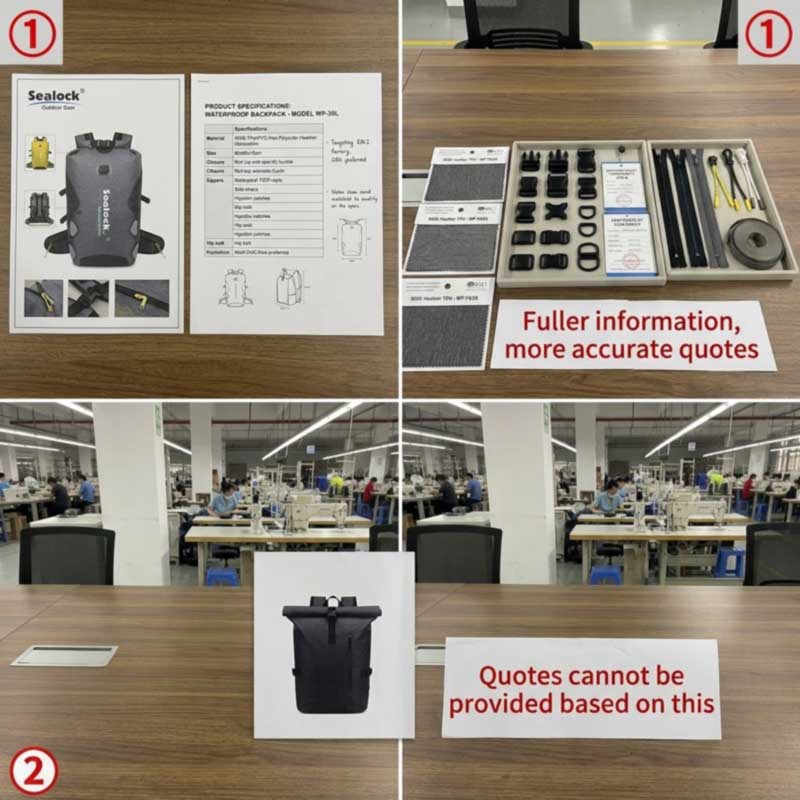
Buyers frequently send a product photo and ask for a price, then find the response slow or vague. The cause is usually incomplete information rather than an unhelpful supplier — a factory cannot give an accurate MOQ, lead time, or price from a photograph, because the photo does not show the material weight, the coating, the closure rating, or the construction method.
What actually determines the number:
| Variable | Effect on price |
|---|---|
| Fabric and coating | The largest single line. Two bags quoted as "600D" can differ substantially in coating thickness and weight |
| Waterproof rating | IPX6 rain protection costs less than IPX7 or IPX8 submersion, because the closure hardware differs |
| Closure type | A rated airtight zipper is a specialised, expensive component; a roll-top achieves a high rating for less |
| Construction complexity | Pockets, padding, harness, and organisation are operator minutes — more compartments means more labour per unit |
| Quantity | Price moves in steps, not a smooth curve, because fabric, hardware, and print setup each have thresholds |
| Logo method | Covered below — screens, moulds, and setup are one-time costs recovered across the run |
Two practical points. First, state your target price in the enquiry. It is not a weakness — it tells the factory which fabric grade, hardware, and structure to specify, and prevents a quotation for a build your programme cannot carry. Second, ask for two or three quantities, because a target sitting just below a price tier can cost more in total than one slightly above it. The full cost structure is set out in the guide to what drives the cost of a waterproof bag.
3. Logo Customization: Yes, and Here Is What to Send
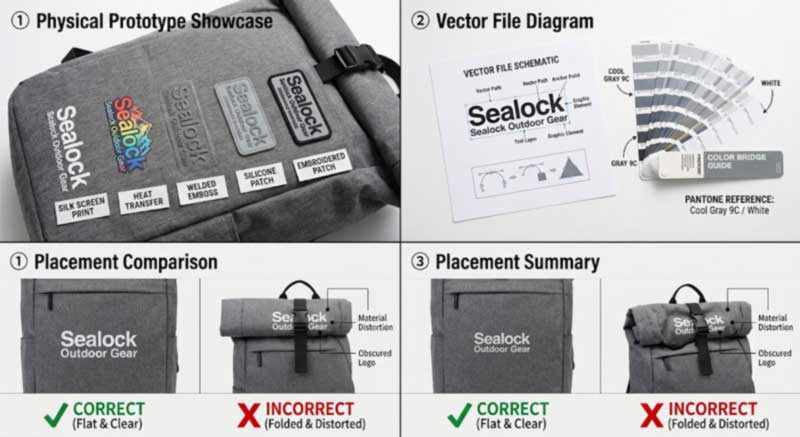
Custom logo is supported across the entire range, in five methods. Which one suits depends on the material, the artwork, and how the bag will be used:
- Silkscreen — the workhorse for bold, solid marks in one to three colours. Durable outdoors and cost-effective at volume; each colour needs its own screen, so complex artwork becomes impractical.
- Heat transfer — for detailed or multi-colour graphics. Method and substrate are confirmed together, since some coated materials are heat-sensitive.
- Welded patch or embossing — a premium, tactile mark with no printed layer to abrade off, and the best fit for coated TPU bodies.
- Rubber patch — contemporary and hard-wearing, common on technical outdoor products.
- Embroidery — traditional and extremely durable, run in house on our sewing line. Applied to a panel or patch rather than through a waterproof shell, since stitching a sealed body creates a leak path.
To get a logo sample right first time, send:
- Vector artwork — AI, PDF, or EPS. These can be resized without losing definition, which matters for screen printing especially. A raster file works only at high resolution, and vector is always preferable.
- Pantone references for the logo colours and, if relevant, the bag colour.
- Preferred size and placement. Worth a note on restraint here: on corporate and retail programmes an oversized mark across a main panel reads as advertising, while a restrained placement gets used daily.
One technical point specific to waterproof bags: the logo goes on a flat, stable panel away from seams, buckles, and roll-top fold zones, because a mark placed in a flex or abrasion path will wear regardless of method. Branding options across materials are covered in the guide to custom dry bags.
4. Samples: What They Cost and Whether You Get It Back
Sampling is where the three questions converge, because an approved sample fixes the specification that determines both price and minimum. Two types exist and they answer different questions — a stock sample from the existing range lets you judge welding, stitching, and materials before any development starts, while a custom prototype built to your specification becomes the production standard.
Samples run 7–15 days here. On fees, the industry convention is that a custom sample is charged because it consumes real production time, and the fee is commonly credited against the bulk order once it is placed. Courier is normally separate. Ask any supplier three things explicitly: the sample fee, whether it is refundable against bulk, and how many revision rounds are included — policies vary widely between factories and the differences add up. The full process is set out in the guide to getting a waterproof bag sample.
5. What to Send With Your First Enquiry
The quality of the quotation follows the quality of the enquiry. Include:
- Product type and use environment — rain, spray, or immersion changes the entire construction.
- Capacity and dimensions, or a reference product to match.
- Reference photos, a sketch, or a physical sample — a sample is the fastest brief of all, because a factory reads pocket layout, closure, and strap design directly from it.
- Required waterproof rating, or the performance target if you would rather we recommend.
- Logo artwork in vector, with method and placement, plus Pantone references.
- Target quantity and target FOB price.
- Destination market and launch date — the market affects compliance and origin, the date affects whether ground-up development is feasible.
6. Start Small, Then Scale
A sensible first order avoids the two mistakes that cost new buyers most: over-customising before the product is tested, and spreading a modest budget across too many variants.
The staged approach that works:
- First order — an existing platform, stock material, one or two colourways, a straightforward logo method. This keeps the minimum at 300 pieces and the timeline short, while still producing a genuinely branded product.
- Once it sells — add custom Pantone colours, upgraded hardware, or additional sizes, now that demand is proven rather than assumed.
- When the line is established — ground-up development of a proprietary silhouette, with its own tooling, that competitors cannot buy.
If the budget is fixed, more units of fewer SKUs buys more leverage than fewer units across many styles. A first order should carry the most important selling point, not every idea on the list.
7. Standard Terms
Sealock (YiFuLong Outdoor Gear Co., Ltd.) has built waterproof bags for over 20 years, producing for international outdoor brands including OSPREY, KAILAS, Helly Hansen, SIMMS, ORVIS, and West Marine.
- MOQ: 300 pcs per model, most models | Samples: 7–15 days | Bulk: 30–45 days
- Logo: silkscreen, heat transfer, welded patch, rubber patch, embroidery — all supported, vector artwork required
- Production: in-house 27.12 MHz high-frequency welding and industrial sewing, separate workshops on the same production floor
- Facilities: Dongguan, China | Ho Chi Minh City, Vietnam — either origin on any model
- Terms: FOB Guangdong, T/T 30% deposit and 70% balance against inspection
- Certifications: ISO 9001, BSCI, SMETA, Sedex, HIGG, GRS, SCAN
8. Platforms Available at Standard MOQ
Models organized by category rather than priority. All can be branded and recoloured without new tooling:
| Image | Model | Category | Material | Rating | MOQ | Product Page |
|---|---|---|---|---|---|---|
|
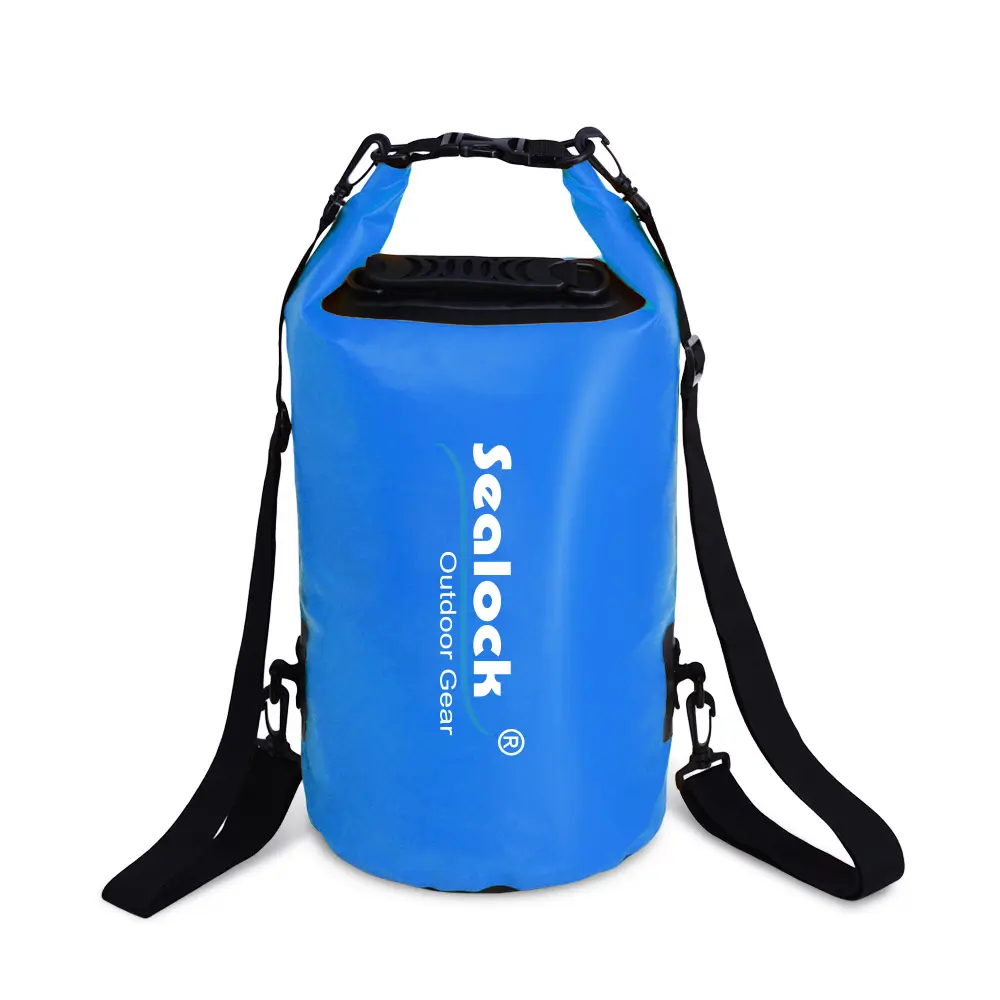
SL-D002 | Dry bag, 5–63L | 500D PVC | IPX7 | 300 | View |
|
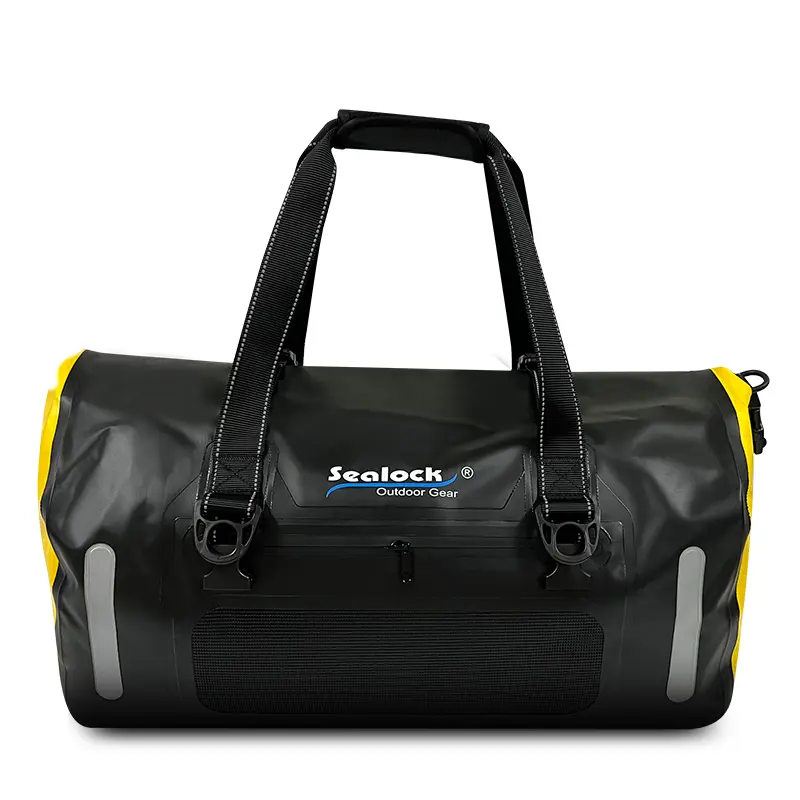
SL-K099 | Duffel, 40 / 60L | 840D TPU | IPX7 | 300 | View |
|
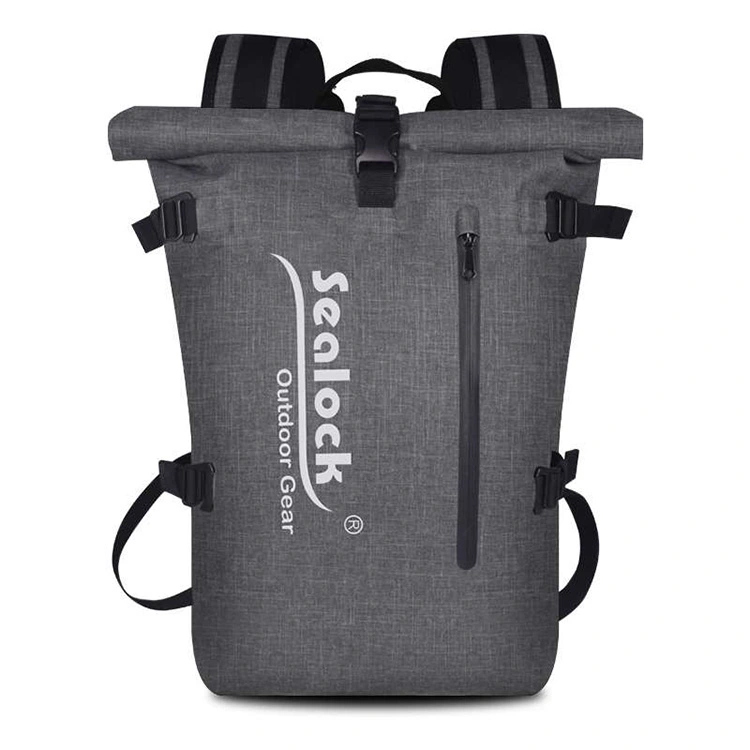
SL-E980 | Commuter backpack, 22L | 600D TPU | IPX6 | 300 | View |
|
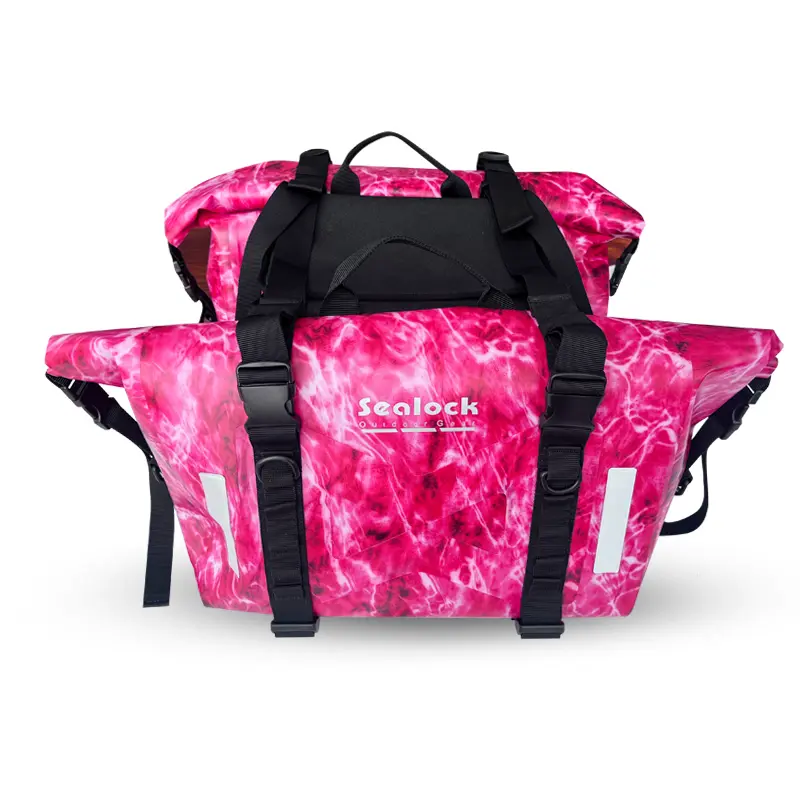
SL-C807 | Motorcycle, 45L | 500D PVC / 420D TPU | IPX6 | 300 | View |
|
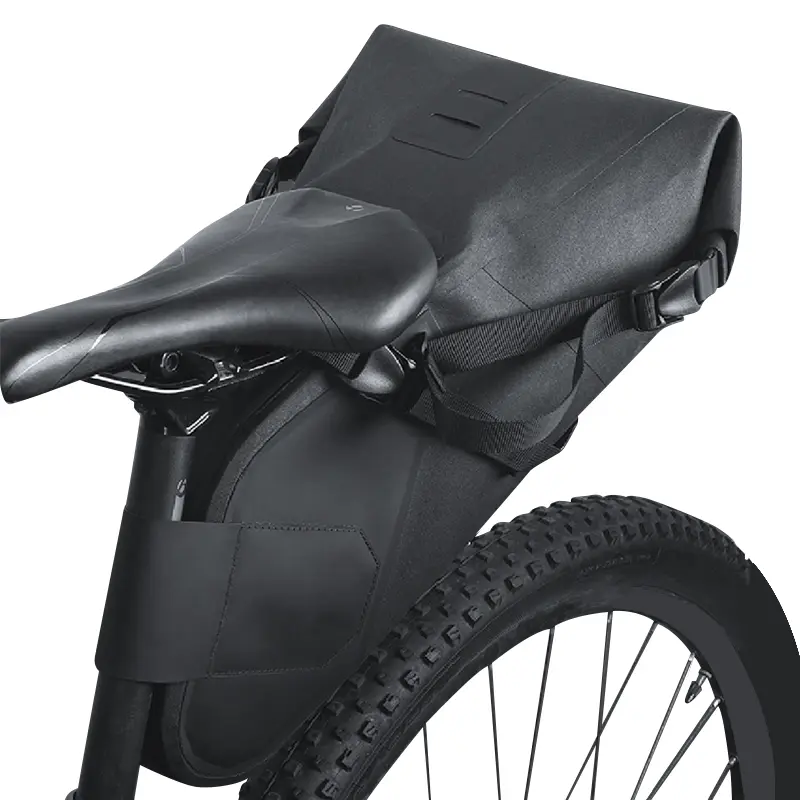
SL-K022 | Bike saddle bag, 10–14L | 420D / 600D TPU | IPX6–7 | 300 | View |
|
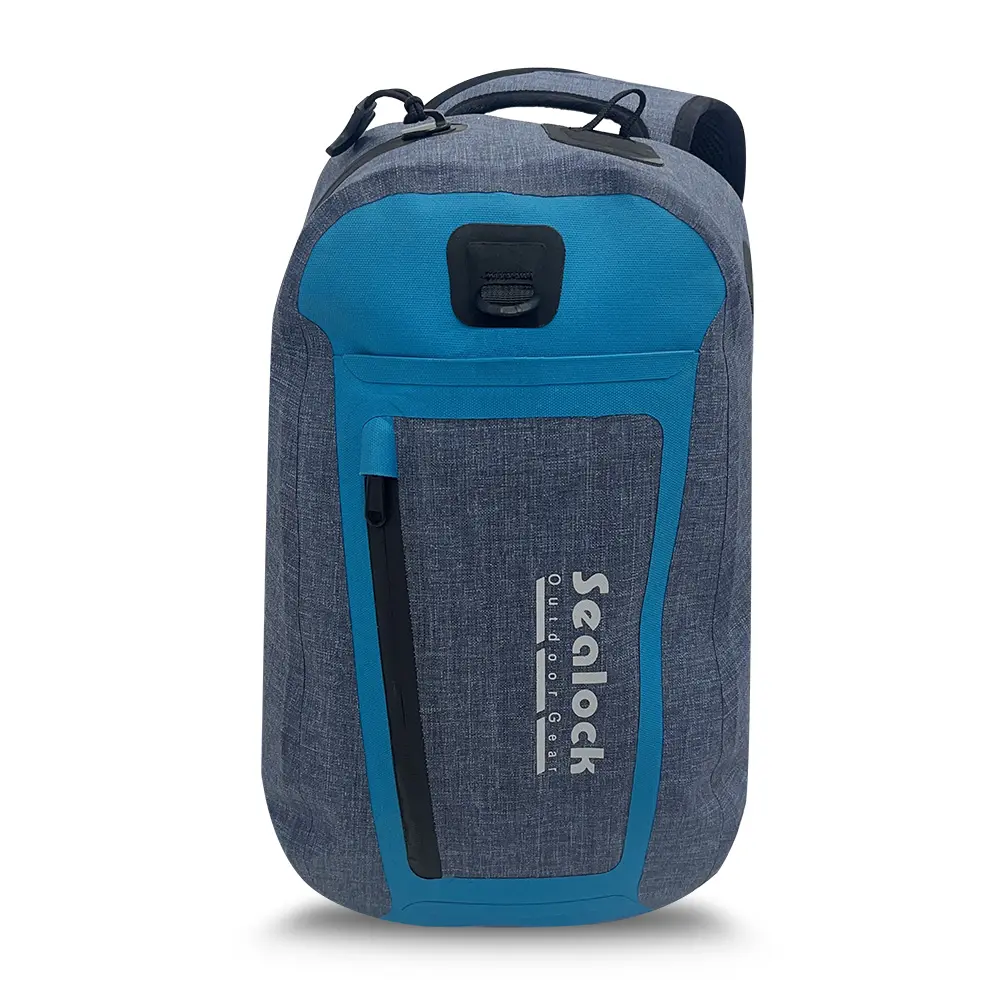
SL-E548 | Fishing sling, 8L | 500D PVC | IPX7 | 300 | View |
Full categories sit under waterproof bags, dry backpacks, and dry bags.
9. Quality Control
Every batch runs IQC on incoming fabric, zippers, and hardware; IPQC in process on both welding and sewing lines, including peel tests on sample welds at run start, stitch density and tension checks, and logo application checks; and OQC with AQL sampling, batch testing to each model's stated rating, colour-difference testing, and signed gold-sample comparison. A signed gold sample is held by both sides so repeat orders match the first. Standards are set out in the quality control standards for waterproof production.
10. FAQ
Q: What is your MOQ?
A: 300 pieces per model on most of the range, with a small number at 500. But the more useful question is the minimum for the bag you actually want — custom dyed fabric, moulded hardware, or a new silhouette each raise it, while stock material and an existing platform keep it at the standard figure.
Q: Does the MOQ apply per colour?
A: Generally per model and per colour. A 300-piece order split across four colourways behaves like four small orders and is likely to trip fabric minimums. Concentrating a first order on one or two colours is the most effective way to keep it workable.
Q: Can you give me a price?
A: Not from a photograph alone. Send capacity, material or performance target, waterproof rating, closure type, logo method, quantity, and a target FOB price, and the quotation will be accurate rather than indicative. Asking for two or three quantities is worth doing, since price moves in steps rather than smoothly.
Q: Can you put our logo on it?
A: Yes, on every model, in silkscreen, heat transfer, welded patch, rubber patch, or embroidery. Send vector artwork — AI, PDF, or EPS — with Pantone references and preferred placement. Method is matched to the material, and the logo is positioned away from fold and abrasion zones.
Q: Is the sample fee refundable?
A: Custom samples are charged because they take real production time, and the fee is commonly credited against the bulk order once placed; courier is normally separate. Ask us — and any supplier — to confirm the fee, the credit, and the number of included revisions in writing before starting.
Q: We are a small brand. Is 300 pieces realistic for a first order?
A: It is the threshold to plan around, and it is manageable if the first order stays simple — one platform, stock material, one or two colours, one logo method. Add custom colours, upgraded hardware, and extra sizes once the product has sold rather than before.
Get a Quotation
Send your product type, capacity, target quantity, logo artwork and target price, and we will come back with an accurate quotation rather than a range — submit an inquiry. Sealock responds to procurement enquiries within 24 hours, with samples in 7–15 days and production from Dongguan, China or Ho Chi Minh City, Vietnam.