
- English
- Español
- Português
- русский
- Français
- 日本語
- Deutsch
- tiếng Việt
- Italiano
- Nederlands
- ภาษาไทย
- Polski
- 한국어
- Svenska
- magyar
- Malay
- বাংলা ভাষার
- Dansk
- Suomi
- हिन्दी
- Pilipino
- Türkçe
- Gaeilge
- العربية
- Indonesia
- Norsk
- تمل
- český
- ελληνικά
- український
- Javanese
- فارسی
- தமிழ்
- తెలుగు
- नेपाली
- Burmese
- български
- ລາວ
- Latine
- Қазақша
- Euskal
- Azərbaycan
- Slovenský jazyk
- Македонски
- Lietuvos
- Eesti Keel
- Română
- Slovenski
- मराठी
- Srpski језик

How to Evaluate a Waterproof Bag Sample: Tests You Can Run Yourself
Sealock produces waterproof bag samples for OEM and wholesale buyers in 7–15 days from factories in China and Vietnam, at an MOQ of 300 pieces. A sample arriving on your desk is the last cheap moment in a programme — whatever you approve becomes what the factory reproduces thousands of times. Yet most buyers evaluate it by looking at it, which tests almost nothing that matters. These are the checks you can run without a laboratory, in the order that finds problems fastest.
1. Why a Spec Sheet Is Not Evidence
Two failure patterns are worth knowing before you start, because both involve a supplier who is not lying and a bag that still leaks.
The first: a fabric can pass a laboratory test while the finished bag fails. Hydrostatic testing measures what the raw material withstands; an IPX rating describes the finished, sealed product. One documented case involved an approved 500D PU-coated shell that leaked entirely through a poorly taped logo patch — the fabric was fine, the construction was not.
The second: ratings get claimed without being verified on the finished article. In another reported case a supplier presented a passing fabric specification and claimed the bag achieved IPX7; submerged, the zipper leaked in twelve seconds. Always test the final construction rather than accepting a material certificate as proof of a product claim.
2. Start With Five Minutes of Inspection
Before any water is involved, four checks take almost no time and eliminate obvious problems:
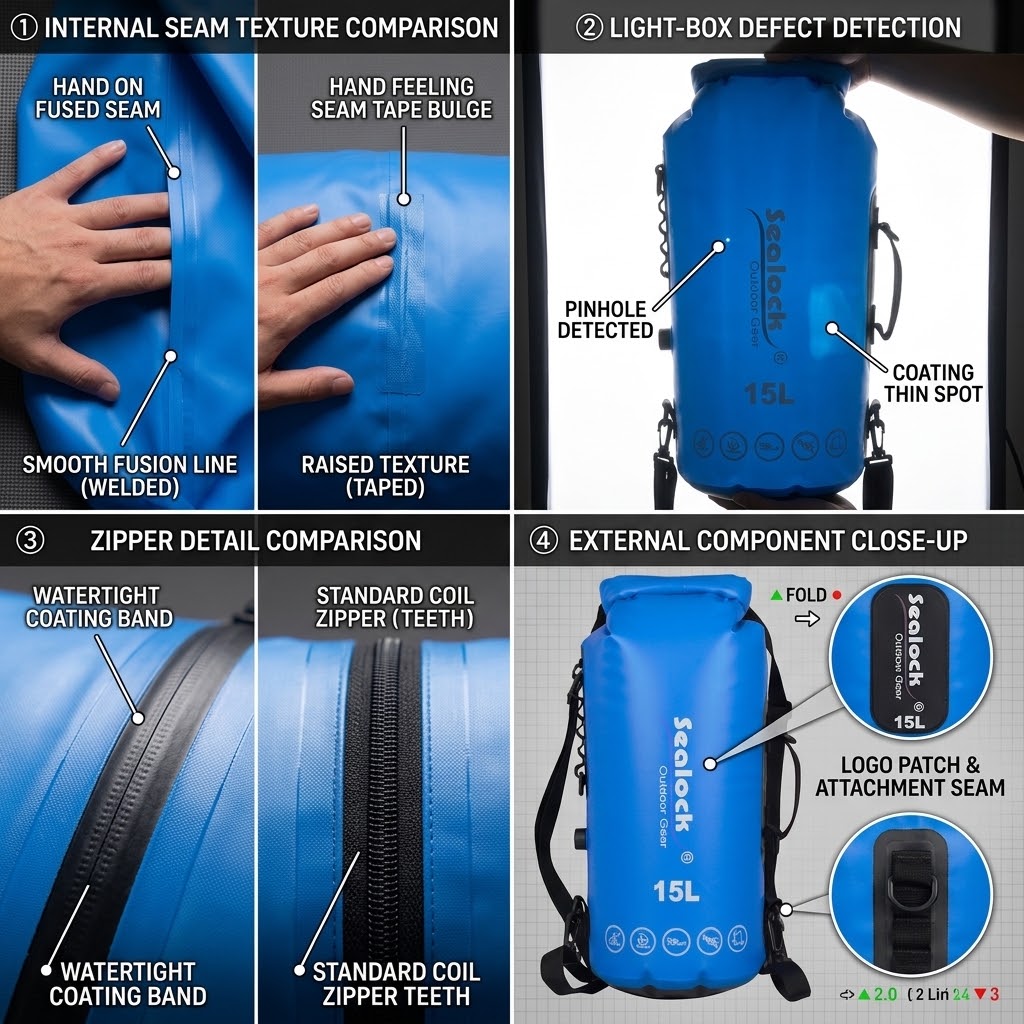
- Find out how the seams are joined. Run a hand along the inside of the main compartment. A smooth fused line means welded construction. A raised plastic strip means stitching covered with tape — acceptable for rain, but tape can peel with flexing and heat, and welded seams are what genuinely support a submersible claim.
- Hold the bag up to a strong light. Pinholes, thin coating, and weak spots show through far more readily than under room light, and a torch into the corners and folds finds what a visual scan misses.
- Look at the closure. A rated waterproof zipper has a visible coated or laminated tape rather than exposed standard teeth. On a roll-top, check the collar folds cleanly three times without buckling.
- Check the logo area and any pocket. These are added features on a sealed body, and they are where the construction is most often compromised — which the case above illustrates precisely.
3. The Air Test: Find the Leak Path in Two Minutes
This is the fastest diagnostic available and it needs nothing but a sink or bath.
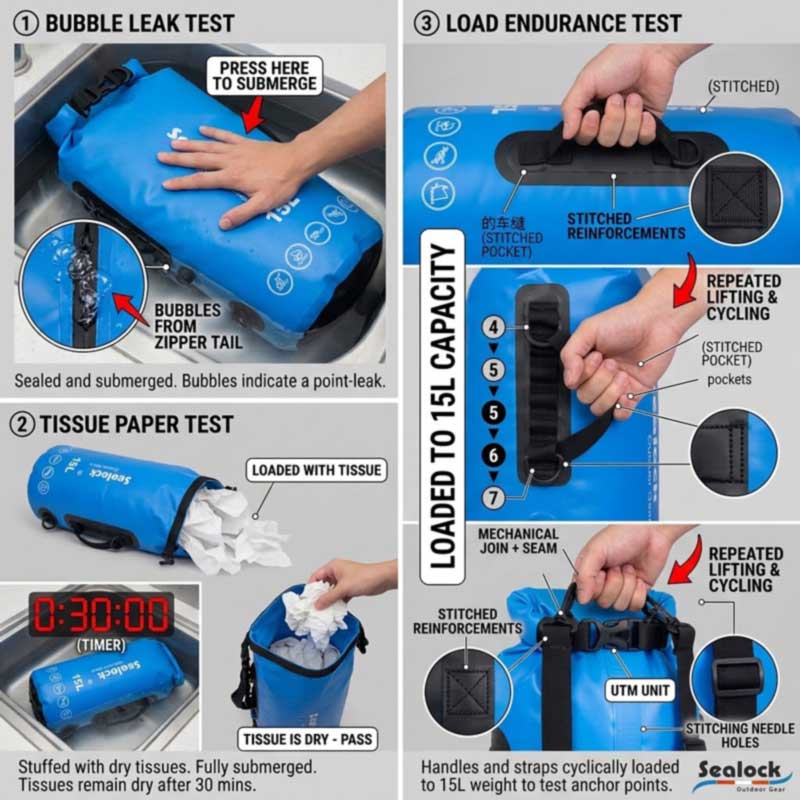
Seal the bag with air trapped inside, submerge it, and apply firm even pressure with both hands. Watch the surface and seam lines. Bubbles escaping from any point indicate a breach, and — more useful — they show you exactly where it is. It will not tell you how serious the leak is, but it locates it immediately.
Run this before the longer water test. If bubbles appear at the zipper end, a corner weld, or the base seam, you have both a fail and a diagnosis, and you can send the supplier a photograph of the specific point rather than the word "leaking".
4. The Tissue Test: The One That Decides Approval
This is the check that answers whether the bag does its job.
- Fill the bag with dry tissue or paper towel. Absorbent indicators reveal moisture that a dry hand would miss — including condensation-level ingress that would still ruin a laptop or a camera.
- Close it exactly as the end user would. A roll-top gets three to four folds and the buckle clipped; a zipper gets pulled fully closed. Listen for air escaping as you compress it.
- Submerge it completely in clean water — dirty water masks slow leaks.
- Leave it there. Thirty minutes to an hour is the practical range for a rated bag, and longer is more revealing. A brief dunk proves very little, because imperfect closure seating and pinholes take time to show.
- Open it and inspect. Dry tissue throughout is a pass. Any damp patch or water staining on an interior wall is a fail — and note where, because the location names the failure: zipper edge, base seam, roll-top junction, or logo patch.
One variation worth running on bags that will carry liquids or wet gear: put water inside the bag, stand it on dry paper towels, and check the towels after a few hours. Bags sometimes seal against water outside and leak from within.
5. Load the Bag, Because Fabric Rarely Fails First
Waterproofing gets the attention; mechanical failure is what actually ends most bags' lives. With the bag still sealed:
- Load it to the weight your customer will carry and lift it repeatedly by each handle and strap in turn. Watch the anchor points rather than the fabric — stitch elongation, patch distortion, or hardware deformation at the attachment is the early warning.
- Operate the closure wet, and with gloves if the product will be used cold. An airtight zipper needs real leverage; a seal the user cannot fully close is not a seal.
- Test it in its actual context. A bike bag goes on a bike in the intended frame size, loaded, with the suspension compressed. A motorcycle bag goes on the machine. A sling goes on a body and swings round. Fit problems never appear on a table.
- Check the weight against the specification, and the dimensions against the approved figures — including usable capacity after a roll-top is closed, which is always lower than the rated volume.
6. What Your Own Tests Cannot Do
Being clear about the limits protects you from over-relying on them. A buyer-side check is informal screening, not formal approval evidence. A garden hose or shower test should not be accepted as qualification for a supplier claim — matching a stated IPX rating requires controlled exposure under the defined method, which is a factory or laboratory activity.
Your tests also cannot assess what only emerges over time: UV ageing, colour fastness, salt spray corrosion on hardware, abrasion resistance, or how a weld behaves after thousands of flex cycles. For those, ask for test results. And one sample passing does not establish that production will match it — that is what a signed gold sample and pre-shipment inspection are for, covered in the quality control standards for waterproof production.
7. What to Ask the Factory to Test
Where your own checks stop, these should be requested with results rather than assurances:
| Test | What it verifies |
|---|---|
| Full water immersion to the stated rating | Seam and closure integrity on filled, sealed units |
| Weld peel test at run start | Full fusion — a correct weld tears the base fabric rather than parting at the seam |
| Load cycling, 1,500+ cycles | Handles, strap anchors, and D-rings under repeated full load |
| Sealed-zipper cycling, 3,000 cycles | Closure seal life on zippered models |
| Salt spray | Hardware corrosion for marine and coastal use |
| Colour fastness and colour difference | UV fading, and batch-to-batch consistency on reorders |
| Bonding and tensile strength | Weld and lamination under pressure; fabric at stress points |
The full customer inspection procedure here — unboxing, vacuum extraction, a 24-hour static rest, and air-leak determination — can also be witnessed end to end by a buyer or their inspector. A 24-hour vacuum hold surfaces the slow leaks a desk test cannot.
8. Record the Result, Whatever It Is
Whether the sample passes or fails, document it: photographs of any leak point, the test method and duration used, measured weight and dimensions, and notes on closure operation and load behaviour. A failed sample with a diagnosed leak point produces a fast, specific revision; "it leaked" produces a guess.
When it passes, the sample stops being a prototype and becomes the contract. Sign it, keep one copy and leave one with the factory, and record the specification version alongside it — that reference is what every future batch is measured against, as set out in the guide to reorder consistency.
9. Sample Any Model in the Range
Organized by category rather than priority:
| Image | Model | Category | Material | Rating to test against | Product Page |
|---|---|---|---|---|---|
|
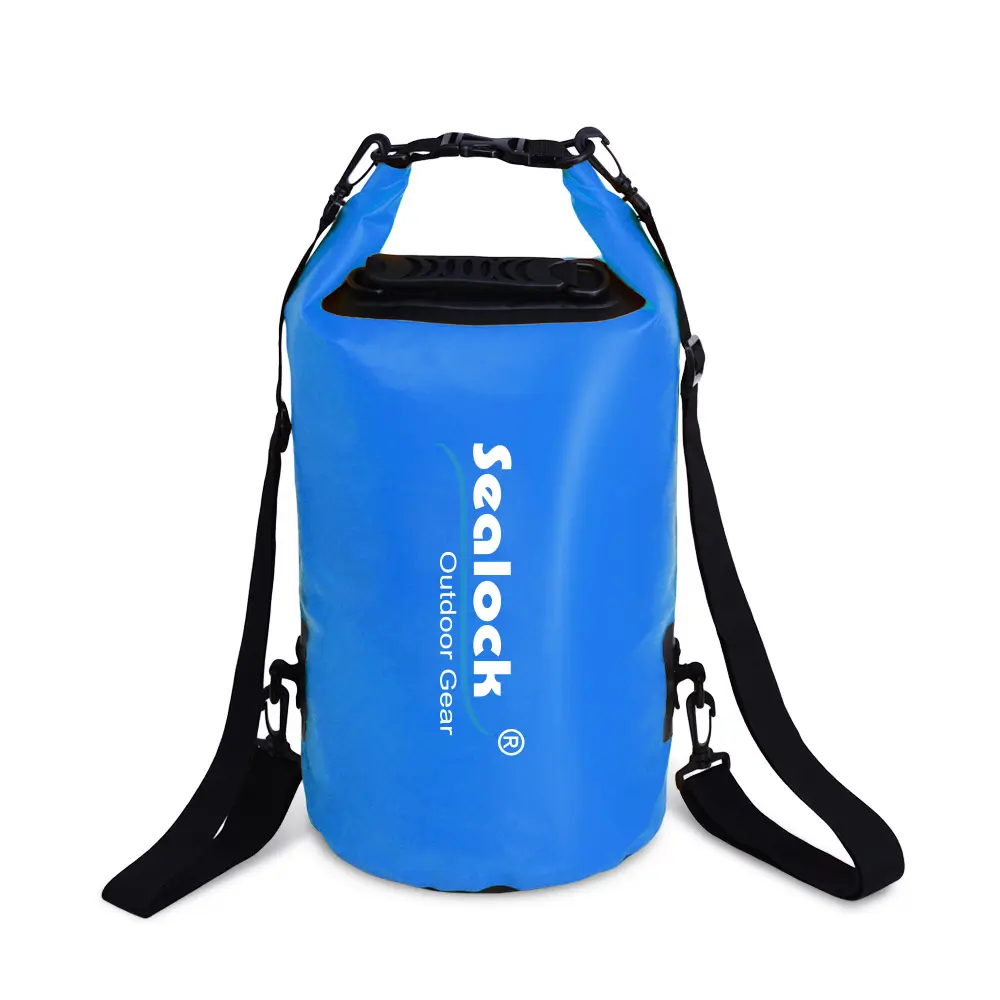
SL-D002 | Dry bag, 5–63L | 500D PVC | IPX7 — submersion test applies | View |

|
SL-E119 | Backpack, 20L | Cationic TPU composite | IPX8 — sustained submersion | View |
|
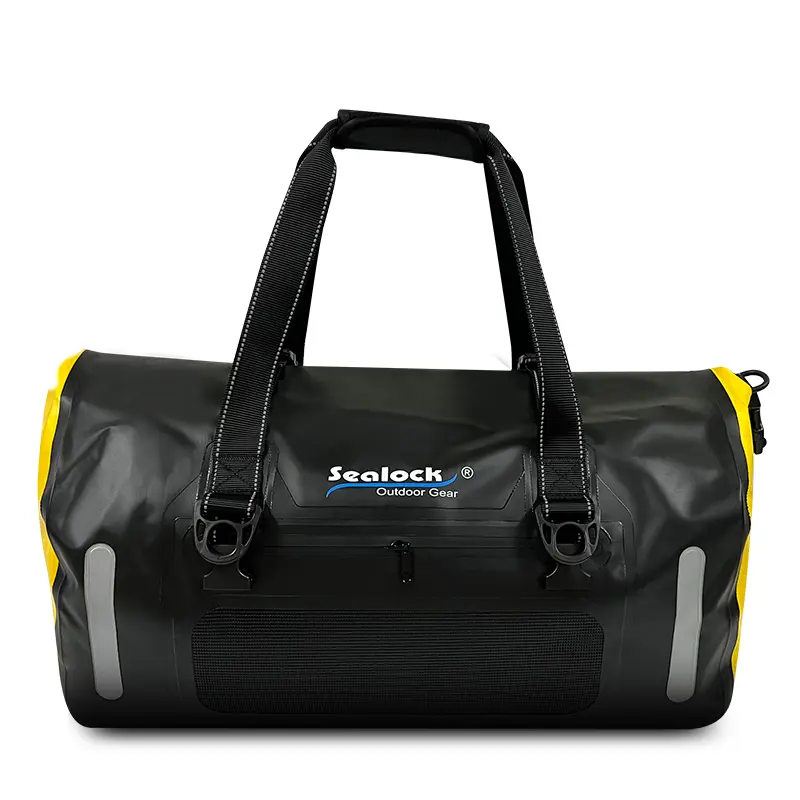
SL-K099 | Duffel, 40 / 60L | 840D TPU | IPX7 — test loaded, check handles | View |
|
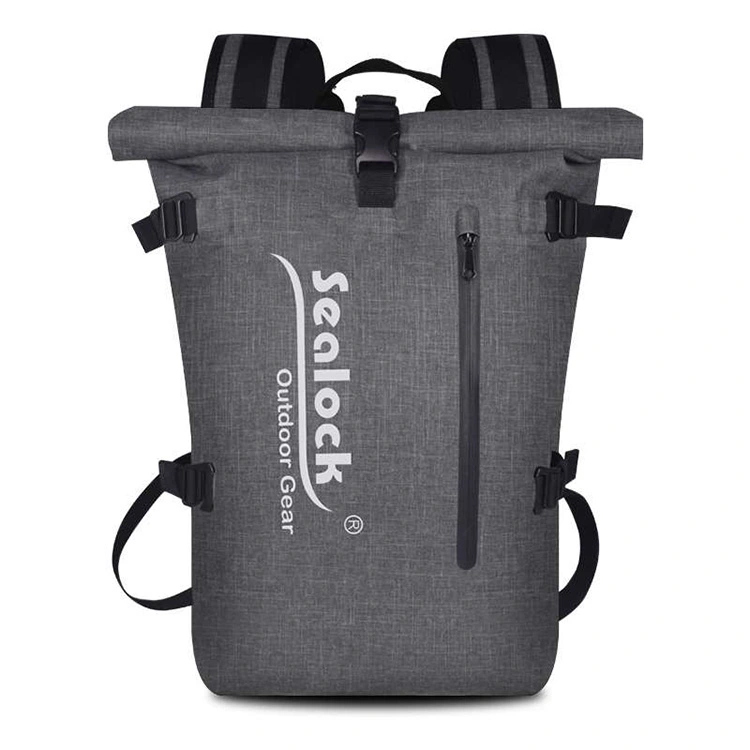
SL-E980 | Commuter backpack, 22L | 600D TPU | IPX6 — rain and spray, not submersion | View |
|
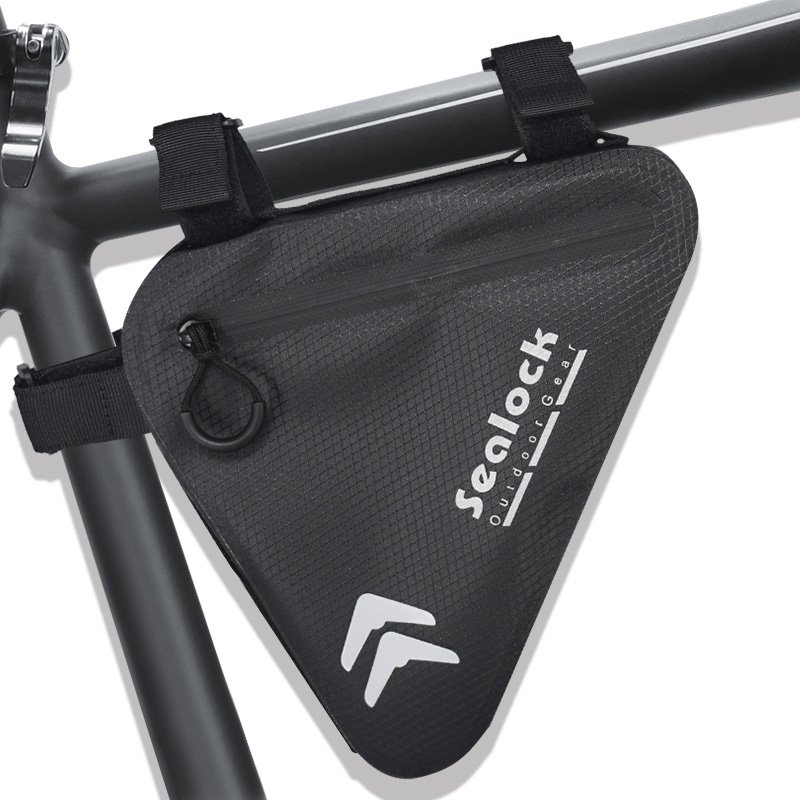
Frame Bag | Bike, 0.8L | 800D TPU | Weather-rated — not for submersion | View |
|
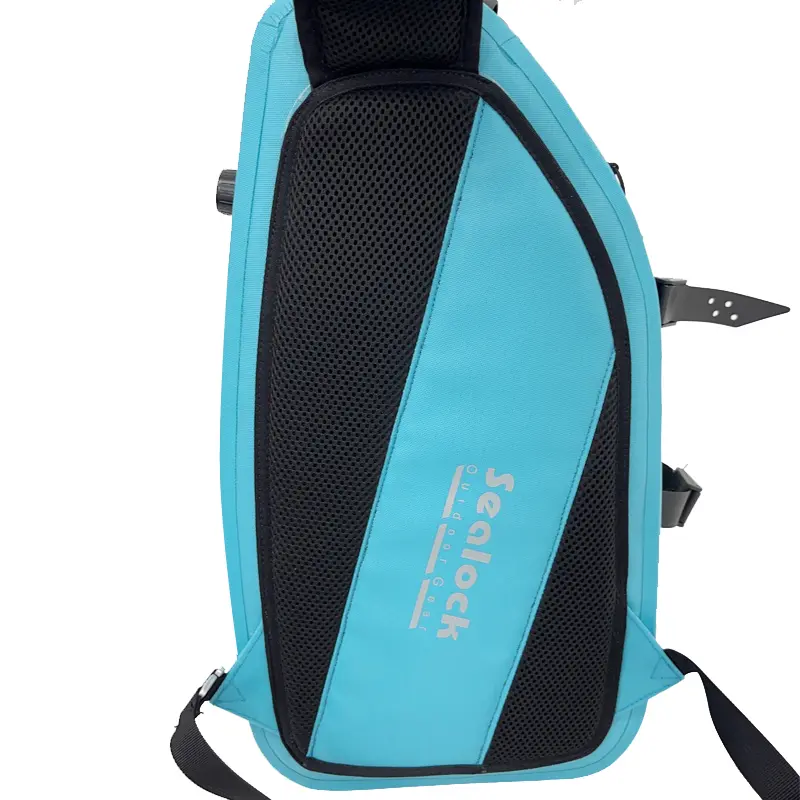
SL-E868A | Fishing sling, 12L | 840D TPU | IPX8 to 20 m — test wet and gloved | View |
Test each model against its own stated rating rather than a universal standard — a weather-rated frame bag failing a submersion test is performing as specified, not failing. Full categories sit under waterproof bags, dry backpacks, and dry bags. How to request a sample is covered in the guide to getting a waterproof bag sample.
10. Standard Terms
Sealock (YiFuLong Outdoor Gear Co., Ltd.) has built waterproof bags for over 20 years, producing for international outdoor brands including OSPREY, KAILAS, Helly Hansen, SIMMS, ORVIS, and West Marine.
- Samples: 7–15 days | MOQ: 300 pcs per model | Bulk: 30–45 days
- Logo: silkscreen, heat transfer, welded patch, rubber patch, embroidery — vector artwork required
- Production: in-house 27.12 MHz high-frequency welding and industrial sewing, separate workshops on the same production floor
- Facilities: Dongguan, China | Ho Chi Minh City, Vietnam — either origin on any model
- Certifications: ISO 9001, BSCI, SMETA, Sedex, HIGG, GRS, SCAN
11. FAQ
Q: Can I test waterproofing myself or does it need a lab?
A: You can screen it yourself effectively — an air bubble test locates leaks in minutes, and a tissue-filled submersion test decides pass or fail. What you cannot do at a desk is qualify a formal IPX claim, which requires controlled exposure under the defined method, or assess UV, abrasion, and corrosion behaviour over time.
Q: How long should I submerge the sample?
A: Thirty minutes to an hour for a rated bag, and longer is more revealing. A brief dunk proves little, because slow leaks and imperfect closure seating take time to appear. Use clean water — dirty water hides exactly the small leaks you are looking for.
Q: The supplier sent a fabric test report. Is that enough?
A: No. Hydrostatic testing measures the raw material; an IPX rating describes the finished sealed product. A perfectly good fabric can be assembled into a bag that leaks at a logo patch, a pocket seam, or a zipper end. Always test the final construction.
Q: What should I check besides waterproofing?
A: Load behaviour first, because anchors and handles fail before fabric does. Then closure operation when wet and gloved, fit in actual use, and measured weight and dimensions against specification — including usable capacity after a roll-top is rolled shut.
Q: The sample leaked. What do I send the factory?
A: The location, not the verdict. Photograph the point where bubbles escaped or where the tissue was damp — zipper edge, base seam, roll-top junction, logo patch — along with your test method and duration. A diagnosed failure point produces a fast, targeted revision.
Q: Does a passing sample mean the bulk order will be fine?
A: No — it means the design is right. Reproducing it across thousands of units is a separate problem, controlled by a signed gold sample held by both sides, in-process checks, and a pre-shipment inspection tied to the balance payment.
Request a Sample to Test
Tell us the model and the rating you need to verify, and we will send a sample with the specification sheet to test it against — submit an inquiry. Sealock responds to procurement enquiries within 24 hours, with samples in 7–15 days and production from Dongguan, China or Ho Chi Minh City, Vietnam.