
- English
- Español
- Português
- русский
- Français
- 日本語
- Deutsch
- tiếng Việt
- Italiano
- Nederlands
- ภาษาไทย
- Polski
- 한국어
- Svenska
- magyar
- Malay
- বাংলা ভাষার
- Dansk
- Suomi
- हिन्दी
- Pilipino
- Türkçe
- Gaeilge
- العربية
- Indonesia
- Norsk
- تمل
- český
- ελληνικά
- український
- Javanese
- فارسی
- தமிழ்
- తెలుగు
- नेपाली
- Burmese
- български
- ລາວ
- Latine
- Қазақша
- Euskal
- Azərbaycan
- Slovenský jazyk
- Македонски
- Lietuvos
- Eesti Keel
- Română
- Slovenski
- मराठी
- Srpski језик

Waterproof Camera Bag Manufacturer: Welded Shells and Padded Inserts for Photo Brands
Listen to this article
Sealock is a waterproof camera bag manufacturer producing welded camera backpacks, messenger bags and padded inserts for photo, video and outdoor brands, with OEM production from 300 pieces, high-frequency welded TPU shells and in-house sewn padded inserts, and factories in Dongguan, China and Ho Chi Minh City, Vietnam. This guide explains how a camera bag keeps equipment dry and protected, the details photographers judge it on, and what MOQ, price and testing to expect when developing your own range.
A camera bag has two jobs that pull in different directions. It has to keep water out, which calls for a sealed shell and as few openings as possible. And it has to protect and organise fragile, expensive equipment that the photographer needs to reach quickly, which calls for padding, dividers and wide access. Reviews of waterproof camera backpacks show what happens when one job is sacrificed for the other. Coil zippers that let moisture through without a rain cover, rain covers that wear out within a year or two, soft dividers that bow under a telephoto lens, access doors too narrow for a lens hood, and roll-top closures that pop open when the bag is overfilled.
How Do You Build a Camera Bag That Is Both Waterproof and Protective?
We separate the two jobs. The outer shell is formed from TPU laminated fabric joined with high-frequency welded seams, so the body has no needle holes, and it is closed with waterproof zippers rather than standard coils. Inside, protection and organisation come from a padded insert built on our sewing line, with foam-cored walls, a soft brushed lining that will not scratch lenses or screens, and dividers that attach with hook-and-loop. Sealock runs welding and sewing as separate lines in separate rooms on the same production floor, so the shell and the insert are designed to fit each other and are checked together before packing.
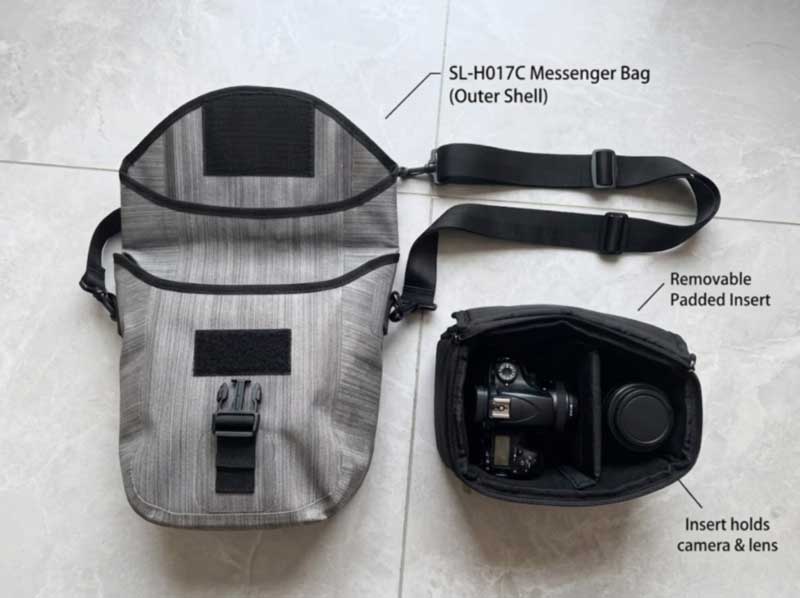
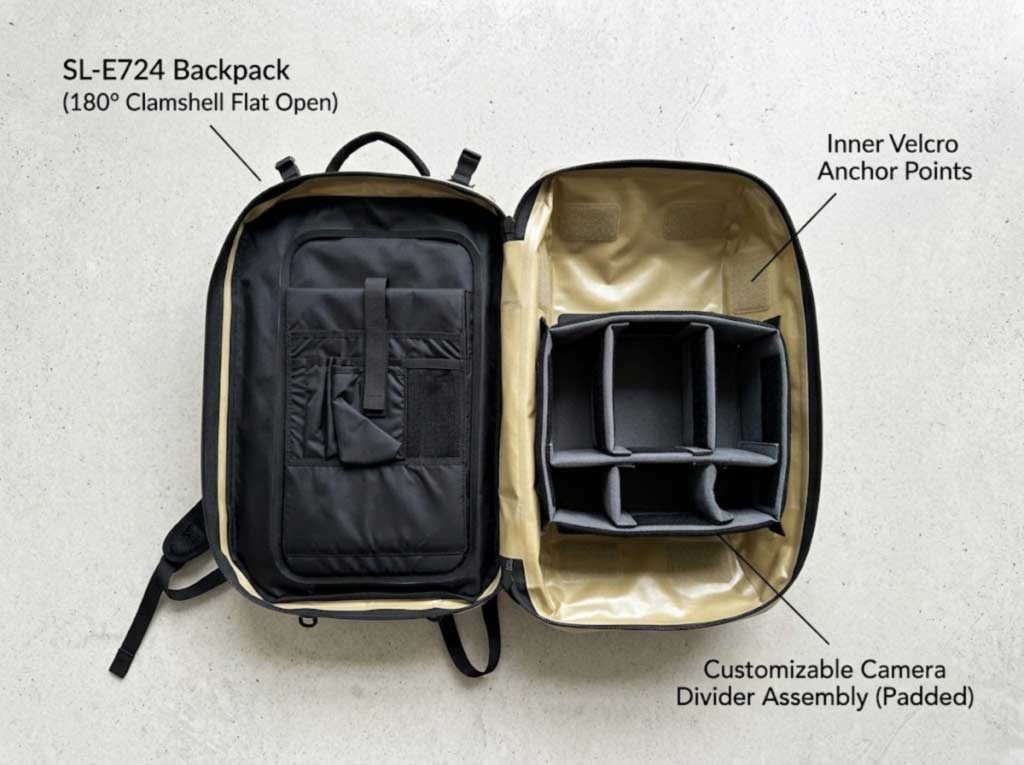
The two-part approach has a practical advantage beyond waterproofing. Because the insert lifts out, the shell can be emptied, wiped and dried after a wet shoot, the insert can be aired separately, and the same insert can move between bags. Our SL-H017C messenger bag is built exactly this way, with a welded TPU shell and a removable padded insert whose divider moves on hook-and-loop to fit a camera body and lens, a small drone or a tablet. Our SL-E724 30 litre clamshell backpack has hook-and-loop anchor panels on its main wall that accept a full camera insert set and dividers for programme-specific layouts.
Which Insert and Divider Details Matter Most?
Depth comes first. A compartment that is too shallow will not take a camera with a battery grip and a lens mounted, which is one of the most common fit complaints in camera bag reviews. When you brief a factory, specify the deepest body and lens combination your customers carry, and design the insert depth around it rather than around an empty shell.
Divider stiffness is next. Thin soft dividers bow under the weight of a telephoto lens and let equipment shift into the next compartment. Dividers with a firmer foam core hold their shape, and a dense loop lining gives the hook-and-loop enough grip to keep them in place on rough trails, while still allowing photographers to rearrange them. Brushed tricot or similar soft facings on the insert walls protect lens elements and rear screens from abrasion.
Access is the third. A clamshell that opens flat to 180 degrees, as on the SL-E724, gives complete access to every compartment and is easy to pack. Side-access doors are quicker in the field but must be wide enough for a lens with its hood fitted. Roll-top camera packs offer excellent weather protection but slower access, and an overfilled roll-top with a magnetic or weak closure can open unexpectedly, so we recommend buckled roll-tops with a defined fold count. A quick-access front pocket with a waterproof zipper keeps spare batteries and memory cards reachable without opening the main compartment.
How Do You Deal With Condensation in a Sealed Camera Bag?
A sealed bag keeps rain out, but it also keeps whatever air is inside, and that air carries moisture. When a photographer moves from a cold shoot into a warm car or room, condensation forms on cold glass and metal, including lenses and sensors. The well-known field practice is to leave the camera sealed inside the bag while it warms up, so that condensation forms on the outside of the bag rather than on the equipment. A sealed welded shell is actually an advantage here.
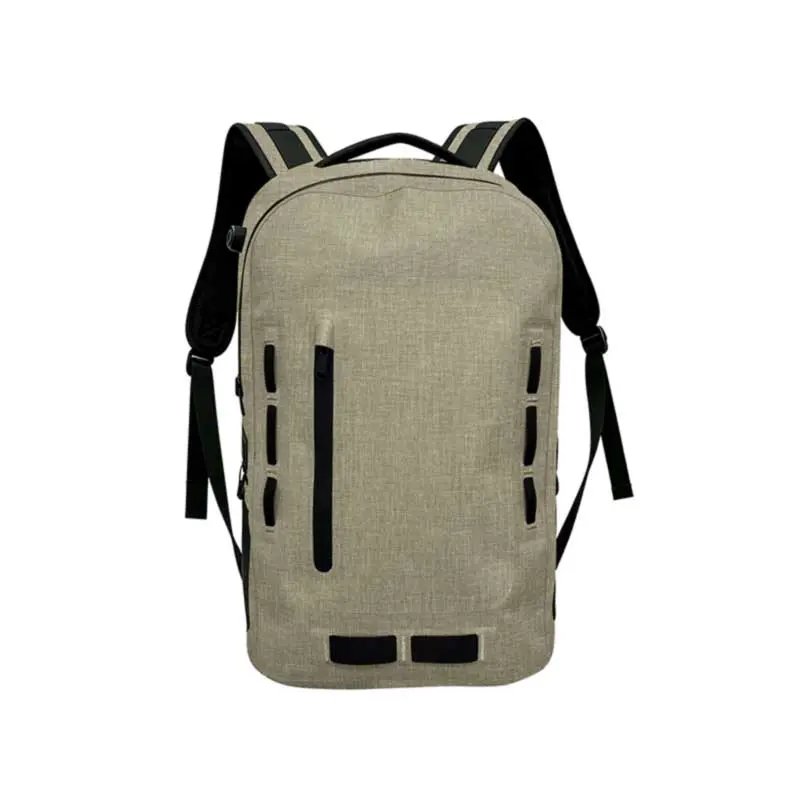
Two design details help. A small mesh pocket inside the insert for a reusable silica gel pack absorbs moisture inside the bag between shoots. And on welded backpacks that go on flights, a one-way pressure-relief valve, such as the one on our SL-E1313, lets trapped air escape during altitude changes without letting water in, which stops the bag ballooning and protects the zippers. We include a short care card on condensation and drying with camera bag orders on request.
What Is the MOQ for Custom Waterproof Camera Bags?
The standard MOQ is 300 pieces per design, including your logo. Shells and inserts can be developed together or separately. A brand can, for example, take an existing welded shell and commission its own insert layout, or order inserts in two depths for the same shell. Custom Pantone colours and custom insert foams need their own material run. A new shell shape needs a new welding die, quoted separately, and ground-up development of a complete camera system takes longer than modifying an existing platform, which we state at quotation. For order structure across our backpack range, see our article on MOQ requirements for waterproof backpack manufacturing.
What Drives the Price of a Waterproof Camera Bag?
The shell construction sets the base. A welded IPX6 shell with waterproof zippers sits in the middle of our range, and a welded IPX8 shell with an airtight zipper costs considerably more because of the closure. The insert is the second major driver, with foam density, the number of dividers, brushed facings and removable or fixed construction all affecting cost. Carry systems, such as a hip belt for heavy kits, tripod straps on welded anchors and a pressure-relief valve, add components. We send a firm FOB quote within 24 hours once we have your reference model or design, the equipment the bag must carry, quantity, colours and logo.
How Can a Camera Bag Be Branded?
Photographers like a bag that looks technical and does not shout. A high-frequency welded TPU logo patch, tone-on-tone shell embossing or a high-build silicone print all suit welded shells without adding needle holes. Inside, the insert can carry a woven label or a printed lining. Branded zipper pulls, colour-matched webbing and a contrasting insert colour that makes small items easier to find in the dark are details users notice every time they open the bag.
How Are Waterproof Camera Bags Tested?
Testing follows the rating. IPX6 camera bags are tested against heavy rain and water jets with all zippers closed, and IPX8 designs go through a full water-immersion test of two hours or more on sampled units from every batch. Weld peel tests run at the start of each production run. Zippers are cycled 3,000 times on our fatigue tester, the bag, straps and tripod anchors go through more than 1,500 load cycles with an equipment-weight load, and hook-and-loop dividers are checked for hold after repeated repositioning. Fabric is checked for abrasion, colour fastness and colour difference. Incoming materials, in-line production and finished goods are inspected in turn, with SGS or QIMA inspection available on request. When buyers inspect welded shipments themselves, we follow the full leak procedure: unboxing, vacuum extraction, a 24-hour static rest, and then the air-leak determination.
Origin in 2026
Goods of both Chinese and Vietnamese origin have carried the 12.5 percent Section 301 baseline in the United States since 24 July 2026, and Chinese origin additionally carries the existing China-specific Section 301 duties. Every Sealock design can be produced at either factory, so United States buyers can compare both origins at the same specification.
Camera Bag Platforms for OEM
The models below are organised by format rather than priority. Each can be fitted with your own insert layout, branding and colours.
| Image | Model | Format | Size | Construction and Protection | MOQ |
|---|---|---|---|---|---|
|
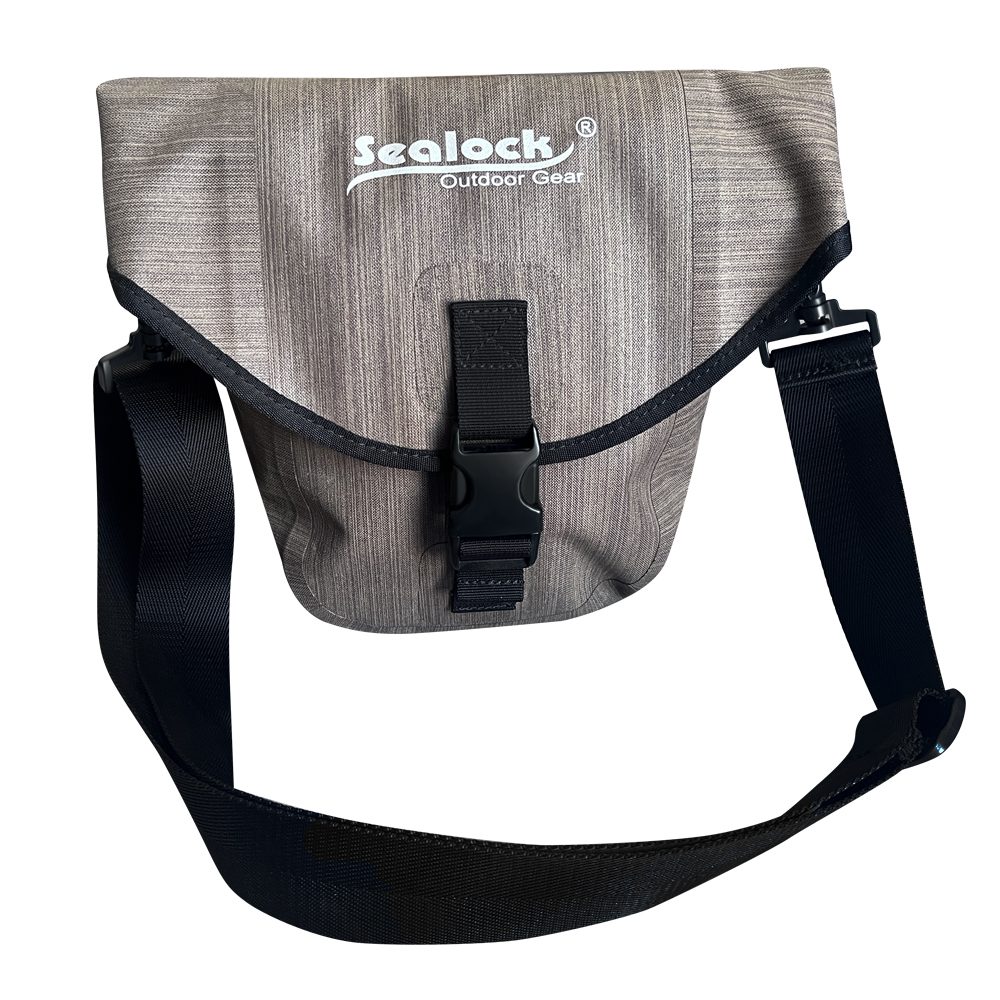
SL-H017C | Messenger with removable padded insert | About 8 to 10 litres | Welded 600D TPU shell, removable insert with hook-and-loop divider, rain and spray rated | 300 pcs |
|
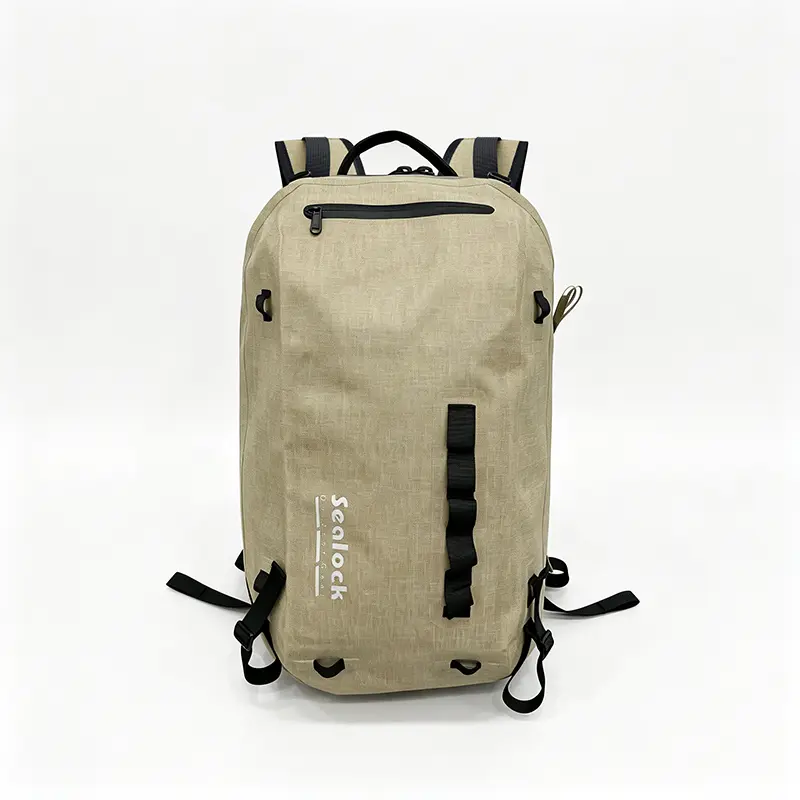
SL-E724 | Clamshell backpack with modular anchors | 30 litres, 27 by 22 by 52 cm, 1 kg | Welded TPU ripstop, YKK waterproof zippers, 180 degree opening, camera insert set option, IPX6 | 300 pcs |
|
SL-E1313 | Backpack with pressure-relief valve | 22 litres, 30.5 by 14.5 by 50 cm, 0.85 kg | Welded 500D TPU laminate, waterproof zippers, one-way valve, suspended padded sleeve, IPX6 | 300 pcs |

|
SL-E119 | Submersible backpack for boat and water shoots | 20 litres, 0.86 kg | Welded TPU composite, airtight zipper, padded compartment, IPX8 | 500 pcs |
|
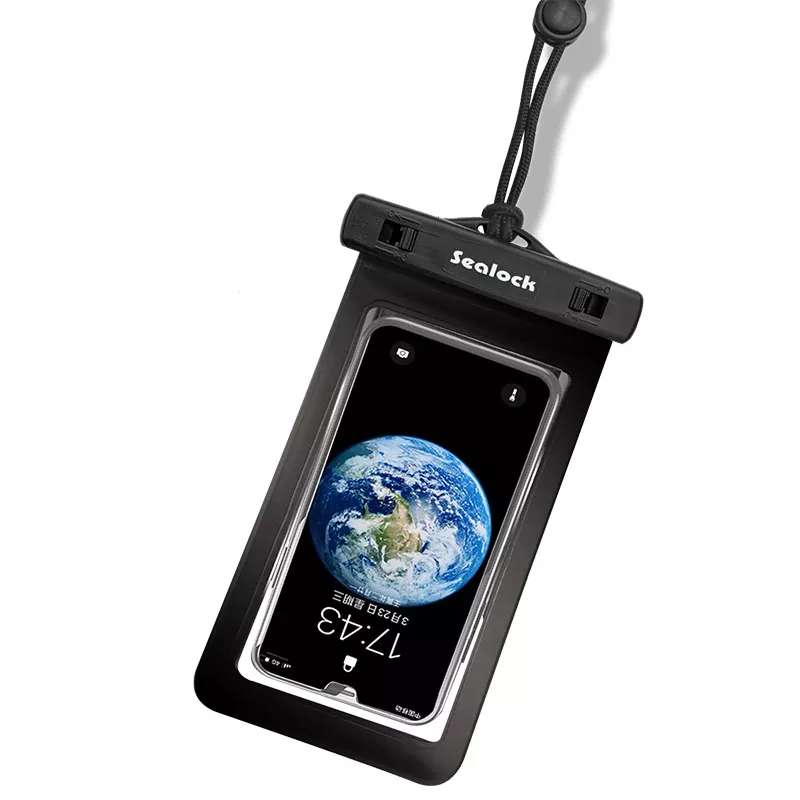
SL-A064 | Phone pouch with rear camera window | Phones up to 7.0 inches | Dual ABS slide locks, front touch window and separate rear camera window, IPX8 to 30 m | 300 pcs |
Standard Terms
Samples take 7 to 15 days on existing shells with your logo, and longer where a new insert or shell must be developed. Bulk production typically takes 30 to 45 days after sample approval. Prices are quoted FOB Guangdong for China origin, with Vietnam origin quoted on request. Sealock has over 20 years of manufacturing experience in welded and sewn bags. For related designs, see our guides to waterproof messenger bags and waterproof laptop backpacks.
Frequently Asked Questions
Do I still need a rain cover?
Not with a welded shell and waterproof zippers. Rain covers wear out and must be deployed in time, while a welded shell is protected all the time.
Why do my dividers bend under a long lens?
Thin, soft dividers bow under heavy lenses. Firmer foam-cored dividers and a dense loop lining keep them in place.
Will my camera fit with a battery grip and lens attached?
It depends on the insert depth. Tell us the largest combination your customers carry and we will size the insert around it.
How do I stop my lens fogging after a cold shoot?
Leave the camera sealed inside the bag while it warms up, so condensation forms on the bag rather than the equipment, and keep a silica gel pack in the insert.
Can the insert be used in other bags?
Yes. Removable inserts lift out in one piece and can be moved between bags or used on their own.
Can you make an insert for a drone?
Yes. Insert layouts can be designed around drones, controllers and spare batteries, as well as cameras and lenses.
Request a Quote for Waterproof Camera Bags
Send us your reference model or design brief, the equipment the bag must carry, quantity, colours, logo file and target market, and we will reply within 24 hours with a construction and insert recommendation, an FOB price and a sample timeline. Contact Sealock about your camera bag project, or email info@sealock.com.hk.