

On an 80°F day, the inside of a parked car can reach 99°F within ten minutes and 109°F within twenty, according to figures from the US National Weather Service cited by Consumer Reports. Frozen food on its way home spends that time in an environment hot enough to start thawing it, and US food-safety guidance allows meat only two hours out of refrigeration, or one hour above 90°F. An insulated grocery bag buys time, and an insulated grocery bag with a zipper buys a great deal more of it than an open-top one. This guide explains why the zipper matters, the three kinds of insulated grocery bag, what to look for, how to use and clean one, and what retailers should specify for their own branded bags. It is written by Sealock (YiFuLong Outdoor Gear Co., Ltd.), which manufactures insulated totes and soft coolers with sewn and high-frequency welded construction in China and Vietnam.
Why a Zipper Makes Such a Difference
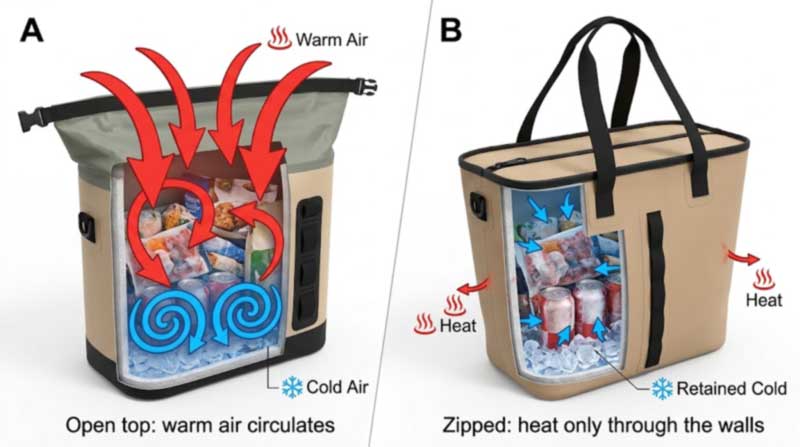
An insulated bag slows heat coming in through its walls, but an open top lets heat in by a faster route: warm air. Cold air is heavier than warm air, so in an open bag the cold sinks and pools around the frozen goods while warm air from the car moves freely across the top, carrying heat in continuously. Closing the bag stops that exchange. A zipper that runs the full width of the opening seals the bag into a closed, insulated box, which is why zippered grocery bags keep frozen food firm for noticeably longer than open totes of the same size and insulation.
The zipper does three other useful things. It keeps everything in place when the bag tips over in a car footwell. It contains drips from thawing packs and condensation, so they do not run onto car seats. And it lets bags stack, because a closed bag has a flat top. For a bag carrying meat, the closure also helps keep raw-meat juices away from everything else in the car.
Three Kinds of Insulated Grocery Bag
| Open-top foil tote | Zippered foam tote | Welded leakproof cooler tote | |
|---|---|---|---|
| Construction | Non-woven or woven fabric with thin foil-faced foam, sewn | Fabric shell, closed-cell foam, wipe-clean liner, sewn, full-width zipper | TPU-laminated shell and liner joined by high-frequency welding, thicker foam, waterproof or airtight zipper |
| Keeps frozen food frozen | Short trips only | A typical drive home, with margin | Long drives, hot days, several stops |
| Contains drips | No | Mostly, if kept upright | Yes, even tipped |
| Washable | Hard to clean, often discarded | Wipe-clean liner | Wipe and rinse, liner seams cannot trap dirt |
| Folds flat | Yes | Usually | Less so |
| Typical use | Store checkout bag | Weekly grocery shopping | Bulk shopping, rural drives, also used as a day cooler |
What to Look For in an Insulated Grocery Bag With Zipper
A zipper that opens the whole top. A narrow zip opening makes loading a frozen pizza or a family pack of meat awkward and tempts you to leave the bag half open. Look for a zipper that runs the full width, ideally on three sides or with two sliders, so the bag opens wide and closes completely. The zipper is also the part that wears first; ours are fatigue-tested to 3,000 cycles because a grocery bag is opened and closed every week for years.
Real insulation, not just a foil layer. A thin foil-faced liner reflects some radiant heat but adds little insulation on its own. A grocery bag that keeps frozen food frozen has a layer of closed-cell foam in the walls and, importantly, in the base, which sits on a hot car floor.
A liner you can actually clean. A study published in Food Protection Trends in 2011 tested reusable shopping bags collected from shoppers in California and Arizona and found coliform bacteria in about half of them and E. coli in 8%. Most owners said they seldom or never washed their bags. Washing by hand or machine cut bacteria by more than 99.9%. A smooth, food-grade, wipe-clean liner with few seams and corners is the single most important hygiene feature.
Handles and a base that carry a real load. A full grocery bag can easily weigh 10 kg or more; our grocery totes are rated for a 40 lb (18 kg) load. Check that the handles are stitched through a reinforcing patch or run under the base rather than being sewn to the top edge alone, and that the base is flat and stiff enough for the bag to stand when loaded.
The right size. A bag that is too large for the frozen goods holds a lot of warm air. Many shoppers use two bags: one for frozen items packed tightly together, and one for chilled items.
How to Use One So Food Stays Frozen
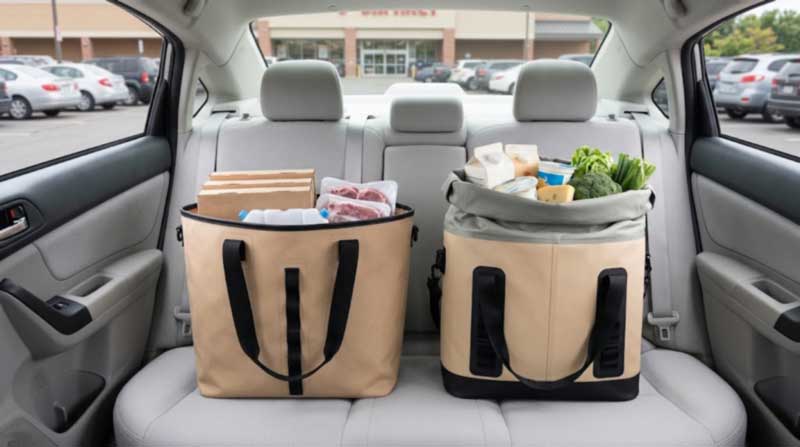
Take the bags into the store with you rather than leaving them to heat up in the car; as one food-safety educator told Consumer Reports, leaving them in the car defeats the purpose. Pick up frozen and chilled items last, and pack frozen goods tightly together in one bag, since frozen items keep each other cold. Keep raw meat and fish separate from other food. Put the bags in the air-conditioned cabin rather than the trunk, which is usually the hottest part of the car, make grocery shopping the last stop, and refrigerate perishables as soon as you get home. On very hot days or long drives, add a frozen gel pack or move the shopping into a cooler.
Cleaning an Insulated Grocery Bag
Empty the bag after every trip and wipe the liner with warm soapy water, especially after carrying meat or anything that has leaked. Leave it open to dry completely before folding it away; a bag zipped shut while damp starts to smell. A bag used for raw meat is worth washing every week. Welded liners are easier to keep clean because their seams are fused, with no stitch lines or tape edges for dirt to collect in. Our guide to how to pack a cooler covers the same principles for longer trips.
For Supermarkets, Retailers and Brands
Insulated grocery bags are one of the most visible branded products a retailer sells: they sit at the checkout, travel home with the customer and are seen in every car park. For store-brand programmes, a sewn zippered foam tote with a full-panel print gives the best balance of price and performance; a welded leakproof tote works as a premium line or for delivery and click-and-collect services where bags must survive repeated cleaning. When we build a private-label grocery bag, the specification fixes foam thickness for the walls and base, the zipper type and length, a food-grade liner, handle construction rated for the load, and the print method for the logo, and we test the sample for zipper life, handle load and leakage before bulk. MOQ starts at 300 pieces, samples take 7–15 days and bulk production 30–45 days.
Insulated Grocery Totes in Our Range
| Image | Model | Specification | Link |
|---|---|---|---|
|
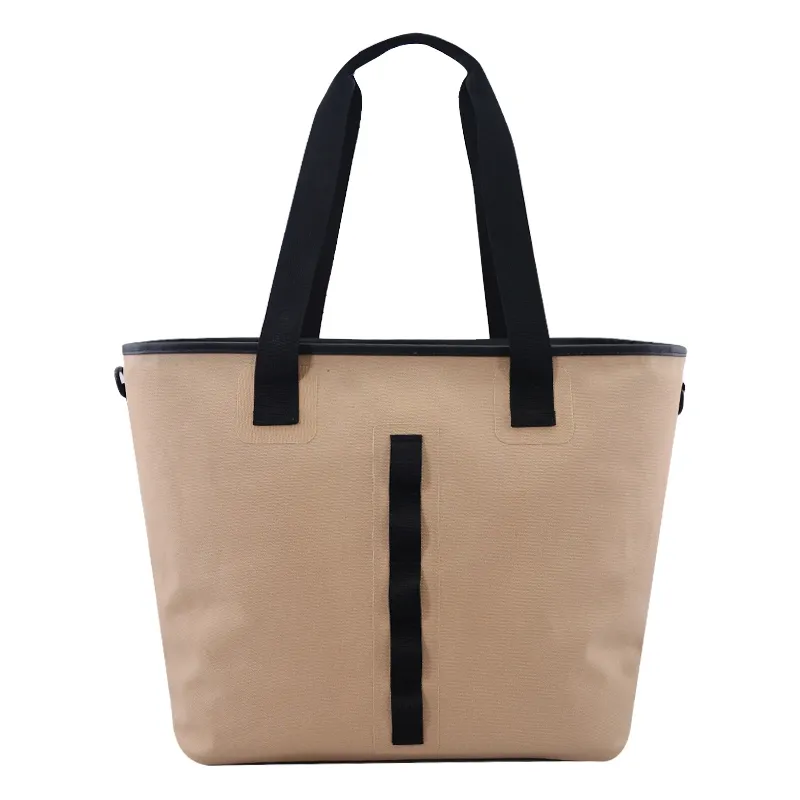
Zippered Cooler Tote Bag (SL-C529) | 50 × 30 × 30 cm; TPU mesh outer, EPE foam, food-safe PEVA liner; waterproof zipper; widened handles for carrying flat; 8+ hr with the zipper closed; 40 lb load | View |
|
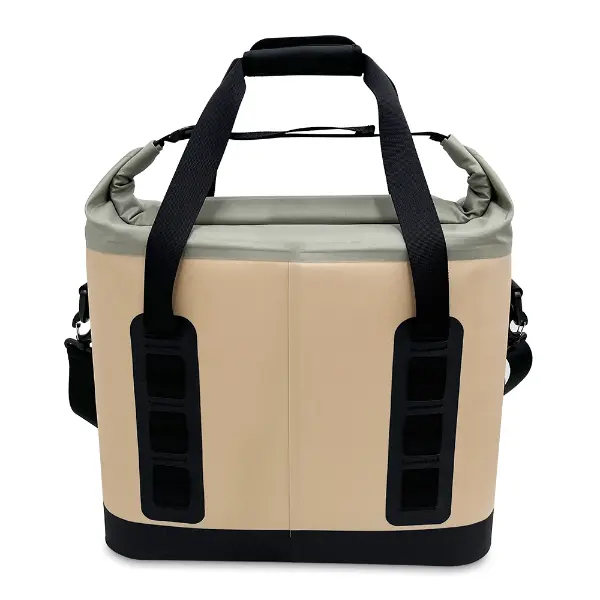
20L Roll-Top Leakproof Cooler (SL-I288) | Welded roll-top: 840D TPU, closed-cell EPE, reinforced base, up to 48 hr | View |
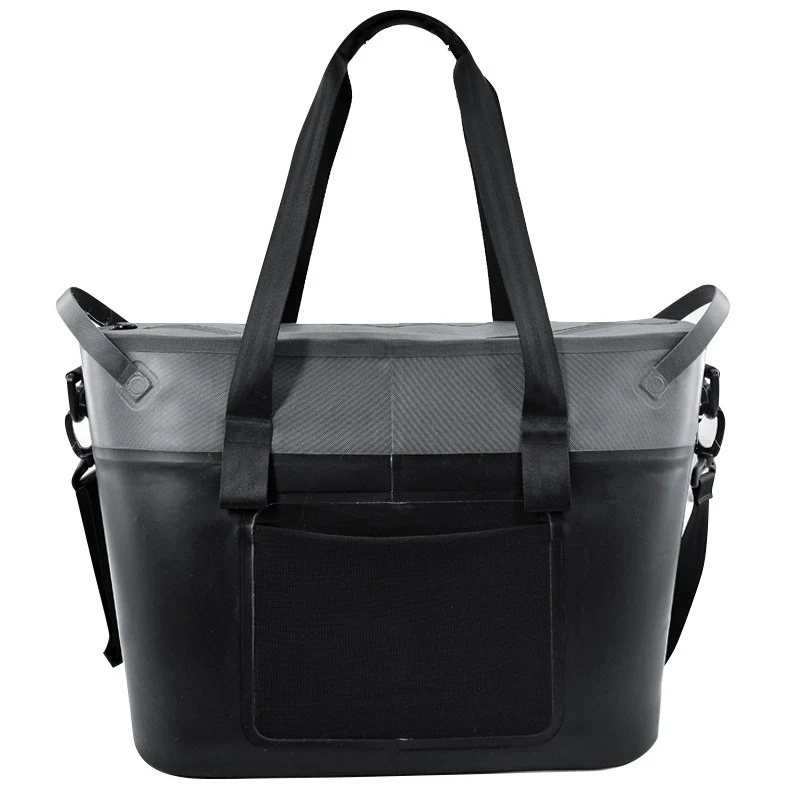
|
Insulated Tote Bags | Everyday grocery and shopping tote; TPU or polyester outer, odour-resistant PEVA liner, zipper; custom sizes and prints | View |
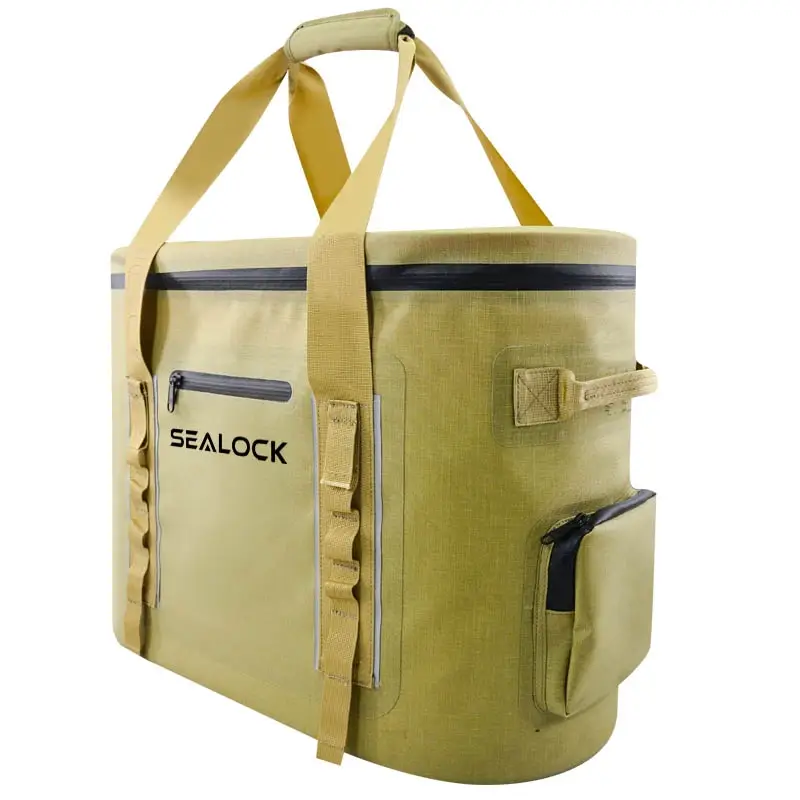
|
Large Cooler Tote Bag | 30+ cans; TPU mesh outer, multi-layer insulation, zipper; for bulk shopping and family loads | View |
All are available with your logo, colours and print, in custom sizes, with food-grade liners as standard. MOQ starts at 300 pieces, samples take 7–15 days and bulk production 30–45 days.
FAQ
Q: Do insulated grocery bags keep frozen food frozen?
A: For a normal drive home, a zippered bag with foam insulation keeps frozen food firm, especially if frozen items are packed together and the bag rides in the air-conditioned cabin. For long drives or hot days, add a frozen gel pack or use a cooler.
Q: Is a zipper really necessary on an insulated grocery bag?
A: It makes a large difference. An open top lets warm air circulate over the contents continuously; a full-width zipper closes the bag and stops that exchange, and also contains drips and keeps the bag stackable.
Q: How long can groceries stay in an insulated bag?
A: Treat the bag as extra margin, not storage. US food-safety guidance limits perishables to two hours out of refrigeration, or one hour above 90°F. Get them into the refrigerator as soon as you reach home.
Q: Can you wash an insulated grocery bag?
A: Wipe the liner with warm soapy water after use and let it dry open. Research on reusable shopping bags found washing reduced bacteria by more than 99.9%.
Q: What is the best insulated grocery bag with zipper?
A: One with a full-width zipper, closed-cell foam in the walls and base, a smooth food-grade liner, handles anchored for a 10 kg load and a size that matches what you buy frozen.
Q: Can you make branded insulated grocery bags for our store?
A: Yes, in sewn or welded construction with your print, from 300 pieces, with samples in 7–15 days.
Planning a store-brand insulated bag? Tell us the size, price point and print. We will propose a construction and send samples in 7–15 days.
Email: info@sealock.com.hk · Phone: +86-13632981825 · MOQ 300 pcs
Car temperature figures are from the US National Weather Service as reported by Consumer Reports; reusable bag findings are from Williams, Gerba, Maxwell and Sinclair, Food Protection Trends, 2011. Follow local food-safety guidance.