- English
- Español
- Português
- русский
- Français
- 日本語
- Deutsch
- tiếng Việt
- Italiano
- Nederlands
- ภาษาไทย
- Polski
- 한국어
- Svenska
- magyar
- Malay
- বাংলা ভাষার
- Dansk
- Suomi
- हिन्दी
- Pilipino
- Türkçe
- Gaeilge
- العربية
- Indonesia
- Norsk
- تمل
- český
- ελληνικά
- український
- Javanese
- فارسی
- தமிழ்
- తెలుగు
- नेपाली
- Burmese
- български
- ລາວ
- Latine
- Қазақша
- Euskal
- Azərbaycan
- Slovenský jazyk
- Македонски
- Lietuvos
- Eesti Keel
- Română
- Slovenski
- मराठी
- Srpski језик

Tackle Bag, Tackle Box or Tackle Backpack? How to Carry Fishing Gear So It Stays Organised, Dry and Rust-Free
A tackle bag is a soft bag that holds several plastic utility boxes plus tools, line and accessories in outer pockets. A hard tackle box is a single rigid case with trays. A tackle backpack is a tackle bag with shoulder straps for walking to the water, and a sling or hip pack carries a minimal kit for anglers on the move. Most modern anglers use a soft bag or backpack loaded with standard-size utility boxes, usually the smaller 3600 size, about 11 × 7 inches, or the larger 3700 size, about 14 × 9 inches. This guide explains how to choose between them, what actually destroys tackle in storage, and why a waterproof bag matters more than most anglers think.
Tackle rarely wears out from fishing. It is lost to rust, tangles, melted soft plastics and boxes that flood in the bottom of a boat. The bag you carry it in decides most of that.
Tackle Bag vs Tackle Box: Which Is Better?
A hard tackle box with cantilever trays protects lures well and doubles as a seat on the bank, but it is heavy, awkward to carry far and holds a fixed layout. A soft tackle bag is lighter, carries more in less space and lets you swap utility boxes for each trip: a box of crankbaits for one lake, a box of jigs and soft plastics for another. That flexibility is why soft bags loaded with standard-size utility boxes have become the default for most anglers.
The most useful thing to check on any bag is which box size it is built around. Most soft tackle bags are designed to take either 3600 or 3700 boxes, and some take a few of each. Buy the boxes to match the bag, or the bag to match the boxes you already own, because the two standards do not swap.
When Is a Tackle Backpack or Sling the Better Choice?
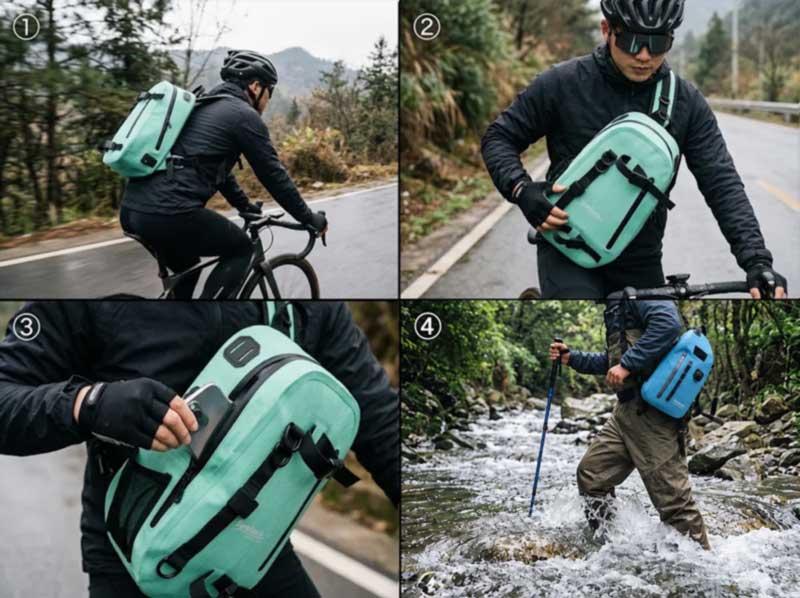
When you walk. Anglers who fish from the bank, hike to a river, wade or move between spots carry far more comfortably on two shoulders, and a tackle backpack keeps both hands free for a rod and a net. Look for a padded back panel, a waist belt for heavier loads and external attachment points for pliers, a net and a rod holder. Our 21 litre SL-E1144 is built this way.
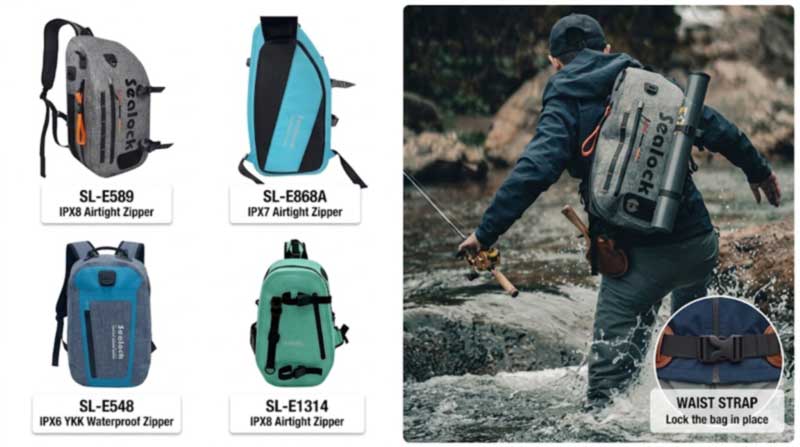
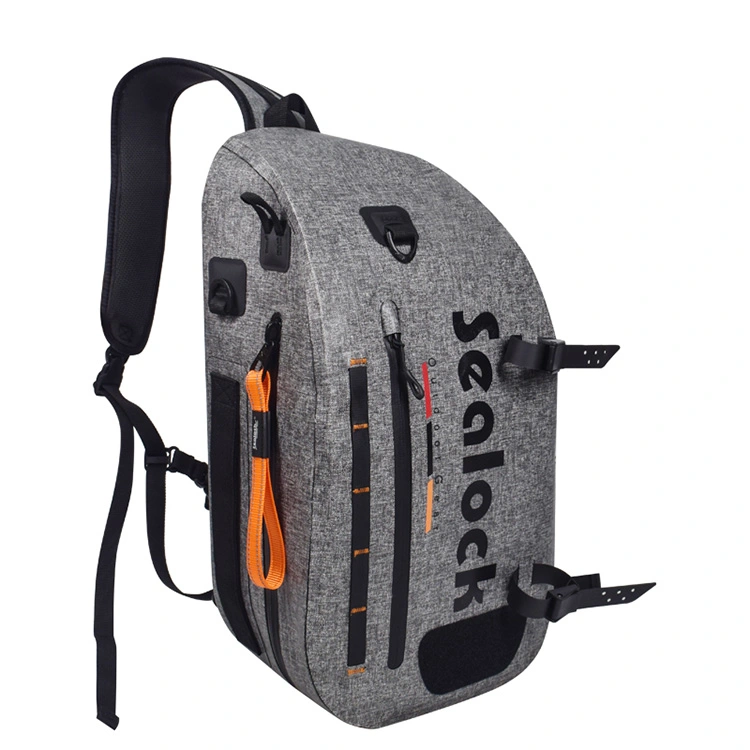
For fly fishing, lure fishing on foot and wading, a sling or hip pack is faster still. A sling swings to the front without being taken off, so a fly box or a lure tray is in your hand in seconds. Our article on waterproof sling bags explains how to choose one, and the trade-off is simple: a sling carries less, so it suits anglers who pick two or three boxes for the day rather than bringing everything.
What Destroys Tackle in Storage?
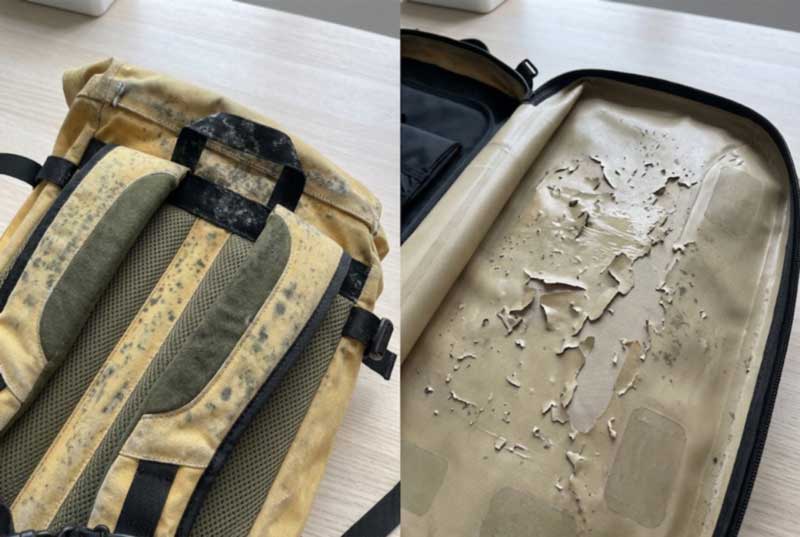
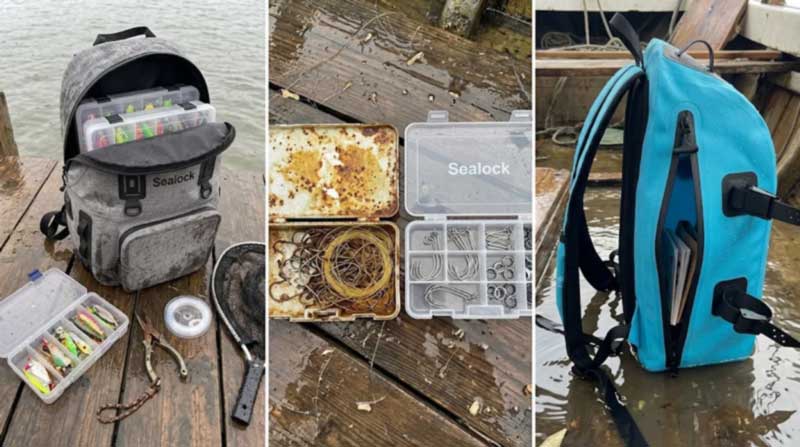
Rust is the first enemy. Hooks, split rings and trebles left wet in a closed box rust within days, and the rust spreads to every lure in the compartment. Salt water accelerates it badly. The habits that prevent it are simple: let lures dry in the open before putting them back, rinse saltwater tackle in fresh water, use vented utility boxes or a rust-inhibiting insert, and never store a wet bag zipped shut. A closed, damp bag is a humid box, the same mechanism that causes the problems described in our article on mold on waterproof bags.
Soft plastics are the second. Some soft plastic baits react with certain hard plastic boxes, softening, melting or fusing to them, and different colours bleed into each other when stored together. Keep soft plastics in their original packets or in boxes marked as worm-proof, and keep them away from hard baits.
Water is the third. A bag sitting in the bilge water at the bottom of a boat, a wave over the gunwale or a slip on a wet rock floods an ordinary polyester tackle bag in seconds. Most standard tackle bags are made of coated polyester with sewn seams and ordinary zippers, so the water goes straight through to the boxes inside. A bag with high-frequency welded seams and a waterproof or airtight zipper keeps the boxes dry, so the rust problem never starts.
Waterproof Tackle Bags We Manufacture
| Image | Model | Capacity | Dimensions (H × W × D) | Weight | Construction | Use |
|---|---|---|---|---|---|---|

|
SL-E1144 | 21 L |
45.5 × 32 × 14.5 cm 17.9 × 12.6 × 5.7 in |
1.1 kg | Welded Melange TPU panels, PU-laminated waterproof main zipper, EVA ventilated back panel, waist belt, multi-point tool and rod attachments | Tackle backpack for bank and boat |

|
SL-E717 | 20 L |
46 × 30 × 16 cm 18.1 × 11.8 × 6.3 in |
1.0 kg | 840D TPU, airtight waterproof zipper, side rod holder, cross-chest pack and bottle holder | Fly and lure fishing day pack |
|
SL-E589 | 15 L |
48 × 27 × 16 cm 18.9 × 10.6 × 6.3 in |
0.87 kg | Welded 840D TPU, airtight zipper with moulded end caps, waist belt, IPX8 to 20 m | Wading sling that holds 3600 boxes |

|
SL-E868A | 12 L |
45 × 23 × 15.5 cm 17.7 × 9.1 × 6.1 in |
0.8 kg | Welded 840D TPU, airtight zipper, seamless welded liner, IPX8 to 20 m | Compact submersible tackle sling |

|
SL-E548 | 8 L |
42 × 22 × 9 cm 16.5 × 8.7 × 3.5 in |
0.6 kg | Welded 500D PVC laminate, full-arc airtight zipper, moulded rod and plier holders, IPX7 | Light lure-fishing sling |

|
SL-E825 | 10 L |
35 × 28 × 12 cm 13.8 × 11 × 4.7 in |
0.55 kg | Nylon and 600D TPU, airtight zipper, net holder on the front, multiple attachment points | Shoulder bag for hooks, line and bait boxes |

|
Creek Hip Pack | 4.5 L |
18 × 30 × 10 cm 7.1 × 11.8 × 3.9 in |
0.45 kg | 840D TPU, waterproof zippers, expandable waist belt, reflective front pocket, 1.5 L bottle pocket | Minimal hip pack for creeks and surf |
The full range is in our waterproof fishing bag category. Waterproof ratings are explained in our guide to waterproof ratings for bags.
Developing Tackle Bags for Your Brand
For fishing brands, the details that win reviews are a main compartment sized precisely to 3600 or 3700 boxes, external tool holders that do not puncture the waterproof shell, a rod holder and a net clip, a light-coloured interior so lures are easy to find, a drain or wipe-clean base and a waterproof phone or licence pocket. The details that cause returns are zippers that corrode in salt water, boxes that do not fit and seams that leak. We weld tool docks and attachment points onto the shell rather than sewing through it, use corrosion-resistant zippers and hardware for saltwater ranges, and can size compartments to a brand's own utility boxes. The MOQ is 300 pieces per design (500 on some models), samples take 7 to 15 days and bulk production 30 to 45 days, quoted FOB Guangdong with Vietnam origin available. Sealock has over 20 years of experience making fishing bags, including for brands such as SIMMS, ORVIS, PENN and AFTCO. For the manufacturing side, see our article on fishing sling bag manufacturing.
Frequently Asked Questions
What size tackle box fits in a tackle bag?
Most bags are built for either 3600 boxes, about 11 × 7 inches, or 3700 boxes, about 14 × 9 inches. Check the bag's specification before buying boxes.
How do I stop my hooks rusting in my tackle bag?
Dry lures in the open before storing them, rinse saltwater tackle, use vented boxes or rust inhibitors, and never leave a wet bag closed.
Why are my soft plastics melting in the box?
Some soft baits react with certain hard plastics. Use worm-proof boxes or the original packets, and keep soft plastics separate from hard baits.
Is a tackle backpack better than a tackle bag?
If you walk to the water or wade, yes. If you fish from a boat or close to the car, a shoulder tackle bag gives easier access to the boxes.
Do I need a waterproof tackle bag?
On boats, kayaks, in surf or when wading, yes. A waterproof bag keeps boxes dry, which is the simplest way to prevent rust.
How many tackle boxes should I carry?
Three or four boxes chosen for the day's target species usually beats carrying everything. A smaller, focused kit is easier to carry and easier to keep organised.
Request a Quote
Tell us the bag type, the box size it must fit, the closure and rating, colours and quantity, and we will reply within 24 hours with suitable base models, an FOB price and a sample timeline. Contact Sealock, or email info@sealock.com.hk.
Send Inquiry
Related Products


News Recommendations