
- English
- Español
- Português
- русский
- Français
- 日本語
- Deutsch
- tiếng Việt
- Italiano
- Nederlands
- ภาษาไทย
- Polski
- 한국어
- Svenska
- magyar
- Malay
- বাংলা ভাষার
- Dansk
- Suomi
- हिन्दी
- Pilipino
- Türkçe
- Gaeilge
- العربية
- Indonesia
- Norsk
- تمل
- český
- ελληνικά
- український
- Javanese
- فارسی
- தமிழ்
- తెలుగు
- नेपाली
- Burmese
- български
- ລາວ
- Latine
- Қазақша
- Euskal
- Azərbaycan
- Slovenský jazyk
- Македонски
- Lietuvos
- Eesti Keel
- Română
- Slovenski
- मराठी
- Srpski језик

Waterproof Fishing Backpacks for Professional Anglers
Sealock manufactures waterproof fishing backpacks for guide services, professional anglers, and OEM brand programmes from factories in China and Vietnam, with welded and stitched construction in house. Among fishing bag formats, the backpack is defined by a specific tension: it carries the most weight and gives the least access. Every design decision that separates a professional-grade pack from a consumer one is an attempt to resolve that — and most of the work happens in load carriage and reinforcement rather than in waterproofing.
1. Company and Terms
Sealock (YiFuLong Outdoor Gear Co., Ltd.) has built waterproof bags for over 20 years, producing for international outdoor and fishing brands including ORVIS, SIMMS, West Marine, and PENN.
- Facilities: Dongguan, China | Ho Chi Minh City, Vietnam — either origin available on any model
- Production: 27.12 MHz high-frequency welding and industrial sewing as separate workshops on the same production floor
- MOQ: 300 pcs on backpack models | Samples: 7–15 days | Capacity: 15,000 pcs/month
- Certifications: BSCI, ISO 9001, Sedex, plus HIGG, GRS, SCAN | Warranty: one year on most fishing models
2. Load Carriage Is the Backpack's Real Engineering Problem
A guide's pack routinely carries more than the angler's own kit — spare flies and tippet for clients, a first aid kit, rain layers, lunch, a camera, and water. Field testing puts a properly loaded fishing backpack in the 5–8 kg range on 20–40L packs, and that weight is carried for a full working day rather than an afternoon.
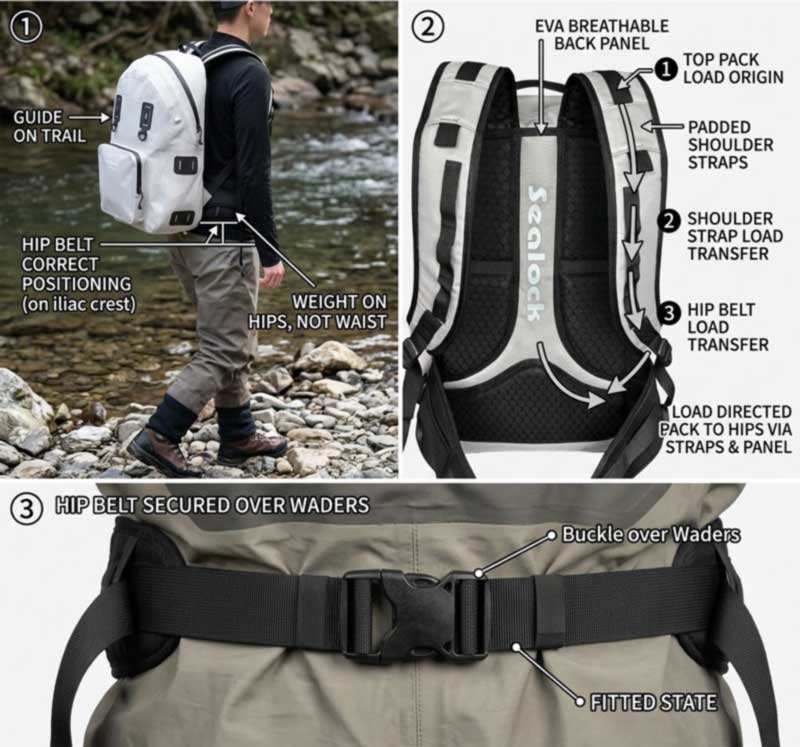
The load distribution system is what makes that sustainable. In comparative field testing, anglers wearing properly fitted packs with hip belts reported meaningfully less shoulder fatigue after six-hour sessions than those using packs without load distribution, with the difference becoming pronounced from around the fourth hour — precisely the point where a guide's day is only half done. For a professional programme that makes the hip belt, sternum strap, and back panel non-negotiable rather than premium features.
Three specifics belong in a professional specification:
- A real hip belt that transfers weight from shoulders to hips, adjustable enough to sit correctly over waders.
- An adjustable sternum strap to stabilise the load during hiking and wading.
- A ventilated back panel — on the 21L pack this is an EVA vent panel with thick padded shoulder straps, an adjustable waist belt, and a sternum clip.
3. The Access Problem, and How Professionals Solve It
The backpack's weakness is structural: reaching gear normally means taking the pack off, which is awkward mid-stream and impossible while holding a rod with a fish on. Consumer packs ignore this; professional users solve it by running a layered system — a backpack carrying the day's bulk, plus a front-mounted element carrying what gets used every few minutes.
Two ways to build that into a product rather than leaving the customer to assemble it:
- An integrated cross chest pack. The 20L fly fishing backpack carries one, so frequently used items sit at the chest while the main volume rides on the back — one product covering both roles.
- Designed pairing. A backpack specified alongside a sling or chest pack in the same range, sharing colourway and branding, so a guide service equips staff with a matched system rather than mixed gear.
For a brand this is a range-architecture decision as much as a product one, and it produces multi-unit sales to the same customer. Format selection across the wider range is covered in the guide to OEM fishing bags for wholesale buyers.
4. Compatibility With Waders and an All-Day Working Day
Professional use adds constraints a weekend angler never notices. Chest and waist straps have to be positioned so they do not interfere with wader straps or a wading belt, and the harness has to adjust across the bulk of layered fishing clothing rather than a t-shirt. Breathability matters more than on general outdoor packs, because a guide works in waders through hot and humid days, and back panel ventilation is what determines whether that is tolerable — the systems that work minimise contact points and keep an airflow channel between pack and back.
Terrain adds another: dense brush along overgrown banks demands snag-resistant surfaces and low-profile external hardware, which is why professional-grade packs tend to run cleaner exteriors than the pocket-covered consumer alternative.
5. Rod Carry: A Genuine Trade-off to Specify
Rod transport on a backpack has two valid answers and no perfect one. External holders and tube straps give quick access and easy loading but leave rods exposed to brush and knocks; internal or sleeved carry protects the blank and tip but slows access. Professional packs typically favour secure external rod tube straps with compression, since a guide hiking into a spot is protecting a cased rod rather than a rigged one, and adding removable rod holders is a way to offer both.
Related attachments worth specifying for professional use: a net slot or sleeve rather than a retractor alone, hydration bladder compatibility with a hose port for long days, tool loops for pliers and cutters, wader loops for securing stockingfoot waders after a session, and D-rings and lash tabs for nets, fish grips, and headlamps.
6. Reinforcement Is Sewing Work, and It Is Where Professional Packs Are Won
Waterproofing gets the marketing attention; reinforcement determines whether a pack survives commercial daily use. On a fishing backpack the stress concentrates in predictable places, and the answers are stitching operations rather than welding ones:
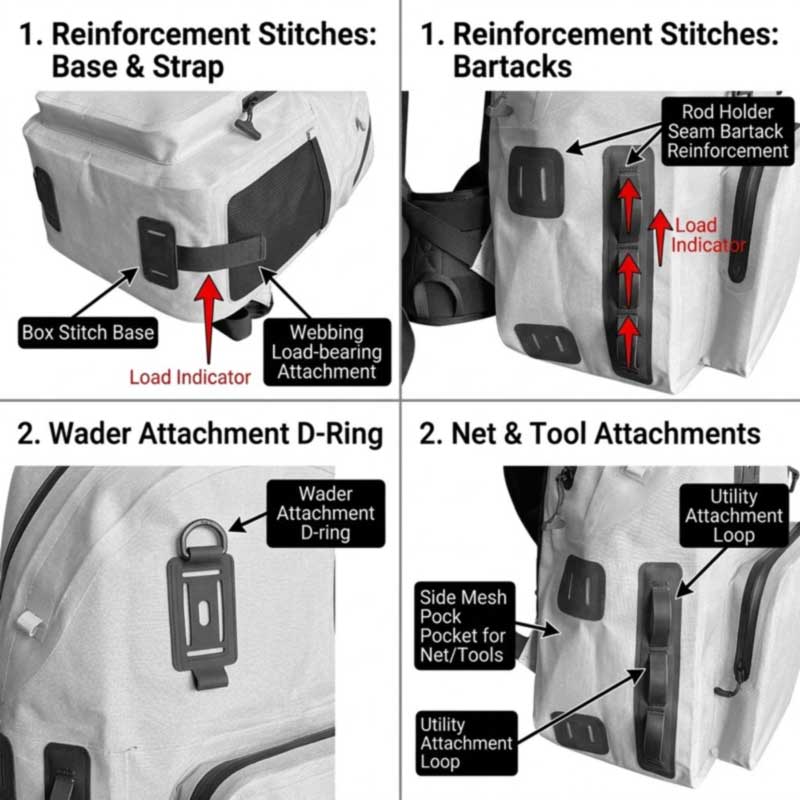
- A box-stitched base that takes repeated setting down on gravel, rock, and boat decks.
- Bartack reinforcement at rod holder seams, which see leverage every time a rod is loaded or removed.
- Webbing underbelts carrying load through the pack body rather than through fabric alone.
- Reinforced strap anchors, attached at welded patches so load never runs through the waterproof membrane.
This is why the sewing workshop matters as much as the welding line for this category. Welding builds the sealed body; sewing builds the harness, the ventilated back panel, the pockets, and every reinforcement above — and the 21L pack combines both, with a fully stitchless RF-welded panel structure carrying a sewn EVA vent back panel, padded straps, waist belt, and multi-point lash system. The harness engineering behind this is covered in the guide for waterproof backpack OEM projects.
7. Capacity Follows Carry Distance, Not Gear Volume
A useful rule for specifying a professional range: how far the pack is carried matters more than how much it holds. A pack moving twenty feet from a truck to a boat deck can prioritise capacity and organisation over weight. A pack carried two miles into a backcountry stream has to prioritise weight optimisation and carry comfort, where hip belts and ventilated panels shift from convenience to necessity.
| Use | Capacity | Priority |
|---|---|---|
| Shore and bank, moving between spots | 15–25L | Nimble profile, quick-access pockets, rod channel |
| Boat and kayak | 20–40L | Sealed closure, capacity, net and tool attachment |
| Hike-in and backcountry | 35–45L | Full harness, hydration, ventilation, removable rod holders |
8. Backpack Range
Models organized by type rather than priority:
| Image | Model | Capacity | Material | Carry system | Product Page |
|---|---|---|---|---|---|
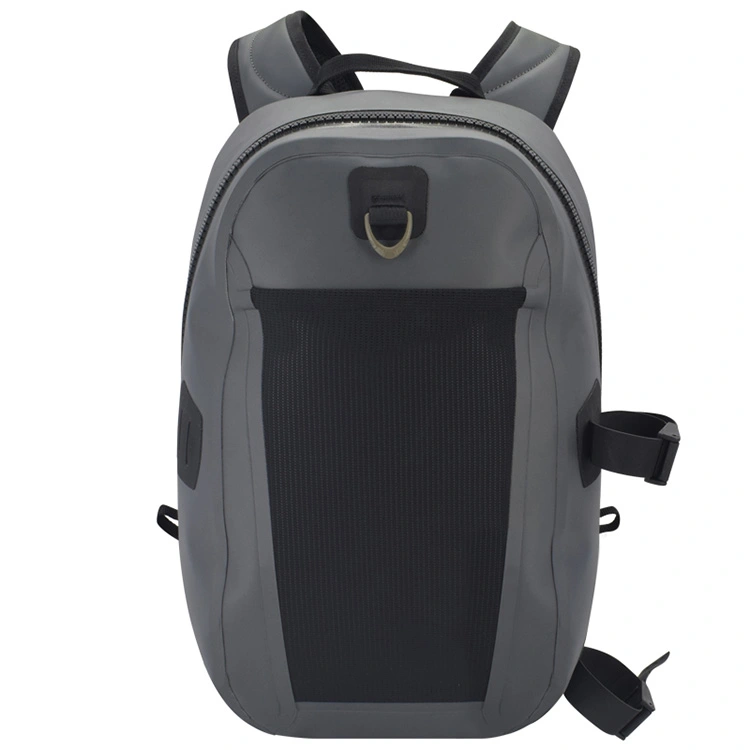
|
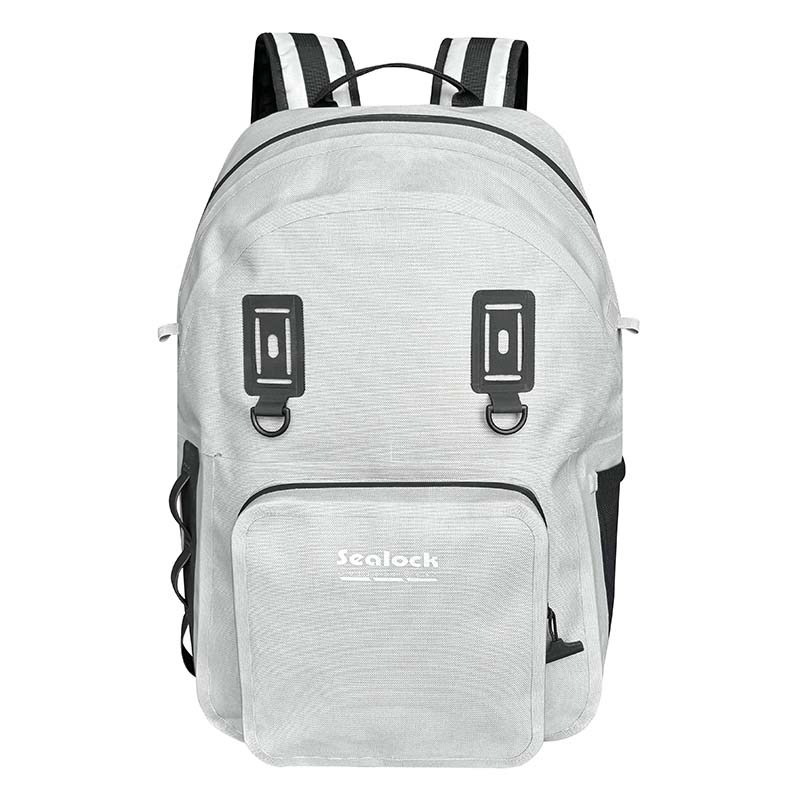
SL-E1144 | 21L (18–20L usable) | Melange TPU laminate | EVA vent back · padded straps · waist belt · sternum clip · multi-point lash and D-rings | View |
|
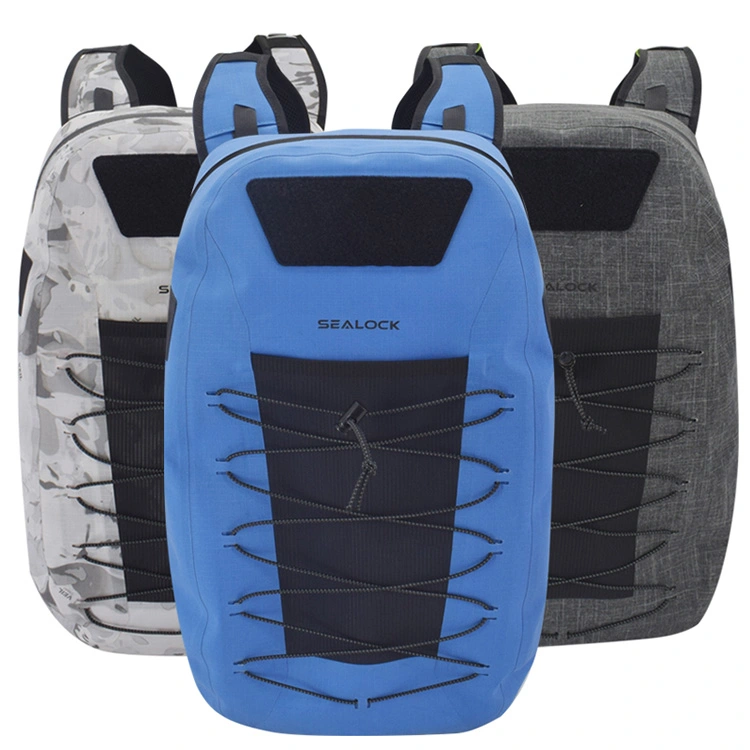
SL-E717 | 20L | 840D / 600D TPU | Integrated cross chest pack · bottle holder | View |
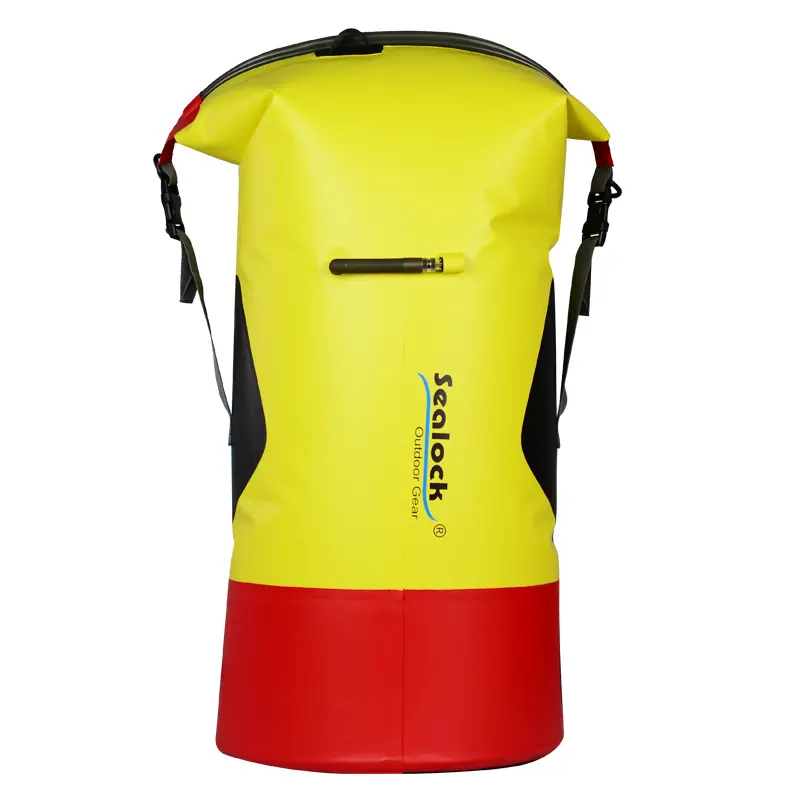
|
SL-E718 | 15L | 600D TPU on nylon | Two-layer construction · compact day carry | View |
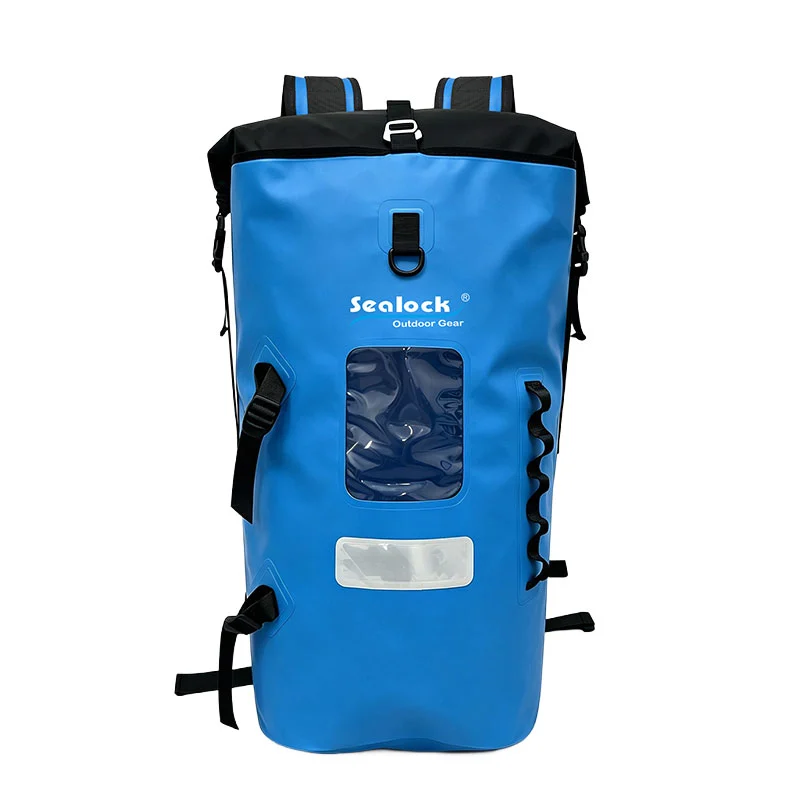
|
SL-E090 | 40L | 500D PVC (TPU option) | Airtight zipper · convertible backpack / tote · reinforced base | View |
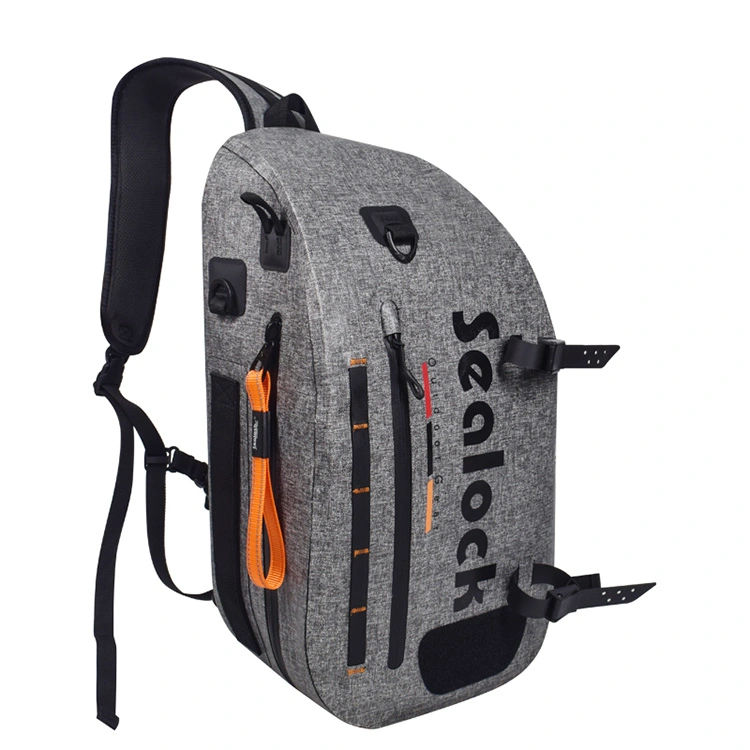
|
SL-E273A | 45L | 500D PVC (TPU option) | Padded straps · sternum strap · waist belt · breathable padded back · side lash points | View |
|
SL-E589 | 15L | 840D double-coated TPU | Sling companion for a layered system · IPX8 to 20 m · waist belt | View |
Full categories sit under dry backpacks, waterproof bags, and dry bags. Category engineering is covered in the guide for fishing bag manufacturing, and fly-specific requirements in the fly fishing bag guide.
9. OEM Scope
Beyond logo and colour, a professional backpack programme can specify construction across welded, stitched, and hybrid builds; capacity and torso dimensions; harness geometry including hip belt, sternum strap, and load lifters; back panel type and ventilation; wader-compatible strap positioning; rod carry method, internal or external, fixed or removable; hydration compatibility; net attachment; tool loops and lash matrix; base and stress-point reinforcement; waterproof level and closure; drainage where a splash-rated build is specified; branding; and packaging. Ground-up development from a sketch, sample, or target spec is supported.
10. Quality Control
Fabric inspection, weld seam inspection, zipper testing, colour consistency against the signed sample, appearance, and carton inspection run at 100%, with full water immersion of two hours or more by batch sampling and strap, buckle, handle, and D-ring pull testing by random sampling. Load cycling over 1,500 cycles targets strap anchors and handles — the first components to fail on a pack carried loaded every working day. Three-stage control applies: IQC on incoming fabric, zippers, and hardware; IPQC on welds, stitch density and tension, and zipper installation in process, including peel tests on sample welds at run start; and OQC with AQL sampling and gold-sample comparison. The full customer inspection procedure — unboxing, vacuum extraction, a 24-hour static rest, and air-leak determination — can be witnessed end to end, with SGS or QIMA inspection available. Standards are set out in the quality control standards for waterproof production.
11. FAQ
Q: What separates a professional fishing backpack from a consumer one?
A: Load carriage and reinforcement, not waterproofing. A guide carries client gear as well as their own, all day, every working day — so a real hip belt, sternum strap, ventilated back panel, box-stitched base, and bartacked rod-holder seams matter more than an extra pocket.
Q: How do we solve the access problem inherent to backpacks?
A: Build the layered system into the product. Either integrate a cross chest pack so frequently used items sit at the chest, or specify a matching sling or chest pack in the same range so a guide service equips staff with one coordinated system rather than mixed gear.
Q: Does the harness need to work with waders?
A: Yes, and it is a common oversight. Chest and waist straps must be positioned so they do not clash with wader straps or a wading belt, and the harness has to adjust across layered fishing clothing rather than a single layer. Confirm it at sampling with the pack worn over waders.
Q: Internal or external rod carry?
A: External tube straps for speed and easy loading, internal or sleeved carry for blank and tip protection. Professional packs generally favour secure external straps with compression, and removable rod holders let one product serve both preferences.
Q: Where do fishing backpacks fail in commercial use?
A: At the base and the attachment seams, not the fabric. Repeated setting down abrades the base and every rod load levers the holder seams, which is why box stitching, bartacking, webbing underbelts, and welded-patch strap anchors are the specification points that determine service life.
Q: How should we choose capacity for a guide programme?
A: By carry distance rather than gear volume. Boat and dock use can prioritise capacity; hike-in and backcountry use demands weight optimisation and a full harness, where a hip belt and ventilated panel stop being optional. 15–25L suits mobile bank work, 20–40L boat and kayak, 35–45L backcountry.
Request a Professional Backpack Proposal
For harness specification, rod carry configuration, samples, or a full OEM proposal for a guide programme, submit an inquiry. Sealock responds to procurement enquiries within 24 hours, with production from Dongguan, China or Ho Chi Minh City, Vietnam.
Previous:Fishing Bag Supplier Selection Guide