- English
- Español
- Português
- русский
- Français
- 日本語
- Deutsch
- tiếng Việt
- Italiano
- Nederlands
- ภาษาไทย
- Polski
- 한국어
- Svenska
- magyar
- Malay
- বাংলা ভাষার
- Dansk
- Suomi
- हिन्दी
- Pilipino
- Türkçe
- Gaeilge
- العربية
- Indonesia
- Norsk
- تمل
- český
- ελληνικά
- український
- Javanese
- فارسی
- தமிழ்
- తెలుగు
- नेपाली
- Burmese
- български
- ລາວ
- Latine
- Қазақша
- Euskal
- Azərbaycan
- Slovenský jazyk
- Македонски
- Lietuvos
- Eesti Keel
- Română
- Slovenski
- मराठी
- Srpski језик

Promotional Dry Bags with Custom Logo: Printing Methods, MOQ and Unit Cost
Sealock manufactures promotional dry bags with custom logo printing for promotional product distributors, event agencies and corporate buyers, with a standard factory MOQ of 300 pieces, roll-top dry bags from 3 to 63 litres, and production in Dongguan, China and Ho Chi Minh City, Vietnam. This guide is written for the buyer who has to put a branded dry bag in front of a client with a price, a proof and a delivery date. It covers how a promotional dry bag is printed, what the MOQ really depends on, what moves the unit cost, and how to plan a run so it arrives before the event rather than after it.
The dry bag has become a fixture of the promotional catalogue, especially in coastal and outdoor markets. It is useful, it is used for years, and it carries a logo on a large, flat, visible surface. It is also a product where a cheap version fails in a very public way. A bag that leaks on the first kayak trip, or a logo that cracks along the roll-top after a week, puts the client's brand on a product that does not work. That is the risk a promotional buyer is managing, whether the client knows it or not.
Stock Promo Bags or Factory-Direct Custom: Which Route Fits Your Order?
There are two ways a promotional dry bag reaches a client. The first is stock decorated locally. A distributor holds blank bags in a few standard colours and sizes, prints the logo in its own market, and can accept orders of 25, 50 or 100 pieces with short lead times. Australian promotional catalogues, for example, list dry bags in materials ranging from 210D PVC-coated tarpaulin to 500D PVC tarpaulin and sublimated polyester, with minimums from 10 to 500 pieces depending on the supplier and the decoration.
The second is factory-direct custom. The bag is produced and printed at the factory to the client's specification, with the client's Pantone colour, chosen material, hardware and packaging, starting from 300 pieces. The unit cost is lower, the product is genuinely the client's own rather than a catalogue item with a logo on it, and the distributor's margin is protected because the item cannot be price-checked against another catalogue. The trade-off is lead time, because sampling, production and sea freight take weeks rather than days.
Most established distributors use both. Small and urgent orders go to local stock, and larger, planned programmes such as dealer kits, sponsorship merchandise, resort retail and annual campaigns go factory-direct. Sealock supplies the second route, and we also produce the blank stock that many distributors decorate locally.
How Is a Logo Printed on a Promotional Dry Bag?
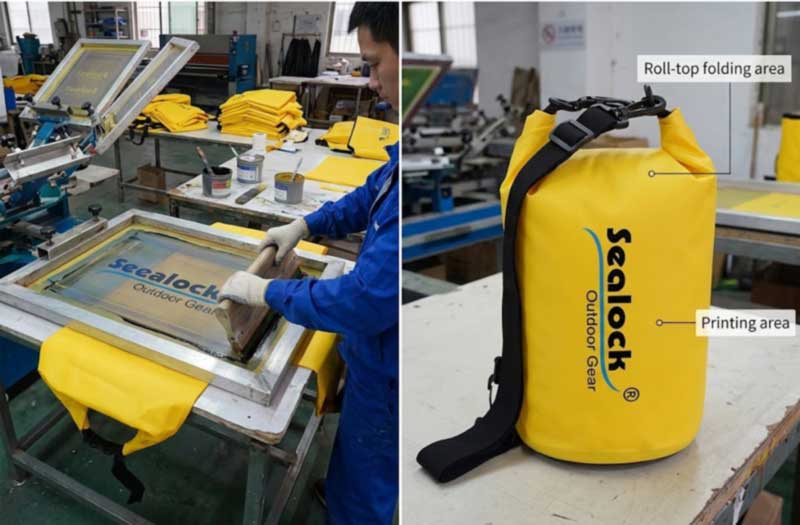
Screen printing is the standard for PVC and TPU dry bags. It suits one to three spot colours, gives crisp edges, and with an ink formulated for the bag material it bonds into the surface rather than sitting on top of it. For most corporate logos it is the right choice and the most economical at factory quantities.
Heat transfer is used for full-colour logos, photographic elements and fine detail on a defined area. Full sublimation is used for all-over artwork, but it only works on polyester fabric, which is why sublimated promotional dry bags are made from coated polyester rather than PVC tarpaulin. Digital UV printing handles gradients and multi-colour artwork on PVC without screens. For outdoor and safety programmes, a reflective print or a high-frequency welded logo patch adds visibility and durability.
Where the logo goes matters as much as how it is printed. The top section of a roll-top dry bag is folded at least three times every time the bag is closed, and ink in that zone is flexed and creased on every use. That is the most common reason promotional dry bags come back with cracked logos. We place the print on the flat body panel below the fold line. Ink is also kept clear of the welding margin, because a layer of ink between two panels interferes with the bond and can weaken the seam it sits on. These two rules are invisible on a proof and decide whether the bag still looks right a year later.
What Is the MOQ for Custom Promotional Dry Bags?
The factory MOQ is 300 pieces per design, including the printed logo. Within 300, a buyer can usually split across sizes of the same model, for example 5 litre and 10 litre bags carrying the same artwork, or across standard colours. This is useful for event kits where staff and VIP guests receive different sizes.
The MOQ rises when the order needs its own material run. A custom Pantone body colour, custom-coloured webbing or a non-standard buckle colour each needs a minimum material purchase. Printing in more colours does not change the MOQ, but it does change the unit cost. The logic is explained in more detail in our article on dry bag MOQ for OEM projects.
The full specification for logo orders, including base models, print areas, sample and bulk lead times and packaging options, is on our custom logo roll-top dry bag page.
What Drives the Unit Cost of a Promotional Dry Bag?
Material is the first driver. A 210D PVC-coated bag is lighter and cheaper, and it suits a single-event giveaway. A 500D PVC tarpaulin bag about half a millimetre thick, such as our SL-D002, is the standard for bags meant to last several seasons, and TPU sits above both for buyers who want a PVC-free product. Size is the second driver, since material is the largest share of cost and a 20 litre bag uses roughly twice the fabric of a 5 litre one.
The third is the print, where each additional screen-printed colour adds a setup and a pass, and full-colour methods carry their own cost structure. The fourth is hardware. A branded-quality buckle such as UTX costs more than a generic one, and it is also the part recipients notice when it breaks. The fifth is packaging. Individual polybags are the baseline, while header cards, printed swing tags and gift boxes add cost but make a promotional item feel like a retail product.
As a working guide, a 5 litre 500D PVC bag with a one-colour logo in a polybag is at the entry point of a factory-direct programme, and a 20 litre bag with a window, a full-colour print and retail packaging costs roughly three times that. Dry bags ship flat and nest tightly, so freight per unit is low compared with rigid promotional items. We send a firm FOB quote within 24 hours of receiving the size, quantity, logo file and packaging choice. If you are pricing a multi-item kit, our guide to custom waterproof phone pouches covers the item most often paired with a dry bag, and both can be produced in one order.
How Do You Plan a Promotional Dry Bag Order Around an Event Date?
Promotional orders fail on timing more often than on quality. Work back from the date the bags must be in the client's hands. Sea freight from South China to Australia, Europe or North America typically takes three to six weeks door to door, depending on the route. Before that, bulk production on a model like the SL-D002 takes about 20 days for up to 500 pieces, about 25 days up to 2,500 pieces, and about 30 days up to 5,000 pieces. Before that again, a printed pre-production sample takes 7 to 15 days and needs the client's approval.
In practice, a factory-direct promotional order should be confirmed ten to twelve weeks before the event. Two seasonal pressures make this tighter. Australian summer promotions for December and January need orders placed by early autumn in the Northern Hemisphere. And Chinese New Year 2027 falls on Saturday 6 February, with Vietnamese Tet on the same day, so factories in both countries slow down from mid-January and restart in late February. Orders for events in February, March and early April should be confirmed by early December.
What Compliance and Cost Pressures Matter in 2026?
PPAI research reports that United States promotional products distributor sales reached 27.1 billion dollars in 2025, only 1.3 percent above 2024, with tariff volatility, freight and compliance costs squeezing margins. In PPAI's own words, many distributors sold more but made less. For United States buyers, goods of both Chinese and Vietnamese origin have carried the 12.5 percent Section 301 baseline since 24 July 2026, and Chinese origin additionally carries the existing China-specific Section 301 duties. Every Sealock dry bag can be produced at either factory, so the same design can be quoted with Vietnam origin to protect margin on United States orders.
On materials, PVC promotional bags sold in the European Union must meet the REACH restriction on the phthalates DEHP, DBP, BBP and DIBP, together no more than 0.1 percent by weight of the plasticised material, and products sold in California need a Proposition 65 warning if listed phthalates are present. Corporate clients increasingly ask for this in writing before approving a promotional item. Our PVC is phthalate-free, we can supply third-party test reports, and TPU or GRS recycled materials are available for clients with sustainability targets.
How Are Promotional Dry Bags Tested?
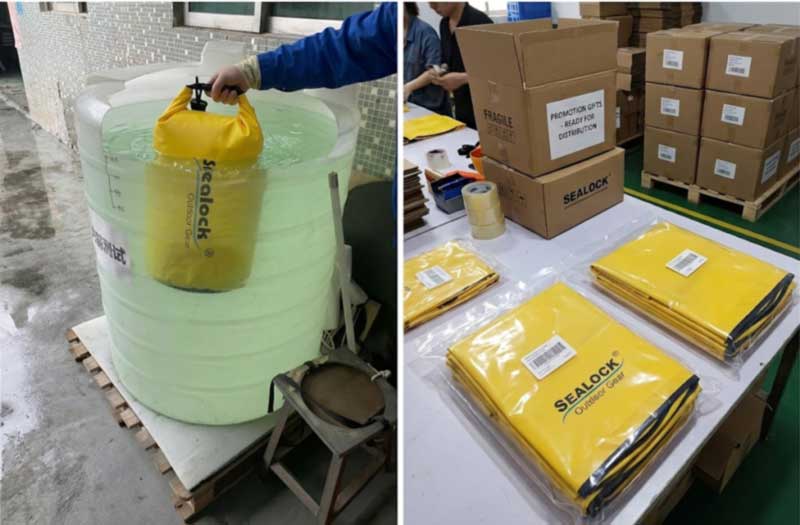
A promotional bag is tested to the same standard as a retail bag, because the client's logo is on it either way. Roll-top dry bags rated IPX7 go through a full water-immersion test of two hours or more on sampled units from each batch. Weld peel tests run at the start of every production run. Printed logos are tested for adhesion with tape and for rub resistance, and colour is checked against the approved Pantone and the signed pre-production sample. Buckles, webbing and D-rings are pull-tested, and fabric is checked for abrasion and colour fastness. Incoming materials, in-line production and finished goods are inspected in turn, and SGS or QIMA inspection is available for clients who require an independent report.
Where a client inspects the shipment, we recommend the full leak procedure our customers use: unboxing, vacuum extraction, a 24-hour static rest, and then the air-leak determination. Our wider standards are set out in the article on quality control for waterproof dry bag production.
Dry Bag Models for Promotional and Branded Programmes
The models below are organised by type rather than priority. Each can be printed with your client's logo and produced in custom colours.
| Image | Model | Type | Sizes | Material and Rating | Promotional Fit |
|---|---|---|---|---|---|
|
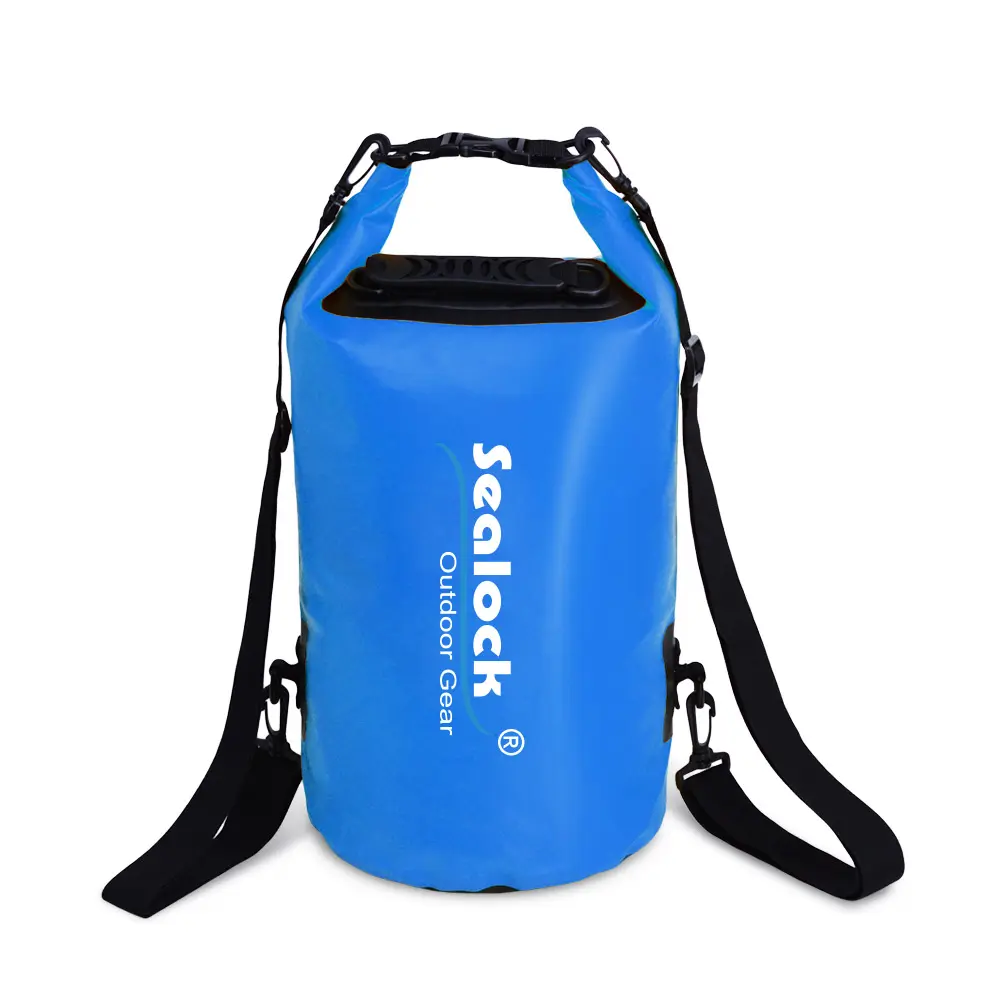
SL-D002 | Classic roll-top dry bag | 5, 10, 15, 20 and 63 litres | 500D PVC tarpaulin 0.5 mm, UTX buckles, IPX7, eight stock colours | Core giveaway and retail item, fastest lead time |
|
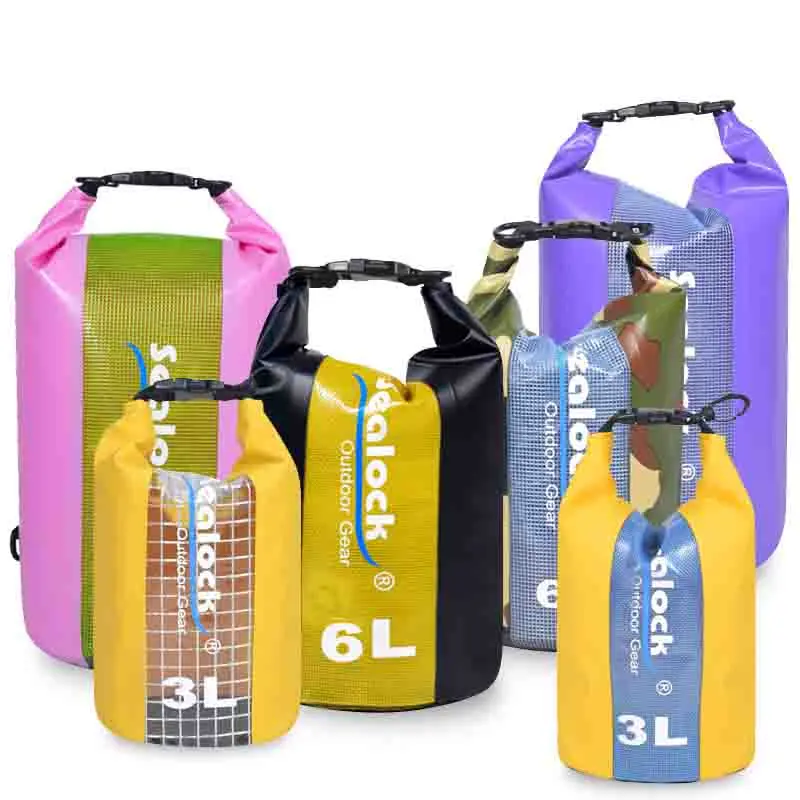
Clear Window Dry Bag | Roll-top dry bag with transparent front window | 3, 6 and 10 litres, 190 to 300 grams | PVC with high-frequency welded seams, buckle tested beyond 20,000 cycles | Beach, festival and resort kits |
|
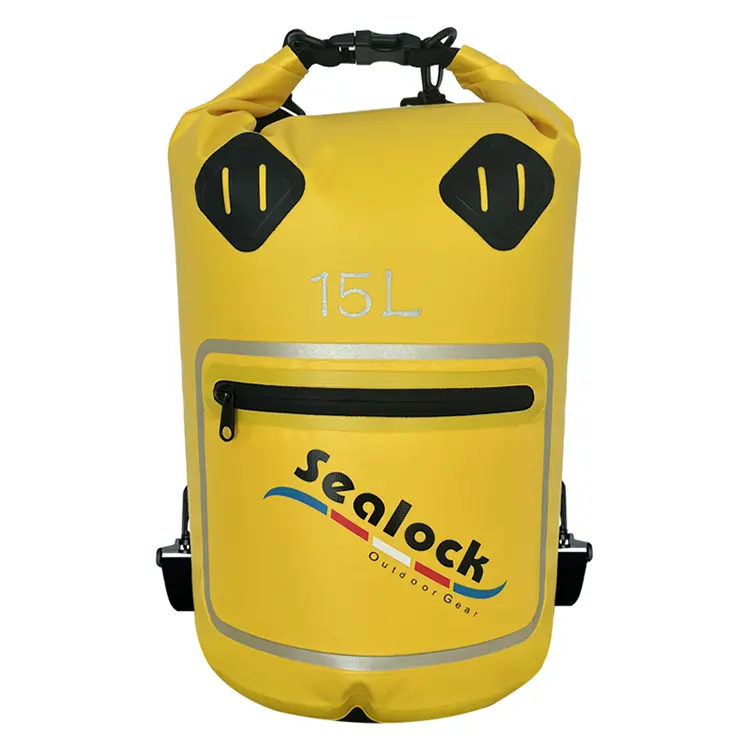
SL-D693 | Window dry bag with dry-wet separation | 15 and 20 litres | 500D PVC tarpaulin, IPX7, detachable strap, yellow or black | Swim clubs, gyms and water sports sponsors |
|
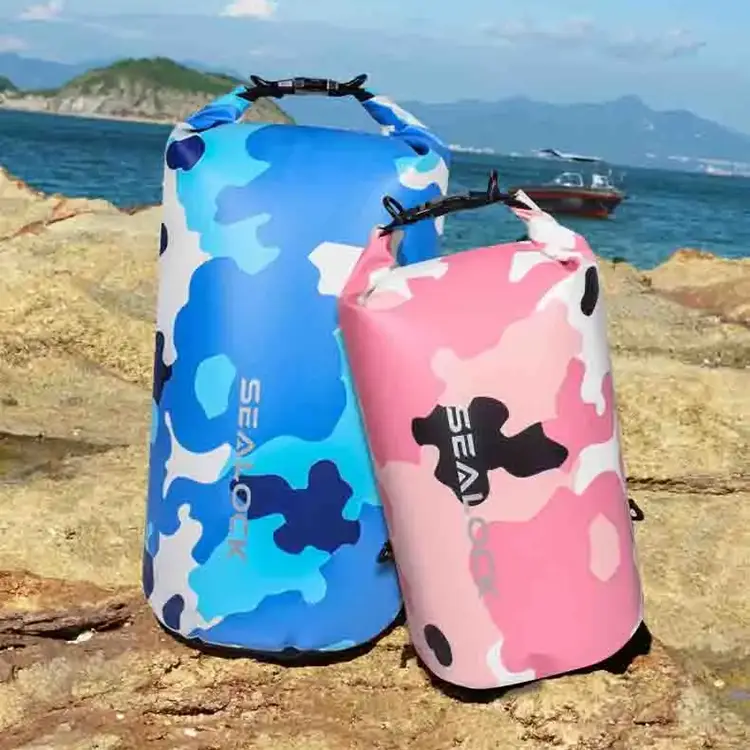
Dry-Wet Separation Dry Bag | Roll-top dry bag with removable inner pouch | 10 and 20 litres | Eco-friendly PVC, IPX7, camouflage prints available | Travel and lifestyle campaigns |
|
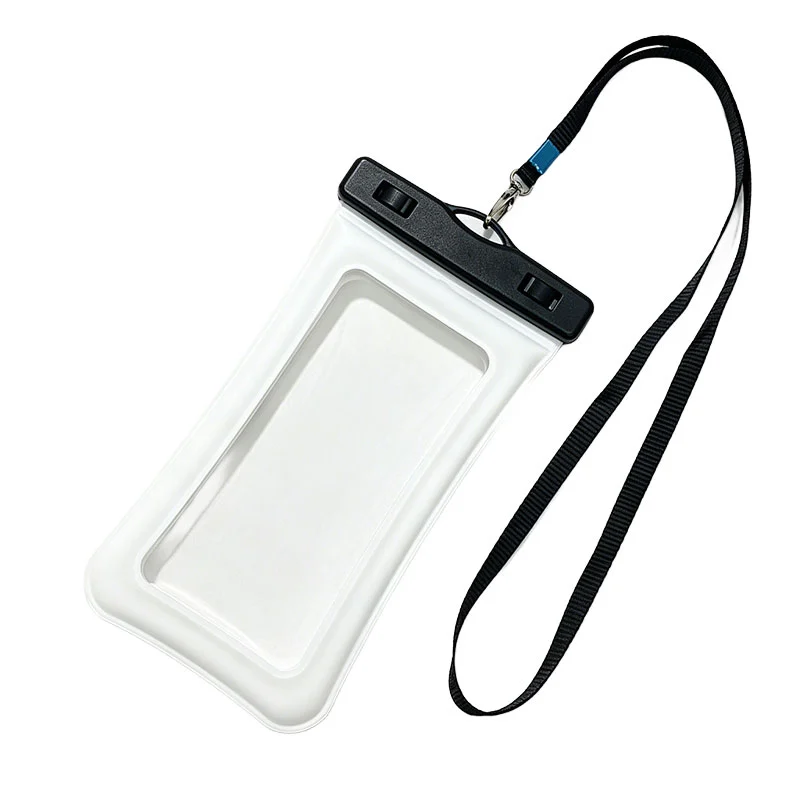
SL-A082 / SL-A083 | IPX8 phone pouch, the usual companion item | Small and large, phones up to 6.9 inches | PVC with double slide lock, IPX8 up to 30 m | Paired with a dry bag in a two-piece kit |
Standard Terms for Promotional Orders
The MOQ is 300 pieces per design, with size splits possible within one model. Printed samples take 7 to 15 days. Bulk production on the SL-D002 runs about 20 to 30 days depending on quantity, and 30 to 45 days on other models. Prices are quoted FOB Guangdong for China origin, with Vietnam origin quoted on request. Sealock has over 20 years of manufacturing experience, with high-frequency welding and industrial sewing in separate rooms on the same production floor, so dry bags, phone pouches, backpacks and duffels for one campaign can ship together. Buyers comparing broader branding options can also read our guide to custom dry bags, materials, sizes and branding, and our waterproof fanny pack article for another wearable promotional item.
Frequently Asked Questions
Why did the logo on our last promotional dry bags crack?
Almost always because it was printed in the roll-top fold zone, or with an ink that was not matched to the bag material. Printing on the flat body below the fold line, with a material-specific ink and an adhesion test on every batch, prevents it.
The bags smell of plastic when opened. Is that normal?
A slight odour is common with PVC straight out of a sealed carton, and it fades after airing. A strong chemical smell usually points to low-grade PVC. Phthalate-free PVC or TPU reduces it, and we can supply test reports to reassure the end client.
Recipients say the bag leaked. Was it faulty?
Sometimes, but more often the top was rolled only once. A roll-top needs at least three tight folds before the buckle is closed. We can print a simple closing instruction on the bag or the swing tag, which removes most of these complaints.
Can we add a carabiner?
Yes. We recommend a solid working clip rather than a thin decorative one, because recipients will hang the bag from a kayak or a backpack and a weak clip fails under load. A branded clip can be supplied as part of the kit.
Can we mix sizes within the 300-piece MOQ?
Usually yes, within one model and with the same artwork. Custom body colours need their own material run and are quoted separately.
Do promotional dry bags float?
A properly closed roll-top dry bag with air trapped inside will usually float, which is useful near water. It should never be marketed as a flotation or safety device.
Request a Quote for Promotional Dry Bags
Send us the size, quantity, logo file, delivery date and destination, and we will reply within 24 hours with an FOB price, a print recommendation, a sample timeline and a production schedule worked back from your event date. For United States deliveries, ask for China and Vietnam origin side by side. Contact Sealock about your promotional dry bag order, or email info@sealock.com.hk.