- English
- Español
- Português
- русский
- Français
- 日本語
- Deutsch
- tiếng Việt
- Italiano
- Nederlands
- ภาษาไทย
- Polski
- 한국어
- Svenska
- magyar
- Malay
- বাংলা ভাষার
- Dansk
- Suomi
- हिन्दी
- Pilipino
- Türkçe
- Gaeilge
- العربية
- Indonesia
- Norsk
- تمل
- český
- ελληνικά
- український
- Javanese
- فارسی
- தமிழ்
- తెలుగు
- नेपाली
- Burmese
- български
- ລາວ
- Latine
- Қазақша
- Euskal
- Azərbaycan
- Slovenský jazyk
- Македонски
- Lietuvos
- Eesti Keel
- Română
- Slovenski
- मराठी
- Srpski језик

Custom Waterproof Phone Pouches Wholesale: Logo Printing, MOQ and IPX8 Testing
Sealock manufactures custom waterproof phone pouches for wholesale buyers, promotional product distributors and private label brands, with a standard MOQ of 300 pieces, logo printing on every model, and production in both Dongguan, China and Ho Chi Minh City, Vietnam. This guide answers the three questions our sales team hears first on almost every pouch enquiry: how many do I have to order, what will it cost, and can you put my logo on it. It then covers the part most buyers only ask about after a bad batch, which is how a pouch is actually tested before it ships.
A phone pouch looks like the simplest product in the waterproof category. It is a sheet of clear film, a sealed edge, a lock and a lanyard. That simplicity is exactly why the category is full of pouches that pass a quick dunk in a sink and then fail on a snorkelling trip, and why the cheapest quote is rarely the cheapest outcome once returns and one-star reviews are counted.
Which Waterproof Phone Pouch Models Can Be Customised?
Every pouch in our range can be produced with your logo, your colours and your packaging. The four current base models cover the main price points and use cases, and each can also serve as the starting point for a fully new design.
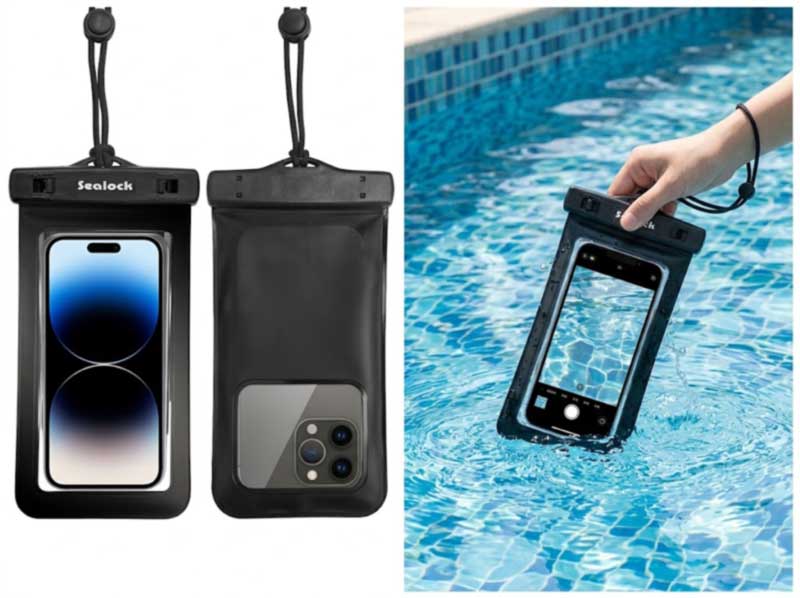
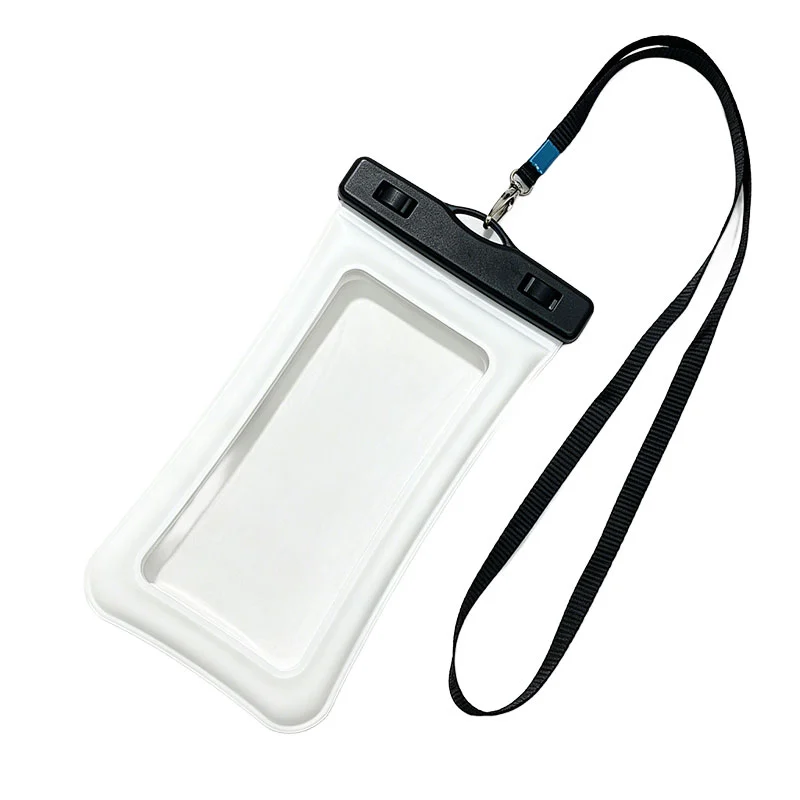
The SL-A064 is our dual-window IPX8 pouch. It has a full-screen touch window on the front and a separate camera window on the back, so the user can take photos and video underwater without removing the phone. It closes with two ABS slide locks over a silicone sealing strip, fits phones up to 7.0 inches, measures 22 by 11.5 cm, and is rated for depths up to 30 metres. It ships with an adjustable braided lanyard of about 45 cm with a stainless steel ring, and comes in black or frosted white as standard.
The SL-A101 is the compact member of the same camera-window family. Instead of slide locks it uses a press-seal strip combined with a fold-over flap backed by a foam compression strip, giving two separate sealing barriers. It fits phones up to 6.5 inches, measures 11 by 17.5 cm, and is offered in yellow, black and frosted white.
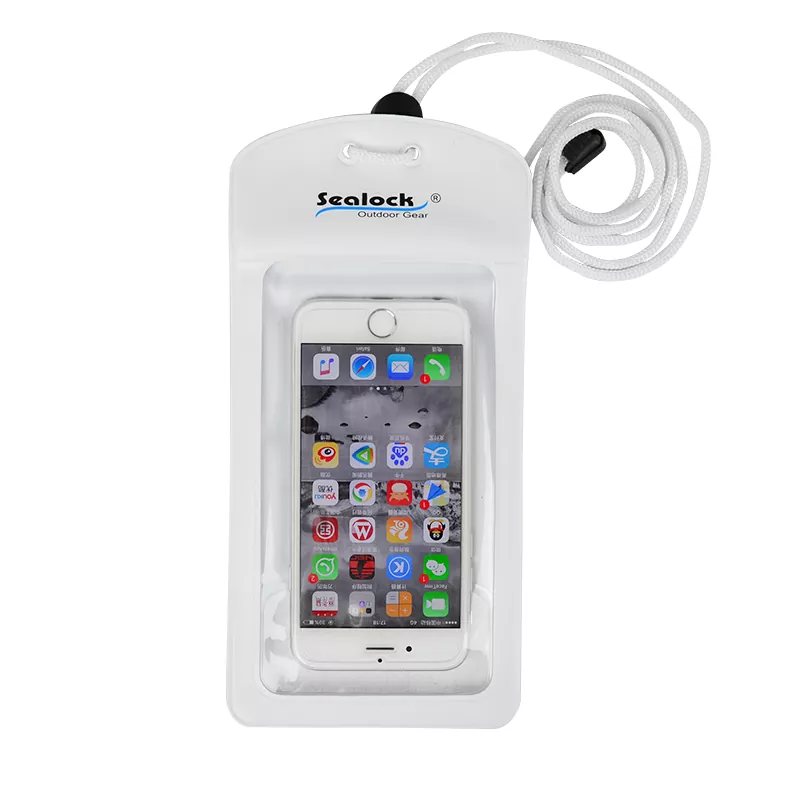
The SL-A082 and SL-A083 are our universal IPX8 pouches in small and large sizes, 10 by 19 cm and 12 by 20.5 cm. Both fit phones up to 6.9 inches, use a double slide lock with a fold-down seal, are made from PVC film 0.30 to 0.35 mm thick, weigh between 55 and 75 grams, and are rated for use from minus 20 to plus 60 degrees Celsius. This is the model most promotional buyers choose for beach and resort giveaways.
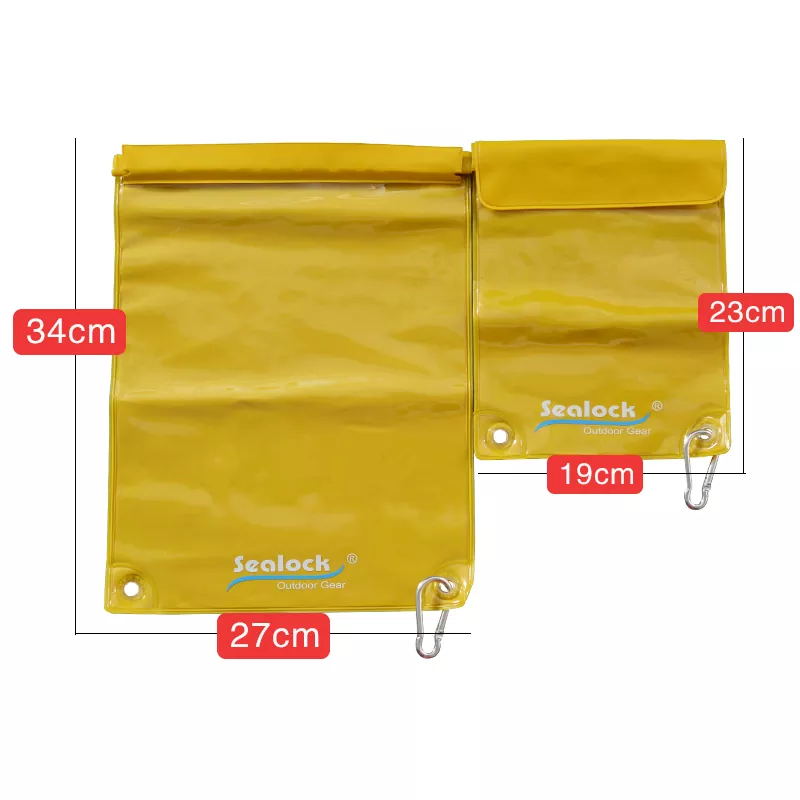
The multi-purpose splash-proof pouch is a different product and we sell it as one. It is a TPU pouch with a fold-over closure and double PVC sealing strips, in two sizes, 19 by 23 cm and 27 by 34 cm, rated for moderate rain and splashes only. It is not designed for submersion, and we tell buyers that before they order. It suits keys, passports, cards and documents on a boat deck or at a festival, where a full IPX8 seal would add cost the end user does not need.
What Is the MOQ for Custom Waterproof Phone Pouches?
The standard MOQ is 300 pieces per model, and that covers your logo printed in your chosen position. Within one order of 300, we can usually split the quantity across two standard colourways of the same model, which is useful for promotional buyers who want a light and a dark version for different events.
Where the MOQ moves is when you ask for something that needs its own material run. A custom Pantone film tint, a custom-coloured ABS lock, or a lanyard in a dyed-to-match colour each needs a minimum material purchase, and on those programmes the practical starting quantity rises. For a new pouch shape built from scratch, the sealing tool is the main investment, and we quote the tool separately so you can see it rather than finding it buried in the unit price. Our earlier article on dry bag MOQ for OEM projects explains the same logic in more detail, and it applies equally to pouches.
For buyers testing a new market, the sensible route is to start at 300 on a standard model with a printed logo, confirm sell-through, and move to custom colours and branded packaging on the reorder.
How Much Does a Custom Waterproof Phone Pouch Cost?
Price is the second question on every enquiry, so here is how it is actually built. Five things move the unit price of a phone pouch more than anything else: the sealing system, the window construction, the film thickness, the printing method and the packaging.
The sealing system is the largest single factor. A double slide lock with a silicone strip, as on the SL-A064, costs more to produce than a press-seal strip, because the lock is a moulded part that has to be assembled and checked. The second factor is the window. A pouch with a separate rear camera window has an extra sealed panel, and every sealed panel is another edge that must be leak-tested. The third is film thickness and grade. Thin, low-grade PVC is cheaper and is also the film that yellows in the sun, goes stiff in cold water and cracks along the fold. The fourth is the print, covered in the next section. The fifth is packaging, where a retail backer card or printed box can add more to the landed cost than the logo itself.
As a working guide, a universal PVC pouch with a one-colour logo at 300 pieces typically lands at the lower end of the waterproof category, and a dual-window pouch with full-colour printing and retail packaging sits at roughly two to three times that figure. Because film and lock costs move with the market, we give a firm FOB price within 24 hours of receiving your quantity, model, logo file and packaging choice, rather than publishing a figure that may be out of date by the time you read it.
Can You Print My Logo on a Waterproof Phone Pouch?
Yes, and on a phone pouch the placement of the logo matters as much as the method. The front touch window and the rear camera window are never printed, because ink on either one blocks the screen or the lens. The usable print areas are the solid border around the window, the back panel of single-window models, the ABS lock, and the lanyard.
Screen printing is the standard choice for one or two spot colours. It gives the sharpest edges and the best rub resistance on PVC, and it is the most economical option at 300 pieces. UV digital printing is used for full-colour artwork, photographs, gradients and small text, with no extra cost per colour. Pad printing puts a small logo onto the curved ABS lock, which is a detail many promotional buyers like because it survives long after the border print has worn. The lanyard can be woven or printed with a repeat logo, and a custom-coloured lanyard is often the cheapest way to make a stock pouch look like your own product.
Every printed batch is checked for ink adhesion with a tape test and for rub resistance, because a logo that peels off after a week of sunscreen and salt water does more damage to a brand than having no logo at all. If you are building a wider branded range, our guide to custom dry bags and branding options shows how the same artwork can carry across dry bags and pouches so the set looks consistent.
What Does IPX8 Actually Mean on a Phone Pouch?
IPX8 is the highest water rating in the IEC 60529 standard, and it is also the most loosely used. The standard defines IPX8 as continuous immersion under conditions agreed by the manufacturer that are more severe than the IPX7 test of one metre for 30 minutes. In other words, IPX8 on its own does not tell you a depth or a time. A pouch tested at 1.5 metres for an hour and a pouch tested at 10 metres can both carry the same label.
That is why we state a depth on every IPX8 model, and why we recommend that buyers write the depth into their own product listing. A marketplace listing that says only "IPX8" invites a customer to take the pouch further down than it was built for. A listing that says the rated depth, and also says the pouch is for surface swimming, snorkelling and kayaking rather than scuba diving, sets the right expectation and cuts returns.
It is also worth separating the pouch rating from what the phone can do inside it. A capacitive touchscreen does not work reliably underwater, because the water itself registers as a touch. That is not a pouch defect, it is physics, and the honest instruction for end users is to open the camera before going under and use the phone's volume button as the shutter. Putting that one line on your packaging removes one of the most common negative reviews in the category.
How Are Waterproof Phone Pouches Tested Before Shipping?
A phone pouch is small enough that a buyer can test one at home, and that is exactly what end customers do on the first day. Our testing is built around the ways pouches really fail, not around a single dunk.
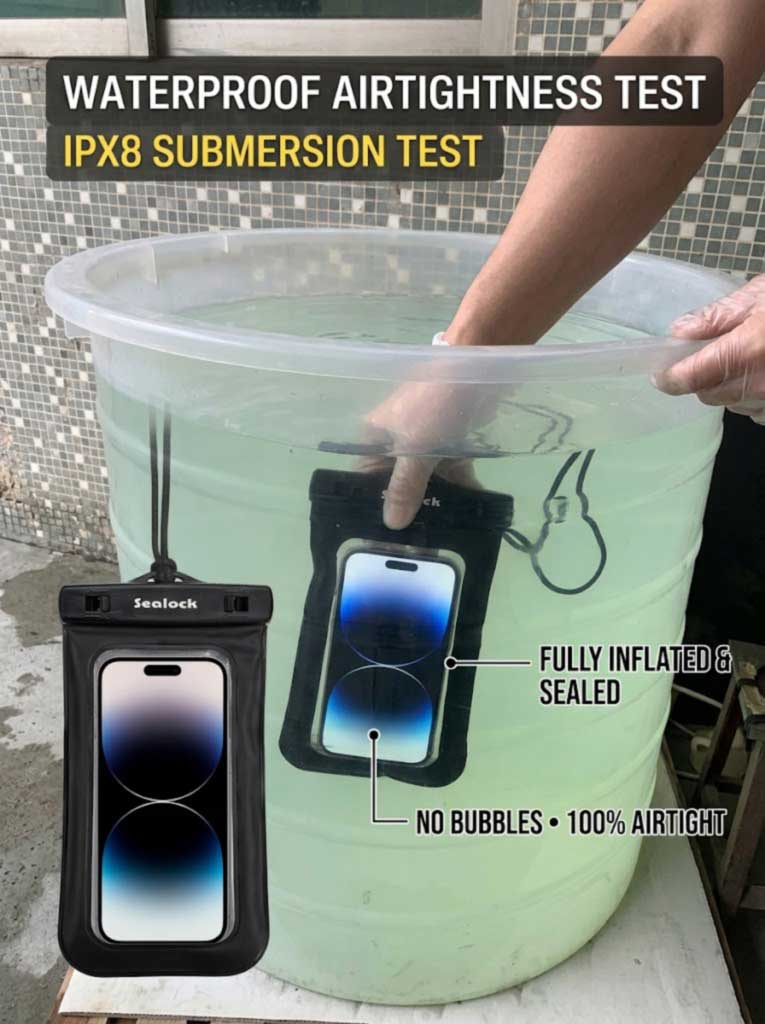
The core check is inflate and submerge. The pouch is filled with air, locked, and held under water while the inspector watches every edge, the lock line and both window panels for a single bubble. Air finds a gap that water would take minutes to find, so this test catches pinholes and weak seals that a plain immersion can miss. Sealed edges are also peel-tested at the start of each run to confirm the heat seal has bonded through the film rather than sitting on the surface.
Beyond leakage, we test the parts that wear out. The slide locks are cycled open and closed repeatedly, because a lock that clicks perfectly on day one can lose its grip after a summer of use. Lanyard attachment points are pull-tested, since in field use many lanyards snap at low force and the phone goes with them. Film samples are checked at low temperature for cracking along the fold line, and for clarity and colour so the window does not arrive already hazy or yellow. Incoming film and locks are inspected before production, the line is checked during production, and finished goods are inspected before packing, with third-party inspection by SGS or QIMA available if you prefer an independent report.
When customers inspect a shipment themselves, we follow and recommend the full procedure our clients use for leak verification: unboxing, vacuum extraction, a 24-hour static rest, and then the air-leak determination. The 24-hour rest is the step that matters most for pouches, because a seal that is only marginal can hold for a few minutes and then let go slowly. Our wider approach to inspection is set out in our article on quality control standards for waterproof dry bag production.
What Compliance Do Phone Pouches Need in 2026?
Most phone pouches are made from PVC film, and PVC is where compliance questions start. In the European Union, REACH restricts four phthalate plasticisers, DEHP, DBP, BBP and DIBP, to a combined 0.1 percent by weight in the plasticised material of consumer articles, a rule that has applied to everyday products since July 2020. In California, Proposition 65 requires either a warning or a reformulated material for several of the same substances. We produce pouches in phthalate-free PVC and can supply third-party test reports for your market, and TPU is available for buyers who want to avoid PVC altogether.
Tariffs are the other 2026 question. A phone pouch is a low-value item, so even a few percentage points of duty change the margin. Since 24 July 2026, goods of both Chinese and Vietnamese origin carry the 12.5 percent Section 301 baseline when entering the United States, and Chinese origin additionally carries the existing China-specific Section 301 duties. Because every Sealock product can be produced at either factory, US buyers can choose Vietnam origin for the pouch line while keeping the same specification and the same artwork. Classification of pouches usually falls under heading 4202, but plastic pouches are sometimes classified elsewhere, so confirm the code with your customs broker before quoting your own customers.
For marketplace sellers there is one more change. Amazon stopped offering FBA prep and labelling services from 1 January 2026, so the supplier now needs to deliver cartons that are already polybagged, labelled and ready to receive. We print FNSKU labels and apply suffocation warnings on polybags as part of the order when requested.
Waterproof Phone Pouch Models for Wholesale and Custom Orders
The models below are organised by type rather than by priority. Choose by use case and budget, and any of them can be adapted with your logo, colours and packaging.
| Image | Model | Type | Size and Fit | Sealing and Rating | MOQ |
|---|---|---|---|---|---|
|
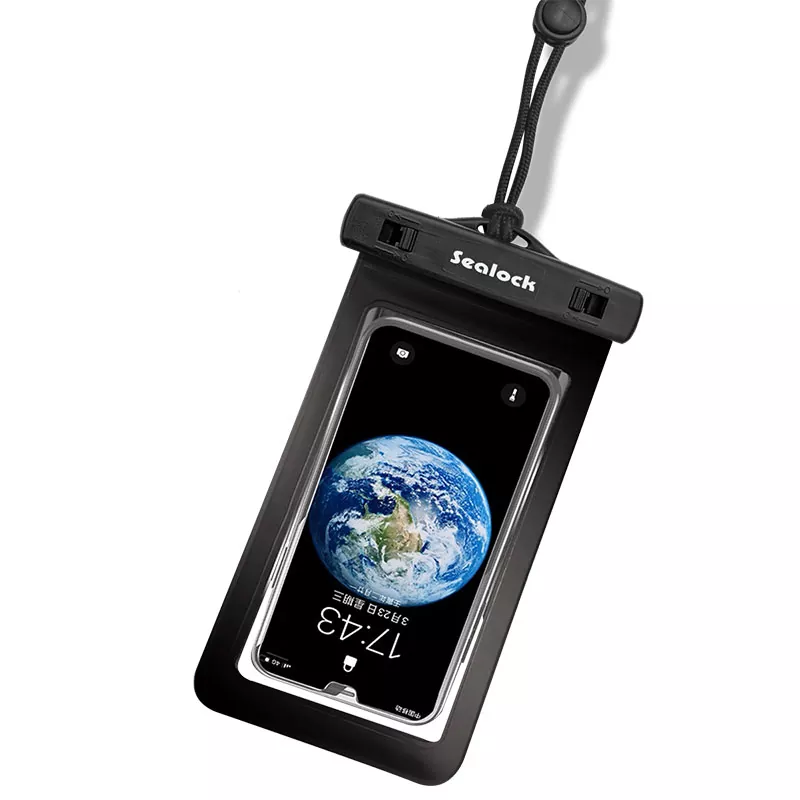
SL-A064 | Dual-window IPX8 pouch with rear camera window | 22 by 11.5 cm, phones up to 7.0 inches | Two ABS slide locks with silicone strip, IPX8 up to 30 m | 300 pcs |
|
SL-A101 | Compact dual-window IPX8 pouch | 11 by 17.5 cm, phones up to 6.5 inches | Press-seal strip plus foam-backed flap, IPX8 | 300 pcs |
|
SL-A082 / SL-A083 | Universal IPX8 pouch, small and large | 10 by 19 cm and 12 by 20.5 cm, phones up to 6.9 inches | Double slide lock with fold seal, IPX8 up to 30 m, minus 20 to 60 °C | 300 pcs |
|
Multi-Purpose Pouch | Splash-proof pouch for keys, cards and documents | 19 by 23 cm and 27 by 34 cm | Fold-over closure with double PVC strips, rain and splash only, not for submersion | 300 pcs |
Standard Terms for Phone Pouch Orders
Samples are ready in 7 to 15 days, including a printed sample with your logo. Bulk production runs 30 to 45 days after sample approval. Prices are quoted FOB Guangdong for China origin, with Vietnam origin quoted separately on request. The SL-A064 packs 200 to 300 pieces per carton, in a carton of about 58 by 40 by 35 cm weighing 16 to 18 kg, which keeps freight per unit low on mixed shipments. Payment is by T/T, with a deposit to start production and the balance before shipment.
Beyond pouches, Sealock has over 20 years of manufacturing behind it, with high-frequency welding and industrial sewing lines running in separate rooms on the same production floor. Pouch orders can be combined in one shipment with dry bags with phone windows, roll-top dry bags and backpacks, which is how many promotional distributors build a complete waterproof gift set from one supplier. Our guides to promotional dry bags with custom logo and to the waterproof fanny pack cover the two items most often bundled with a pouch.
Frequently Asked Questions
Why does my phone pouch fog up on the inside?
Fogging happens when warm, humid air sealed inside the pouch meets cold water and condenses on the film. The fix is to close the pouch in a cool, dry place rather than on a hot, humid beach, and to keep a small silica gel sachet inside for long sessions. For retail buyers, we can print this tip on the backer card.
Will Face ID and the touchscreen work through the pouch?
On dry land, yes. The window film on our IPX8 models is thin enough for touch and Face ID. Underwater, no phone touchscreen works reliably, with or without a pouch, so users should open the camera first and use the volume button to take photos.
Why are underwater photos blurry through some pouches?
On single-window pouches the camera shoots through the same film as the screen, and any scratch, haze or yellowing shows up in the photo. That is the problem the separate rear camera window on the SL-A064 and SL-A101 is designed to solve.
Does a waterproof phone pouch float?
A pouch with a phone inside will only float if enough air is trapped in it, and that cannot be relied on. If floating matters for your market, such as kayaking or boat rental, we can add a foam float strap or floating lanyard as a custom option.
Can I order different colours within the 300 MOQ?
Usually yes, across the standard colourways of one model. Custom Pantone colours for the film, lock or lanyard need their own material run and are quoted separately.
How should end users clean a pouch after the sea?
Rinse it in fresh water with the lock closed, then open it and let it dry fully. Dried salt and sand on the sealing strip are a common cause of later leaks, and a quick rinse prevents most of them.
Request a Quote for Custom Waterproof Phone Pouches
Send us the model you are interested in, your quantity, your logo file and your target market, and we will reply within 24 hours with an FOB price, a printing recommendation and a sample timeline. If you need Vietnam origin for US tariff reasons, say so in your message and we will quote both origins side by side. Contact Sealock for a phone pouch quote, or email info@sealock.com.hk.