
- English
- Español
- Português
- русский
- Français
- 日本語
- Deutsch
- tiếng Việt
- Italiano
- Nederlands
- ภาษาไทย
- Polski
- 한국어
- Svenska
- magyar
- Malay
- বাংলা ভাষার
- Dansk
- Suomi
- हिन्दी
- Pilipino
- Türkçe
- Gaeilge
- العربية
- Indonesia
- Norsk
- تمل
- český
- ελληνικά
- український
- Javanese
- فارسی
- தமிழ்
- తెలుగు
- नेपाली
- Burmese
- български
- ລາວ
- Latine
- Қазақша
- Euskal
- Azərbaycan
- Slovenský jazyk
- Македонски
- Lietuvos
- Eesti Keel
- Română
- Slovenski
- मराठी
- Srpski језик

Motorcycle Duffel Bag: Why Travel Duffels Fail on a Bike and What a Ride-Proof One Needs
A motorcycle duffel bag is a soft, closed bag that straps across the pillion seat or rear rack while you ride and comes off as an ordinary carry bag when you stop. The good ones are waterproof, sit flat, have strap anchors built into the shell and keep their shape under compression straps. This guide explains what separates a duffel that survives a week of motorway rain and gravel from a travel duffel that slides, leaks and flaps, how to strap one down properly, and how the waterproof duffels we manufacture in Dongguan, China and Ho Chi Minh City, Vietnam are specified.
Most riders who try a gym or airline duffel on a bike learn the same three lessons within a day. The bag rolls off-centre on the first roundabout, rain finds its way through the zipper and the stitching, and the shoulder strap ends up whipping the rear fender. None of these is bad luck. Each comes from a design decision that makes sense for a bag carried by hand and makes no sense for a bag exposed to wind, vibration and road spray at 110 km/h.
What Makes a Duffel Bag Motorcycle-Ready?
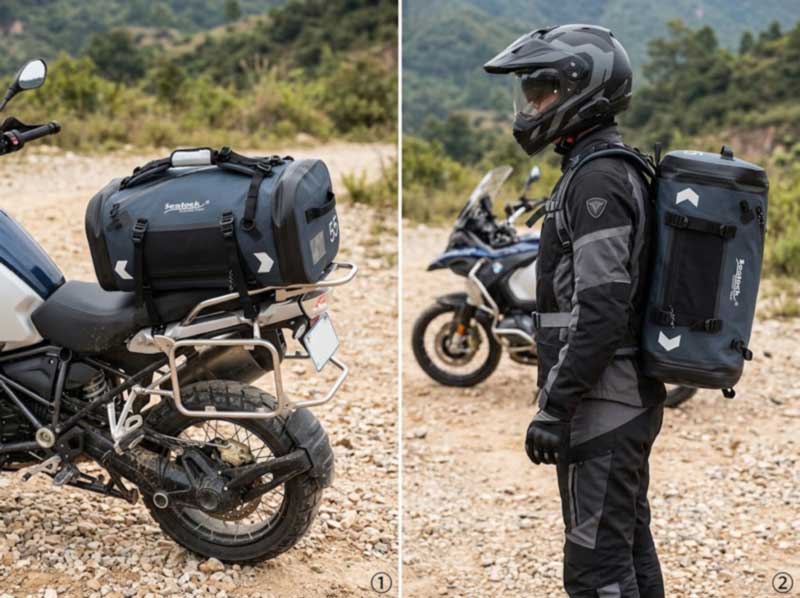
Four things, and the order matters. The first is how the bag holds the straps. A travel duffel has two handles and perhaps a shoulder strap, so the rider ends up running cam straps around the whole body of the bag. Under vibration the bag squirms inside the loop and works its way sideways. A motorcycle duffel has strap points that are part of the shell, welded or bar-tacked D-rings and webbing loops at the four corners, so the strap pulls on the bag rather than squeezing it. Our SL-E984 uses four quick-release mounting straps clipped to anchors on the bag, which is why it can go on and off the bike in under a minute.
The second is shape. A duffel that slumps into a sausage when half full will rock on a narrow pillion seat. Compression straps along the sides, a stiffened base panel, or a roll-top that can be rolled down to the actual load all keep the bag square and low. A rider who fills a 55 litre bag only halfway should be able to cinch it to the size of a 30 litre bag.
The third is how water is kept out. On a bike, rain does not fall on the bag. It is driven into it by wind and thrown up from the rear tyre, which is far harder on seams and closures than standing in a downpour. A duffel sewn from coated fabric has thousands of needle holes along every seam. Tape over them helps for a while, then peels. A bag with high-frequency welded seams has no holes to seal in the first place, because the seams are fused rather than stitched. The closure then decides the rest: a roll-top rolled three times handles sustained rain and road spray, and an airtight zipper takes the bag to submersion level.
The fourth is everything that should not be flapping. Backpack straps, shoulder straps and long strap tails all turn into whips at speed. A ride-proof duffel either lets you detach them or gives you a place to stow them, and the mounting straps have keepers for the loose ends.
Roll-Top, Zipper or Airtight Zipper: Which Closure Should a Motorcycle Duffel Have?
A roll-top is the simplest closure and the most forgiving of dirt and grit. It cannot jam, it cannot split, and if it is rolled at least three times and buckled, it keeps out heavy rain and road spray for hours. The trade-off is access. Getting to the bottom of a roll-top on the side of the road means unstrapping it from the bike first. Our SL-K099 roll-top duffel in 40 and 60 litres and the SL-C619 rack-mount luggage bag in 35 and 50 litres work this way.
A standard waterproof zipper with a coated tape is faster to open and fine for most touring, but it is the weak point in prolonged rain at speed, particularly once grit gets into the teeth. It suits a bag that will live on the seat during a mixed-weather trip rather than one heading into monsoon conditions.
An airtight zipper is the top end. It is the same type of closure used on drysuits, and when it is fully closed the bag can be dropped into a river and stay dry inside. Our SL-E984 three-way motorcycle bag, the SL-C594 55 litre travel duffel and the SL-C261 kayaking duffle all use airtight zippers and are rated IPX7. These zippers need a little care: they should be kept clean and lubricated with the supplied wax or silicone, and they are stiffer to pull than an ordinary zipper. Bags with a moulded T-pull or a pull loop make that easier with gloves on.
For road touring in Europe or North America, a well-made roll-top is usually enough. For adventure routes with water crossings, long rainy stretches or the chance of the bike going down in a stream, the airtight zipper is worth it.
Waterproof Motorcycle Duffel Bags We Manufacture
The table below lists the duffel-format bags in our range that work on a motorcycle. All are made with high-frequency welded seams, all are available with custom colours and logos, and the standard MOQ is 300 pieces per design.
| Image | Model | Format | Capacity and Size | Closure and Rating | Motorcycle Notes |
|---|---|---|---|---|---|
|
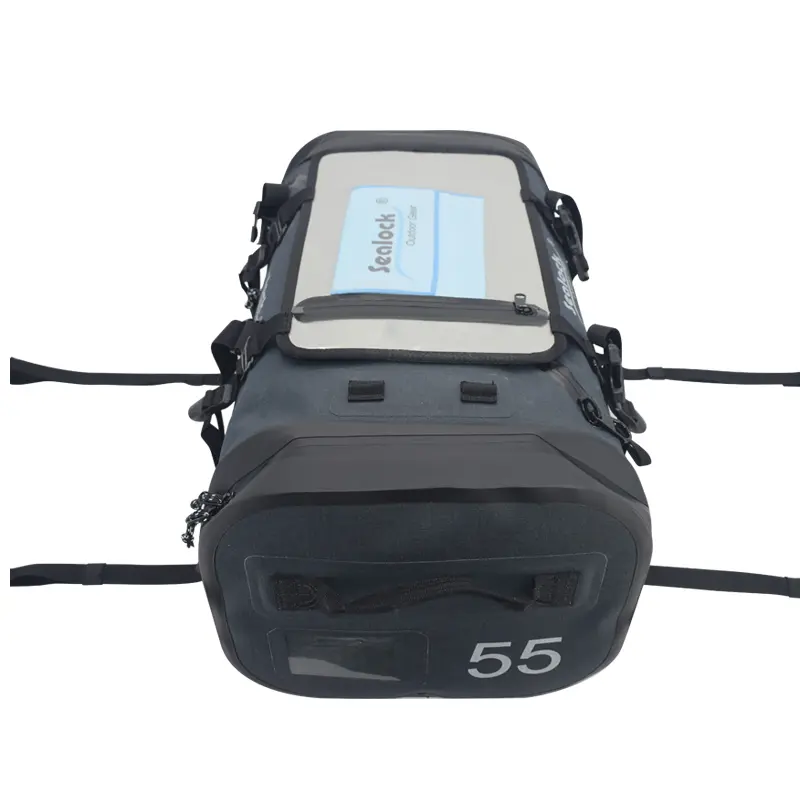
SL-E984 | Three-way motorcycle duffel: strap-on, backpack, hand carry | 55 litres, 57 × 32 × 26 cm, 1.27 kg | Airtight zipper, IPX7 | Four quick-release mounting straps, padded back panel, reflective panels and piping, detachable phone pouch |
|
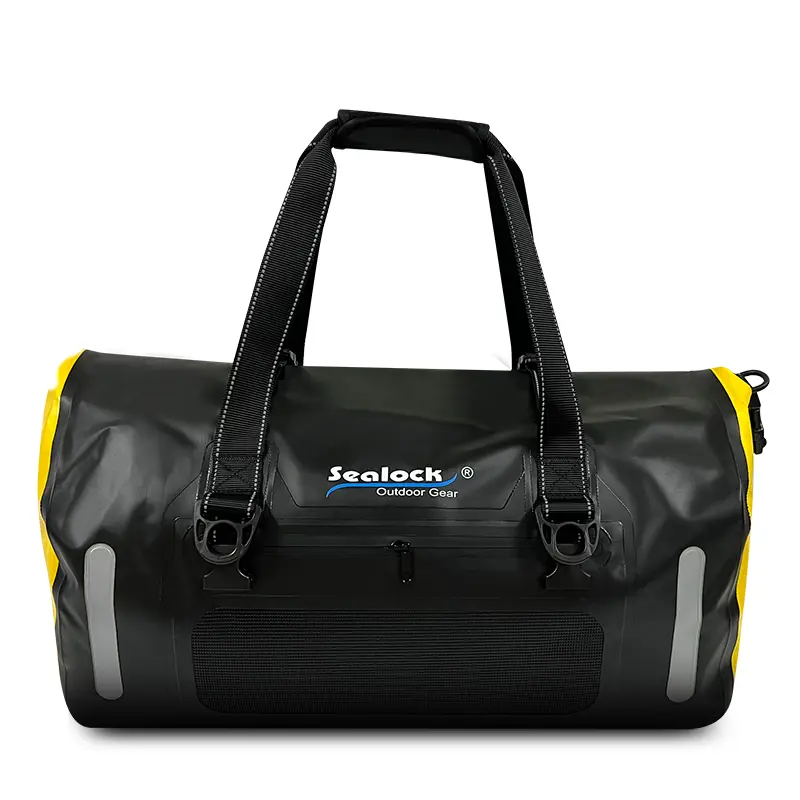
SL-K099 | Roll-top duffel | 40 L (55 × 30 × 30 cm) and 60 L (65 × 35 × 35 cm) | Roll-top, IPX7 | 840D TPU, rolls down to the load, detachable shoulder strap |
|
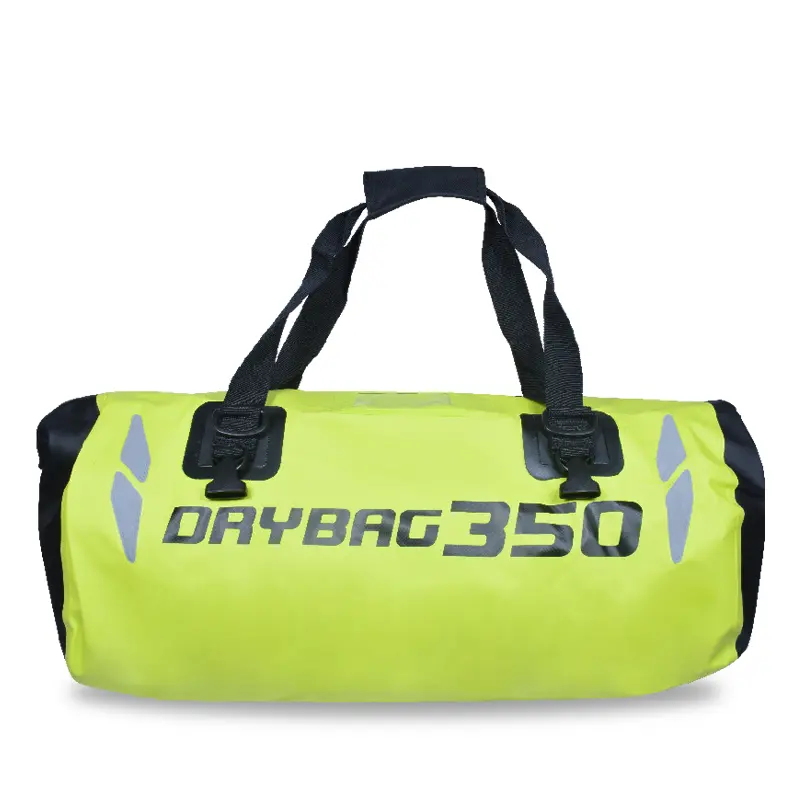
SL-C619 | Rack-mount roll-top luggage bag | 35 L (45 × 25 × 31 cm) and 50 L (48 × 30 × 35 cm) | Roll-top, IPX6 | PVC reinforcement panels, heavy nylon D-rings, reflective print |
|
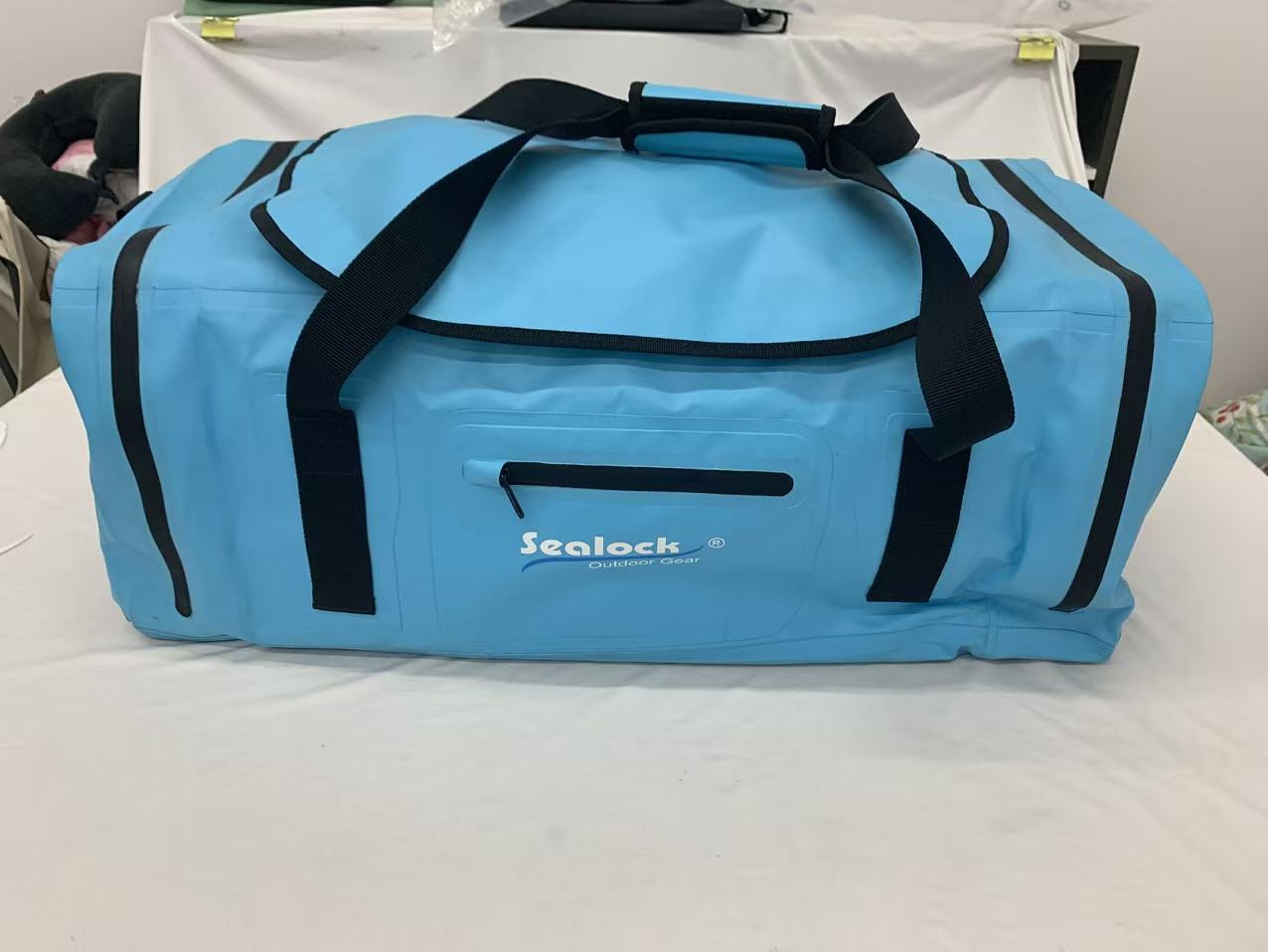
SL-C594 | Travel duffel with two end compartments | 55 litres, 63.5 × 36 × 25 cm, 1.2 kg | Three airtight zippers, IPX7 main compartment | End compartments separate wet rain gear from dry clothes, abrasion-resistant base |
|
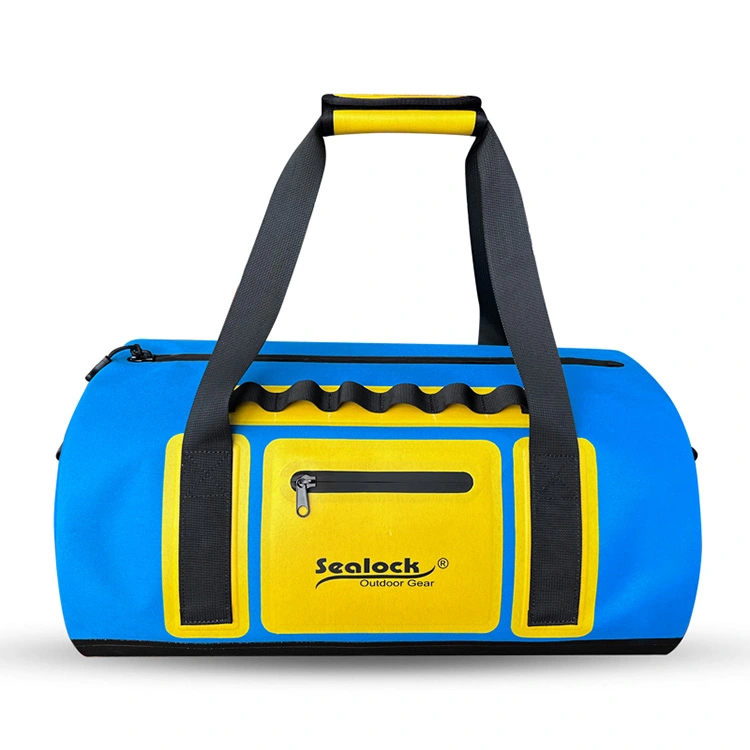
SL-C759 | Compact adventure duffel | 25 litres | Waterproof zipper | Small enough to sit on top of a tail rack or behind a solo rider |

|
SL-C689 | Convertible duffel-backpack | 25 litres | Roll-top or zipper versions | Backpack straps for walking from the parking area to the hotel or ferry |
How to Strap a Duffel Bag to a Motorcycle
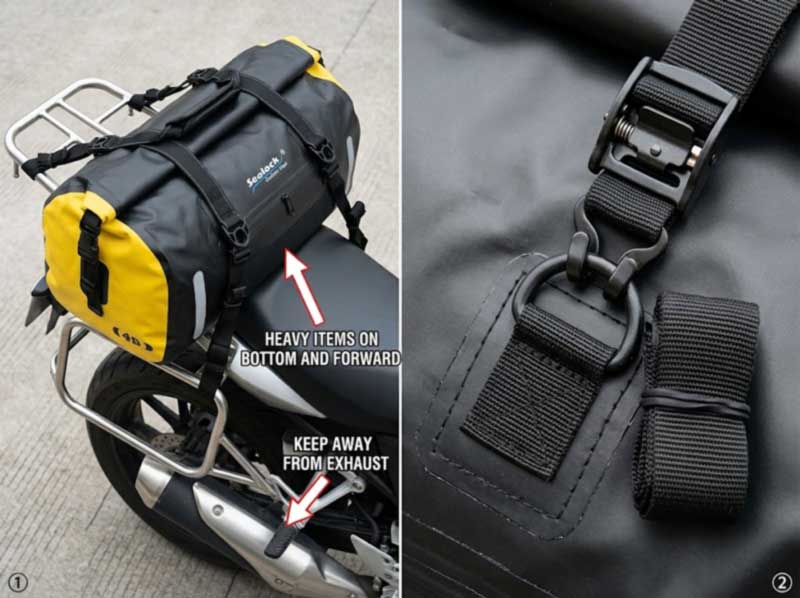
The method is the same whether the bag sits on a pillion seat or a rear rack. Pack the heaviest items at the bottom and towards the front of the bag, so the weight sits low and close to the rider. Close the bag fully before mounting it, because a roll-top rolled after the straps are tight will never be rolled properly. Then lay the bag lengthways or crossways depending on the seat. On most adventure and touring bikes a bag of 40 to 55 litres sits crossways on the rack and lengthways on the pillion seat.
Use cam-buckle straps or purpose-made quick-release straps, never bungee cords. Bungees stretch under load, let the bag bounce, and can snap back into the rider's face when released. Run each strap from a fixed point on the bike, the rack, the grab rail or the passenger peg mounts, to an anchor on the bag, and keep the straps away from the exhaust and the rear tyre. Four points are better than two, because two straps let the bag pivot around them.
Tighten until the bag does not shift when you push it hard from each side, but not so tight that the bag visibly deforms. Then ride for ten or fifteen minutes and check again, because straps settle and loads compress. On long or rough days, check at every fuel stop. Tuck or tie off every loose strap end, and stow or remove any shoulder or backpack straps the bag came with.
A few things are worth checking on the bike itself. Keep a soft bag well clear of the silencer, since a hot exhaust will melt TPU or PVC within minutes. Put a rubber mat or a piece of non-slip material under the bag on painted bodywork to stop it rubbing. And respect the load rating of your rack, which is often lower than riders assume. Our step-by-step piece on how to install a waterproof motorcycle bag covers tail bags and saddlebags as well.
Duffel, Tail Bag or Saddlebags?
A duffel is the right choice when the bag has to leave the bike at the end of the day and be carried any distance, into a hotel, onto a ferry, up to a campsite. A dedicated tail bag such as our SL-C807 45 litre tail bag is shaped for the seat and holds its form better on the bike, but it is awkward to carry. Saddlebags lower the centre of gravity and leave the seat free, which matters off-road and with a passenger. Many riders combine a pair of saddlebags with a small duffel strapped across the top. Our comparison of the three formats is in the guide to the best waterproof motorcycle bag, and the full range is in our waterproof motorcycle bag category.
Developing a Motorcycle Duffel for Your Brand
For motorcycle accessory brands, dealers and touring outfitters, a duffel is often the easiest bag to add to a range, because it fits almost every bike without model-specific mounting hardware. The specifications that change the price and performance most are the fabric weight (420D or 500D for most touring bags, 840D TPU for heavy adventure use), the closure (roll-top, waterproof zipper or airtight zipper), the mounting system and the carry options. Reflective print or reflective piping is a common request for European markets, and a hook-and-loop panel for a club or dealer patch is a cheap way to make a stock design feel bespoke.
Our SL-E984 carries a registered design patent, so brands that want a three-way bag in the same class are developed with an original body shape and their own details rather than a copy. We can work from a sketch, a sample or a target specification. Samples take 7 to 15 days and bulk production 30 to 45 days, with China origin quoted FOB Guangdong and Vietnam origin available for buyers who want a different tariff position into the United States. Sealock has over 20 years of manufacturing experience in both sewn and welded bags. For more on the manufacturing side, see our guides to motorcycle tail bag manufacturing for OEM projects and wholesale motorcycle waterproof bags, or browse the waterproof duffel bag range.
Frequently Asked Questions
Can I use a normal duffel bag on a motorcycle?
For a short dry trip, yes, if you strap it with cam straps and keep it clear of the exhaust. For anything longer, a normal duffel tends to slide, the zipper and seams let rain in, and the loose straps flap. A motorcycle duffel has built-in strap anchors and a waterproof shell.
Why does my duffel keep sliding sideways on the seat?
Usually because the straps go around the bag rather than to anchors on it, or because the bag is half empty and slumping. Use four anchor points, compress the bag to its load and put a non-slip mat underneath.
How big a duffel bag can I put on a motorcycle?
Most adventure and touring bikes carry 40 to 60 litres comfortably on the pillion seat or rack. Check the rack's load rating and keep the bag from sitting so high that it pushes you forward or catches crosswinds.
Is a roll-top duffel waterproof enough for riding in rain?
Yes. A welded roll-top rolled three times keeps out sustained heavy rain and road spray. It is not intended to be held under water. For river crossings, choose an airtight zipper bag rated IPX7.
Why is the airtight zipper so stiff?
The tight seal is what makes it watertight. Keep the teeth clean and apply the zipper lubricant every few weeks of use. A T-pull or pull loop helps with gloves on, and pulling in a straight line along the zipper prevents strain on the ends.
Will the bag melt if it touches the exhaust?
Any TPU or PVC bag will be damaged by a hot silencer. Mount the bag so it cannot shift towards the exhaust, and fit a heat shield if the clearance is tight.
Should I use bungee cords to hold the bag?
No. Bungees stretch, let the bag bounce and can snap back when released. Cam-buckle straps or dedicated quick-release mounting straps hold the bag firmly and can be adjusted on the road.
Request a Quote for Motorcycle Duffel Bags
Send us the model or your design, the capacity, the closure you prefer, the quantity, your colours and logo, and your destination market, and we will reply within 24 hours with an FOB price and a sample timeline. Contact Sealock about motorcycle duffel bags, or email info@sealock.com.hk.