

Ask any adventure rider who has spent a long day riding through thick trail mud or enduring overnight rainstorms at a remote campsite about their biggest gear regret. It is almost never a simple pinhole leak in the fabric. It is the frustrating moment during a freezing cold weather fuel stop when they pull into a gas station, look back with wet gloves, and realize their tail luggage has slipped sideways onto the hot exhaust pipe, or that a tension strap has rubbed clean through their pack after miles of non-stop washboard vibration.
When you are out on a multi-day backcountry tour, your motorcycle luggage faces an aggressive beating that standard outdoor bags never encounter. Between high-speed highway wind drag trying to yank the gear off your rear rack, and dust-covered straps grinding away at the corner seams, your equipment has to survive brutal conditions. This guide strips away the standard retail fluff to look at real dual-sport packing limits, secure tie-down habits, and the actual material tech needed to find the best waterproof motorcycle bag for your next overland route.
Quick Selector: Adventure Touring Motorcycle Packing Grid
| Luggage Profile | Target Bag Style | Core Field Defense Spec |
|---|---|---|
| Rear Tail Rack Rig | Heavy Duty Duffle Pack (35L–50L) | 4-Point Subframe Webbing Tension Loops (Neutralizes Highway Flapping) |
| Dual-Side Pannier Rig | Modular Dry Saddles (15L–25L) | Ballistic TPU Composite Matrix (Resists Trail Mud & Crash Abrasion) |
1. The Highway Drag Factor: Why Loose Folds Lead to Blown Seams
When you are pushing through an open valley during overnight rainstorms, the wind hitting your bike stops behaving like gentle air and starts acting like a physical wall. If your waterproof tail bag is packed sloppily with loose, wrinkly fabric folds hanging off the edges, those excess flaps catch the air tracks and begin to flap violently at high speeds. This isn't just an annoying sound—it is a continuous mechanical stress attacking your gear.
This relentless snapping action generates localized friction right along the material layers. On cheap PVC luggage, this constant stress rapidly breaks down the material bond, leading to fast layer delamination. Once that fabric skin gives way, rain water easily seeps through the inner weave during long night riding segments, soaking your dry clothes and sleeping sack. To ride with peace of mind, you need equipment built with solid TPU reinforcement that holds its clean shape against the wind even when only half full. Before you strap down on your rack at the campsite, look at our comprehensive heavy duty dry bag sizing snapshot so you don't load a loose, overstuffed bag that turns into a wind sail.
2. Washboard Roads and Mud-Caked Webbing Straps
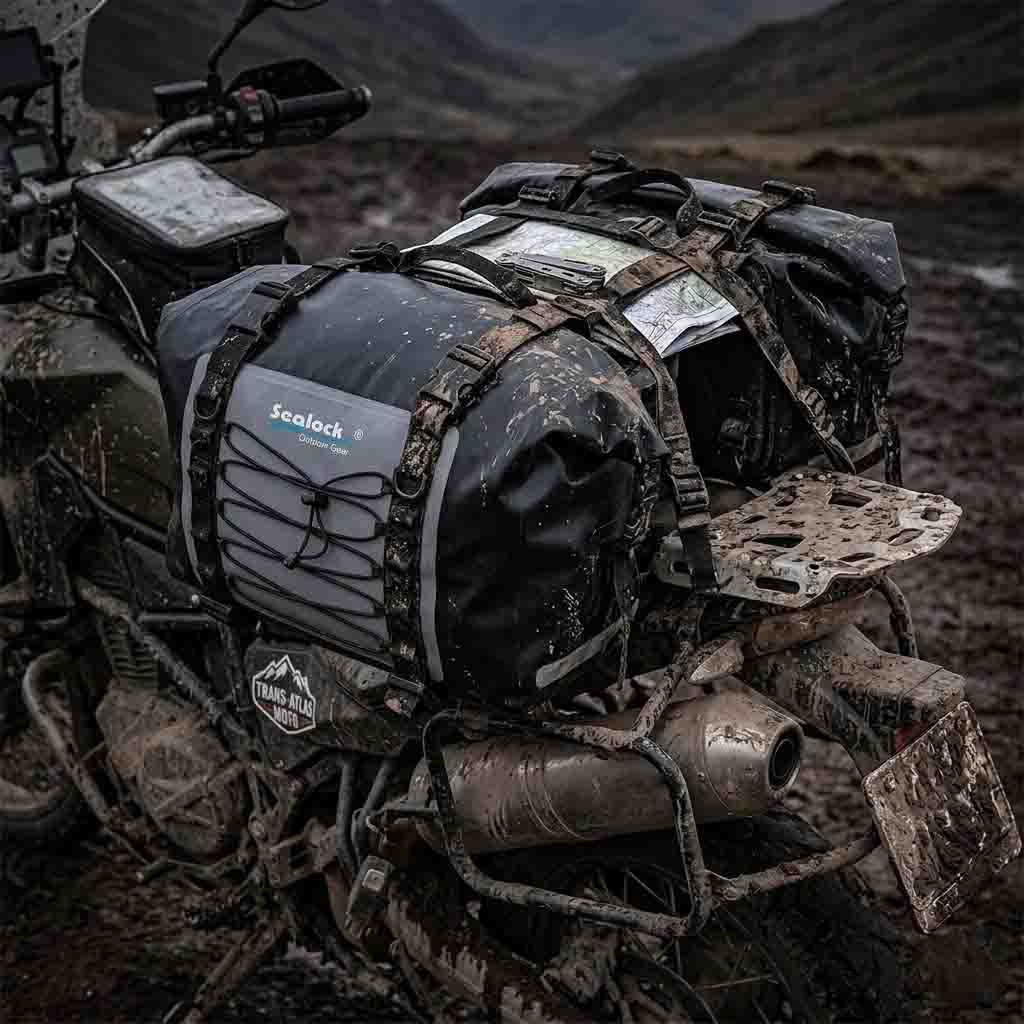
The real testing ground for soft luggage happens when you leave the paved highway behind and hit miles of deeply rutted washboard gravel. This non-stop vertical shaking forces your entire bike suspension to cycle aggressively. If you wrap standard tie-down straps tightly across a bare, unshielded bag face, those dust-covered straps quickly turn into a file.
As the bike jars over dirt tracks, the fine trail grit and trail mud trapped underneath the webbing acts exactly like coarse sandpaper, grinding directly into the bag's protective coating. Furthermore, if you lose your front tire in a slick mud hole or have a low-speed tip-over during a deep river crossing, your luggage takes the direct weight of the slide. Flimsy plastic buckles or cheap stitched seams will snap under that impact pressure, causing an immediate pack failure miles away from the nearest fuel stop. To prevent your gear from tearing open in the backwoods, look for rugged configurations that rely on heavy-duty RF welded seams and molded anchor plates to take strap strain. Explore our current factory direct layouts built to survive rough trail abrasion by browsing our full heavy-duty waterproof gear collection.
3. The Decision Tree: Matching Motorcycle Luggage to Your Route
To avoid a stressful, rainy fuel station unpacking routine with freezing wet gloves, use this simple formula to align your luggage defense to your specific trip parameters:
If your upcoming tour involves mostly high-speed asphalt cruising, highway commuting, and night riding:
➔ Secure a Wide-Base TPU Tail Duffle Pack. Long pavement stretches require a clean, aerodynamic bag profile that sits tight within the wind shadow of your back. Make sure all excess strap tails are rolled down into elastic keepers so they don't whip around at speed, and check out our specialized heavy-duty motorcycle waterproof bags built with low-drag air tracks.
If your expedition maps involve muddy single-track mountain paths, deep ruts, and predictable bike drops:
➔ Secure a set of Modular Soft Side Panniers utilizing 1000D Ballistic TPU fabric. Hard aluminum pannier boxes are dangerous in deep rock fields—they can bend your motorcycle's subframe during a crash or trap your leg in a rut. Heavy soft luggage acts as a dynamic cushion during low-side slides, easily absorbing trail abrasion. Just ensure your tie-down webbing channels squarely through integrated MOLLE loops to distribute the weight evenly.
If you are tackling deep river beds, tidal estuaries, or riding through unpredictable monsoon rain:
➔ Enforce a strict 4-Roll Interlocking Closure system equipped with cold-weather impact buckles. Cheap commercial plastic clips easily warp or shatter in freezing cold weather when packed with dry mud grit. A rugged roll-top configuration utilizing solid stiffening bars gives you a reliable mechanical wall that blocks water tracking even if your motorcycle slips completely under water during a technical river crossing.
4. Real Rider Q&A: Luggage Setup and Trail Reality
Before you load up your motorcycle for the next long-distance track, review these common field questions collected from actual adventure touring riders who have broken gear in the wild:
Q: Will a motorcycle dry bag flap at highway speed?
A: Yes, if you pack it loose or leave empty dead-air space inside. At 100 km/h, wind drag catches loose material folds, turning them into micro-parachutes that snap violently in the wind. This constant flapping causes cheap fabric coatings to delaminate. You can stop this entirely by pushing out all excess air columns before buckling, rolling the top tightly at least 3 to 4 times, and pulling your compression straps down flat to kill any loose fabric slack.
Q: Can soft luggage survive a motorcycle crash?
A: Premium soft luggage built with thick, high-density ballistic TPU reinforcement can survive severe trail slides better than hard cases. Hard aluminum panniers easily bend out of shape, split their pop-rivets, or break their mounting racks during a slide, causing permanent water leaks. Heavy-duty soft bags flex dynamically under impact, absorbing the weight shock of the bike and shrugging off harsh rock abrasion across deep gravel paths.
Q: Are roll-top bags better than zippers for ADV riding?
A: Absolutely. For serious backcountry adventure touring involving trail mud, deep river bogs, and dust-covered straps, roll-top closures are a much safer choice than waterproof zippers. Coarse sand grit and dried mud crusts will easily jam zipper teeth paths, causing the slider track to split open when you force it shut. A roll-top bar closure has no moving parts to break—if it gets caked in heavy mud at the campsite, you just rinse it off with fresh water and roll it down.
5. Sourcing Metrics: Tensile Reinforcement and Private-Label Manufacturing
For motorcycle accessory distributors, regional adventure rental fleets, and global outfitting procurement managers structuring bulk OEM inventory runs, basic waterproof labels aren't enough to look at. The number one cause of costly customer warranty returns is anchor patch delamination and webbing cleavage splits caused by relentless wind drag and trail vibration. When low-tier contract factories cut corners with cheap PVC materials or weak high-frequency tooling setups, the strap mounts will rip out during heavy field use, causing immense brand overhead and batch recall liabilities.
Our direct Sealock industrial production facilities eliminate these performance failures at the manufacturing level. We engineer our entire motorcycle luggage catalog utilizing premium 840D and 1000D ballistic TPU composites fused via heavy-duty 27.12MHz high-frequency RF welded seams. Every anchor patch and webbing point passes rigorous automated tensile pulling tests that simulate years of washboard gravel abuse before any cargo clears our floor. To protect your brand assets from international logistics friction, our dual-manufacturing footprint spans across both China and Vietnam, offering verified SMETA P4/GRS compliance data sheets and major EU/US tariff optimization advantages. Private-label managers can coordinate direct access to our unedited laboratory load sheets, material tear data books, or bulk pricing configurations by contacting our main Sealock Factory Sourcing and Technical Compliance Desk.