
- English
- Español
- Português
- русский
- Français
- 日本語
- Deutsch
- tiếng Việt
- Italiano
- Nederlands
- ภาษาไทย
- Polski
- 한국어
- Svenska
- magyar
- Malay
- বাংলা ভাষার
- Dansk
- Suomi
- हिन्दी
- Pilipino
- Türkçe
- Gaeilge
- العربية
- Indonesia
- Norsk
- تمل
- český
- ελληνικά
- український
- Javanese
- فارسی
- தமிழ்
- తెలుగు
- नेपाली
- Burmese
- български
- ລາວ
- Latine
- Қазақша
- Euskal
- Azərbaycan
- Slovenský jazyk
- Македонски
- Lietuvos
- Eesti Keel
- Română
- Slovenski
- मराठी
- Srpski језик

Roll Top Waterproof Backpacks: Features and Manufacturing Advantages
Sealock manufactures roll top waterproof backpacks for OEM, wholesale, and private label buyers from factories in China and Vietnam. The roll-top has taken over the waterproof backpack category for a reason that is usually explained from the user's side — it seals better — but the more interesting half of the story is on the factory floor. The construction is simpler to build, cheaper to source, easier to inspect, and has fewer things that can fail. This covers both: what the closure delivers to the end user, and why it delivers a better product at a given price point.
1. Company and Production Base
Sealock (YiFuLong Outdoor Gear Co., Ltd.) has built welded waterproof bags for over 20 years, producing for international outdoor and marine brands including OSPREY, KAILAS, Helly Hansen, and CHUMS.
- Established: 2003
- Facilities: Dongguan, China | Ho Chi Minh City, Vietnam — either origin available on any model
- Certifications: ISO 9001, BSCI, SMETA, HIGG, GRS, SCAN
- Terms: MOQ 300 pcs per model (a small number at 500), samples 7–15 days, bulk 30–45 days, FOB Guangdong
2. The Features the Closure Creates
Every user-facing property of a roll-top pack traces back to the same mechanism — folding coated fabric against itself and clamping it under buckle tension:
- Sealing without moving parts. Three to four folds stack into a labyrinth the water has to travel through, with nothing to wear out, jam, or need lubricating.
- Adjustable volume. Rolling more turns compresses a half-full pack into a stable shape; rolling once opens it to full capacity. One pack covers a light commute and a loaded weekend.
- Buoyancy. The fold traps air, so a sealed pack floats rather than sinking if it goes overboard.
- Grit and salt tolerance. Sand and mud act like slow cutting blades on a zipper track; a rolled collar rinses clean in a river and keeps sealing.
- Over-packing capability. An overstuffed pack still closes with fewer folds, where a zipper simply will not shut.
3. Why the Roll-Top Wins on the Factory Floor
This is the part buyers rarely see, and it is where the cost and reliability advantages actually come from:
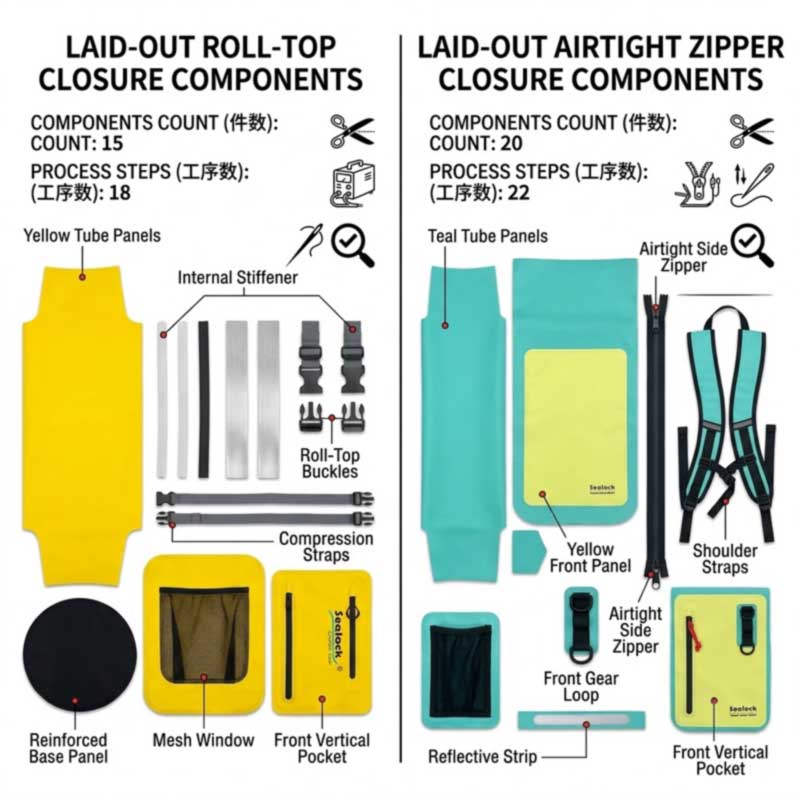
- Fewer components. A roll-top main compartment is a welded body, a stiffened collar, webbing, and buckles. A rated waterproof zipper closure adds a purchased zipper, its welded-in seat, a protective flap, and pull hardware — every one of which is another part to source, install, align, and inspect.
- No zipper supply dependency. Rated airtight zippers are a specialised, expensive, single-source component with their own lead times. Removing them from the main closure takes both the cost and the supply risk out of the bill of materials — the single largest cost lever on a waterproof pack.
- The closure is made from the same material as the body. A roll-top collar is welded fabric, so it uses the same rolls, the same 27.12 MHz welding process, and the same tooling logic as the body itself, rather than introducing a second material system that has to be joined to the first.
- Fewer failure points to engineer around. Every transition between welded panel, sewn panel, zipper, pocket, and strap is a potential weak point that has to be designed and tested. Removing the main zipper removes the most demanding of those transitions.
- Simpler, faster QC. A rolled closure is verified by checking collar stiffness, weld continuity, and buckle strength. A sealed zipper adds seating alignment, slider function, gasket condition, and cycle life to the same inspection.
- Lower reject and rework exposure. Welds can be repaired only by patching or heat treatment, so a defect caught late is costly — fewer welded interfaces and no zipper installation means fewer opportunities to create one.
The net effect is a pack that reaches a higher waterproof rating at a lower cost with fewer things to go wrong. That is the manufacturing logic behind the silhouette's dominance, more than any styling trend. The underlying welding sequence is set out in the manufacturing process from cutting to RF welding.
4. Collar Engineering: The Detail That Separates Good From Bad
The collar is where roll-top quality is decided, and it is a genuine engineering choice rather than a formality. Sealock specifies a stiffened collar rim: a reinforcing strip welded just below the opening that keeps the fabric flat so the fold seats evenly, without wrinkles, and makes a correct seal intuitive rather than a knack the user has to learn.
The alternative some factories use — a hook-and-loop strip along the opening — looks like a cheap way to add sealing, and it creates a real problem in the field. If the strip is not perfectly aligned, the hook side rubs against whatever is packed at the top, which on a commuter pack means an expensive knit or a wool scarf. A stiffened rim achieves the same fold discipline without abrading the contents. Collar height, stiffener width, and buckle placement are all specifiable on an OEM programme.
5. Material Choice Matters More on a Roll-Top
A roll-top concentrates repeated stress on one crease line, which changes the material calculation compared with a fixed-opening pack:
- TPU-laminated fabric stays flexible in cold and returns to shape after thousands of fold cycles, which is why it is the default for packs that will be rolled daily or used in cold climates.
- PVC tarpaulin welds easily and costs less, and it performs well in temperate use — but its plasticizers migrate out over time, so a PVC pack stored tightly folded in a freezing garage over winter can dry out and split along the crease and welded corner lines. For cold-market lines, specify TPU or a heavier PVC with the fold zone reinforced.
Both are welded on the same lines, and the trade-offs are set out in the comparisons of TPU material advantages and PVC cost and performance. High flex resistance at the fold zone should be part of the specification either way.
6. The Honest Trade-offs
A roll-top is not the right closure for every programme, and specifying one where a zipper belongs generates complaints:
- Slower access. Unrolling to reach the main compartment becomes friction on a pack opened many times a day — the main reason commuter lines often choose a zipper.
- Usable capacity is lower than rated. Volume is measured open, so a 20L pack holds less once rolled three times. List the usable figure, not the rated one.
- The seal depends on the user. Fewer than three folds leaks, and no construction prevents that — clear closure instructions belong in the packaging.
- Bulk at the top. The rolled collar takes space a zipped top does not, and the format suits vertical, bucket-shaped bodies more than wide flat ones.
- Single large opening. Organisation depends on internal dividers or external pockets rather than multiple entry points.
7. Hybrid Construction: Roll-Top Main, Zipped Pockets
Most modern designs resolve the access problem with a hybrid: a roll-top main compartment for the waterproof rating, plus welded zipped pockets for the items needed on the move. It works well, but it re-introduces exactly the interfaces the pure roll-top avoided, so each transition between welded panel, zipper, and pocket has to be engineered and tested rather than assumed. A front pocket is a hole in a sealed body unless it is separately sealed with a rated zipper and welded seams — and the listing should say whether it is waterproof or only water-resistant.
8. Roll-Top Backpack Range
Models across capacities, materials, and hybrid variants, organized by type rather than priority:
| Image | Model | Capacity | Material | Construction / rating | Product Page |
|---|---|---|---|---|---|
|
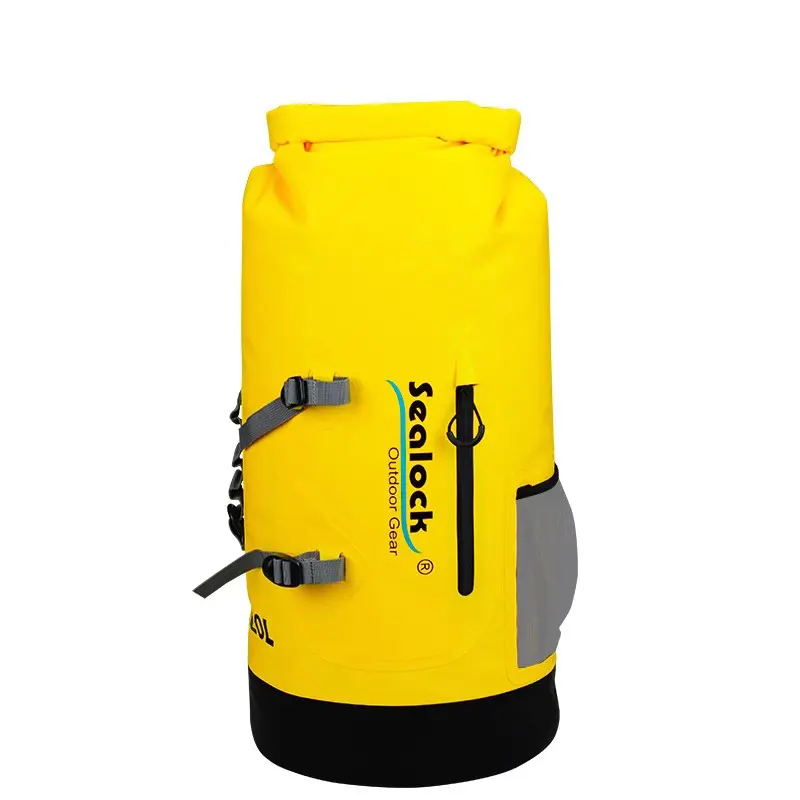
SL-E105 | 20 / 28L | 500D PVC | Roll-top + zip front pocket · IPX7 | View |
|
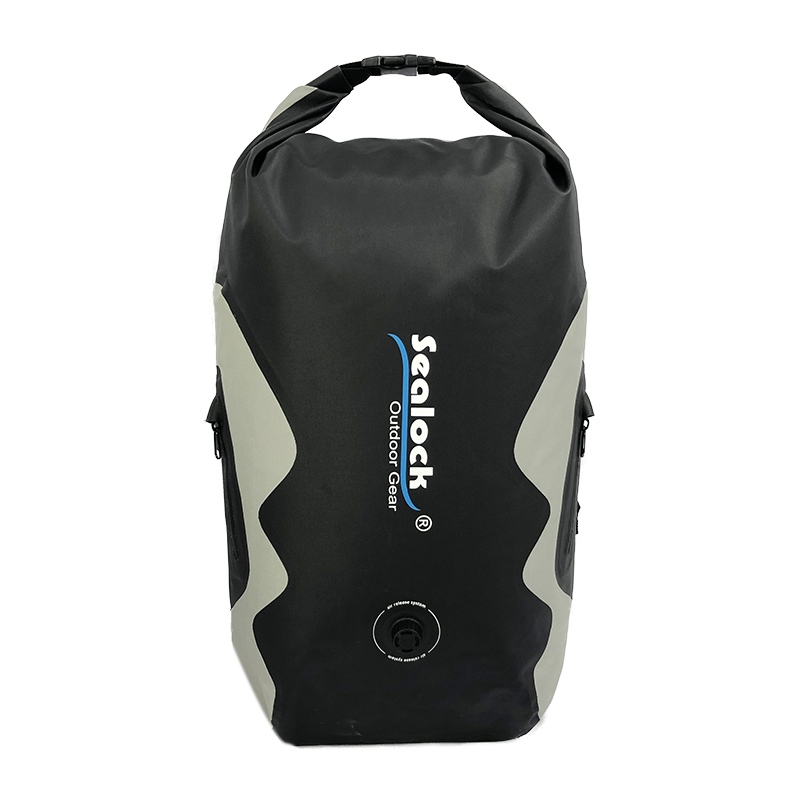
SL-E070 | 25L | 420D TPU | Roll-top · IPX8 · purge valve | View |
|
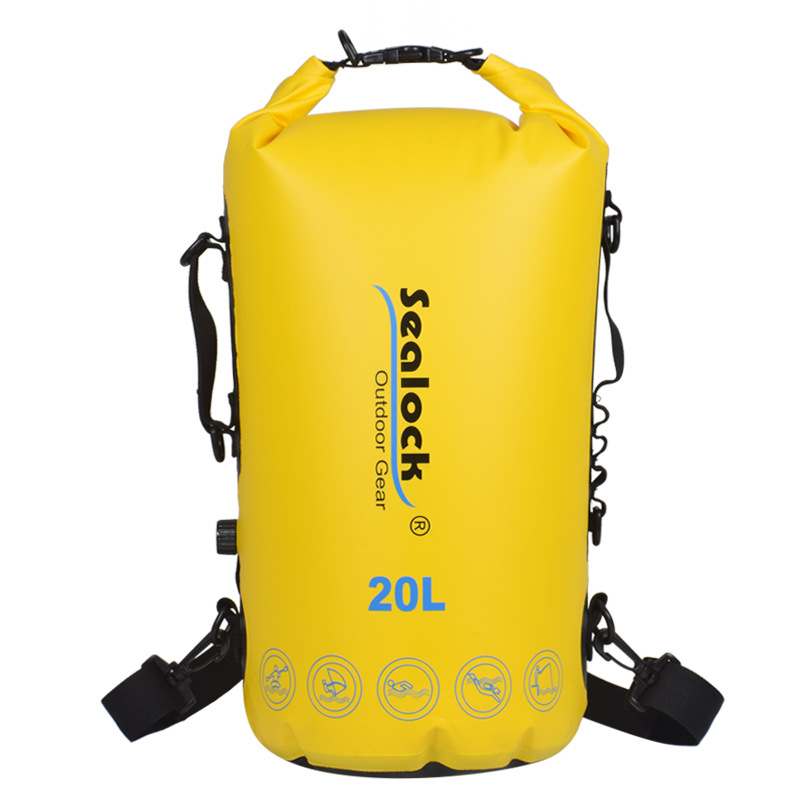
SL-E102 | 15 / 20L | 500D PVC | Roll-top · IPX7 · patented dual seal | View |

|
SL-E229K | 23L | TPU laminate | Hybrid: roll-top + wrap-around zip · IPX6 | View |
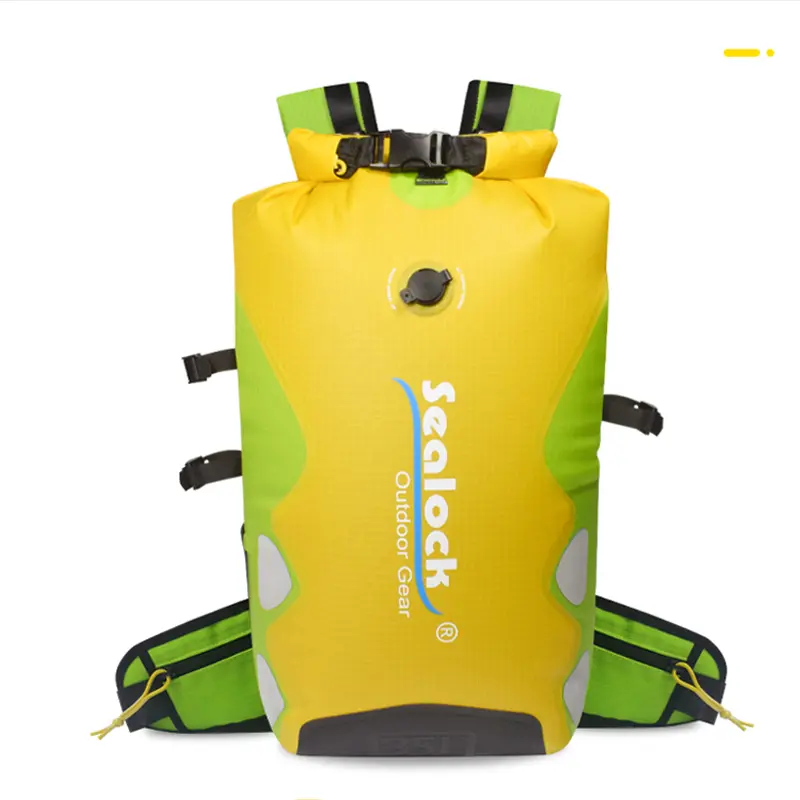
|
SL-E801 | 35L | 420D TPU | Roll-top · IPX7 · air valve | View |
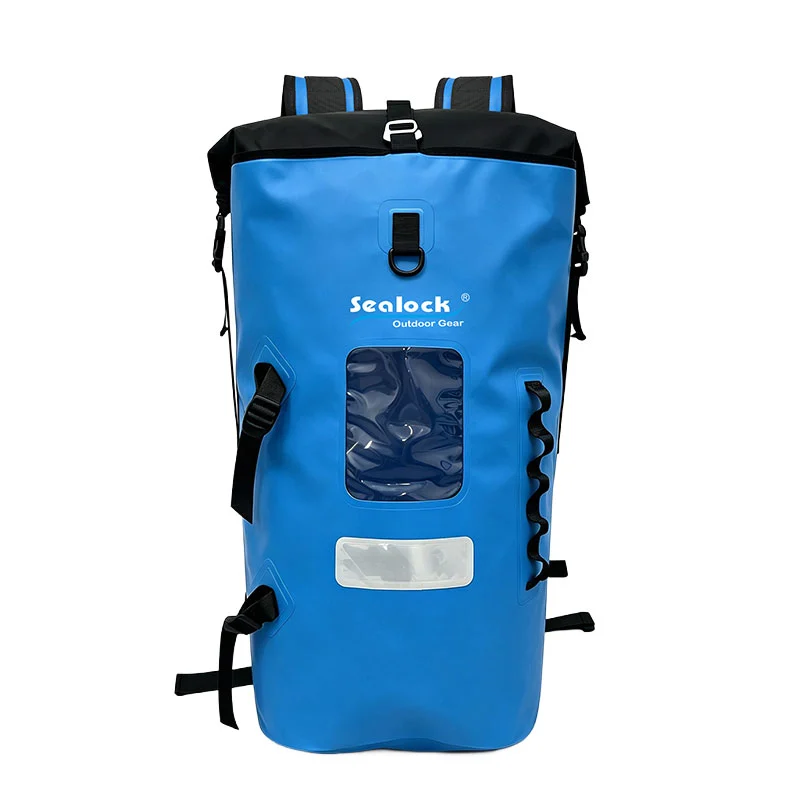
|
SL-E273A | 45L | 500D PVC (TPU option) | Roll-top · IPX6 · window, full harness | View |
Roll-top constructions run from 15L to 65L in PVC and TPU, in commuter, hiking, and water-sports configurations. Full categories sit under dry backpacks, dry bags, and duffels. Collar height, fold count, buckle grade, harness, and pocket layout are all specifiable — see the guide to OEM waterproof backpack manufacturing.
9. Quality Assurance
Every batch runs three-stage control: IQC on incoming fabric, buckles, and webbing; IPQC in line, including peel tests on sample welds at run start and collar stiffener seating checks; and OQC with AQL sampling, batch immersion testing, and signed gold-sample comparison. The laboratory suite covers full water immersion, load testing over 1,500 cycles at strap anchors and handles, tensile and bonding strength, salt spray, friction resistance, colour fastness, and colour difference, with 3,000 sealed-zipper cycles on hybrid models.
For airtight verification, Sealock strictly executes a full customer inspection procedure that a buyer or their inspector can witness end to end: unboxing of sealed cartons in the inspector's presence, vacuum extraction to place the closure and welded seams under differential pressure, a 24-hour static rest, and air-leak determination against the batch record. A 24-hour vacuum hold surfaces slow leaks that a brief dunk test cannot detect. Third-party inspection through SGS or QIMA is available, under the quality control standards for waterproof production.
10. FAQ
Q: Why are roll-top waterproof backpacks usually cheaper than zippered ones at the same rating?
A: Because the closure is made from the same welded fabric as the body, while a rated airtight zipper is an expensive purchased component that also needs a welded seat, a protective flap, and extra inspection. Removing it from the main closure is the single largest cost lever on a waterproof pack.
Q: My roll-top pack's collar strip catches on my knitwear — is that normal?
A: It is a design flaw, not a normal wear issue. Some factories use a hook-and-loop strip along the opening; if it is slightly misaligned, the hook side abrades whatever is packed at the top. A welded stiffened collar rim gives the same fold discipline without touching the contents — specify it.
Q: My PVC roll-top split along the fold after a winter in storage. Why?
A: Plasticizers migrate out of PVC over time, and storing it tightly folded in freezing conditions dries the material so it can split along the crease and welded corner lines. For cold climates specify TPU, which stays flexible and recovers after repeated folding, or reinforce the fold zone.
Q: Roll-top or zipper for a commuter line?
A: A zipper usually, or a hybrid. Commuters open a pack many times a day and unrolling becomes friction. Roll-top suits water sports, expedition, and high-exposure use where sealing beats speed of access.
Q: Why does my 20L roll-top hold less than 20 litres?
A: Rated capacity is measured with the pack open; usable volume drops once it is rolled three times. Ask for the size before closure, after three rolls, and the recommended usable figure, and publish the usable one to avoid "smaller than described" returns.
Q: Is a roll-top genuinely submersible?
A: Correctly rolled at least three times against a welded body, it handles rain, spray, and brief immersion — which is what IPX6 and IPX7 cover. For sustained submersion, specify a rated airtight zipper model or a patented dual-seal construction, and match the marketing claim to the actual rating.
Request Roll-Top Samples and Specs
For collar and closure configurations, capacities, samples, or a full OEM/private label proposal, submit an inquiry. Sealock responds to procurement enquiries within 24 hours, with production from Dongguan, China or Ho Chi Minh City, Vietnam.