
- English
- Español
- Português
- русский
- Français
- 日本語
- Deutsch
- tiếng Việt
- Italiano
- Nederlands
- ภาษาไทย
- Polski
- 한국어
- Svenska
- magyar
- Malay
- বাংলা ভাষার
- Dansk
- Suomi
- हिन्दी
- Pilipino
- Türkçe
- Gaeilge
- العربية
- Indonesia
- Norsk
- تمل
- český
- ελληνικά
- український
- Javanese
- فارسی
- தமிழ்
- తెలుగు
- नेपाली
- Burmese
- български
- ລາວ
- Latine
- Қазақша
- Euskal
- Azərbaycan
- Slovenský jazyk
- Македонски
- Lietuvos
- Eesti Keel
- Română
- Slovenski
- मराठी
- Srpski језик

Waterproof Backpack Factory: Production and Quality Assurance
Sealock operates waterproof backpack factories in Dongguan, China and Ho Chi Minh City, Vietnam, producing OEM and wholesale packs for outdoor brands and importers. A waterproof backpack factory has to run two production disciplines at once — high-frequency welding for the waterproof body and industrial sewing for the load-bearing structure — and the order in which they happen determines whether the pack stays sealed. This is how the line is organised, and how quality is assured from incoming roll to the customer's own inspection.
1. Two Disciplines on One Line
Most bag factories do one thing well. A dry bag plant welds; a conventional backpack plant sews. A waterproof backpack needs both, because the body must be a continuous welded skin while the harness, pockets, and reinforcement are sewn assemblies that carry load. Running them together is a sequencing problem more than a machinery problem: every stitch is a hole, so the sewing work has to be finished before the waterproof seal exists, and anything attached afterwards must be welded onto reinforcement rather than sewn through the membrane.
That constraint shapes the whole factory layout. Machines are organised by process stage — cutting, sub-assembly sewing, welding, reinforcement, finishing — because process discipline is what keeps error rates low and separates a structured plant from a workshop. Sealock runs both disciplines in-house across roll-top and zippered constructions in PVC and TPU.
2. The Production Flow, Stage by Stage
- Material inspection. Fabric rolls are checked for shade variation, weave flaws, stains, and coating consistency before anything is cut. Material decides a large share of a pack's durability and cost, so a bad roll stopped here never becomes a bad batch.
- Cutting. Panels are cut to pattern with markers arranged for material efficiency. Precision matters more than speed and the errors are irreversible: a millimetre of drift compounds across seams into misalignment, uneven stress distribution, and long-term seam distortion.
- Branding. Logos are applied to flat panels — silkscreen, heat transfer, embroidery, or welded emboss — before assembly, while the panel is still accessible.
- Sub-assembly. Small components are built first: pockets, organisers, mesh, linings, webbing, and shoulder straps with their foam. Building these separately reduces complexity at the later stages, where mistakes are expensive.
- Structural sewing and reinforcement. Load-bearing elements are attached to the panels — harness anchors, D-ring patches, base reinforcement — with reinforcement following the load paths rather than applied uniformly. A backpack can run to thirty or more operations on a single line, and more on complex designs.
- High-frequency welding. The body is welded at 27.12 MHz into a continuous, needle-hole-free skin, with window panels and rated zippers welded in as part of the same sealed structure. The full technical sequence is set out in the manufacturing process from cutting to RF welding.
- Final assembly. Closures, buckles, valves, straps, and hardware are fitted, with anything mounted to the sealed body welded onto reinforcement patches.
- Inspection and packing. Functional and appearance checks, then packing to the order's carton, label, and marking specification.
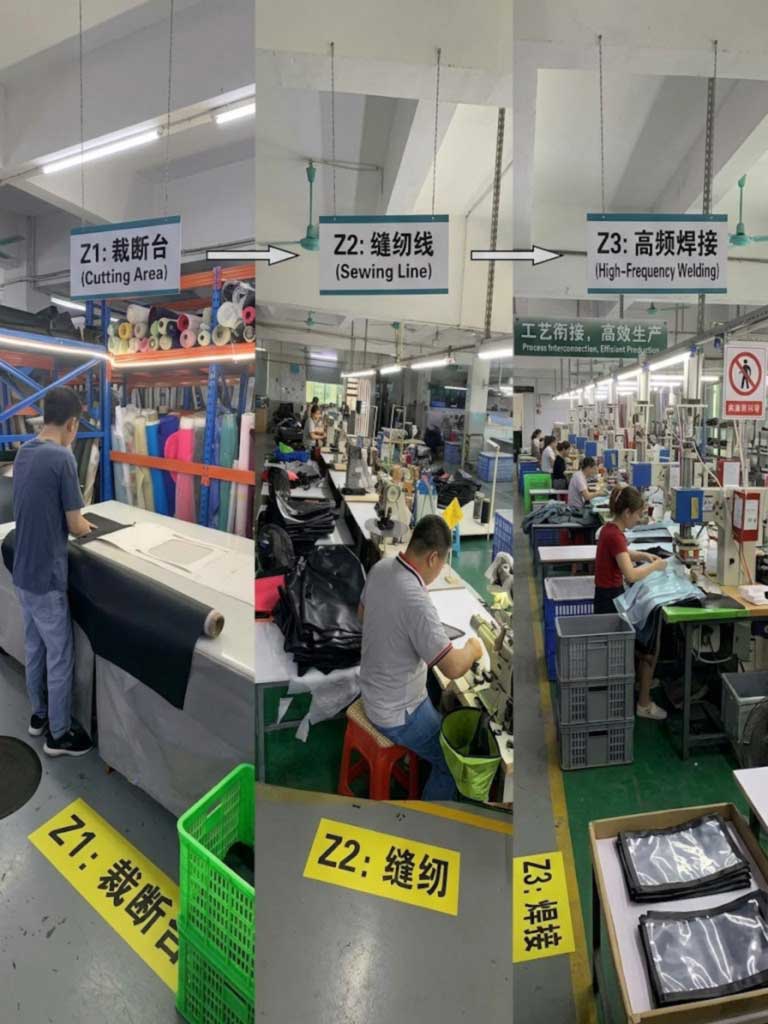
3. Why Bulk Drifts From the Sample — and How the Line Prevents It
The uncomfortable truth of bag production is that samples are built slowly by senior technicians, while bulk runs at production speed with more operators and more variables. That gap is where sample-to-bulk differences come from, and controlling it is the factory's real deliverable: reproducing the approved sample's shape, function, and finish across thousands of units within defined tolerances.
The controls that close the gap are upstream, not at final inspection: fabric lot and shade control, locked webbing and foam specifications, hardware compatibility confirmed before the run, repeatable sewing standards for stitch length and tension, strict version control between the approved sample and the production spec, active in-line QC, and packing rules that protect shape in transit. When a defect appears during cutting, sewing, or welding, the line is stopped and corrected rather than allowed to propagate — the difference between catching a problem at unit fifty and discovering it at unit five thousand.
4. Quality Assurance Across Three Stages
Sealock applies control at every handoff rather than relying on a final look:
- IQC — incoming fabric, zippers, buckles, webbing, and foam verified against specification, including coating consistency and shade against the approved standard.
- IPQC — in-line control covering cutting accuracy, stitch density and tension, stress-point reinforcement, and weld quality, with peel tests pulled on sample welds at the start of every run to confirm the parameter set is producing full fusion.
- OQC — AQL sampling against the agreed defect classification, batch immersion testing, dimensional and colour checks, and comparison against the signed gold sample before packing.
Third-party pre-shipment inspection through SGS, QIMA, Bureau Veritas, or Intertek is available, and buyers are welcome to send their own inspector. The applicable standards, AQL levels, and defect classifications are set out in the quality control standards for waterproof production.
5. The Customer Inspection Procedure
Beyond routine batch testing, Sealock strictly executes a full customer inspection procedure for airtight verification, run end to end in front of the buyer or their inspector:
- Unboxing — sample units are drawn and unpacked from sealed cartons in the inspector's presence.
- Vacuum extraction — air is drawn out of the sealed pack to place the closure and welded seams under differential pressure.
- 24-hour static rest — the evacuated unit is left undisturbed for a full 24 hours, long enough for any slow leak to reveal itself, which a brief dunk test cannot detect.
- Air-leak determination — the unit is assessed after the rest period; any recovery of internal volume indicates a leak path, and the result is recorded against the batch.
This procedure is deliberately harder to pass than a short immersion check. A pack can survive a two-minute dunk and still have a pinhole or an imperfectly seated zipper that fails in sustained real-world exposure; a 24-hour vacuum hold surfaces exactly that class of defect.
6. The Laboratory Test Suite
Backpacks fail mechanically more often than hydraulically, so the suite covers both:
| Test | Verifies |
|---|---|
| Full water immersion | Seam and closure integrity against the stated IPX rating |
| Vacuum hold, 24 hours | Slow leaks and imperfect closure seating that a short test misses |
| Weld peel test at run start | Full fusion — a correct weld tears the fabric rather than parting at the seam |
| Load test, 1,500+ cycles | Strap anchors, handles, and D-rings under repeated full load |
| Sealed-zipper cycling, 3,000 cycles | Zipper seal life on zippered models |
| Tensile and bonding strength | Fabric at stress points; weld and lamination under pressure |
| Salt spray | Hardware corrosion in marine and coastal use |
| Friction resistance | Abrasion from dragging, setting down, and transit |
| Colour fastness / colour difference | UV fading and batch-to-batch drift against the Pantone standard |
7. Production Capacity and Terms
Multiple welding lines run in parallel alongside the sewing lines, so categories do not queue behind a single machine. Standard terms: MOQ 300 pcs per model (a small number at 500), samples in 7–15 days, bulk in 30–45 days, FOB Guangdong. Production is available from Dongguan, China or Ho Chi Minh City, Vietnam so a buyer can route country of origin to suit a tariff position. Payment is 30% deposit with the 70% balance against a passed pre-shipment inspection. Compliance is backed by ISO 9001, BSCI, SMETA, HIGG, GRS, and SCAN, with test documentation available for vendor approval and tender submissions. How to assess a factory's stated capacity against its real output is covered in the guide to production capacity and quality standards.
8. Products Built on This Line
Models across closures, back systems, and capacities, organized by type rather than priority:
| Image | Model | Capacity | Material | Closure / rating | Product Page |
|---|---|---|---|---|---|

|
SL-E144 | 15L | TPU | Zipper · IPX6 · floating vented back | View |

|
SL-E119 | 20L | Cationic TPU composite | Airtight zipper · IPX8 · laptop | View |
|
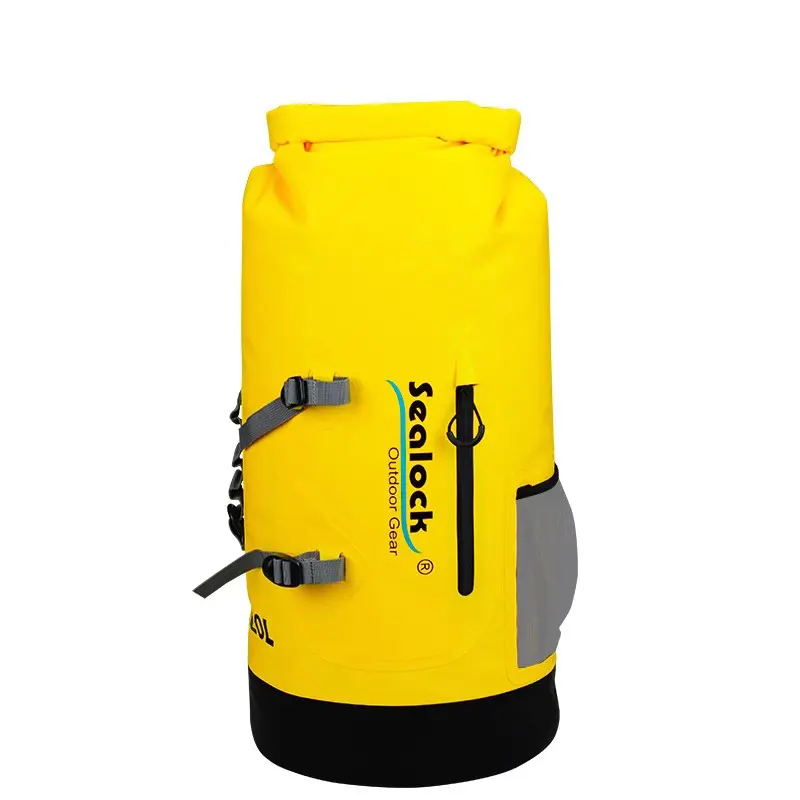
SL-E105 | 20 / 28L | 500D PVC | Roll-top · IPX7 · air-mesh back | View |
|
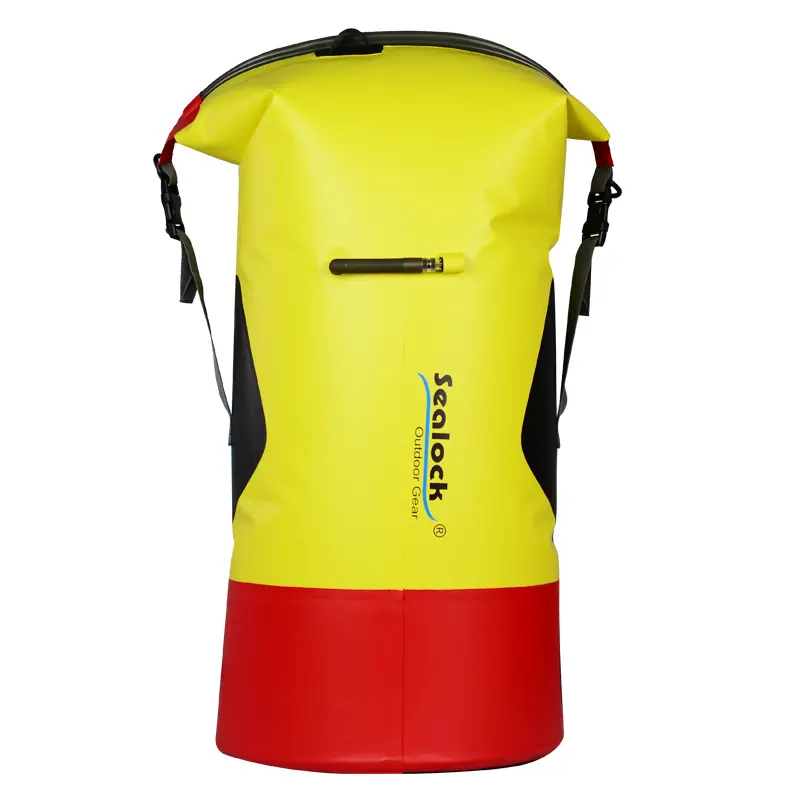
SL-E090 | 40L | 500D PVC (TPU option) | Airtight zipper + fold-over · IPX7 · air valve | View |
|
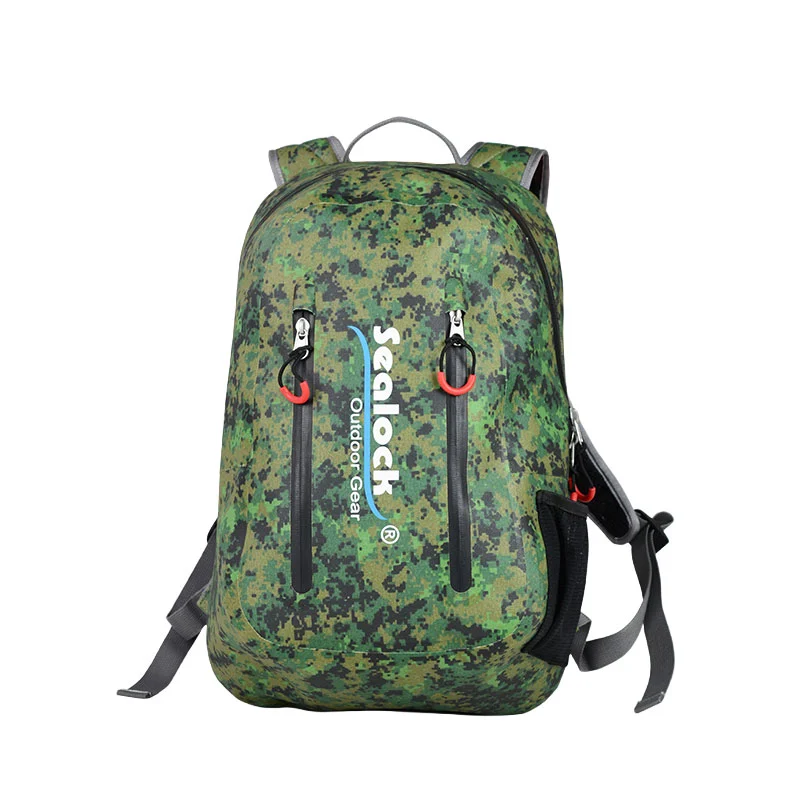
SL-E127 | 15L | 900D TPU | Zipper · IPX6 · air-flow back | View |

|
SL-E282 | 35L | Coated poly + welded TPU | Roll-top · suspended back · hip belt | View |
The range spans 15L to 65L across roll-top, zipper, and hybrid constructions. Full categories sit under dry backpacks, dry bags, and duffels. Ground-up development from a sketch, sample, or target spec is supported, as set out in the guide to OEM waterproof backpack manufacturing.
9. FAQ
Q: Why does a waterproof backpack factory need both welding and sewing?
A: Because the body has to be a sealed welded skin while the harness and reinforcement are sewn load-bearing assemblies. The two must be sequenced so stitching is completed before the waterproof seal exists — anything attached afterwards is welded onto reinforcement patches, never sewn through the membrane.
Q: Our sample was perfect but the production run varied. Is that inevitable?
A: No, but it is the default outcome without upstream control. Samples are built slowly by senior technicians; bulk runs at speed with more operators. Fabric lot and shade control, locked foam and webbing specs, repeatable sewing standards, version control against the approved sample, and in-line QC are what close that gap.
Q: What is the vacuum test and why does it matter more than a dunk test?
A: Air is drawn out of a sealed pack, which is then left for 24 hours and assessed for leakage. A brief immersion can miss a pinhole or a zipper that is not fully seated; a 24-hour vacuum hold puts the seal under sustained differential pressure and surfaces exactly those slow-leak defects. Buyers can witness the full procedure.
Q: What defects should an inspection catch on a waterproof backpack?
A: Beyond leaks: wavy or misaligned zippers, crooked stitching, asymmetry from cutting drift, weak strap anchors, hardware failure, colour variation against the standard, and packing faults. Cutting inaccuracy is a common root cause — a millimetre of drift compounds into visible asymmetry and uneven stress.
Q: Can we witness production or inspection ourselves?
A: Yes. Factory audits, video walks of the welding and sewing lines, buyer-appointed inspectors, and third-party pre-shipment inspection through SGS or QIMA are all supported, and the customer inspection procedure is run in the inspector's presence.
Q: How is consistency maintained on reorders?
A: Through a repeat-production record held against a signed gold sample — approved sample photos, material names, colour codes, logo files, hardware details, packing method, carton spec, and inspection notes — plus colour-difference testing so a later order matches the first.
Arrange a Factory Review
For a capacity profile, a video walk of the production line, test documentation, or to arrange an inspection, submit an inquiry. Sealock responds to procurement enquiries within 24 hours.