- English
- Español
- Português
- русский
- Français
- 日本語
- Deutsch
- tiếng Việt
- Italiano
- Nederlands
- ภาษาไทย
- Polski
- 한국어
- Svenska
- magyar
- Malay
- বাংলা ভাষার
- Dansk
- Suomi
- हिन्दी
- Pilipino
- Türkçe
- Gaeilge
- العربية
- Indonesia
- Norsk
- تمل
- český
- ελληνικά
- український
- Javanese
- فارسی
- தமிழ்
- తెలుగు
- नेपाली
- Burmese
- български
- ລາວ
- Latine
- Қазақша
- Euskal
- Azərbaycan
- Slovenský jazyk
- Македонски
- Lietuvos
- Eesti Keel
- Română
- Slovenski
- मराठी
- Srpski језик

Waterproof Duffel Bag Supplier Selection Guide
Sealock is a waterproof duffel bag supplier and OEM manufacturer serving outdoor brands, retailers, and importers from factories in China and Vietnam. Duffels expose supplier weaknesses that smaller products hide: the hardest welds on any waterproof bag are its corners and base, and the longest, most demanding zipper track in the category runs the full length of its body. A factory that produces excellent flat-panel dry bags can still fail at both. This is what to verify before committing.
1. Why Duffel Supplier Selection Is Its Own Problem
Flat seams are the easy part of welding. Corners, curves, and bottom panels are where leakage risk concentrates, and a duffel is essentially a box — it has more corners, a large base that takes the bag's whole weight, and thick multi-layer junctions where panels meet. On top of that, larger styles integrate carrying capability with waterproofing far more tightly than a small dry bag does: the load path runs through handles and anchors mounted on a sealed body, so anchoring and sealing have to be engineered together rather than as separate steps.
The practical consequence for a buyer is that a supplier's dry bag samples tell you little about its duffel capability. The questions below are the ones that actually separate them.
2. Five Capability Questions Specific to Duffels
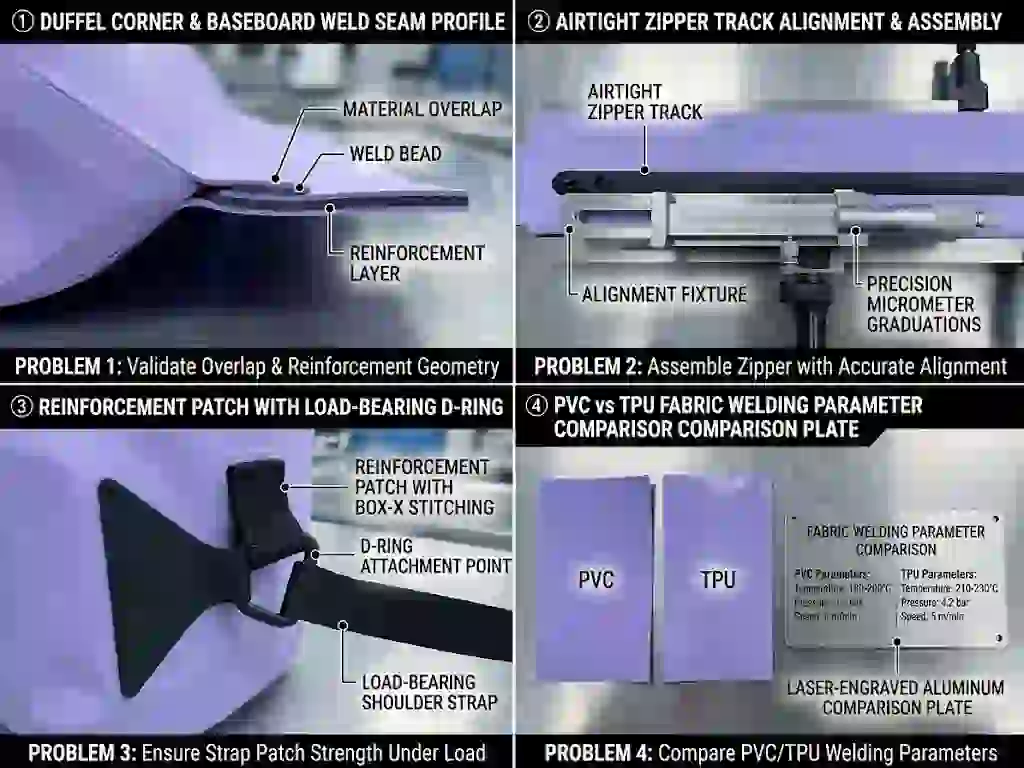
- How is corner and base leakage controlled? A capable factory can explain seam overlap design, tooling, reinforcement, and welding sequence at corners and the bottom panel, and can show whether thick junction areas are fully bonded. Vagueness here is disqualifying — this is where duffels leak.
- How is a long linear zipper track kept aligned? A full-length airtight zipper needs consistent alignment across the whole run, which requires proper track alignment jigs and tooling that can be set for heavy-duty airtight or gas-tight tooth zippers. Ask what equipment holds that alignment at volume.
- What load do the handles and anchors carry, and how is it tested? A duffel has no harness to spread weight, so anchors are the primary failure point. A supplier should state a rated load and test it, not describe the webbing.
- Is the material confirmed compatible with the welding method? Not every waterproof-looking fabric welds the same way. PVC-coated fabrics respond well to high-frequency welding; TPU-coated materials may require different process control depending on formulation and structure. Compatibility should be confirmed before material approval, not discovered at sampling.
- Can they build both ratings? A supplier limited to one construction cannot serve a full range. Building both IPX6 water-resistant duffels with coated zippers and IPX7 immersion-rated duffels with airtight zippers — and upgrading one to the other on request — is a genuine capability signal.
3. Test the Sample Filled, Not Flat
The most common sampling mistake on a duffel is evaluating it empty on a table. A flat sample hides exactly the failures a duffel produces in service: corner welds under outward pressure, base seams under load, zipper track tension as the body flexes when lifted, and anchor stress when the bag is carried in one hand. Fill the sample, load it to the weight the end customer will carry, lift it repeatedly by each handle, and then test the waterproofing.
Sample turnaround is itself a signal. A first sample in roughly one to two weeks is the industry benchmark; slower usually means a factory stretched beyond capacity or lacking technical agility. Just as informative is how the supplier behaves during sampling — one that asks clarifying questions and flags manufacturability problems is a partner, while one that silently guesses will do the same in bulk.
4. Verifiable Numbers to Demand
Ask for results, not adjectives. Reasonable requests on a duffel programme:
| Test | What to ask for |
|---|---|
| Handle and strap pull | Loaded to a multiple of the expected carry weight, held without stitch elongation or hardware deformation |
| Load cycling | Repeated full-load cycles at anchors and handles — Sealock runs 1,500+ |
| Zipper cycling | Thousands of open-close cycles on the main zipper, tested on production-batch samples — Sealock runs 3,000 sealed-zipper cycles |
| Waterproof verification | Immersion testing for IPX7, rain and water-jet testing for IPX6 — on filled, sealed units |
| Salt spray | Hardware exposure for marine and coastal programmes |
| Colour difference | Batch consistency against a signed reference — colour variation between runs is a top complaint in the category |
Sealock applies a 100% inflation and leak-testing gate on technical duffels after assembly: bags are inflated to a set internal pressure, checked with leak-detection fluid, and monitored for pressure drop-off over a fixed window, with technicians manually verifying the top closure zipper and the base welding points. Only units that hold volume without deviation pass. Separately, the full customer inspection procedure — unboxing, vacuum extraction, a 24-hour static rest, and air-leak determination — can be witnessed end to end by a buyer or their inspector. Standards and defect classification are set out in the quality control standards for waterproof production.
5. Verify the Equipment, Not the Catalogue
Welded waterproof products need heat-sealing or high-frequency welding equipment that a general sewing factory simply does not have, so a video walkthrough of the floor is worth more than a catalogue. Look for welding presses and their tooling, alignment jigs for zipper installation, industrial sewing for load-bearing sub-assembly, and a testing station with pressure or immersion rigs. Ask what percentage of the factory's output is in this product category, and whether cutting, sewing, welding, and QC all happen under one roof. Close-up images or video of welded seams, corners, and attachment points reveal more about real production quality than any catalogue page.
6. Red Flags
- Answering price questions fluently and technical questions vaguely. A reliable manufacturer can explain welding parameters, seam design, corner sealing, and testing clearly.
- Only flat samples offered. If a supplier resists filled or loaded testing, it knows what that reveals.
- Weak anchor points and low-grade zippers on the sample. Both signal a product built for low-cost markets rather than durability, and both are the components that generate warranty claims.
- Pushing bulk before sample testing is finished. The clearest warning sign on any waterproof product.
- No stated MOQ per style and per colourway. Get it in writing; misalignment here wastes both sides' time.
- Reluctance to allow inspection. A factory confident in its process welcomes an audit, a video walk, or a third-party inspector.
7. Ask About the Reorder Before the First Order
A supplier's real value shows on the fifth order, not the first. Confirm in advance whether the same fabric lot, colour, zipper, and hardware can be reserved or matched for a repeat run, whether spare material is held, and whether a signed gold sample plus colour-difference testing governs consistency. Colour drift between runs is among the most common complaints in the bag industry and it signals weak process control — it is a capability question you can screen for before the first purchase order, not a risk you have to discover.
8. Sealock Capability Summary
Sealock (YiFuLong Outdoor Gear Co., Ltd.) has built welded waterproof bags for over 20 years, producing for international outdoor and marine brands including OSPREY, Helly Hansen, West Marine, and CHUMS. In-house 27.12 MHz high-frequency welding runs alongside industrial sewing lines, with line setup that can be configured for heavy-duty airtight zipper installation. Terms: MOQ 300 pcs per model, samples 7–15 days, bulk 30–45 days, FOB Guangdong, with production from Dongguan, China or Ho Chi Minh City, Vietnam on any model. Compliance covers ISO 9001, BSCI, SMETA, HIGG, GRS, and SCAN, and buyers are welcome to send their own or a third-party inspector. The engineering behind duffel construction specifically is set out in the guide for global wholesale duffel buyers.
9. Range to Evaluate Against
Models across both ratings, closures, and capacities, organized by type rather than priority:
| Image | Model | Capacity | Material | Closure / rating | Product Page |
|---|---|---|---|---|---|
|
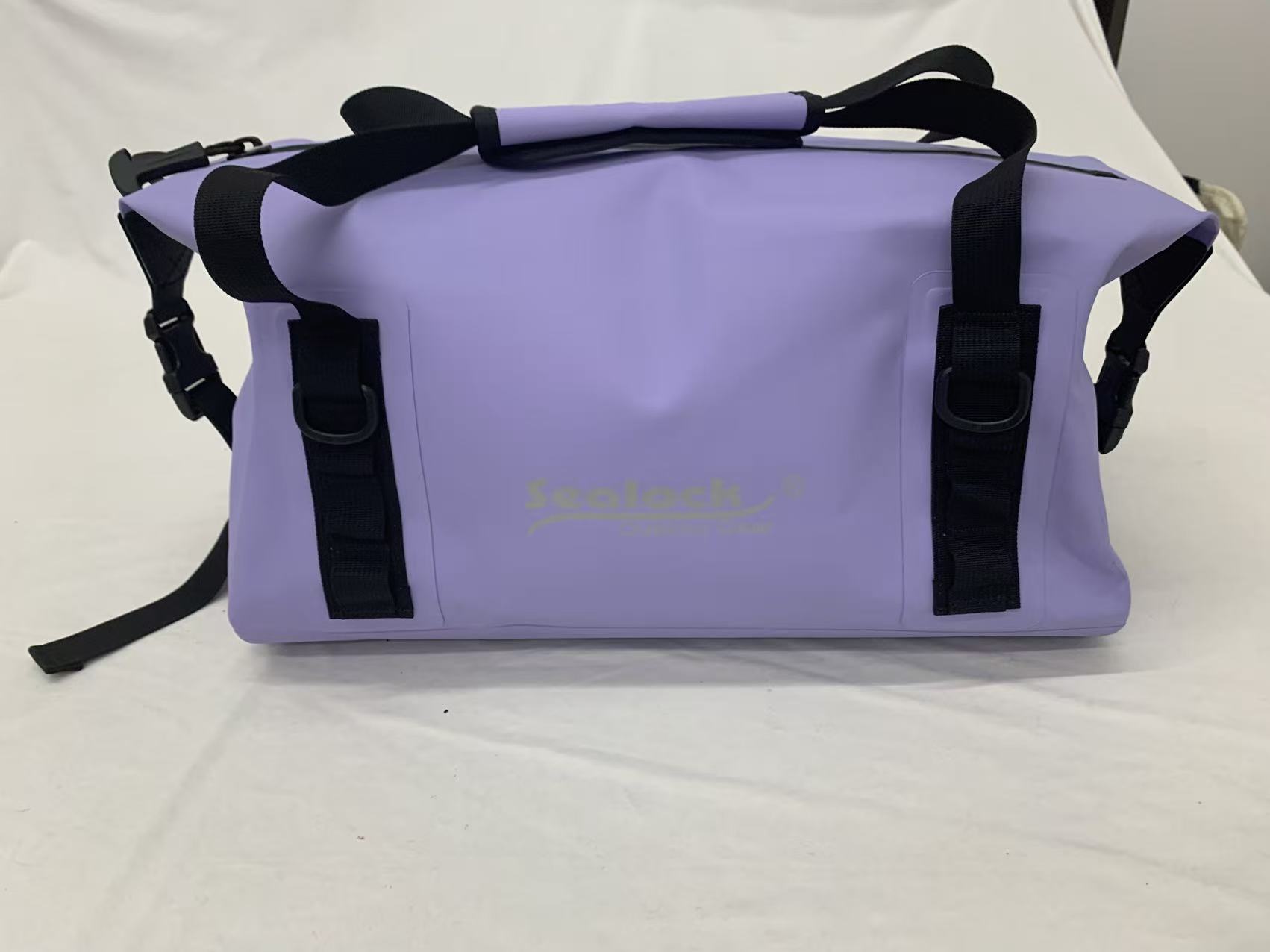
SL-C878 | 20L | 840D TPU | Airtight zipper · IPX7 | View |

|
SL-C261 | 30L | TPU composite | IPX8 zipper · foldable | View |
|
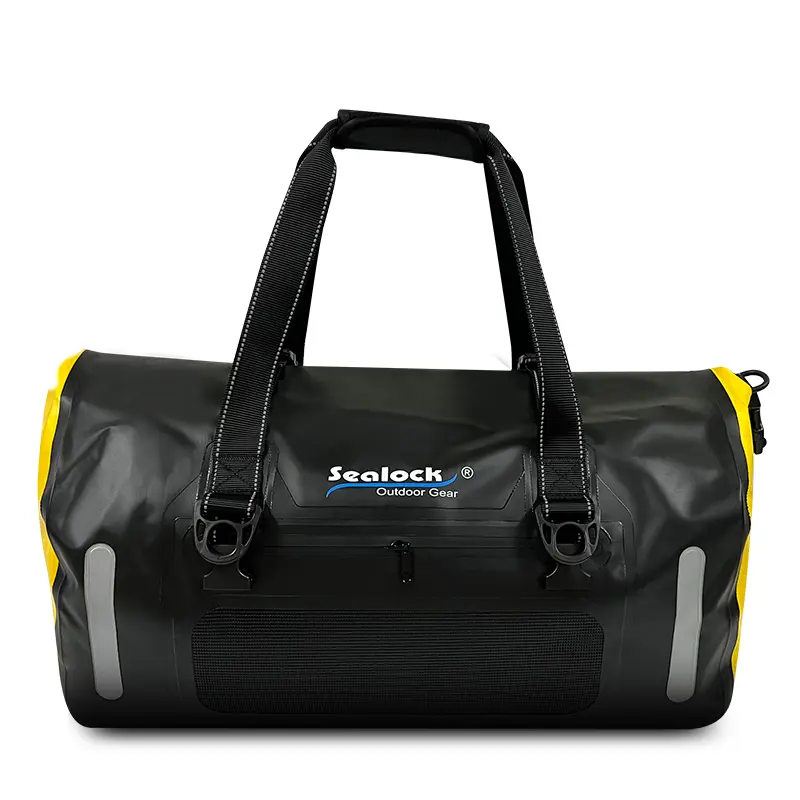
SL-K099 | 40 / 60L | 840D TPU | Roll-top · IPX7 | View |
|
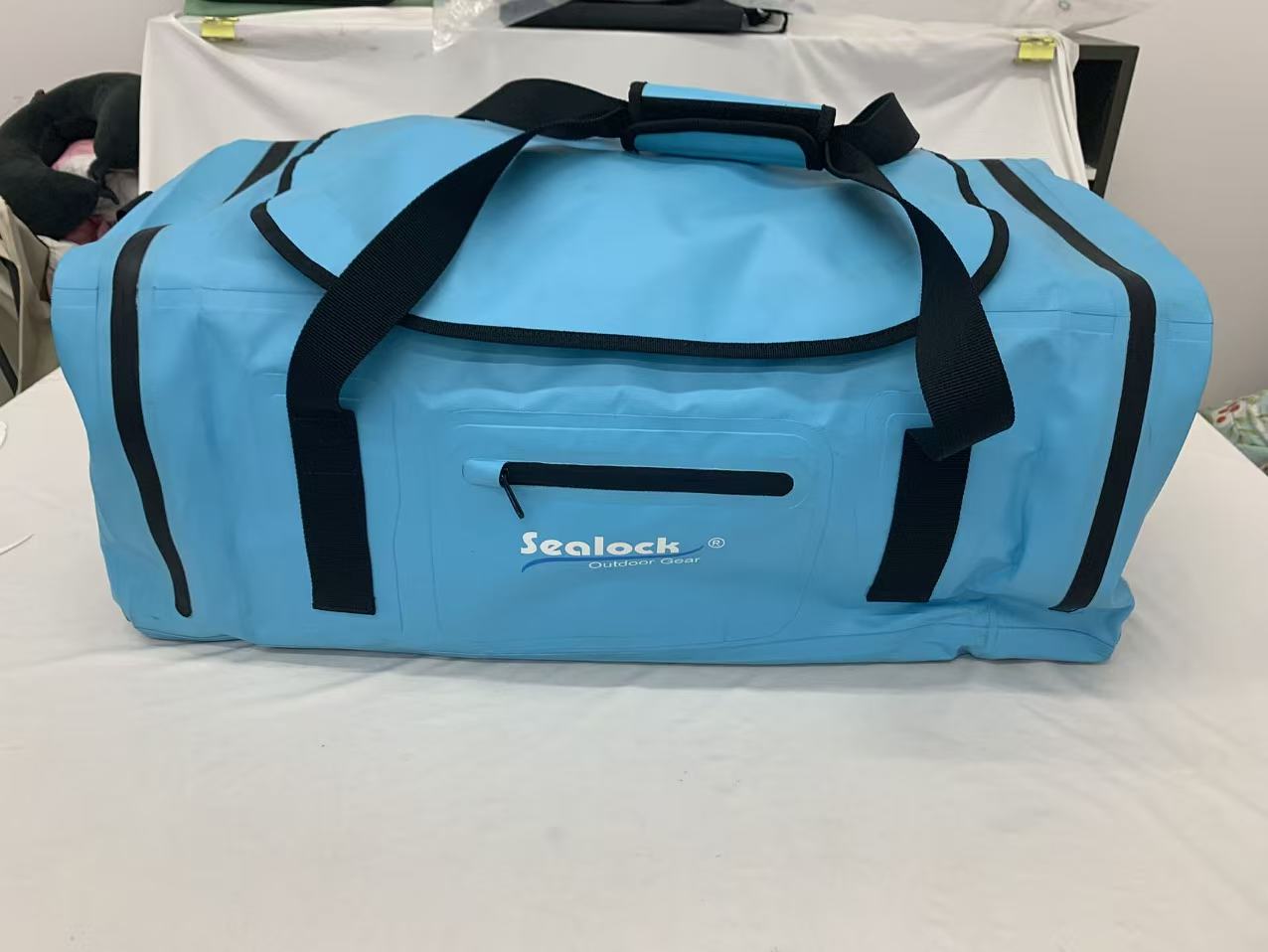
SL-C594 | 55L | 500D PVC (TPU option) | Airtight zipper · IPX7 · 2 sealed end compartments | View |
|
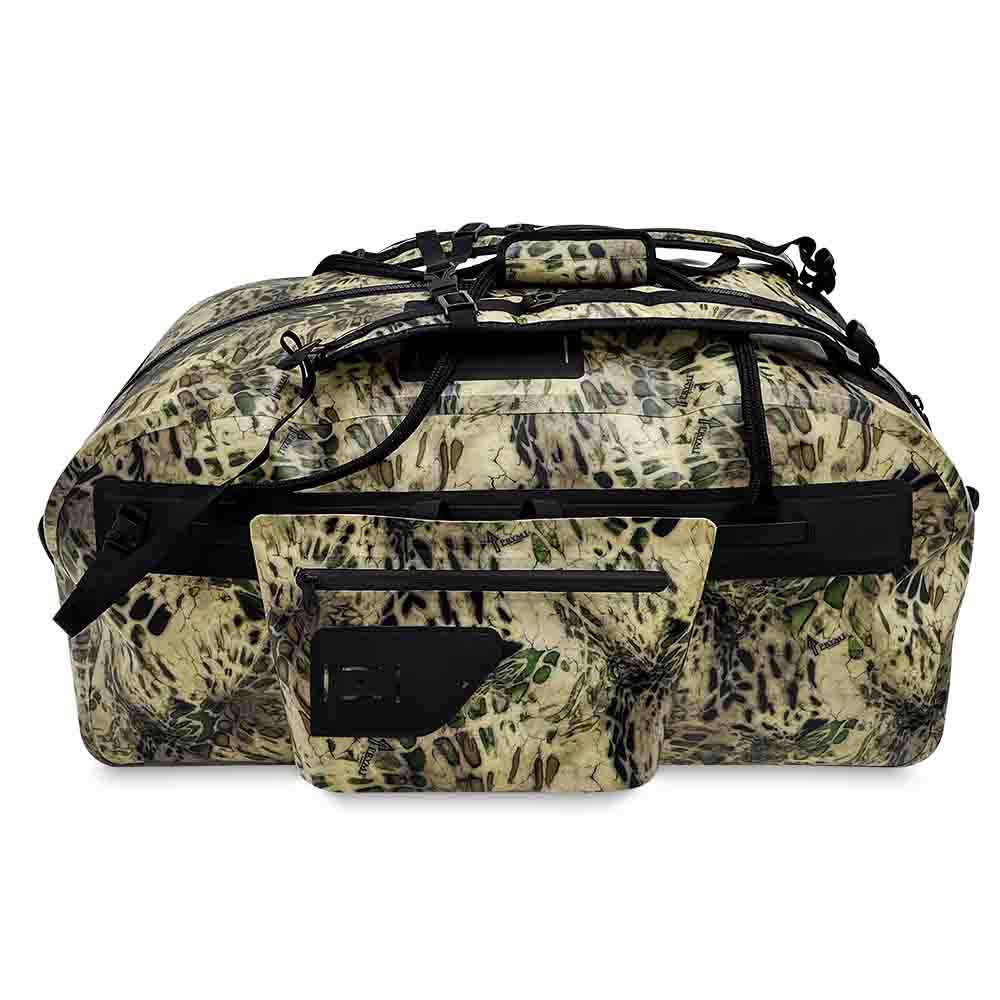
SL-C893 | 70L | Printed TPU laminate | Coated zipper · IPX6 · upgradeable to airtight | View |

|
SL-C689 | 25L | TPU (HF welded) | Roll-top / zipper · backpack straps | View |
The range spans 20L to 70L across both IPX6 and IPX7 constructions in PVC and TPU. Full categories sit under duffels, dry bags, and dry backpacks. Customization scope is set out in the guide to OEM duffel factory customization.
10. FAQ
Q: A supplier makes excellent dry bags — can it make a good duffel?
A: Not automatically. Flat-panel dry bags are the easy welding case; duffels concentrate corner welds, a large load-bearing base, and a full-length zipper track. Ask specifically how corner and base sealing is controlled and how a long zipper track is kept aligned at volume.
Q: What should I check on the sample first?
A: Fill it and load it. Corner welds, base seams, zipper track tension, and anchor strength only reveal themselves under load — a flat sample on a table hides all four. Then run the waterproof test on the filled, sealed bag rather than an empty one.
Q: How do I verify a factory is real without visiting?
A: Request a video walkthrough and look for welding equipment and zipper alignment tooling that a general sewing factory would not own, plus close-up video of welded seams, corners, and attachment points. Ask what share of output is in this category and whether cutting, sewing, welding, and QC are under one roof.
Q: Which test results matter most on a duffel?
A: Handle and anchor pull strength and load cycling first, because anchors fail before fabric does; then zipper cycling on the main closure; then waterproof verification on filled units. Salt spray matters for marine programmes and colour-difference testing for repeat orders.
Q: The quote is far below the others — is that an opportunity?
A: Treat it as a warning. Weak anchor points and low-grade zippers are where cost is usually removed, and both surface later as warranty claims. Ask what specifically differs in the specification rather than assuming the same product at a lower price.
Q: How do I protect against the second order not matching the first?
A: Ask before the first order whether fabric lot, colour, zipper, and hardware can be reserved or matched, whether spare material is held, and whether a signed gold sample with colour-difference testing governs each batch. Colour drift between runs signals weak process control and is screenable in advance.
Evaluate Sealock as a Supplier
To assess capability the practical way — request a video walk of the welding line, corner and base weld close-ups, and a sample built to your own specification for filled load testing — submit an inquiry. Sealock responds to procurement enquiries within 24 hours.