
- English
- Español
- Português
- русский
- Français
- 日本語
- Deutsch
- tiếng Việt
- Italiano
- Nederlands
- ภาษาไทย
- Polski
- 한국어
- Svenska
- magyar
- Malay
- বাংলা ভাষার
- Dansk
- Suomi
- हिन्दी
- Pilipino
- Türkçe
- Gaeilge
- العربية
- Indonesia
- Norsk
- تمل
- český
- ελληνικά
- український
- Javanese
- فارسی
- தமிழ்
- తెలుగు
- नेपाली
- Burmese
- български
- ລາວ
- Latine
- Қазақша
- Euskal
- Azərbaycan
- Slovenský jazyk
- Македонски
- Lietuvos
- Eesti Keel
- Română
- Slovenski
- मराठी
- Srpski језик

Waterproof Duffel Bag Factory: Materials and Production Process
Sealock operates waterproof duffel bag factories in Dongguan, China and Ho Chi Minh City, Vietnam, supplying OEM and wholesale programmes to outdoor brands and importers. Two things determine whether a duffel survives its service life: what it is built from, and how the panels are joined. Neither is visible in a product photograph, and both are where the cost differences between apparently identical bags actually sit. This covers the material stack in detail, then walks the production sequence that turns it into a sealed, load-bearing bag.
1. Company and Production Base
Sealock (YiFuLong Outdoor Gear Co., Ltd.) has built welded waterproof bags for over 20 years, producing for international outdoor and marine brands including OSPREY, Helly Hansen, West Marine, and CHUMS.
- Established: 2003
- Facilities: Dongguan, China | Ho Chi Minh City, Vietnam — either origin available on any model
- Certifications: ISO 9001, BSCI, SMETA, HIGG, GRS, SCAN
- Terms: MOQ 300 pcs per model, samples 7–15 days, bulk 30–45 days, FOB Guangdong
2. Reading a Duffel Material Specification
"Waterproof fabric" tells a buyer almost nothing. Four variables decide performance, and they have to be read together:
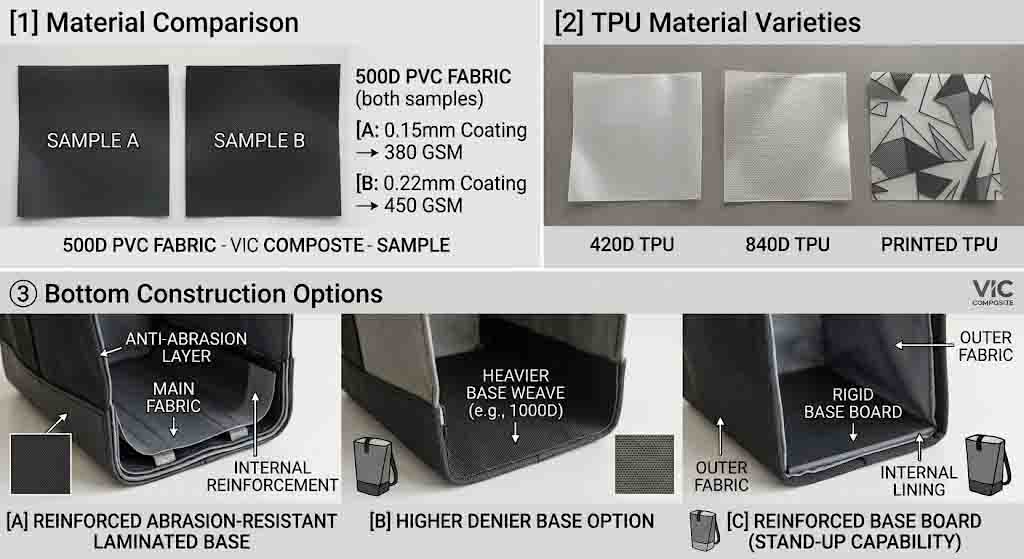
- Base scrim and denier. The woven substrate carries tensile and tear strength. Denier indicates yarn thickness — useful but incomplete on its own, since weave density matters as much. Higher denier means a tougher fabric and more weight.
- Coating type. PVC seals absolutely and resists abrasion but is heavier and stiffer; TPU bonds strongly to the fabric, stays flexible in cold, and carries no plasticizers; PU is the lightest and least protective, suited to rain rather than immersion.
- Coating thickness. On tarpaulin this typically runs in the sub-millimetre range, built up in layers — thicker means more material to lose before the coating fails in a high-abrasion application.
- Weight in GSM. The most honest single comparison between two fabrics of the same type, since it captures scrim and coating together.
Two fabrics quoted as "500D PVC" can differ materially in coating thickness and GSM, which is why a specification should name all four rather than a shorthand. The broader material trade-offs are set out in the comparisons of TPU material advantages and PVC cost and performance.
3. The Material Stack by Programme Type
| Programme | Body material | Why |
|---|---|---|
| Marine, rafting, industrial | 500D PVC tarpaulin | Absolute waterproofing and abrasion resistance against rock, sand, and saltwater; welds cleanly; cost-effective at volume |
| Premium travel and technical | 840D TPU laminate | Heavy-duty abrasion resistance with cold flexibility, low odour, and a refined finish |
| Lightweight and packable | 420D TPU laminate | Lower weight where packability leads, still fully weldable |
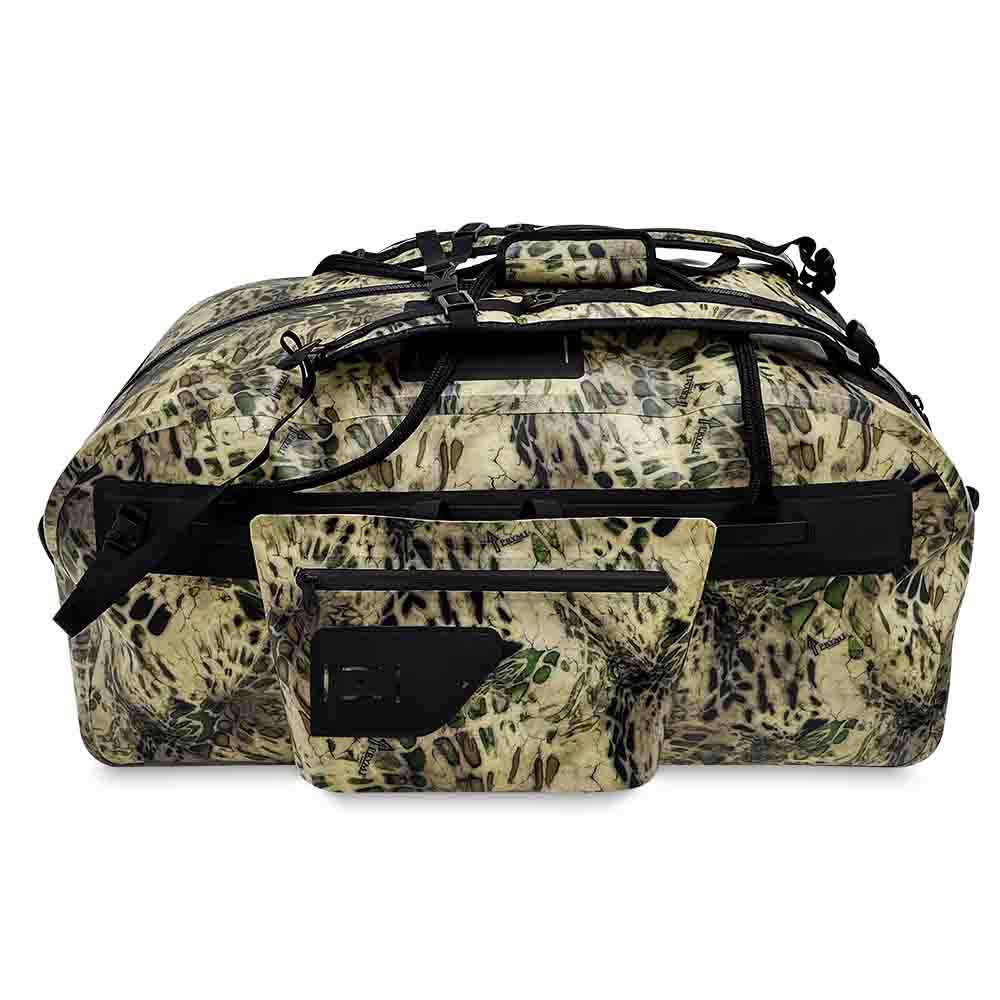
| Hunting, camo, field | Printed TPU laminate | Pattern printing with tear and abrasion resistance; buyer artwork or original pattern development |
4. The Base Panel Is a Separate Decision
The base is the part of a duffel that fails first, because it takes the whole load and every set-down on gravel, decks, and truck beds. It should be specified for the abuse pattern the bag will actually see, not for how it looks on a shelf — a bag used on wet concrete has a different base requirement from one that lives in a car boot.
Options include a reinforced abrasion laminate for rough ground and marine decks, a heavier denier than the body for high-wear programmes, and a reinforced padded base board where the bag needs to hold its shape and stand up on its own, as on the 20L travel model. Buyers should ask for three physical anchors before committing to bulk: material swatches to judge texture and weight, an assembled base sample showing internal boards and hardware, and test results from real-world conditions rather than a datasheet.
5. Hardware and Trims
Hardware is a small share of the bill of materials and a large share of complaints, so each component is specified rather than left to default: airtight waterproof zippers for immersion-rated builds or heavy-duty coated zippers for water-resistant ones; moulded T-grip pulls that give the leverage an airtight zipper needs with wet or gloved hands; reinforced nylon webbing for handles; moulded D-rings and anchor plates; quick-release compression buckles; and welded MOLLE-style lash strips that add attachment points without piercing the shell.
6. Production Sequence
- Incoming inspection. Fabric rolls checked for coating consistency, thickness, shade against the approved standard, and weave flaws; zippers and hardware verified against specification.
- Cutting. Panels cut to the marker by die or automated cutting. A duffel has large panels where a small dimensional drift compounds into misalignment across long seams, so precision here sets the ceiling on everything after.
- Branding. Logos applied to flat panels while they are still accessible.
- Sub-assembly. Pockets, linings, webbing assemblies, handles, and straps built as separate units before the body is closed.
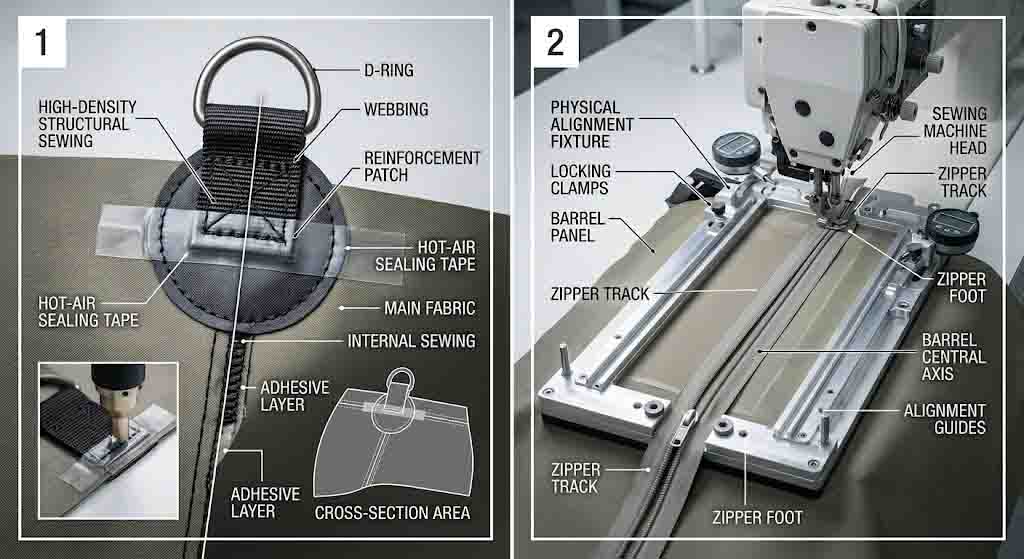
- Structural sewing. High-density stitching attaches load-bearing elements — handle and strap anchors, D-ring patches, base reinforcement — with reinforcement following the load paths.
- Panel alignment and zipper installation. The critical step on a duffel, covered below.
- High-frequency welding. Seams welded at 27.12 MHz into a continuous needle-hole-free skin, with corners, base junctions, and zipper seats given specific attention as the highest-risk areas.
- Cooling, trimming, final assembly. Bonds set under controlled cooling, then closures, buckles, straps, and valves are fitted.
- Testing, drying, and packing. Leak testing, then moisture-controlled staging before cartoning.
7. The Two Stages That Define a Duffel Factory
Hybrid joining. Standard dry bags rely purely on welding across simple flat panels. A heavy-duty duffel cannot: it needs high-density structural stitching to carry physical weight, backed by hot-air seam sealing tape or localised reinforcement patches to protect waterproof integrity where thread passes through the coating. The engineering sits at that junction, and Sealock stabilises the parameters where mechanical thread meets polymer coating rather than treating welding and stitching as independent operations.
Zipper track alignment. Cylindrical duffels give the best volume efficiency but create a specific assembly problem: the top straight zipper track must sit perfectly parallel to the bag's central axis. Any twisting during manual material feeding produces uneven tension across the zipper teeth once the bag is fully loaded — which is how a track separates in service. Sealock locks the cut panels with physical tracking jigs before the top closure profile is stitched, preventing fabric bunching along the zipper boundary. The line can be reconfigured to accommodate heavy-duty airtight or gas-tight tooth zippers where a programme requires them.
8. Testing and Quality Control
Random batch sampling alone is insufficient on technical duffels, where one loose stitch or a misaligned centimetre of seam tape can compromise a production run. Sealock maintains a 100% inflation and leak-testing gate after assembly: bags are inflated to a predetermined internal pressure, checked with leak-detection fluid, and monitored for pressure drop-off over a fixed window, with technicians manually verifying the top closure zipper and the base welding points. Only units that hold structural volume without deviation pass to final clearance.
Around that gate, three-stage control applies — IQC on incoming tarpaulin or laminate, zippers, and hardware; IPQC on welds and zipper installation in process; and OQC with AQL sampling, batch immersion or rain-jet testing according to rating, and signed gold-sample comparison. The laboratory suite covers full water immersion, load testing over 1,500 cycles at handles and anchors, 3,000 sealed-zipper cycles, tensile and bonding strength, salt spray, friction resistance, colour fastness, and colour difference. The full customer inspection procedure — unboxing, vacuum extraction, a 24-hour static rest, and air-leak determination — can be witnessed end to end by a buyer or their inspector. Standards are set out in the quality control standards for waterproof production.
9. Drying and Packing
Production does not end at inspection. A bag packed while still holding residual moisture from water testing, or absorbed from a humid workshop, carries that moisture inside a sealed carton across hot maritime lanes, where trapped condensation can induce hydrolysis and mould. Bags are fully dried and deflated, folded along non-critical stress axes to avoid permanent creasing, and packed into heavy-duty export cartons with carton quantity, dimensions, and gross weight confirmed at quotation — relevant to freight because duffels are volumetric and cube drives cost more than weight.
10. Products Built on This Process
Models organized by type rather than priority:
| Image | Model | Capacity | Material | Closure / rating | Product Page |
|---|---|---|---|---|---|
|
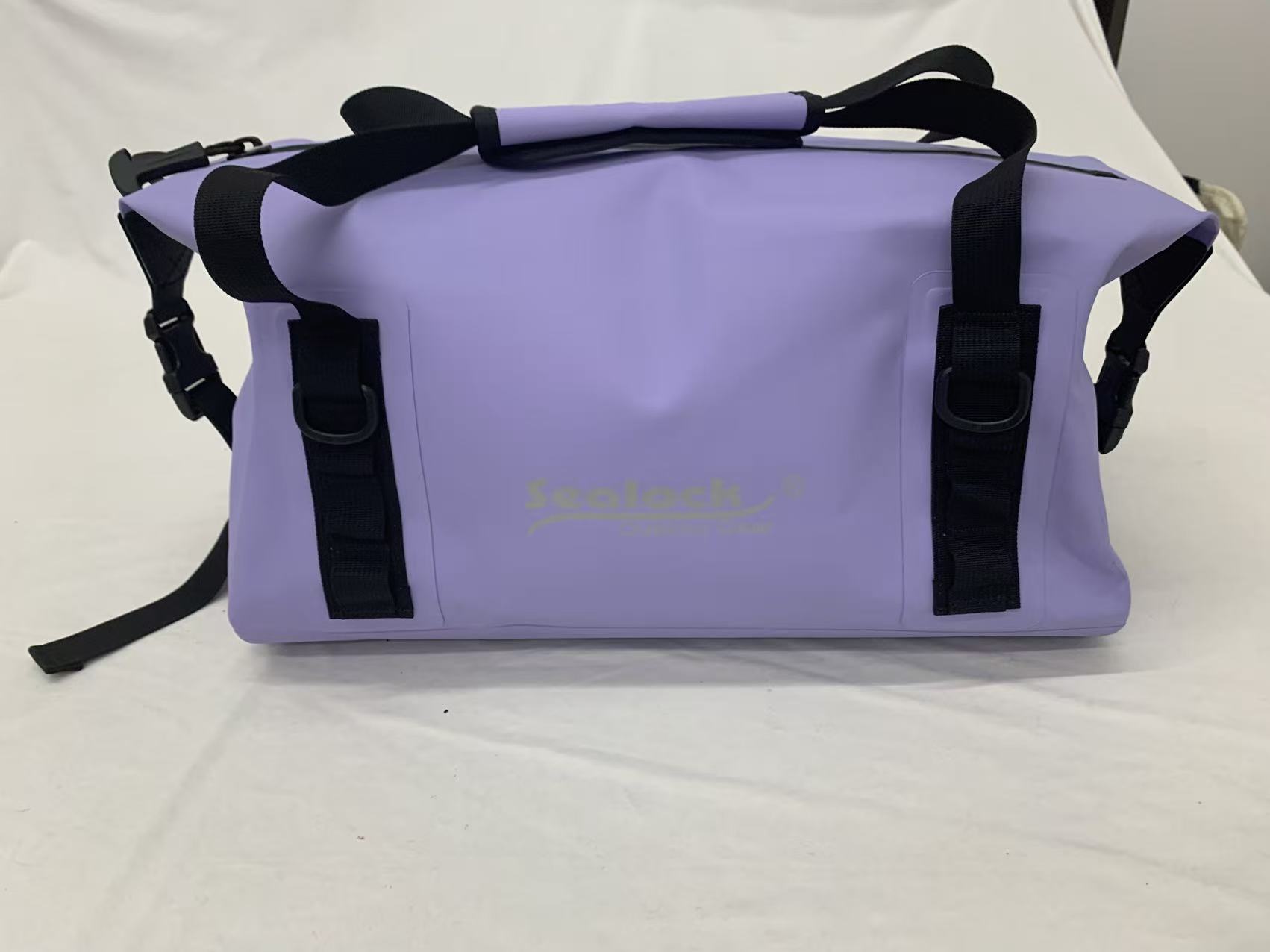
SL-C878 | 20L | 840D TPU | Airtight zipper · IPX7 · base board | View |

|
SL-C261 | 30L | TPU composite | IPX8 zipper · foldable | View |
|
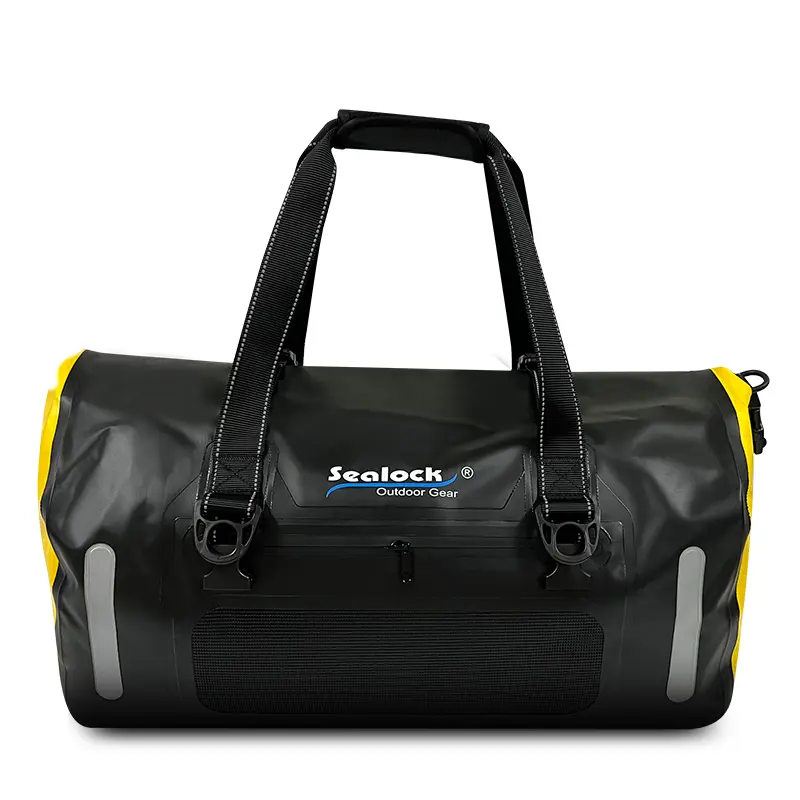
SL-K099 | 40 / 60L | 840D TPU | Roll-top · IPX7 | View |
|
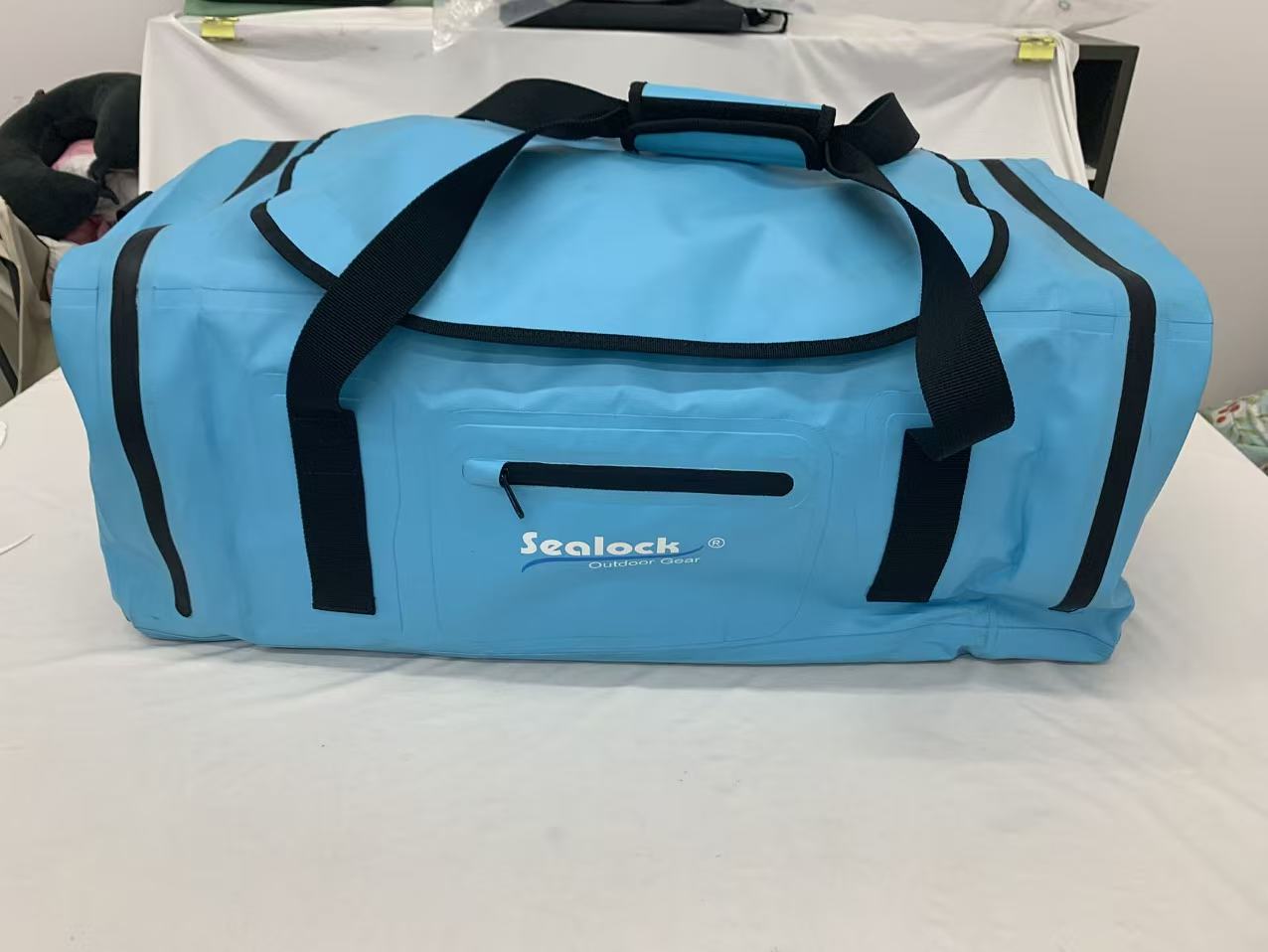
SL-C594 | 55L | 500D PVC (TPU option) | Airtight zipper · IPX7 · sealed end compartments | View |
|
SL-C893 | 70L | Printed TPU laminate | Coated zipper · IPX6 · reinforced base | View |

|
SL-C689 | 25L | TPU (HF welded) | Roll-top / zipper · backpack straps | View |
The range spans 20L to 70L in PVC and TPU across roll-top and airtight-zipper constructions. Full categories sit under duffels, dry bags, and dry backpacks. Customization scope is covered in the guide to OEM duffel factory customization, and capability verification in the supplier selection guide.
11. FAQ
Q: Two suppliers both quote "500D PVC" — why do the bags feel different?
A: Because denier only describes the yarn in the base scrim. Coating thickness, weave density, and total GSM can differ substantially between two fabrics with the same denier label. Ask for all four figures, and compare GSM as the single most honest number.
Q: Should I just specify the highest denier available?
A: No. Higher denier adds weight and cost, and the right specification balances the abuse pattern, moisture exposure, load, and shipping cost. Build for how the bag will actually be used, not for the highest number on a spec sheet.
Q: Why does the base need a separate specification?
A: Because it takes the full load and every set-down on gravel, decks, and truck beds — it is the first area to fail. Specify a reinforced abrasion laminate, a heavier denier than the body, or a padded base board depending on whether the bag needs wear resistance, shape retention, or both.
Q: Can a heavy-duty duffel be built with welding alone?
A: Only for light-duty designs. Carrying real weight requires high-density structural stitching, backed by seam sealing tape or reinforcement patches where thread meets the coating. A factory that treats welding and stitching as separate uncalibrated operations produces field failures at the anchors.
Q: Why do long duffel zippers fail in service?
A: Usually alignment, not the zipper. If the straight track is not perfectly parallel to the bag's central axis, a fully loaded bag puts uneven tension across the teeth. Physical tracking jigs that lock the panels before the closure profile is stitched are what prevent fabric bunching and uneven load along the track.
Q: Is batch sampling enough quality control on a technical duffel?
A: Not on its own. One loose stitch or a misaligned centimetre of seam tape can compromise a run, which is why a 100% inflation and leak-testing gate is applied after assembly, with manual verification of the top closure zipper and base welding points before a unit is passed.
Request Material Specs and Samples
For fabric options, base construction, test documentation, or an OEM proposal, submit an inquiry. Sealock responds to procurement enquiries within 24 hours, with production from Dongguan, China or Ho Chi Minh City, Vietnam.