
- English
- Español
- Português
- русский
- Français
- 日本語
- Deutsch
- tiếng Việt
- Italiano
- Nederlands
- ภาษาไทย
- Polski
- 한국어
- Svenska
- magyar
- Malay
- বাংলা ভাষার
- Dansk
- Suomi
- हिन्दी
- Pilipino
- Türkçe
- Gaeilge
- العربية
- Indonesia
- Norsk
- تمل
- český
- ελληνικά
- український
- Javanese
- فارسی
- தமிழ்
- తెలుగు
- नेपाली
- Burmese
- български
- ລາວ
- Latine
- Қазақша
- Euskal
- Azərbaycan
- Slovenský jazyk
- Македонски
- Lietuvos
- Eesti Keel
- Română
- Slovenski
- मराठी
- Srpski језик

Waterproof Duffel Bag Manufacturer for Global Wholesale Buyers
Sealock is a waterproof duffel bag manufacturer supplying OEM and wholesale programmes to outdoor brands, importers, and distributors from factories in China and Vietnam. Duffels look like the simplest product in a waterproof range and are the hardest to scale correctly: when a programme moves from a prototype to a full container, the primary risk stops being material selection and becomes structural stress distribution. This is what separates a duffel built to survive a season from one that generates field returns.
1. Company and Production Base
Sealock (YiFuLong Outdoor Gear Co., Ltd.) has built welded waterproof bags for over 20 years, producing for international outdoor and marine brands including OSPREY, Helly Hansen, West Marine, and CHUMS.
- Established: 2003
- Facilities: Dongguan, China | Ho Chi Minh City, Vietnam — either origin available on any model
- Certifications: ISO 9001, BSCI, SMETA, HIGG, GRS, SCAN
- Terms: MOQ 300 pcs per model, samples 7–15 days, bulk 30–45 days, FOB Guangdong
2. Why Duffel Production Is Its Own Discipline
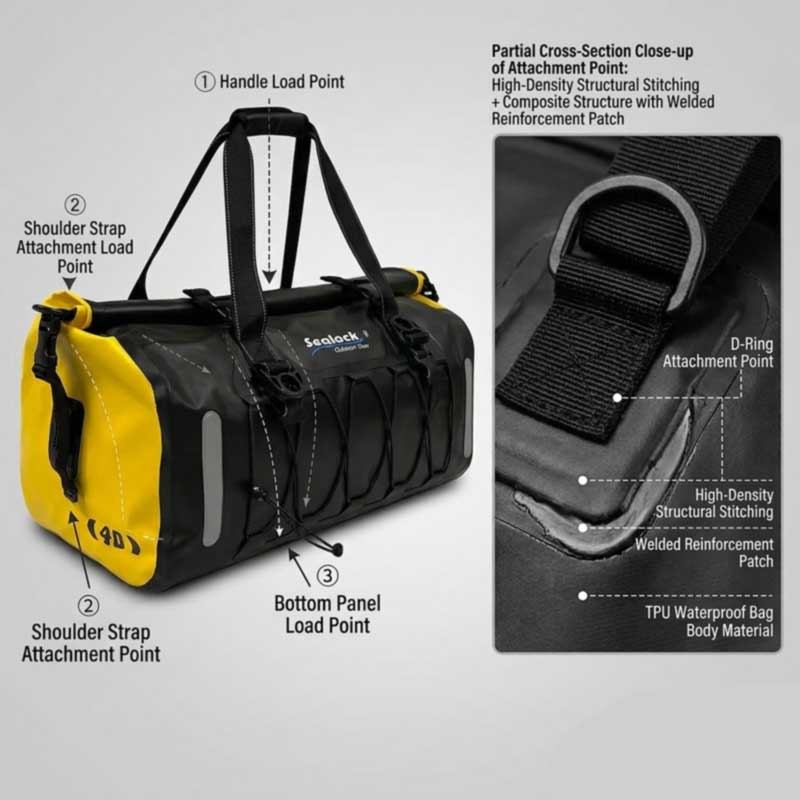
A backpack distributes load across a harness, a hip belt, and the wearer's frame. A duffel has none of that. Every kilogram inside a loaded 40L or 60L duffel travels through three points only — the grab handles, the shoulder strap anchors, and the base — and it does so while the bag is swung, dropped, dragged across a deck, and stacked under other freight.
That concentration is why duffel engineering is a load-path problem before it is a waterproofing problem. A duffel packed with expedition gear puts severe shear forces on shoulder strap anchors and along linear zipper tracks. If a manufacturer treats waterproofing and mechanical anchoring as two separate, uncalibrated steps, field returns follow — the bag stays dry until the moment an anchor tears, at which point it is neither strong nor waterproof. Convertible designs such as the duffle-backpack (SL-C689) shift part of that load onto shoulder straps for carrying over distance, which eases the hand-carry problem but raises the demand on the anchor points rather than removing it.
3. The Hybrid Construction Problem
Standard dry bags rely purely on high-frequency welding across simple flat panels, which works because the load is light and evenly spread. A heavy-duty travel duffel cannot be built that way. It needs a hybrid approach: high-density structural stitching to carry physical weight, backed by localised reinforcement patches or specialised seam sealing to protect waterproof integrity where the thread passes through.
The engineering challenge sits exactly at that junction — where mechanical thread meets polymer coating. Get the parameters wrong and the stitching either pulls through the coating under load or compromises the seal. Sealock's approach is to stabilise those parameters rather than treat welding and stitching as independent operations, so anchoring strength and waterproof integrity are calibrated together. The welding side of that equation is detailed in the manufacturing process from cutting to RF welding.
4. The Stress Points That Decide Duffel Life
A wholesale specification should name each of these rather than leave them to the factory's default:
- Shoulder strap anchors — the highest-shear point on the bag. Reinforcement patches, bar-tacking, and a stated load rating belong in the spec.
- Grab handles — carried single-handed and often over-loaded; reinforced webbing and anchoring matter more than handle padding.
- The base panel — set down on wet ground, dragged across gravel and decks. A reinforced or heavier-denier base is what stops abrasion becoming a leak.
- Zipper track ends — a linear zipper on a duffel takes tension along its length as the bag flexes when lifted; the ends are where separation starts.
- Corner welds — large flat panels concentrate stress at the corners, especially when the bag is over-packed.
5. Closure Architecture
Both architectures are produced, and the choice follows the use rather than the factory's preference. A roll-top gives the most rugged seal with no moving parts, floats when sealed, and tolerates sand and salt — the right call for paddling, rafting, and marine duty. A rated waterproof zipper gives fast, clean, full-width access on a bag that gets packed and unpacked repeatedly, which suits travel and gear-transport programmes. On a duffel the zipper decision carries more weight than on a small bag, because the opening runs the length of the body: a longer track means more seal to maintain and more tension to engineer around.
6. Materials for Duffel Duty
Duffels get dragged more than any other category, so denier runs heavier than on packs:
- 840D TPU — the balanced heavy-duty choice: abrasion resistance for dragging and stacking, with TPU's cold flexibility and low odour, welded seamlessly.
- 420D TPU — lighter programmes where weight and packability lead.
- 500D PVC tarpaulin — rugged, structured, cost-effective for value lines.
- Reinforced base panels — a heavier denier at the bottom and corners where wear concentrates, regardless of body fabric.
The material trade-offs are set out in the comparison of TPU duffels against traditional PVC designs. Whatever the face fabric, the waterproof claim is decided by seam strategy and closure design, not by the fabric alone.
7. Quality Control, Including the Tests Duffels Specifically Need
Every batch runs three-stage control — IQC on incoming fabric, zippers, webbing, and hardware; IPQC on welds and structural stitching in line, including peel tests at run start; and OQC with AQL sampling, dimensional and colour checks, and signed gold-sample comparison. Load testing over 1,500 cycles targets handles, strap anchors, and D-rings, which on a duffel is the test that matters most, alongside 3,000 sealed-zipper cycles on zippered models, tensile and bonding strength, salt spray, friction resistance, colour fastness, and colour difference.
For airtight verification, the full customer inspection procedure is executed and can be witnessed end to end: unboxing of sealed cartons in the inspector's presence, vacuum extraction to place the closure and welded seams under differential pressure, a 24-hour static rest, and air-leak determination against the batch record. Only units that hold structural volume without deviation pass, with technicians manually verifying the top closure and base welding points. The applicable standards are set out in the quality control standards for waterproof production.
8. The Packing Stage Wholesale Buyers Rarely Ask About
Production does not end when a duffel passes inspection, and this stage matters specifically to importers shipping by sea. A bag packed while still holding residual moisture from water testing — or absorbed from a humid workshop — carries that moisture inside a sealed carton across hot equatorial maritime lanes. The trapped condensation can induce material hydrolysis and mould in transit, so a container that left the factory in perfect condition arrives with stained or degraded stock.
Sealock's final line uses moisture-controlled staging: bags are fully dried and deflated, folded along non-critical stress axes to avoid permanent creasing, and packed into heavy-duty double-wall corrugated master cartons. For a wholesale buyer this is worth confirming with any supplier, because it is invisible at inspection and only surfaces when the container is opened. Carton quantity and dimensions should also be confirmed up front — duffels are volumetric, so cubic volume drives sea freight cost more than weight does, as covered in the bulk purchasing guide for importers.
9. Wholesale Duffel Range
Models across closures, materials, and capacities, organized by type rather than priority:
| Image | Model | Capacity | Material | Closure / rating | Product Page |
|---|---|---|---|---|---|
|
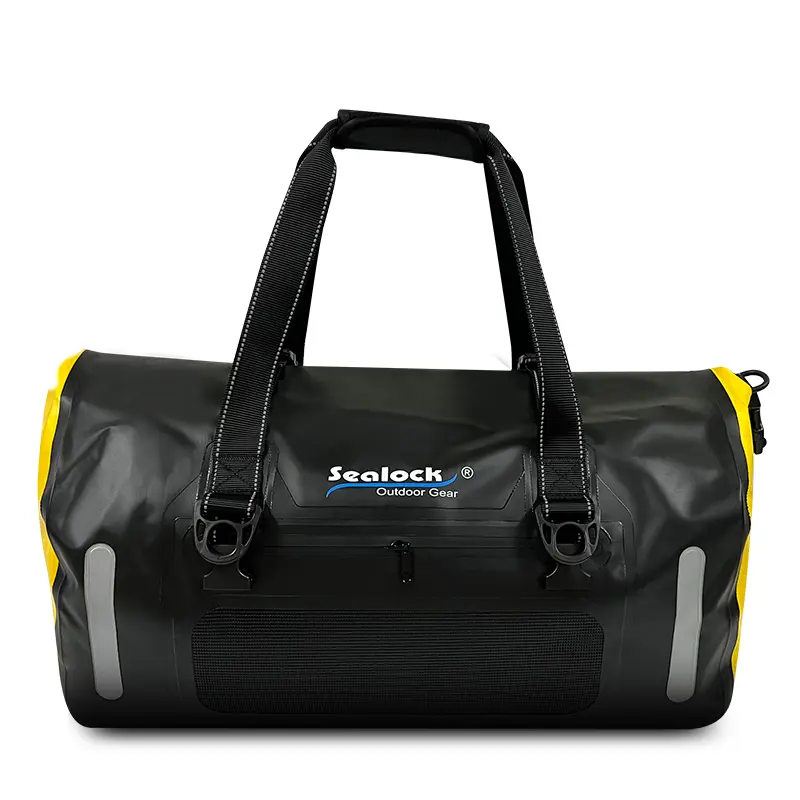
SL-K099 | 40 / 60L | 840D TPU | Roll-top · IPX7 · removable strap | View |

|
SL-C261 |
30L | TPU composite | IPX8 zipper · foldable | View |

|
SL-C689 |
25L | TPU (HF welded) | Roll-top / zipper · backpack straps | View |
|
SL-C080 |
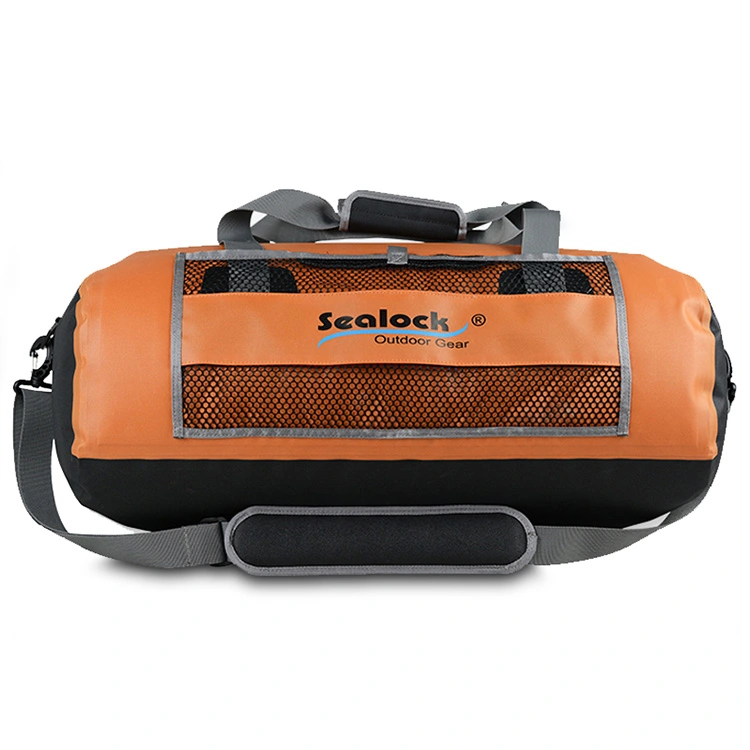
40L/60L | 420D TPU | Roll-top | View |
|
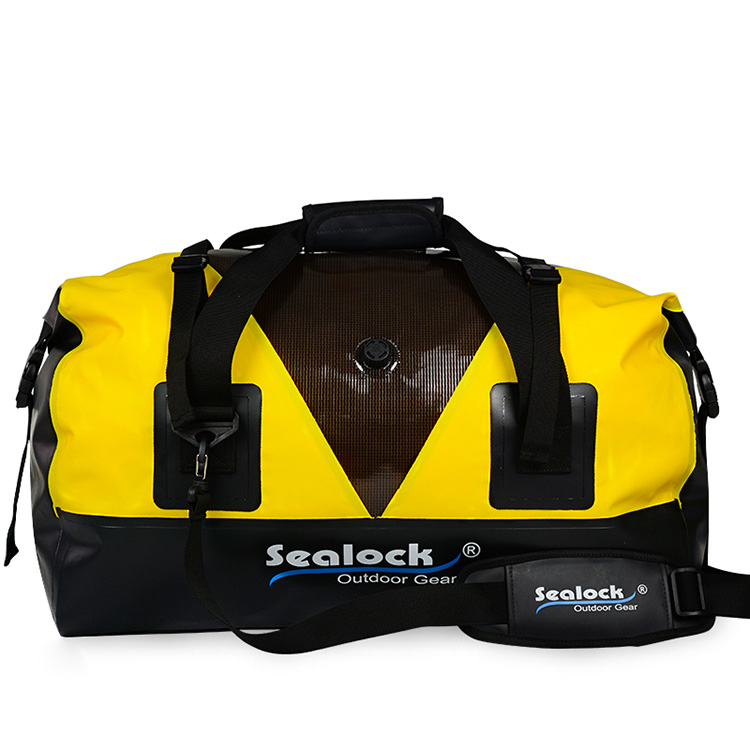
SL-C067 | 60L | 500D PVC (HF welded) | Roll-top | View |
|
SL-C759 |
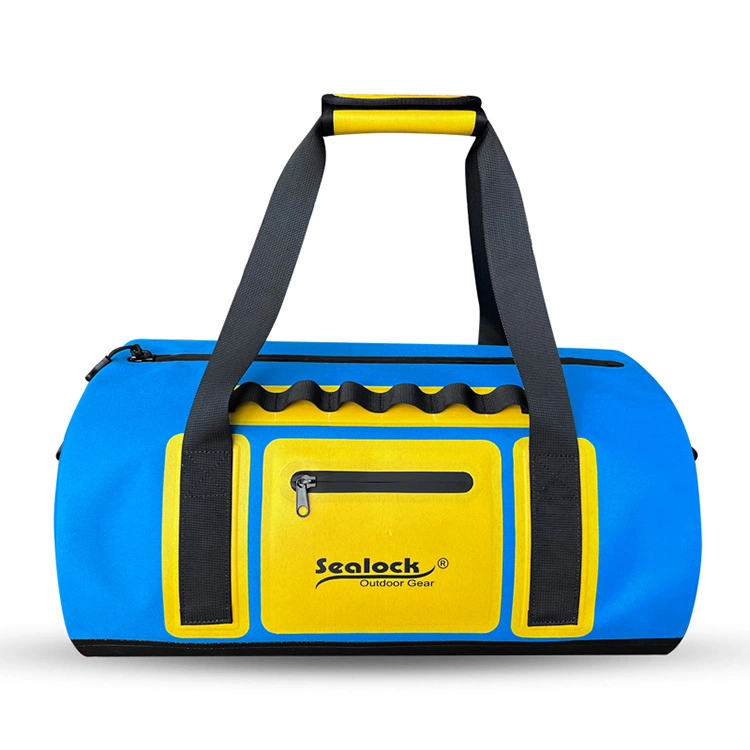
25L | TPU composite | waterproof zipper | View |
Capacity guidance for assortment planning is covered in the 40L capacity guide and the 60L packing guide. Full categories sit under duffels, dry bags, and dry backpacks.
10. OEM and Wholesale Scope
Beyond logo and colour, a duffel programme can specify capacity and proportions, closure architecture, fabric and denier including a heavier base, handle and strap configuration, anchor reinforcement and rated load, D-rings and lash points, internal dividers, reflective detailing, and packaging from wholesale polybag-and-carton to retail hangtags and barcode labels. Ground-up development from a sketch, sample, or target spec is supported, with tooling and lead time scheduled against the launch date. Payment is 30% deposit with the 70% balance against a passed pre-shipment inspection, and production can be routed through China or Vietnam to suit a tariff position.
11. FAQ
Q: Why do duffels fail at the straps rather than the fabric?
A: Because a duffel has no harness to spread load — the entire packed weight moves through the handles, strap anchors, and base, under shear as the bag is swung, dropped, and dragged. Specify anchor reinforcement, bar-tacking, and a rated load, and require load-cycle testing on those points.
Q: Can a waterproof duffel be fully welded like a dry bag?
A: Only for light-duty designs. Simple flat-panel dry bags can be welded alone, but a heavy-duty duffel needs structural stitching to carry weight, backed by reinforcement or sealing where the thread meets the coating. A supplier that treats welding and anchoring as separate steps will produce field failures.
Q: Roll-top or waterproof zipper for a wholesale duffel line?
A: Roll-top for paddling, rafting, and marine duty — most rugged seal, floats, tolerates grit. Rated zipper for travel and gear transport where the bag is opened repeatedly and full-width access matters. The zipper decision weighs more on a duffel because the track runs the length of the body.
Q: Why does my container of duffels arrive with mould or staining?
A: Usually residual moisture at packing. Bags packed while still damp from water testing or a humid workshop trap condensation inside sealed cartons, and long hot ocean transits can induce hydrolysis and mould. Ask any supplier how it dries and stages goods before packing — it is invisible at inspection.
Q: What denier should a wholesale duffel be?
A: 840D TPU is the balanced heavy-duty choice because duffels are dragged more than any other category; 420D TPU suits lighter programmes and 500D PVC value lines. Whichever body fabric, specify a reinforced or heavier base where abrasion concentrates.
Q: What affects freight cost most on a duffel order?
A: Cubic volume, not weight. Confirm units per carton and carton dimensions at quotation, since duffels are bulky and cube drives sea freight. Folding method also matters — bags should be folded along non-critical stress axes to avoid permanent creasing in transit.
Request a Wholesale Duffel Quotation
For bulk pricing, samples, carton and packing specifications, or an OEM proposal, submit an inquiry. Sealock responds to procurement enquiries within 24 hours, with production from Dongguan, China or Ho Chi Minh City, Vietnam.