- English
- Español
- Português
- русский
- Français
- 日本語
- Deutsch
- tiếng Việt
- Italiano
- Nederlands
- ภาษาไทย
- Polski
- 한국어
- Svenska
- magyar
- Malay
- বাংলা ভাষার
- Dansk
- Suomi
- हिन्दी
- Pilipino
- Türkçe
- Gaeilge
- العربية
- Indonesia
- Norsk
- تمل
- český
- ελληνικά
- український
- Javanese
- فارسی
- தமிழ்
- తెలుగు
- नेपाली
- Burmese
- български
- ລາວ
- Latine
- Қазақша
- Euskal
- Azərbaycan
- Slovenský jazyk
- Македонски
- Lietuvos
- Eesti Keel
- Română
- Slovenski
- मराठी
- Srpski језик

OEM Waterproof Duffel Bags: Factory Customization Services
Sealock provides OEM waterproof duffel bag manufacturing for outdoor brands, importers, and private label buyers, building each programme to specification rather than selling a fixed catalogue item. On a duffel, customization is not decoration — capacity, compartment layout, closure rating, and anchor construction decide whether the bag suits its market and survives its load. This sets out what can be specified at each level, what the factory needs from a brief, and how a project runs from reference sample to bulk.
1. Company and Production Base
Sealock (YiFuLong Outdoor Gear Co., Ltd.) has built welded waterproof bags for over 20 years, producing for international outdoor and marine brands including OSPREY, Helly Hansen, West Marine, and CHUMS.
- Established: 2003
- Facilities: Dongguan, China | Ho Chi Minh City, Vietnam — either origin available on any model
- Certifications: ISO 9001, BSCI, SMETA, HIGG, GRS, SCAN
- Terms: MOQ 300 pcs per model, samples 7–15 days, bulk 30–45 days, FOB Guangdong
2. Waterproof Rating: The Decision That Sets Everything Else
The first specification on a duffel programme is not size or colour — it is how waterproof the bag has to be, because that determines the closure, the construction, and much of the cost:
| Rating | Construction | Suits |
|---|---|---|
| IPX6 — water-resistant | Welded body with a heavy-duty coated waterproof zipper | Hunting, field, overlanding, tactical — heavy rain, spray, mud and dust, not submersion |
| IPX7 — immersion-rated | Welded body with an airtight waterproof zipper, or a sealed roll-top | Travel, kayaking, rafting, boating, sailing — rain, spray and temporary immersion |
An IPX6 design can be upgraded to a submersible build by specifying airtight-zipper construction, which is a common route for buyers who start with a field line and later add a water-sports model. Marketing should match the rating: an IPX6 bag listed like a submersible one generates returns, and neither rating covers sustained depth.
3. Structure and Compartment Layout
This is where a duffel is genuinely differentiated, and where reference samples communicate faster than descriptions. Configurable elements:
- Capacity and proportions — from a 20L gym and cabin size through 55L travel to 70L expedition, with multi-size series developed off one construction.
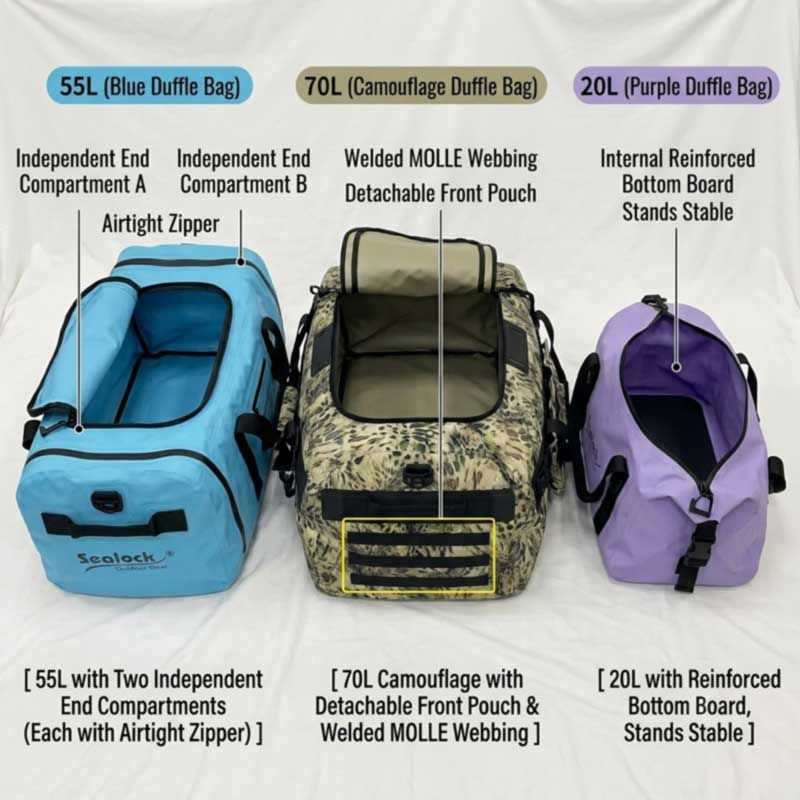
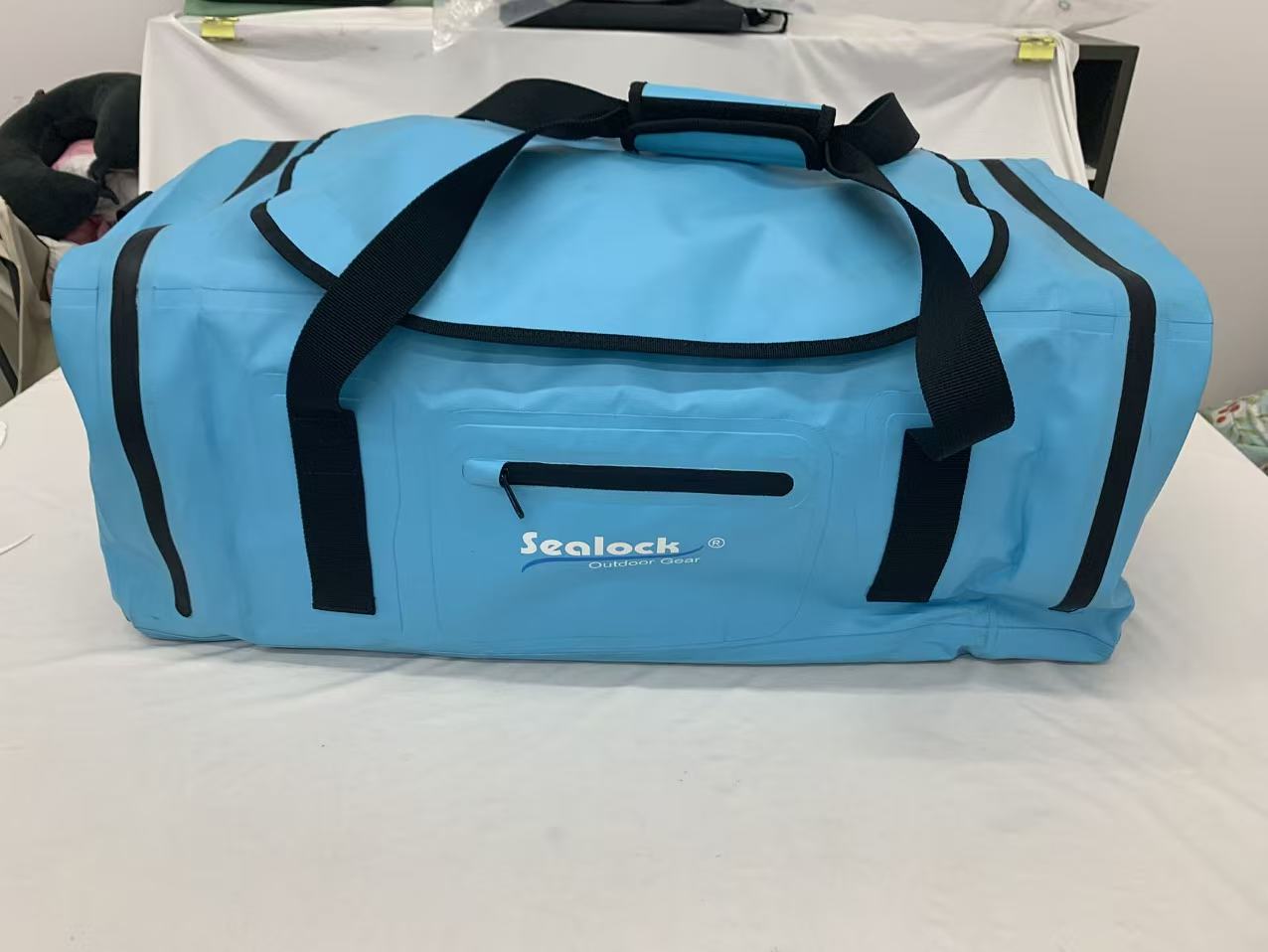
- Independent sealed compartments — end compartments with their own airtight zippers, as on the 55L model, separate wet, dirty, or bulky kit from the main load.
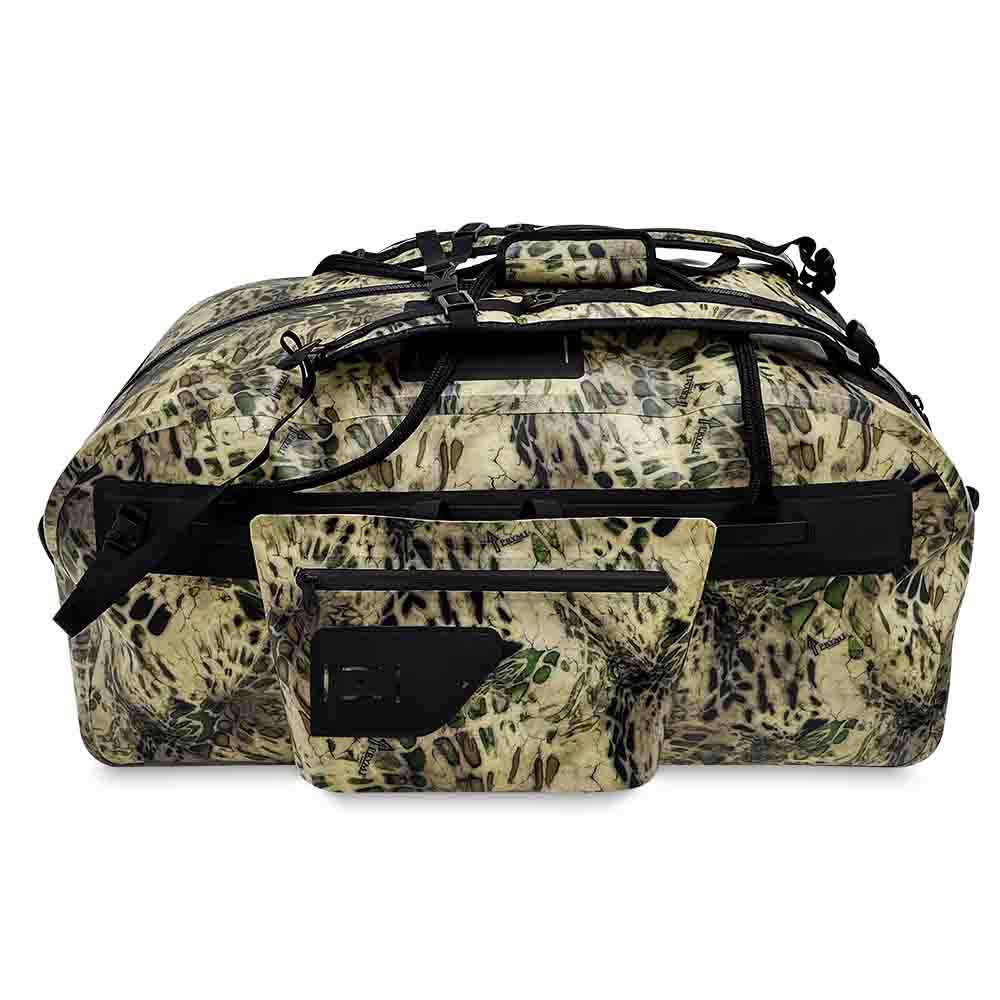
- Detachable front pouch — a separate sealed compartment that removes for a clean profile, as on the 70L camo model.
- External access pockets — welded splash-proof or fully sealed zip pockets for a phone, documents, or licence.
- Interior organisation — lid mesh zip pockets, internal zip pockets, dividers, and wet/dry separation.
- Base construction — an abrasion-resistant panel as standard, a reinforced padded base board where the bag needs to stand up and hold shape, or upgraded thickness for rough ground.
4. Carry System and Attachment
A duffel carries its whole load through handles and anchors, so the carry configuration is specified rather than assumed:
- Carry modes — twin webbing handles, side and end grab handles for a two-person lift on heavy loads, a detachable padded shoulder strap, or removable backpack straps for long approaches.
- Anchor reinforcement — welded triangular or patch reinforcement that spreads strap load into the shell instead of concentrating it at a stitch line.
- Compression — end straps with quick-release buckles to cinch a part-full bag.
- Attachment systems — welded MOLLE-style lash strips that add external gear capacity without piercing the waterproof shell, plus moulded D-rings, bungee cords, and hook-and-loop patch panels.
- Zipper pulls — moulded T-grip pulls give the leverage an airtight zipper needs and can be operated with wet or gloved hands, which matters on cold-weather and marine programmes.
The reason anchor construction gets its own line in a spec is that a duffel has no harness to spread load — the failure point is almost always an anchor rather than the fabric, as covered in the guide for wholesale duffel buyers.
5. Material Specification
- 840D TPU — heavy-duty with cold flexibility and low odour; the balanced choice for premium travel and technical lines.
- 500D PVC tarpaulin — tough, structured, cost-effective, and easy to weld; suits value and high-volume programmes.
- 420D TPU — lighter programmes where packability leads.
- Printed TPU laminate — for camo and pattern programmes, printed to a buyer's own artwork or developed as an original pattern; licensed patterns require the buyer to supply the licence.
Denier and thickness are specified to the use, and a PVC design can be quoted in a TPU version where a buyer wants the material upgrade. The trade-offs are set out in the comparison of TPU duffels against traditional PVC designs.
6. Branding and Packaging
Logo methods are selected according to the material, artwork, placement, and the durability expected — welded patch, rubber patch, silkscreen, heat transfer, embossing, or embroidery — with size, colour, and position confirmed during sampling before the method is released for bulk. Colour runs from stock shades to full Pantone matching. Packaging is specified to the channel: PE or PP individual bags and five-layer export cartons for wholesale, or hangtags, care labels, barcode placement, retail packaging design, and OEM carton printing for shelf and e-commerce resale. Carton quantity, dimensions, and gross weight are confirmed at quotation, since duffels are volumetric and cube drives freight cost.
7. What the Factory Needs From a Brief
A duffel quote is only as good as the brief. Four inputs shorten development materially:
- Intended use and target market — a gym duffel, an expedition bag, and a marine transport bag need different construction, and clear positioning lets the factory recommend materials and structure rather than guess.
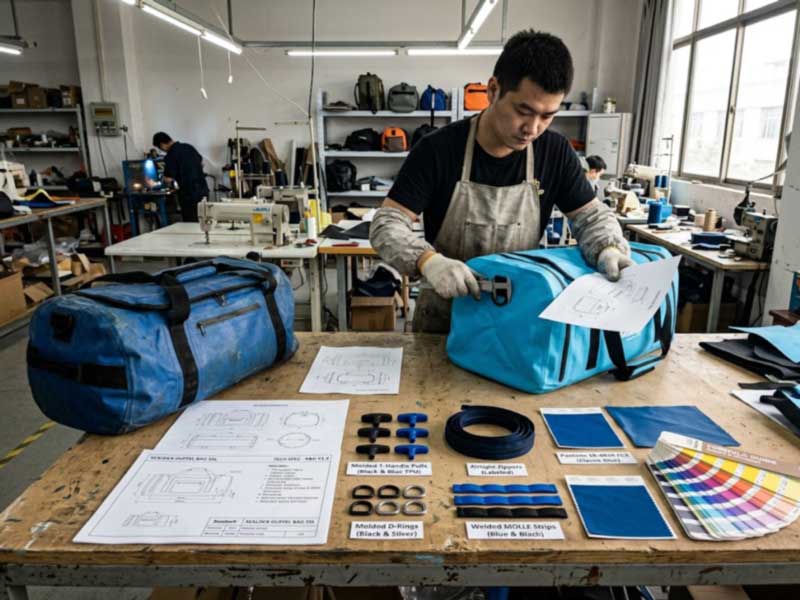
- A reference sample or images — the fastest way to communicate expectations, since a factory can read pocket layout, zipper configuration, strap design, and internal compartments directly from a sample.
- A target FOB price — price expectations drive fabric grade, hardware quality, and structural complexity, so stating the target avoids quoting a specification the programme cannot carry.
- Quantity and launch date — quantity affects planning and unit cost; the launch date determines whether ground-up development is feasible or a platform modification is the better route.
8. Development Sequence
- 1. Brief and specification — use case, capacity, rating, materials, layout, carry system, branding, packaging, quantity, target price, launch date.
- 2. Quotation — unit price, sample and tooling cost, MOQ, lead time, Incoterms.
- 3. Sampling — construction and reinforcement confirmed through the sample, evaluated under realistic load rather than inspected on a table, with logo method and placement approved at this stage.
- 4. Pre-production sign-off — final material, colour, hardware, and packing confirmed against a signed gold sample held by each side.
- 5. Bulk production under QC — IQC, IPQC, OQC as below.
- 6. Pre-shipment inspection — AQL check, batch testing, and third-party SGS or QIMA inspection on request before the balance payment.
Ground-up development from a sketch, sample, or target spec is supported and runs longer than a stock-colour change, so the launch date should be shared at the enquiry so sampling can be scheduled against it.
9. Quality Control Applied to Every Programme
Inspection runs IQC on incoming tarpaulin or laminate, zippers, and hardware; IPQC on welds and zipper installation in process; and OQC before shipment with an AQL check, batch testing, and signed gold-sample comparison. On duffel programmes, fabric inspection, weld seam inspection, zipper function, colour consistency against the signed sample, appearance, and carton inspection are run at 100%, with immersion or rain-and-jet testing by batch sampling according to the rating, and handle, strap, and buckle load testing by random sampling.
For airtight verification the full customer inspection procedure is executed and can be witnessed end to end: unboxing of sealed cartons in the inspector's presence, vacuum extraction to place the closure and welded seams under differential pressure, a 24-hour static rest, and air-leak determination against the batch record. Standards and defect classification are set out in the quality control standards for waterproof production.
10. Platforms Available for Customization
Most programmes start from a proven construction and are modified, which is faster and lower-risk than ground-up development. Models organized by type rather than priority:
| Image | Model | Capacity | Material | Closure / rating | Product Page |
|---|---|---|---|---|---|
|
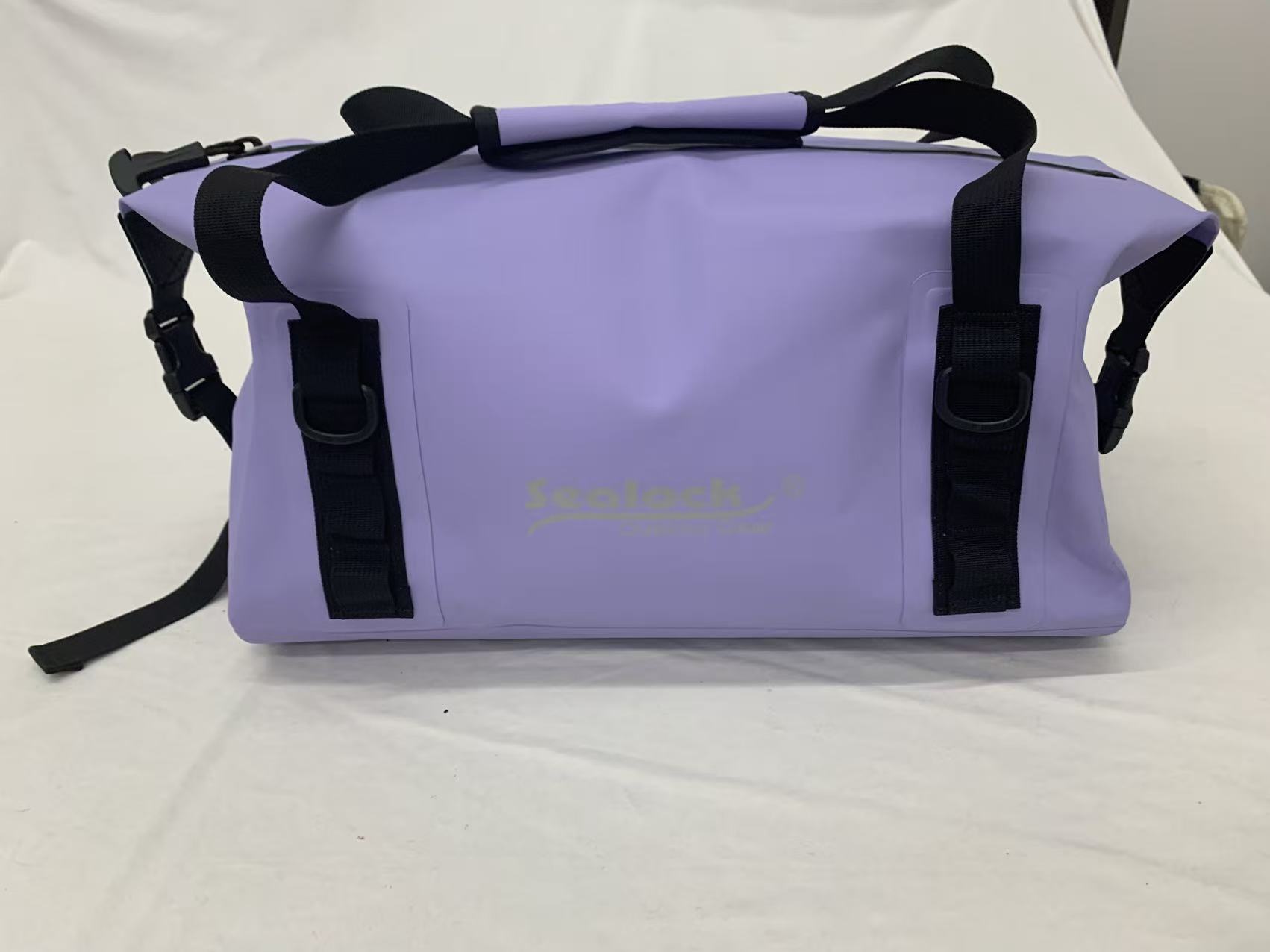
SL-C878 | 20L | 840D TPU | Airtight zipper · IPX7 · base board | View |

|
SL-C689 | 25L | TPU (HF welded) | Roll-top / zipper · backpack straps | View |
|
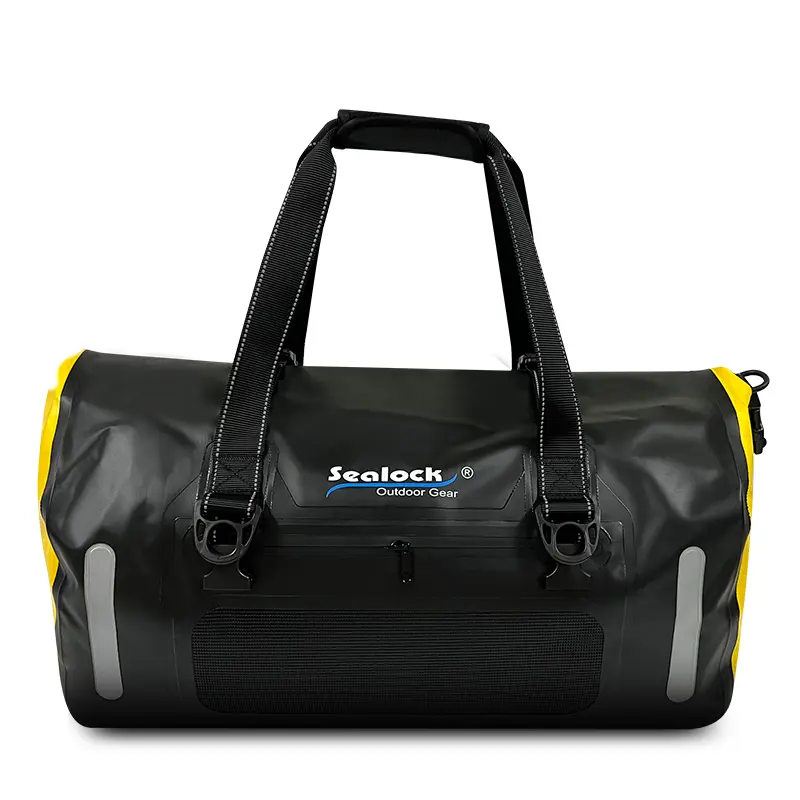
SL-K099 | 40 / 60L | 840D TPU | Roll-top · IPX7 | View |
|
SL-C594 | 55L | 500D PVC (TPU option) | Airtight zipper · IPX7 · 2 sealed end compartments | View |
|
SL-C893 | 70L | Printed TPU laminate | Coated zipper · IPX6 · detachable pouch, MOLLE | View |
|
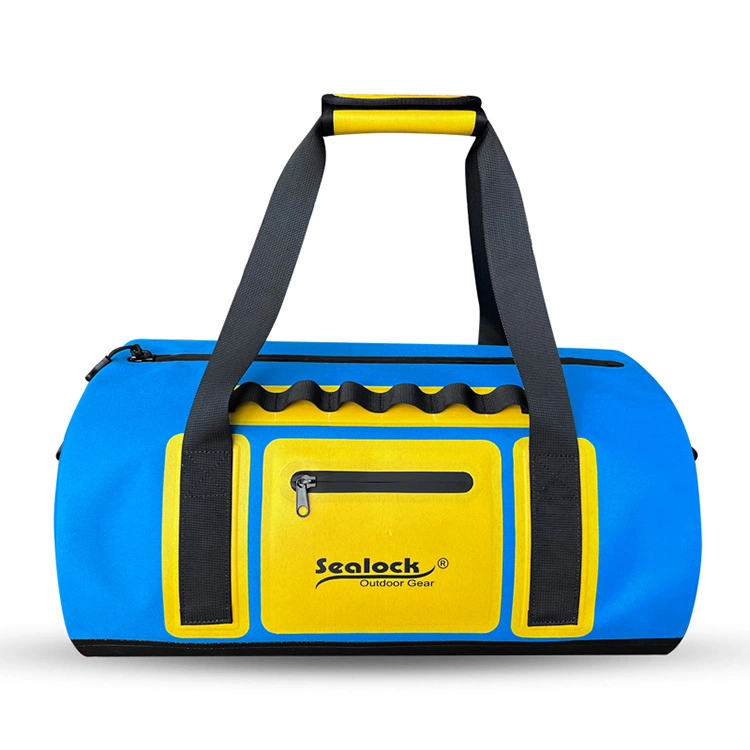
SL-C759 | 25L | TPU composite | Waterproof zipper · multi-sport | View |
Capacity now spans 20L to 70L across roll-top and airtight-zipper constructions in PVC and TPU. Full categories sit under duffels, dry bags, and dry backpacks. Assortment planning for a bulk programme is covered in the 40L capacity guide and the 60L packing guide.
11. FAQ
Q: What can actually be customized on an OEM waterproof duffel?
A: Capacity and proportions, waterproof rating and closure type, fabric and denier, compartment layout including sealed end compartments and detachable pouches, interior organisation, base reinforcement, handle and strap configuration, attachment systems, zipper pulls, logo method, colour, and packaging. Ground-up development from a sketch or sample is supported.
Q: Can an IPX6 design be made fully submersible?
A: Yes — specifying airtight-zipper construction upgrades a water-resistant welded design to an immersion-rated one. It is a common path for buyers extending a field or hunting line into water sports, and it changes cost and closure hardware rather than the whole structure.
Q: How do I add external gear capacity without compromising waterproofing?
A: With welded MOLLE-style lash strips, moulded D-rings, and patch panels bonded to the shell rather than stitched through it. Anything sewn through a welded body creates a leak path; welded attachment adds mounting points without piercing the waterproof layer.
Q: What's the fastest way to communicate what I want?
A: A reference sample or clear images, plus intended use, target FOB price, quantity, and launch date. A factory reads pocket layout, zipper configuration, strap design, and internal structure directly from a sample far faster than from a written description, and a stated price target prevents quoting a build the programme cannot carry.
Q: Can you match my brand's Pantone colours and print custom camo?
A: Yes — Pantone colour matching across the range, and camo printed to your own artwork or developed as an original pattern. Where a licensed camouflage pattern is required, the buyer supplies the licence and production runs to it.
Q: Do I need a separate MOQ for each size in a series?
A: MOQ applies per model at 300 pcs, so a multi-size series counts each size separately. Sizes developed off one construction and sharing a base fabric are easier to schedule and quote together, which is the practical way to launch a range without over-committing to one size.
Request an OEM Duffel Proposal
For structural development, samples, packing specifications, or a full OEM/private label proposal, submit an inquiry. Sealock responds to procurement enquiries within 24 hours, with production from Dongguan, China or Ho Chi Minh City, Vietnam.