
- English
- Español
- Português
- русский
- Français
- 日本語
- Deutsch
- tiếng Việt
- Italiano
- Nederlands
- ภาษาไทย
- Polski
- 한국어
- Svenska
- magyar
- Malay
- বাংলা ভাষার
- Dansk
- Suomi
- हिन्दी
- Pilipino
- Türkçe
- Gaeilge
- العربية
- Indonesia
- Norsk
- تمل
- český
- ελληνικά
- український
- Javanese
- فارسی
- தமிழ்
- తెలుగు
- नेपाली
- Burmese
- български
- ລາວ
- Latine
- Қазақша
- Euskal
- Azərbaycan
- Slovenský jazyk
- Македонски
- Lietuvos
- Eesti Keel
- Română
- Slovenski
- मराठी
- Srpski језик

Tooling and Die Costs on a Waterproof Bag Programme
Sealock develops custom waterproof bag programmes for OEM and wholesale buyers from factories in China and Vietnam, with tooling quoted separately and transparently before sampling begins. Tooling is the line item buyers understand least and argue about most. It appears late in a quotation, it is not obviously connected to anything the customer will ever see, and the commercial terms attached to it — who owns the die, how the cost is recovered, what happens if the relationship ends — are often left undefined until they matter. This explains what the money buys and which terms to fix in writing.
1. Why a Welded Bag Needs Tooling at All
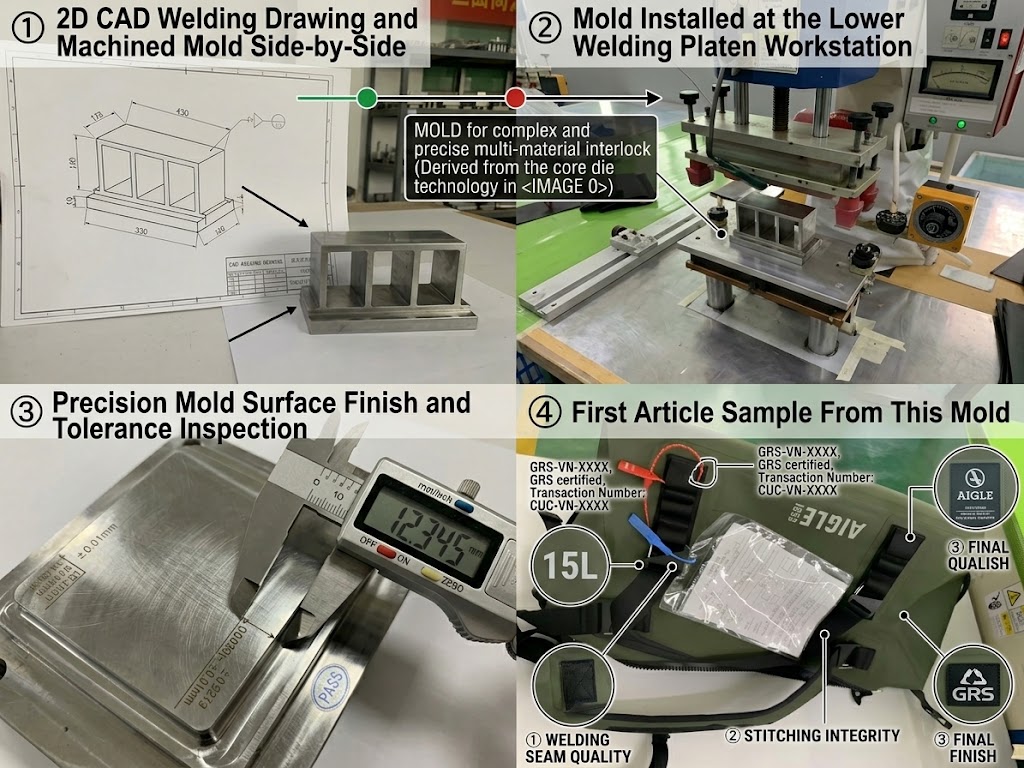
High-frequency welding does not work like sewing. The machine presses material between an upper electrode and a lower platen, and that electrode — a custom-machined copper or brass die — physically defines the shape of every seam it produces. A new bag geometry therefore requires a new die before a single sample can exist.
The sequence is fixed: the bag's three-dimensional geometry is translated into a precise two-dimensional weld pattern, a die is machined to that pattern, and only then can a first-article sample be welded. This is why tooling carries lead time rather than only cost, and why a quotation for a genuinely new shape looks different from one for a colour change on an existing platform.
Not every project needs it. Modifying an existing platform — different colour, different fabric, different strap configuration, different branding — generally runs on existing tooling. It is the geometry that triggers a new die, which is the single most useful thing to know when scoping a project against a budget.
2. What the Tooling Charge Actually Covers
A tooling quote on a welded bag is not simply a block of metal. It includes:
- Engineering — converting the design into a manufacturable weld pattern, which is where problems get found while they are still free to fix.
- Die machining — the copper or brass electrode itself, machined smooth and to tight tolerance, because surface imperfections and dimensional drift both translate directly into weld defects.
- The jig and nest — the tool plate and lower weld station that hold the panels in position.
- Trials and validation — proving the parameter set on the actual material before the tool is released to production.
Sewn constructions have an equivalent but cheaper step: pattern development rather than die machining. A new shape still needs patterns cut and graded, but the upfront cost is materially lower — which is one reason a heavily organised, sewing-led product can be cheaper to start than a simple welded one, even though its unit cost is higher. The construction trade-off is covered in the guide to sewn versus welded construction.
3. Two Ways to Pay, and They Are Not Equivalent
Tooling is normally structured one of two ways, and the difference goes beyond cash flow:
|
|
One-time charge | Amortised into unit price |
|---|---|---|
| Cash flow | Paid upfront as a line item | No upfront cost; recovered across an agreed quantity |
| Ownership | Normally assigned to the buyer | Usually retained by the factory |
| Suits | Buyers who want the tool to be theirs and portable | Buyers confident in volume who prefer to preserve cash |
| Risk | Upfront outlay if the programme does not run | Ownership never transfers; effective cost rises if volume falls short |
The amortisation route is genuinely useful for buyers with a committed pipeline, but it carries a term worth reading carefully: where tooling is structured as a deposit folded into unit pricing, the buyer may never own the tool outright even after years of production. That is not necessarily unfair — the factory carried the cost — but it should be a decision rather than a discovery.
4. The Amortisation Mistake That Costs Buyers Most
When tooling is spread across volume, the arithmetic depends entirely on which volume you use. The common and expensive error is amortising against projected volume rather than committed volume. A tool costed across three million units that ends up producing five hundred thousand has an effective per-unit burden several times higher than planned, and industry survey data suggests a substantial share of tooling investments fail to reach their projected breakeven within the expected timeframe.
The disciplined approach is to amortise against first-year committed volume only and treat anything beyond that as upside. If the tool pays for itself inside the first programme year, every subsequent unit improves margin rather than rescuing a plan.
5. Ownership, Possession, and Portability Are Three Different Things
This is where buyers get caught, and the distinction is simple once stated:
- Legal ownership — who holds title to the tool. Where a buyer pays the tooling charge outright, the contract should state that title passes on full payment, not merely that an invoice was issued.
- Physical possession — the factory keeps the die because that is where it is used. Possession is normal and not in itself a problem.
- Portability — the buyer's right to have the tool transferred to another supplier if the relationship ends, and on what timeline and at whose cost.
Absent explicit language, a supplier that built the tool may claim rights over it even after the buyer has paid in full. Three clauses prevent that: explicit transfer of title on payment, confirmation that physical custody does not affect legal title, and a stated transfer process on termination. It is worth adding a retention period as well — factories commonly store buyer tooling for a defined time after the last run, and if your programme is seasonal you want that period long enough to cover a gap year.
6. Questions to Ask Before Tooling Is Cut
- Is a new die actually required, or can an existing platform be modified? Often the honest answer saves the entire charge.
- Is the quote itemised? Engineering, die machining, jig, and validation separated rather than bundled, so a revision later can be priced against something.
- What happens if the design changes after the die is cut? Modification costs are the most common source of tooling budget overrun, and they are avoidable by resolving geometry during the design review rather than after.
- One-time charge or amortised, and what does each do to ownership?
- What is the retention period, and what are the transfer terms if we move production?
- Does the tooling work at both production sites? For programmes that may shift origin for duty reasons, this matters — and the answer should be given before the tool is made, not after.
Sealock quotes tooling separately and states it before sampling rather than introducing it after a design is approved, with the same quality system and approved sample governing production at either the Dongguan or Ho Chi Minh City site. The origin question is covered in the guide to choosing a manufacturing base in 2026.
7. How to Reduce Tooling Exposure Legitimately
There are sensible ways to lower this cost that do not compromise the product:
- Start from an existing platform. Most OEM programmes modify a proven construction rather than developing a new silhouette, which avoids die tooling entirely while still delivering a branded, specified product.
- Settle geometry before the die is cut. The largest single tooling cost driver is redesign after the tool exists. Decisions that cost nothing in a drawing cost real money in machined copper.
- Group related geometries. Where a range shares construction, developing patterns together is more efficient than treating each as an isolated project.
- Consider a sewing-led construction where the product's requirements allow it, since pattern development is cheaper upfront than die machining.
- Amortise honestly. Against committed volume, not hoped-for volume.
8. Platforms Available Without New Tooling
Models that can be branded, recoloured, and specified without die development. Organized by category rather than priority:
| Image | Model | Category | Material | Rating | Product Page |
|---|---|---|---|---|---|
|
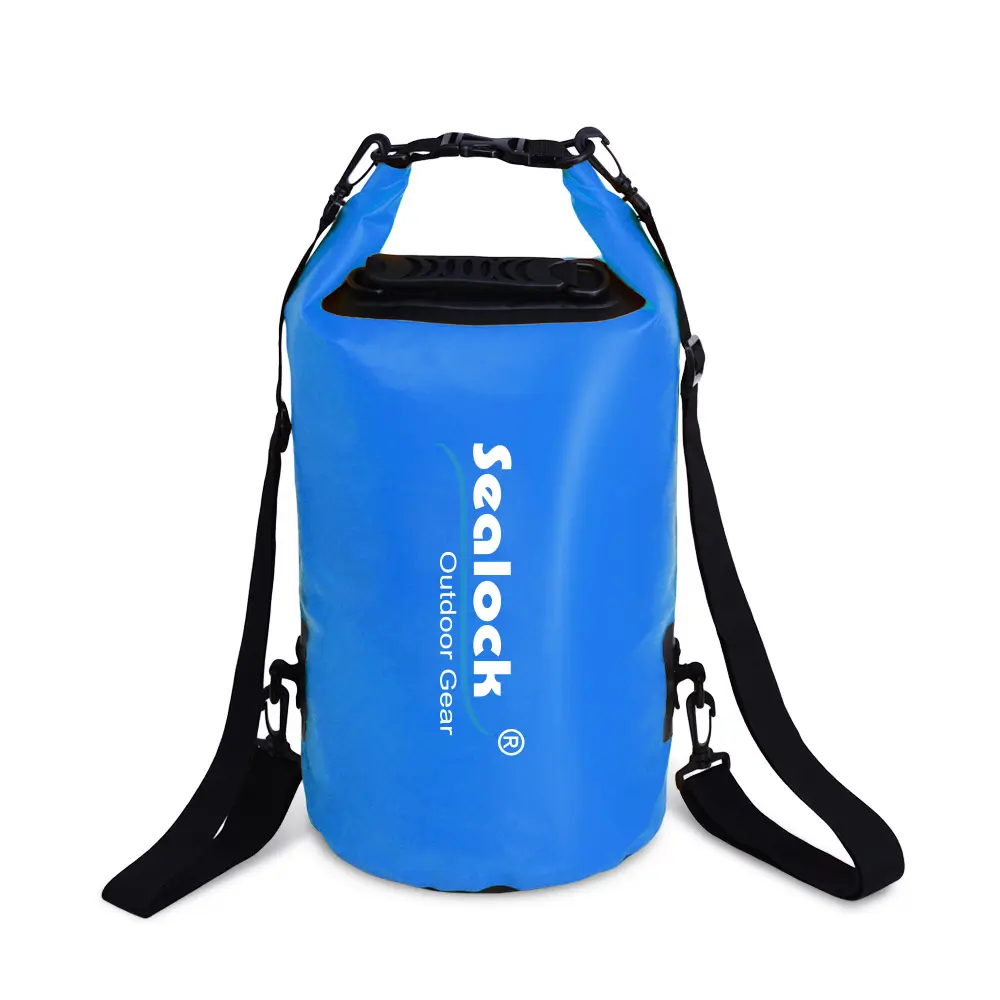
SL-D002 | Dry bag, 5–63L | 500D PVC | IPX7 | View |
|
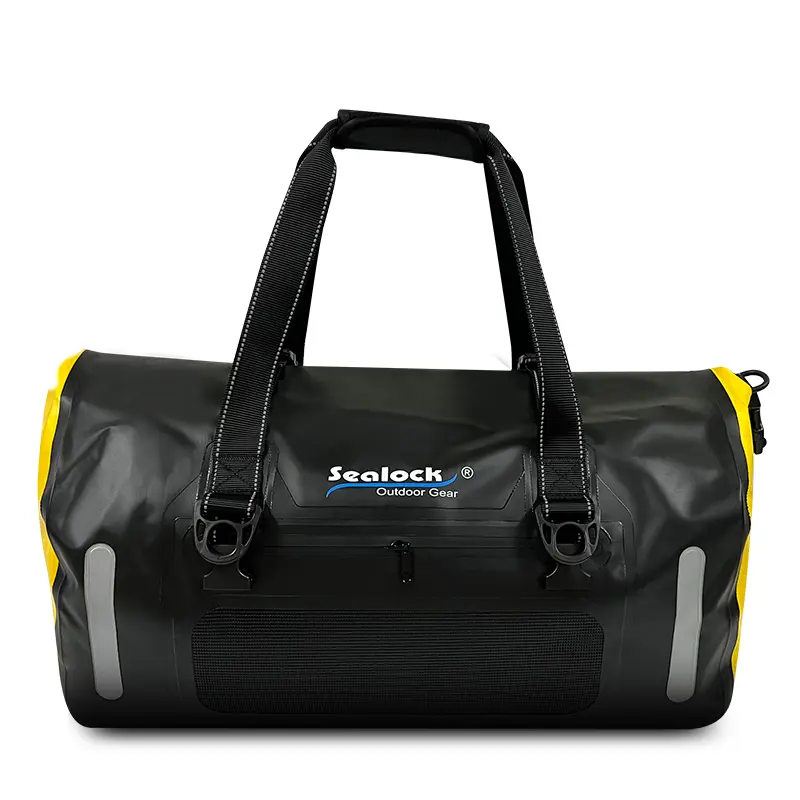
SL-K099 | Duffel, 40 / 60L | 840D TPU | IPX7 | View |

|
SL-E119 | Backpack, 20L | Cationic TPU composite | IPX8 | View |
|
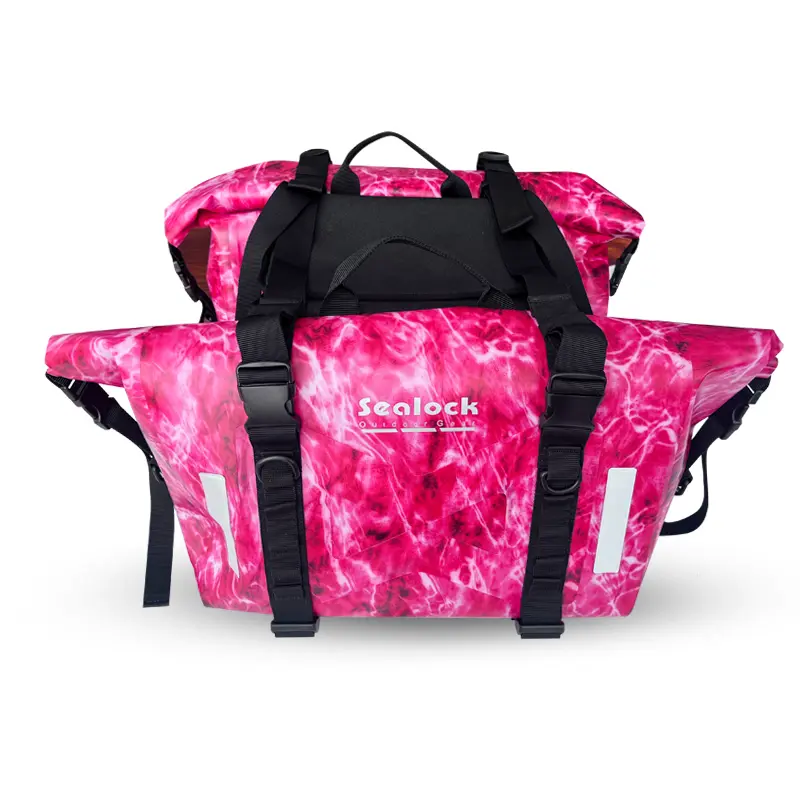
SL-C807 | Motorcycle, 45L | 500D PVC / 420D TPU | IPX6 | View |
|
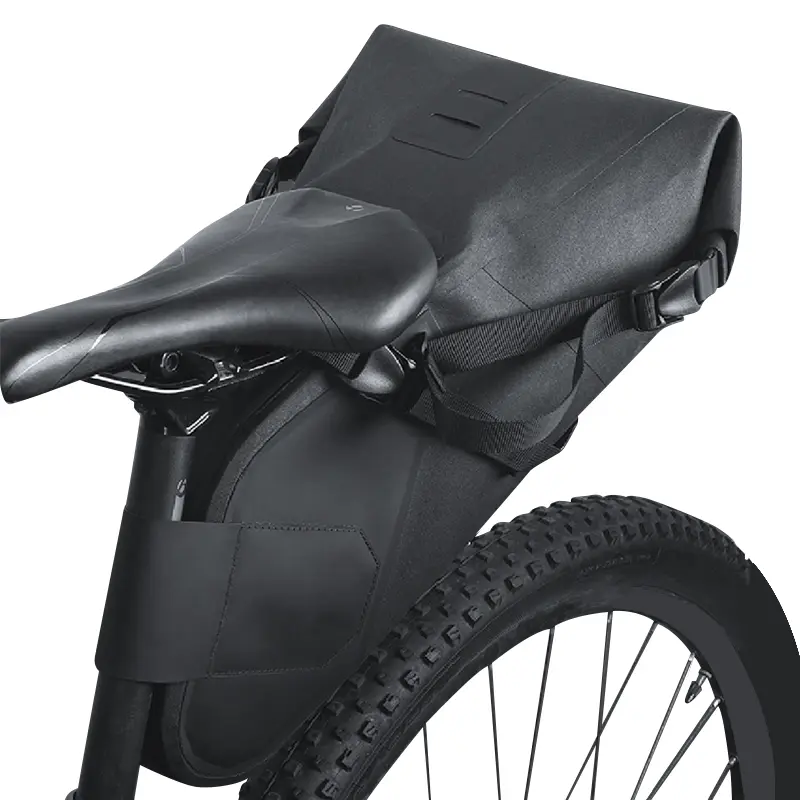
SL-K022 | Bike saddle bag, 10–14L | 420D / 600D TPU | IPX6–7 | View |
|
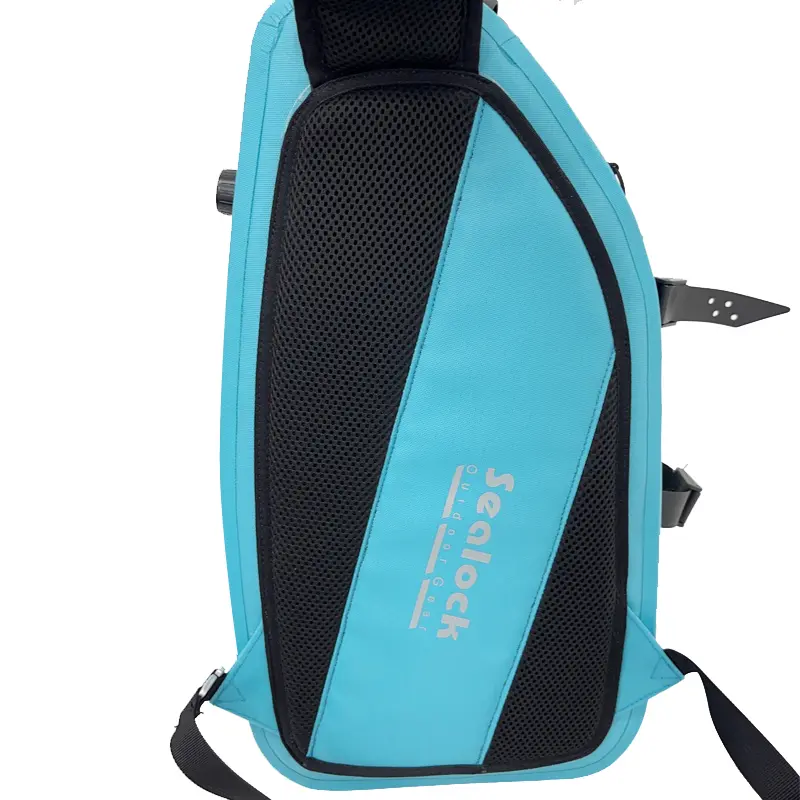
SL-E868A | Fishing sling, 12L | 840D TPU | IPX8 | View |
Full categories sit under waterproof bags, dry backpacks, and dry bags. Sampling and approval are covered in the guide to getting a waterproof bag sample, and the wider cost structure in the guide to what drives the cost of a waterproof bag.
9. Terms
Sealock (YiFuLong Outdoor Gear Co., Ltd.) has built waterproof bags for over 20 years, producing for international outdoor brands including OSPREY, KAILAS, Helly Hansen, SIMMS, ORVIS, and West Marine.
- MOQ: 300 pcs on most models | Samples: 7–15 days | Bulk: 30–45 days
- Tooling: quoted separately for new geometries, stated before sampling; existing platforms modified without die development
- Production: in-house 27.12 MHz high-frequency welding and industrial sewing, separate workshops on the same production floor
- Facilities: Dongguan, China | Ho Chi Minh City, Vietnam — either origin on any model
- Certifications: ISO 9001, BSCI, SMETA, Sedex, HIGG, GRS, SCAN
Every batch runs IQC on incoming materials, IPQC in process on both welding and sewing lines including peel tests at run start, and OQC with AQL sampling and signed gold-sample comparison, under the quality control standards for waterproof production.
10. FAQ
Q: Do we always need to pay for tooling?
A: No. Colour, fabric, strap configuration, interior layout, and branding changes run on existing platforms without die development. Tooling is triggered by new geometry — a shape the existing dies cannot produce. Ask this first, because the honest answer often removes the charge entirely.
Q: Who owns the die once we have paid for it?
A: Whatever the contract says, which is why it should say something. Where the charge is a one-time payment, ownership is normally assigned to the buyer and the contract should state that title passes on full payment. Where the cost is amortised into unit price, the factory usually retains ownership — a reasonable arrangement, but one to agree knowingly rather than discover later.
Q: Should we amortise tooling or pay upfront?
A: Upfront if you want the tool to be yours and portable; amortised if you are confident in volume and prefer to preserve cash. If you amortise, calculate against first-year committed volume rather than projected volume — that single discipline prevents the most common and expensive tooling miscalculation.
Q: What if we change the design after the die is made?
A: Modification costs money and time, and it is the most frequent cause of tooling overrun. Resolve geometry during design review, when changes cost nothing. A factory that raises manufacturability issues before cutting steel is doing you a favour, not slowing you down.
Q: How long will you keep our tooling?
A: Agree a retention period in the order rather than relying on convention, and make it long enough for your reorder rhythm — a seasonal programme with a gap year needs a longer period than a continuous one. Include transfer terms in case production moves.
Q: Can the same tooling be used at your Vietnam site?
A: Ask before the tool is made rather than after. For buyers who may shift origin to manage duty exposure, tooling compatibility across sites is worth confirming at the quotation stage so a later move is a scheduling decision rather than a re-tooling one.
Request an Itemised Tooling Quote
Send your design or reference sample and we can confirm whether new tooling is required at all, and quote it itemised and separately from unit price if it is — submit an inquiry. Sealock responds to procurement enquiries within 24 hours, with production from Dongguan, China or Ho Chi Minh City, Vietnam.