
- English
- Español
- Português
- русский
- Français
- 日本語
- Deutsch
- tiếng Việt
- Italiano
- Nederlands
- ภาษาไทย
- Polski
- 한국어
- Svenska
- magyar
- Malay
- বাংলা ভাষার
- Dansk
- Suomi
- हिन्दी
- Pilipino
- Türkçe
- Gaeilge
- العربية
- Indonesia
- Norsk
- تمل
- český
- ελληνικά
- український
- Javanese
- فارسی
- தமிழ்
- తెలుగు
- नेपाली
- Burmese
- български
- ລາວ
- Latine
- Қазақша
- Euskal
- Azərbaycan
- Slovenský jazyk
- Македонски
- Lietuvos
- Eesti Keel
- Română
- Slovenski
- मराठी
- Srpski језик

OEM Waterproof Bike Bags with Custom Design
Sealock develops OEM waterproof bike bags to custom design for cycling brands, bikepacking labels, and distributors, from factories in China and Vietnam. Bicycle luggage is unlike every other bag category in one respect that shapes the whole development process: the product has to fit a specific machine, and no two frames are the same shape. A duffel fits anyone. A frame bag fits one frame model in one size — which makes custom development in this category a geometry problem before it is a materials problem.
1. Company and Terms
Sealock (YiFuLong Outdoor Gear Co., Ltd.) has built waterproof bags for over 20 years, producing for international outdoor and cycling brands including KAILAS, OSPREY, Helly Hansen, and CHUMS.
- Facilities: Dongguan, China | Ho Chi Minh City, Vietnam — either origin available on any model
- Production: 27.12 MHz high-frequency welding and industrial sewing as separate workshops on the same production floor
- MOQ: 300 pcs per model | Samples: 7–15 days | Bulk: 30–45 days
- Certifications: ISO 9001, BSCI, SMETA, HIGG, GRS, SCAN
2. The Frame Bag Is the Hardest Custom Job in the Category
Saddle packs, handlebar bags, and top tube bags mount to standardised parts — seatposts, bars, and headtubes vary far less than frame triangles do. A frame bag has to fill a space defined by three tubes whose angles and lengths change with every model and every size within that model, while clearing bottle cage mounts, cable stops, derailleur clamps, and any other bag already strapped to the bike.
That is why a bike brand commissioning its own accessories has an advantage a generic bag supplier cannot match: it owns the frame geometry. A bag cut to the brand's own frame sizes fits where a universal one gaps, sags, and rubs — and it is a product only that brand can sell.
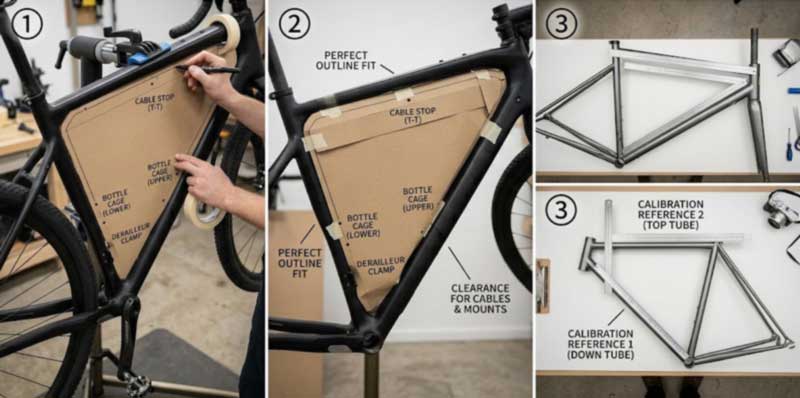
3. How a Frame Template Is Captured
Two methods are established in the industry, and both work for OEM development:
- Physical tracing. Card is taped against the frame and the inside edge of the triangle traced as closely as possible, then cut out and test-fitted before every edge is measured and written on the template. It remains the most accurate method and is still preferred by many makers.
- Photographic templating. A calibrated photograph — frame shot square-on with a ruler or tape in the plane of the frame — is converted to a template in software. It is faster, works remotely, and is how most modern development is done.
Either way, the same details must be captured or the first sample will fit badly:
- Bottle cage mounts, so strap positions do not land on them and bottles can still be removed — for half-frame bags, the cages and the largest intended bottles should be fitted before the template is taken.
- Cable stops, ports, and derailleur clamps, which dictate where the bag body must be relieved.
- Any other bag in the system. If a top tube bag will be mounted, fit it first and mark its straps on the template so the two do not fight for the same anchor points.
4. From One Template to a Production Range
This is the step where a one-off custom bag becomes a manufacturable programme, and where most brands underestimate the work. A single frame model in four sizes is four patterns, not one — and a brand with three frame models across four sizes is planning a twelve-pattern programme.
Three ways to keep that manageable:
- Build a template library. Established makers hold hundreds of frame templates on file, so a repeat or adjacent model is a pattern adjustment rather than a fresh development. The same applies to a brand's own catalogue across model years.
- Grade rather than redraw. Where a frame family shares geometry proportionally, patterns can be graded across sizes instead of individually templated, which cuts development time substantially.
- Offer half-frame alongside full-frame. A half-frame bag tolerates far more geometry variation than a full-frame one, so it covers several frame sizes from one pattern — often the right choice for the volume SKU, with full-frame reserved for hero models.
Volume is not the constraint on this once patterns are settled. The 600D TPU frame bag platform runs to 50,000 pieces per month, so a brand covering several frame models across sizes is limited by pattern development time rather than by line capacity — which is another argument for building a template library early and grading where geometry allows.
5. Width Geometry: The Detail That Decides Whether Riders Use It
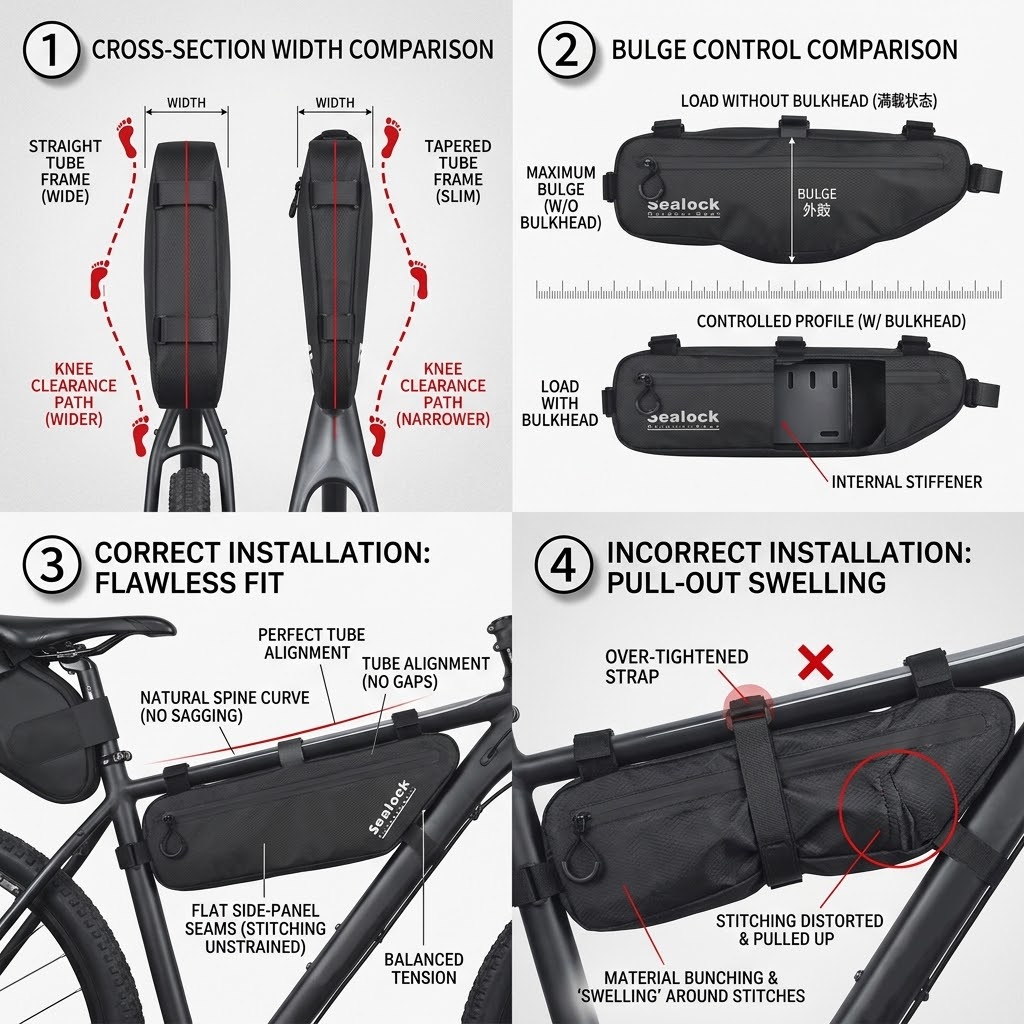
Frame bag width is a real engineering decision rather than a capacity preference, because the rider's knees pass either side of it on every pedal stroke. The variables:
- Frame type drives permitted width. A mountain frame's lower, longer triangle sits further from the knee path, so the bag can be wider; a gravel or road frame needs a narrower profile to avoid rub.
- Taper versus slim. A tapered bag is wider in the middle and narrows toward the spine; a slim profile keeps constant width front to back for riders with a narrow stance or a history of knee contact. Offering both in a range covers both rider types from one platform.
- Bulge control. A packed bag bulges wider than its nominal width, and an internal baffle is what limits that on larger bags — without one, a large frame bag becomes a knee problem the moment it is full.
- Spine width is specified separately from overall width, since it determines the clearance against the tubes themselves.
6. Component-Level Specification
A custom bike bag brief should reach component level, because several choices are size-dependent rather than preference-driven:
- Zipper sizing by bag type. Larger gauge zippers suit full frame bags where the opening is long and loads are heavier; lighter gauges suit half-frame and small bags. Undersizing a full-frame zipper is a common failure route.
- Gusset fabric. The centre panel facing the frame tubes takes constant contact and should be specified in a heavier, more abrasion-resistant fabric than the side panels.
- Mounting method and strap count. Velcro straps suit universal and retrofit fitment — the 0.8L top tube platform uses three repositionable straps, two on the top tube and one on the head tube, so the bag can be slid along the tube to clear a bottle cage or a cable. Bolt-on grommets suit frames with accessory mounts and give the most secure, rattle-free result; a bike brand with its own frames can specify bolt-on because it controls where those mounts sit.
- Cable ports for routing a charging lead from a power bank or dynamo inside the bag to a head unit.
- Internal layout — divider, document pocket, hydration or dynamo slot.
7. Design So It Cannot Be Fitted Badly
An overlooked part of custom development is designing against user error. Riders routinely over-tighten Velcro straps, and in extreme cases that puts destructive force on the bag itself. A correctly fitted frame bag sits evenly inside all three tubes with the spine naturally relaxed and the side panel seams running as smooth lines — not stretched into peaks at each strap.
Two design responses: locate straps where the load path is supported rather than where the panel is unsupported, and specify enough strap positions that tension is distributed instead of concentrated. Clear fitting instructions in the box are part of the product on this category, exactly as they are on vehicle luggage.
8. Custom Parameters for the Other Positions
Frame bags dominate the development effort, but the other positions carry their own specifiable parameters:
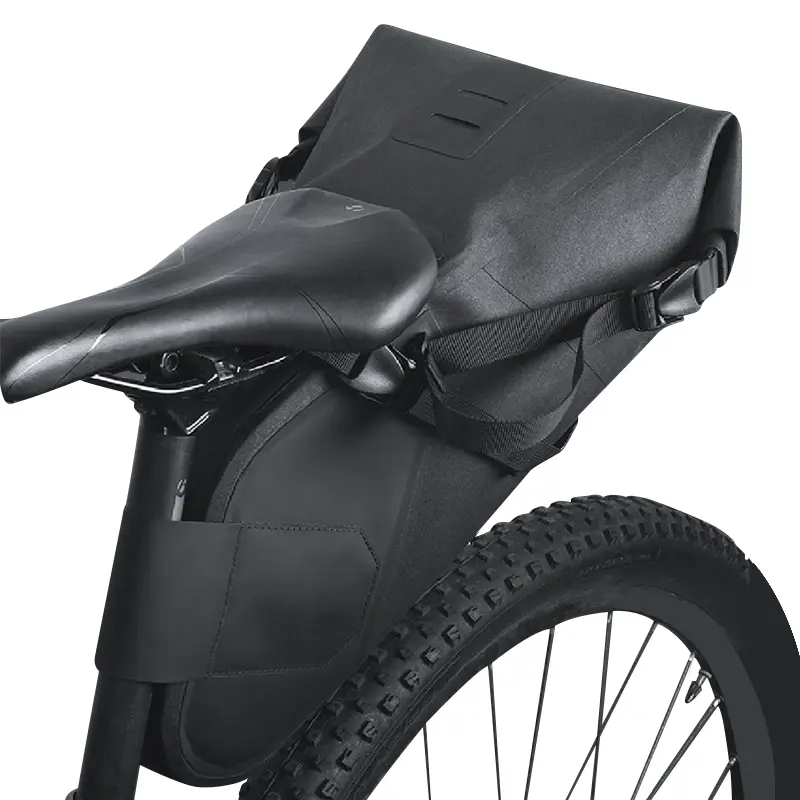
- Saddle packs — capacity and length, seat rail and seatpost mounting interface, internal stiffener and anti-sway construction, compression strap count, and clearance geometry for the intended tire size. The 10–14L platform is built with a 420D TPU body and a 600D TPU reinforcement panel on UTX or Duraflex buckles, with roll-top closure and dual mounting at the rails and post.
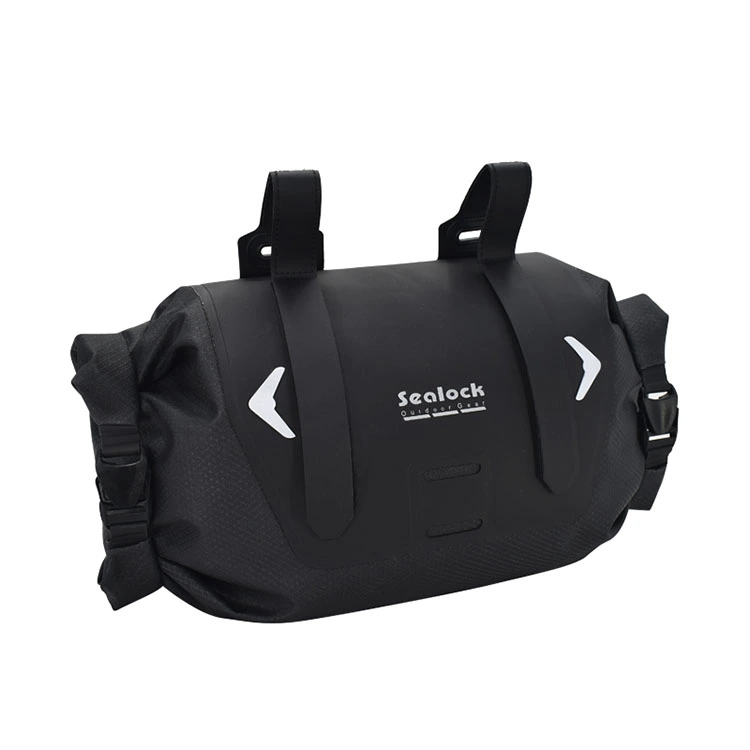
- Handlebar bags — bar diameter and drop clearance, cable routing relief, and mounting interface; the 7L TPU platform covers both mountain and road cockpits.
- Top tube bags — bolt-on or strap mounting, rigid sides, one-handed closure, cable port.
- Cycling backpacks — back panel and harness geometry, covered in the guide for waterproof backpack OEM projects.
The load-placement logic that determines which position gets which capacity is set out in the guide for cycling brands.
9. Development Sequence
- 1. Brief and geometry capture — frame models and sizes, templates or calibrated photographs, target capacity, mounting method, materials, colourway, branding, quantity, launch date.
- 2. Pattern development — templates converted to production patterns, with grading across sizes where geometry allows.
- 3. Sampling — first samples produced and, critically, test-fitted on the actual frames rather than assessed on a table; strap positions, clearance, and bulge under load confirmed with the bike loaded.
- 4. Revision and approval — pattern adjusted, then a signed gold sample held by each side.
- 5. Bulk production under QC and pre-shipment inspection.
Custom development runs longer than a colour change, and welded components need their own machined dies quoted separately, so the launch date should be shared at enquiry. Cycling brands should also plan against their own model-year cycle, since accessories cut to a frame need to arrive with the bike rather than after it.
Minimums run 300 pieces per model across most of the cycling range, with the tail bag platform at 500. Where a programme spans several positions, models sharing a base fabric are easier to schedule and quote together than the same count spread across unrelated materials.
10. Bike Range
Models organized by type rather than priority:
| Image | Model / type | Capacity | Material | Mounting / features | Product Page |
|---|---|---|---|---|---|
|
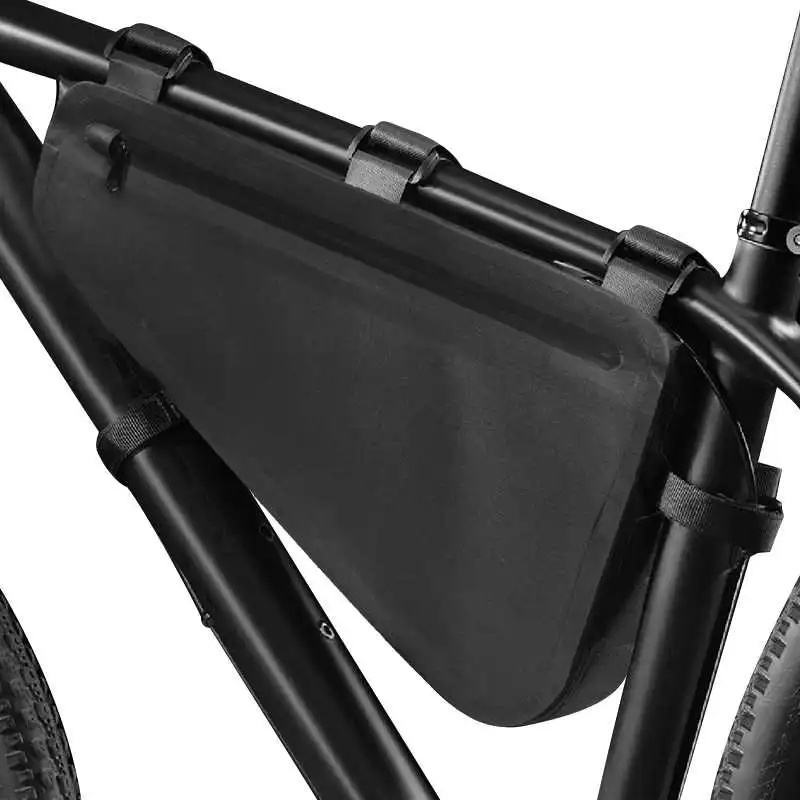
SL-K089-A Frame Bag | Cut to buyer specification | 600D TPU | Template-driven custom sizing · black, grey, army green, brown · capacity to 50,000 pcs/month | View |
|
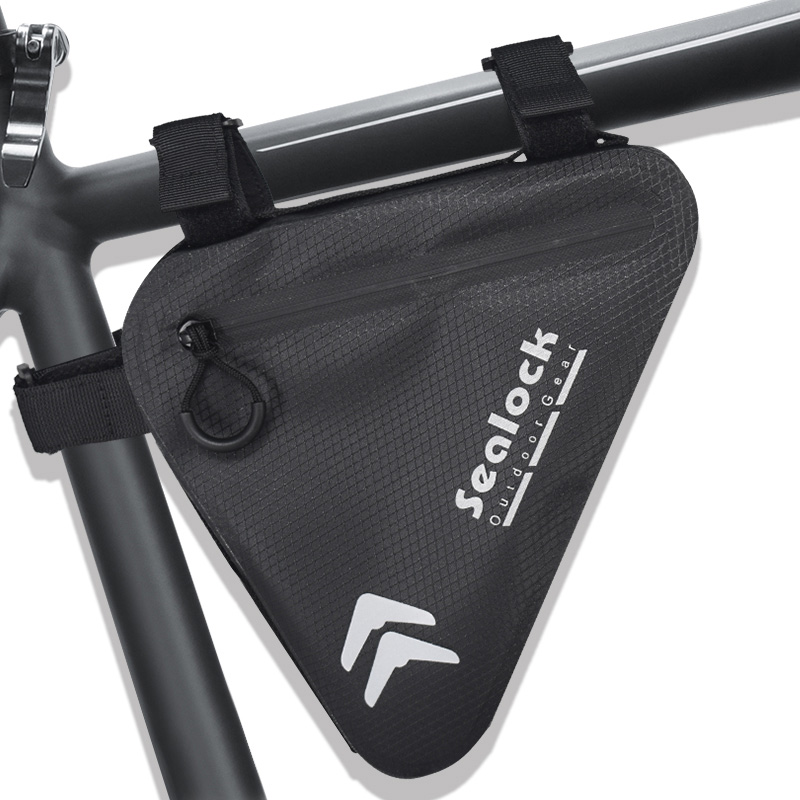
Top Tube Frame Bag | 0.8L · 80 g | 800D TPU | Three repositionable straps · waterproof zip · rain and spray rated | View |
|
SL-K022 Saddle Bag | 10–14L | 420D TPU + 600D TPU reinforcement | Seat rails + seatpost · roll-top · IPX6–7 · UTX/Duraflex buckles | View |
|
SL-K060B Handlebar Bag | 7L | TPU | Cockpit mount · mountain and road · black, grey | View |

|
SL-K088-A Seat Bag | 20 × 9.5 × 5 cm | 600D TPU | Under-saddle · four stock colours | View |
|
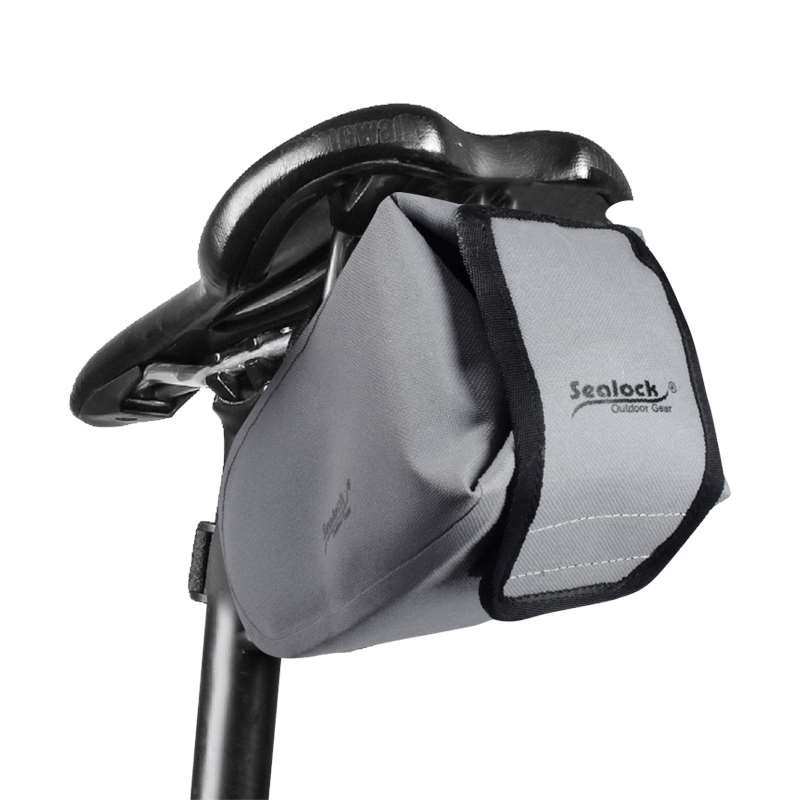
K055 Under-Seat Bag | 22.5 × 10.5 × 7 cm | 600D TPU | Under-saddle · BSCI / ISO | View |

|
SL-K1102-A Tail Bag | 30 × 17.5 × 56 cm | Coated waterproof fabric | Rear rack mount · MOQ 500 pcs | View |
|
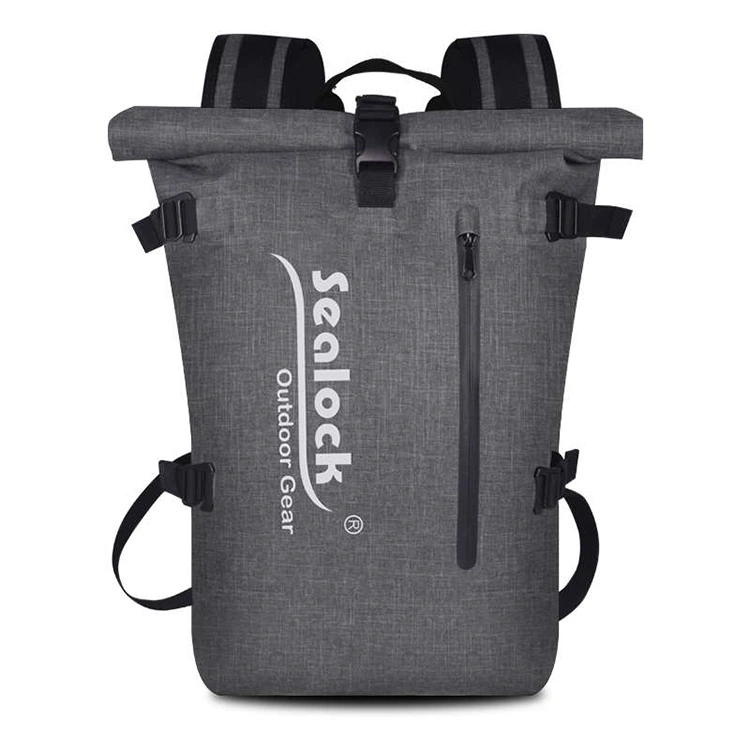
SL-E980 Commuter Backpack | 22L | 600D TPU laminate | Roll-top · IPX6 · detachable laptop sleeve, 13"/14"/15.6" options · 3D EVA airflow back | View |

|
SL-E144 Cycling Backpack | 15L | TPU | Floating ventilated back · IPX6 · 0.85 kg | View |
|
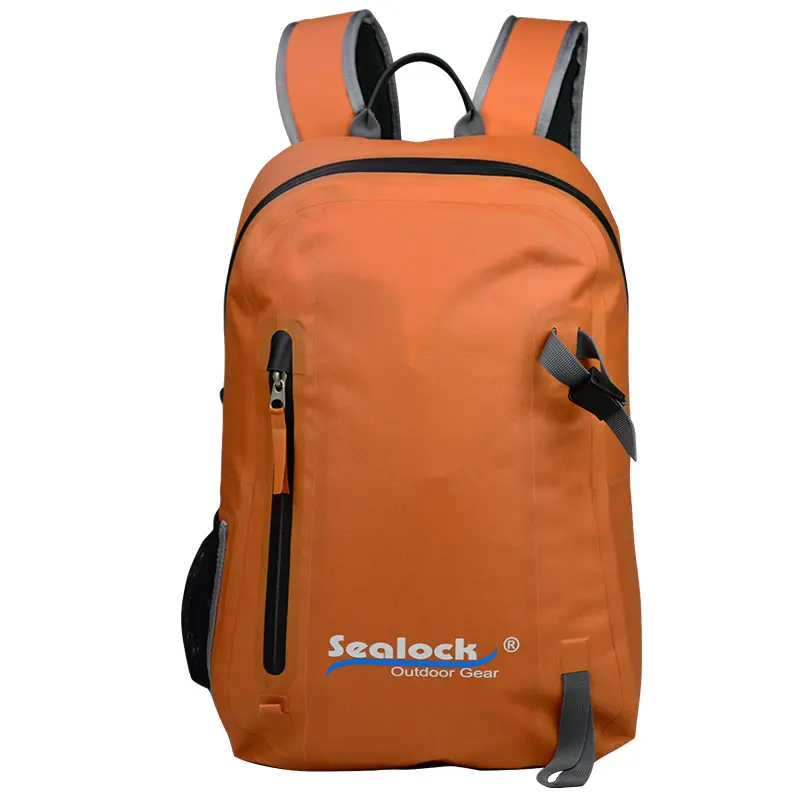
SL-E216 Commuter Backpack | 20L | 420D TPU laminate | IPX6 · waterproof front pocket · EVA air-mesh back · reflective | View |
Full categories sit under waterproof bags, dry backpacks, and dry bags. Material options are covered in the TPU material guide and branding scope in the guide to custom dry bags.
11. Quality Control
Every batch runs IQC on incoming fabric, zippers, buckles, and webbing; IPQC on welds, stitch density and tension, and mounting-point construction in process, including peel tests on sample welds at run start; and OQC with AQL sampling, batch immersion testing, dimensional checks against the approved pattern, and signed gold-sample comparison. Dimensional control matters more here than in most categories, because a frame bag a few millimetres out of pattern no longer fits the frame it was cut for. Load cycling over 1,500 cycles targets straps and anchors, alongside tensile and bonding strength, friction resistance, colour fastness, and colour difference. The full customer inspection procedure — unboxing, vacuum extraction, a 24-hour static rest, and air-leak determination — can be witnessed end to end, with SGS or QIMA inspection available. Standards are set out in the quality control standards for waterproof production.
12. FAQ
Q: What do you need from us to develop a frame bag?
A: The frame geometry — either physical templates traced from the front triangle or calibrated photographs with a ruler in the plane of the frame — plus the frame models and sizes to be covered. Capture bottle cage mounts, cable stops, derailleur clamps, and the straps of any other bag that will share the frame.
Q: How many patterns will our programme need?
A: One per frame model per size for full-frame bags, so a three-model catalogue in four sizes is a twelve-pattern development. Grading across a frame family and offering a half-frame bag, which tolerates far more geometry variation, are the two ways to keep that count down.
Q: How wide should the frame bag be?
A: As wide as the frame type allows without meeting the rider's knees. Mountain frames permit more width, gravel and road frames need a narrower profile, and a tapered version plus a slim version covers both rider stances. Specify an internal baffle on larger bags, because a packed bag bulges wider than its nominal width.
Q: Velcro straps or bolt-on mounting?
A: Velcro for universal and retrofit fitment; bolt-on for the most secure, rattle-free result where the frame has accessory mounts. A bike brand developing accessories for its own frames can specify bolt-on because it controls where those mounts sit.
Q: Can the first sample be approved from photographs?
A: It should not be. Bike bags have to be test-fitted on the actual frame and assessed loaded — strap positions, tube clearance, and bulge under load only reveal themselves on the bike. Build that into the sampling round rather than treating it as a formality.
Q: How should we plan the timeline?
A: Around your model year. An accessory cut to a specific frame needs to launch with the bike, so work backwards from that date through bulk production, sampling and revision, pattern development, and geometry capture — and share the launch date at enquiry so tooling and sampling can be scheduled against it.
Request a Custom Cycling Proposal
For frame-specific development, template guidance, samples, or a full OEM proposal, submit an inquiry. Sealock responds to procurement enquiries within 24 hours, with production from Dongguan, China or Ho Chi Minh City, Vietnam.