
- English
- Español
- Português
- русский
- Français
- 日本語
- Deutsch
- tiếng Việt
- Italiano
- Nederlands
- ภาษาไทย
- Polski
- 한국어
- Svenska
- magyar
- Malay
- বাংলা ভাষার
- Dansk
- Suomi
- हिन्दी
- Pilipino
- Türkçe
- Gaeilge
- العربية
- Indonesia
- Norsk
- تمل
- český
- ελληνικά
- український
- Javanese
- فارسی
- தமிழ்
- తెలుగు
- नेपाली
- Burmese
- български
- ລາວ
- Latine
- Қазақша
- Euskal
- Azərbaycan
- Slovenský jazyk
- Македонски
- Lietuvos
- Eesti Keel
- Română
- Slovenski
- मराठी
- Srpski језик

Bike Frame Bag Manufacturer for Bikepacking Brands
Sealock manufactures bike frame bags for bikepacking brands, cycling labels, and OEM programmes from factories in China and Vietnam, with welded and stitched construction in house. The frame bag anchors a bikepacking system — it holds the dense gear at the bike's centre — but it also creates the single most consequential trade-off in the category: fill the triangle and you lose the water bottles. How a brand resolves that determines its whole range architecture.
1. Company and Terms
Sealock (YiFuLong Outdoor Gear Co., Ltd.) has built waterproof bags for over 20 years, producing for international outdoor and cycling brands including KAILAS, OSPREY, Helly Hansen, and CHUMS.
- Facilities: Dongguan, China | Ho Chi Minh City, Vietnam — either origin available on any model
- Production: 27.12 MHz high-frequency welding and industrial sewing as separate workshops on the same production floor
- MOQ: 300 pcs per model | Samples: 7–10 days on frame bags | Capacity: up to 50,000 pcs/month on the frame bag line
- Certifications: ISO 9001, BSCI, SMETA, HIGG, GRS, SCAN
2. Full Frame or Half Frame: The Decision That Shapes the Range
Every other frame bag choice follows from this one:
|
|
Full frame | Half frame |
|---|---|---|
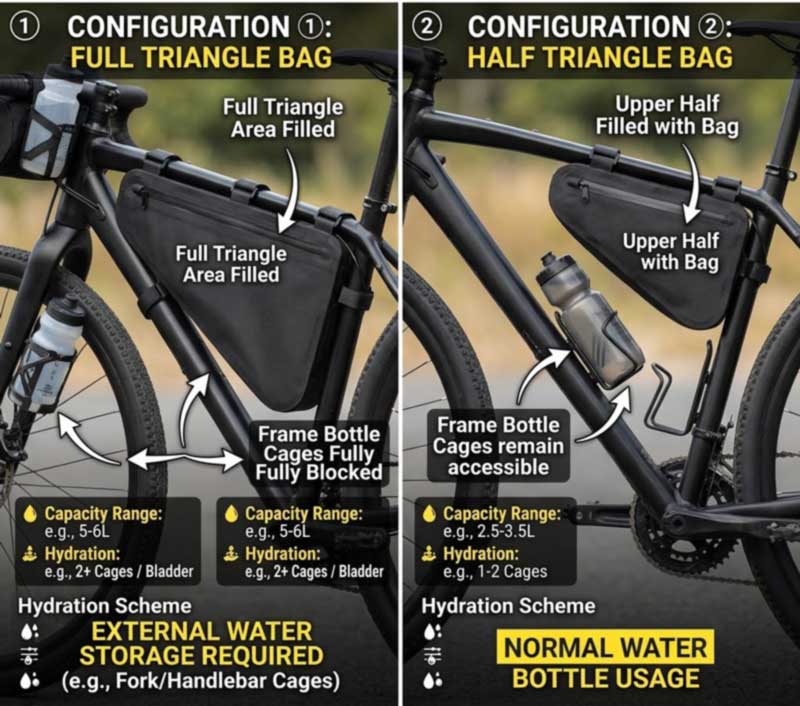
| Fills | The entire main triangle | The upper portion of the triangle |
| Typical capacity | Roughly 6–12L depending on frame size | Roughly 3–6L |
| Bottles inside the frame | None — the cage mounts are covered | Room for at least one cage on the seat tube |
| Suits | Long remote routes and wet regions where water is easy to resupply | Most bikepacking, and any route where water access drives the packing plan |
| Fits frame sizes | One pattern per frame model per size | Tolerates more geometry variation across sizes |
For a brand building a first range, the half frame is the volume SKU. It is the configuration most bikepackers choose, it preserves a bottle, and because it forgives geometry variation it covers more frames from fewer patterns. The full frame belongs in the range as the expedition option rather than the default.
3. The Bottle Problem Is a Product Design Problem
A full frame bag blocks the bottle cage mounts inside the triangle, so the brand has to answer where the water goes — leaving it to the customer produces a product that reviews badly. The established answers, and what each asks of the product:
- A hydration bladder inside the bag. The logical solution for trail and mountain use, and it requires a hydration port at the top front of the bag so a hose can run up and clip to the bar. On a medium or large mountain frame there is generally room for a one or two litre bladder alongside tools and small items.
- Fork and downtube cargo cages. Moves bottles outside the triangle entirely, which suits desert and remote routes where several litres must be carried.
- Stem or handlebar bottle holders. Keeps a bottle within reach without stopping.
- Half frame instead. The simplest answer, and the reason it outsells full frame.
One detail worth engineering rather than assuming: riders are wary of putting a bladder in the same compartment as gear they need to stay dry. A separate, sealed bladder sleeve — or at minimum a divider isolating the wet side — turns a hesitation into a selling point.
4. Route Conditions Should Drive the Recommendation
A useful framing for a brand's product copy and for dealer staff, because it turns a spec comparison into advice a customer can act on:
- Water sources far apart, hot conditions — half frame plus fork cages. Easy hydration access matters more than extra frame storage.
- Wet region, water everywhere, rain likely — full frame works well, because carrying capacity is never the constraint and the storage goes to rain gear instead.
- Weekend overnighter on a known route — half frame is ample; expedition capacity is not needed for one night out.
- Multi-week remote touring — full frame plus fork cages plus a bladder, where both capacity and water options are needed.
5. Full-Suspension Frames Are a Separate Product, Not a Size
This is worth calling out because brands routinely underestimate it. On a typical full-suspension bike with a horizontal shock, the usable triangle space is often barely enough for a standard water bottle — the shock, linkage, and dropped top tube consume most of it. A full-suspension frame bag is therefore not a smaller version of a hardtail bag; it is a differently shaped product, usually made to order per frame model, with relief cut around the shock and mounting that works with limited strap real estate.
For an OEM range this means treating full-suspension as its own development stream with its own patterns, or deliberately scoping the range to hardtail, gravel, and road frames where triangles are consistent enough to serve from graded patterns. Either decision is defensible; leaving it undecided is what produces a bag that does not fit the customer's bike.
6. Mounting That Does Not Fight the Rest of the Bike
Frame bags compete for space with everything else on the frame, so the mounting system determines whether a customer can run the brand's full range at once:
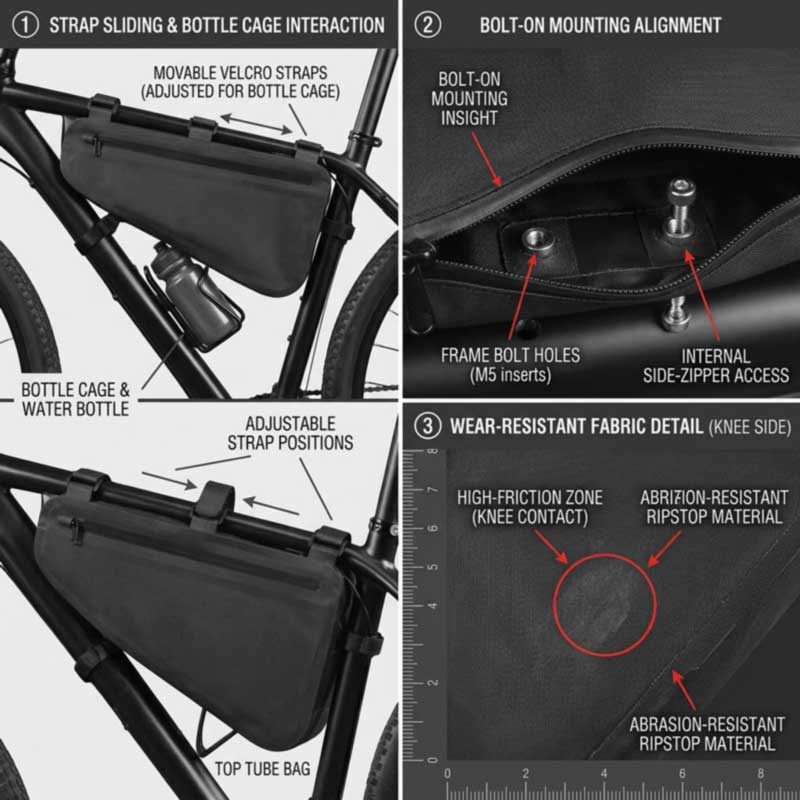
- Repositionable hook-and-loop straps with daisy chain webbing let the anchor points slide along the top and down tubes, so the bag does not clash with a top tube bag or the bottle mounts. This is the single most useful feature for universal fitment — the 0.8L top tube platform uses three repositionable straps, two on the top tube and one on the head tube, and any can be removed or moved.
- Bolt-on mounting where the frame has accessory bosses. It keeps straps clear of under-cage mounts entirely and produces a cleaner, rattle-free result — the right specification for a bike brand developing accessories for its own frames, because it controls where those bosses sit.
- Strap count and placement distributed so tension is spread rather than concentrated at one point on an unsupported panel.
7. Frame Bags Take More Abrasion Than Any Other Bike Bag
A saddle pack meets air. A frame bag meets the frame on one side, the rider's knees on the other, and a shoe or crank on the corners — continuously, every pedal stroke, for the life of the bag. That makes scratch and abrasion resistance the leading material requirement in this position rather than a secondary one.
The range reflects that: the compact top tube platform is built in 800D TPU specifically for scratch resistance, while the custom-cut frame bag platform runs 600D TPU across a wider size range. Both are welded for a sealed body with sewn strap systems and reinforcement, and both are rated for rain and road spray rather than immersion — a small frame bag that sits inches above a wet tire needs to shed water, not survive being sunk, and stating that accurately in product copy is what keeps returns down. Material trade-offs are covered in the TPU material guide.
8. Building the Range Around the Frame Bag
A bikepacking brand launching a system should anchor it on frame storage and build outward, because the frame bag is what a customer buys first and it determines what the other positions must carry. A workable first range: a half frame bag as the volume SKU, a compact top tube bag for no-stop access, a saddle pack for compressible bulk, and a handlebar bag for light bulky items — four positions that complement rather than compete. The load-placement logic behind that split is set out in the guide for cycling brands, and the pattern development process in the guide to OEM bike bags with custom design.
9. Frame and System Range
Models organized by type rather than priority:
| Image | Model / type | Capacity | Material | Mounting / features | Product Page |
|---|---|---|---|---|---|
|
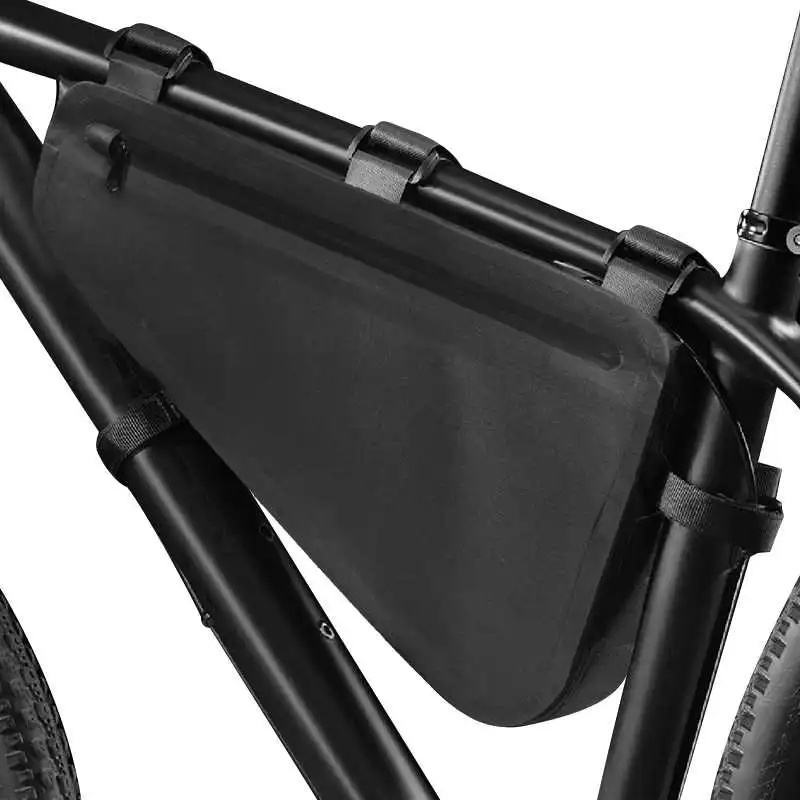
SL-K089-A Frame Bag | Cut to specification | 600D TPU | Sizes to buyer spec · black, grey, army green, brown · line capacity to 50,000 pcs/month | View |
|
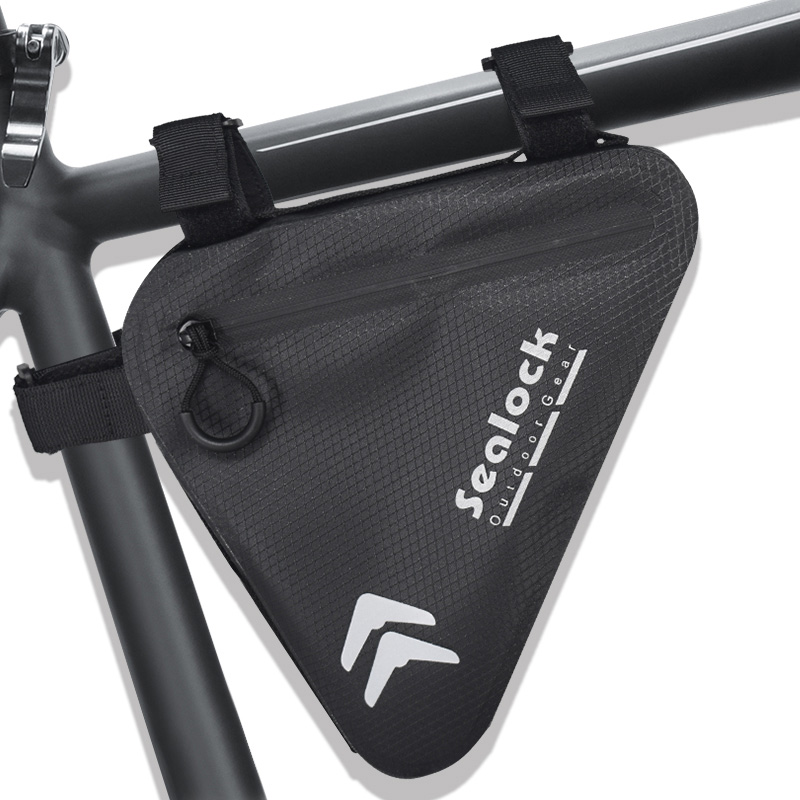
Top Tube Frame Bag | 0.8L · 80 g | 800D TPU | Three repositionable straps · waterproof zip · scratch-resistant · rain and spray rated | View |
|
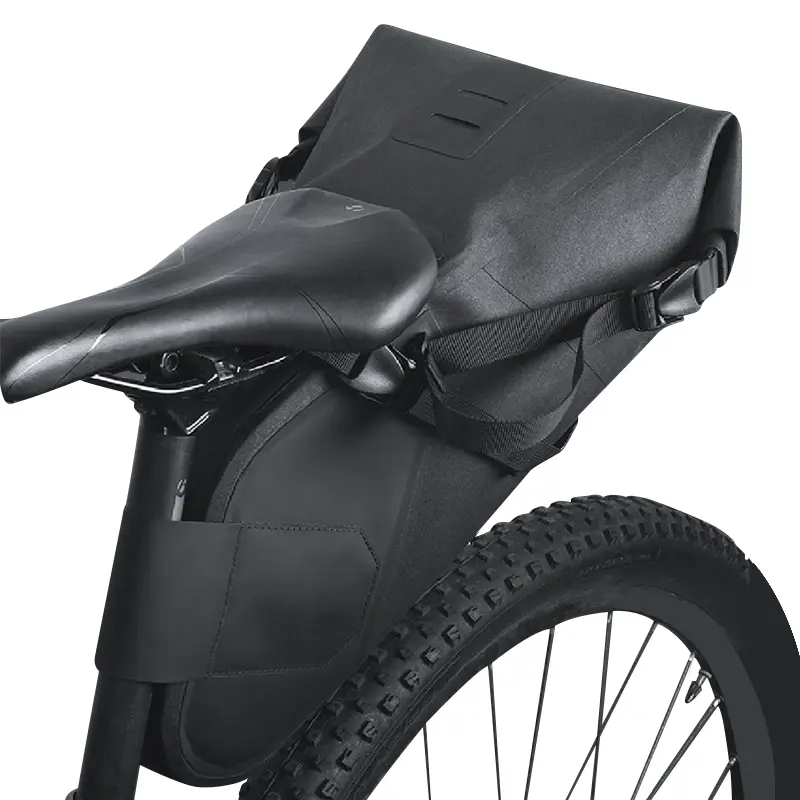
SL-K022 Saddle Bag | 10–14L | 420D TPU + 600D TPU reinforcement | Seat rails + seatpost · roll-top · IPX6–7 · UTX/Duraflex buckles | View |
|
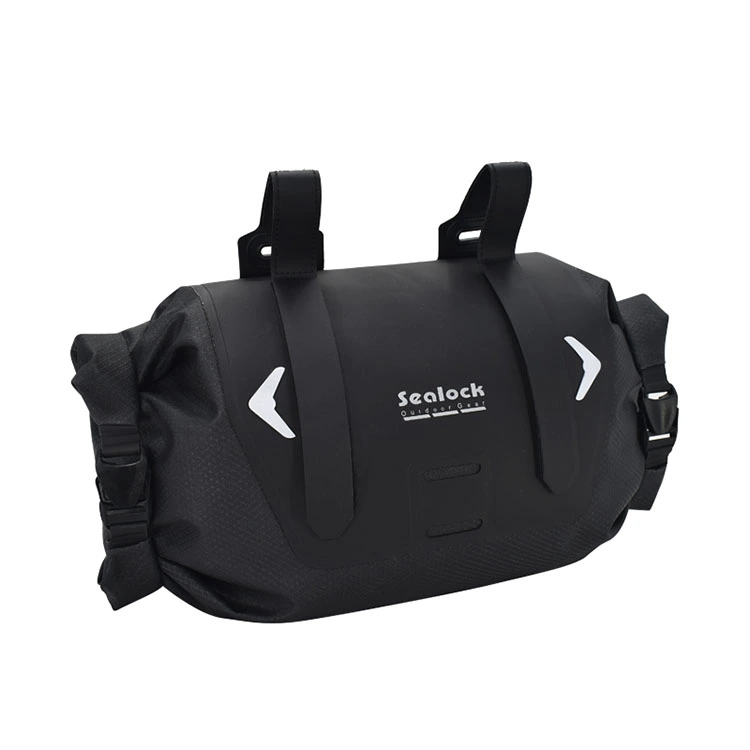
SL-K060B Handlebar Bag | 7L | TPU | Cockpit mount for mountain and road · black, grey | View |

|
SL-K088-A Seat Bag | 20 × 9.5 × 5 cm | 600D TPU | Under-saddle carry for tube, tools and keys | View |
|
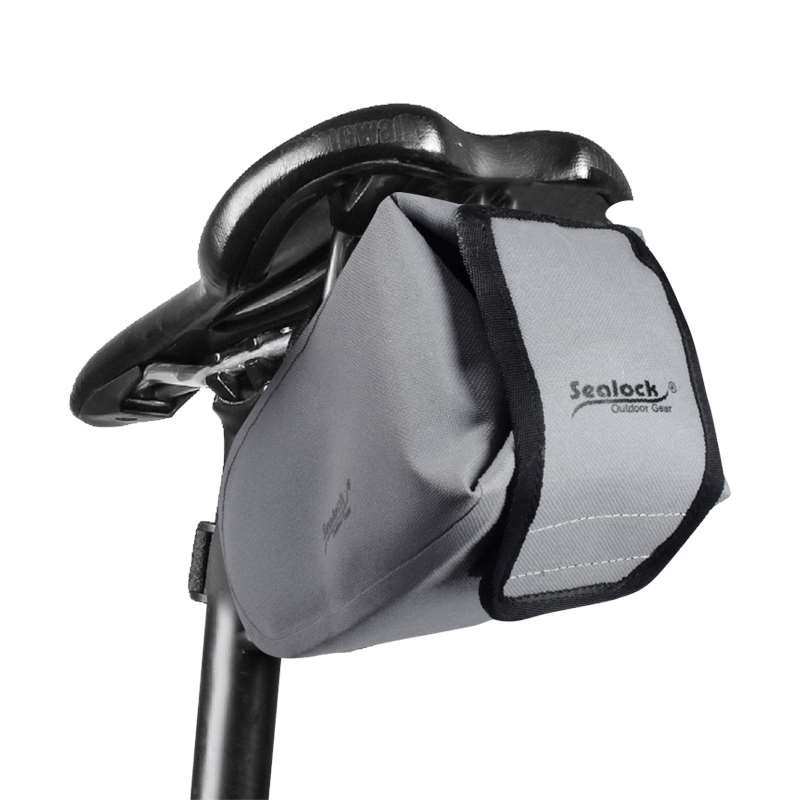
K055 Under-Seat Bag | 22.5 × 10.5 × 7 cm | 600D TPU | Under-saddle carry · BSCI / ISO | View |
Full categories sit under waterproof bags, dry backpacks, and dry bags. Branding scope is covered in the guide to custom dry bags.
10. OEM Scope
Beyond logo and colour, a frame bag programme can specify full or half frame architecture, capacity and shape cut to named frame models and sizes, hydration port and bladder sleeve, internal dividers and document pocket, mounting method from repositionable straps to bolt-on, strap count and placement, cable ports, fabric and denier, spine and side panel width, closure type and zipper gauge, frame-contact protection, reflective detailing, and packaging. Ground-up development from a sketch, sample, or target spec is supported; welded components need their own machined dies, quoted separately and built before sampling.
11. Quality Control
Every batch runs IQC on incoming fabric, zippers, buckles, and webbing; IPQC on welds, stitch density and tension, and mounting-point construction in process, including peel tests on sample welds at run start; and OQC with AQL sampling, dimensional checks against the approved pattern, and signed gold-sample comparison. Dimensional control carries more weight here than in most categories, because a frame bag a few millimetres out of pattern no longer fits the frame it was cut for. Load cycling over 1,500 cycles targets straps and anchors, alongside tensile and bonding strength, friction resistance for the panels that contact frame and knees, colour fastness, and colour difference. Testing is matched to the stated rating — rain and spray testing for the small frame and top tube bags rather than immersion protocols intended for submersible products. Standards are set out in the quality control standards for waterproof production.
12. FAQ
Q: Should our first frame bag be full or half?
A: Half, in almost every case. It is the configuration most bikepackers choose, it leaves room for a bottle on the seat tube, and it tolerates far more frame geometry variation so it covers more bikes from fewer patterns. Add full frame as the expedition option once the line is established.
Q: If we make a full frame bag, where does the water go?
A: Answer it in the product rather than the manual. Specify a hydration port at the top front so a bladder inside the bag can run a hose to the bar, and design the range so fork or downtube cargo cages and stem bottle holders are available alongside. On medium and large mountain frames there is usually room for a one to two litre bladder plus tools.
Q: Riders say they don't trust a bladder next to their dry kit. Is that solvable?
A: Yes, and it is worth solving. A separate sealed bladder sleeve, or at minimum a divider isolating the wet side from the gear compartment, converts a common objection into a feature.
Q: Can one frame bag cover full-suspension bikes too?
A: No. On a typical full-suspension frame with a horizontal shock, the usable triangle is often barely enough for a single water bottle, so the bag needs a different shape with relief around the shock and limited strap positions. Treat it as its own development stream or scope the range to hardtail, gravel, and road frames deliberately.
Q: How do we stop the frame bag clashing with bottle cages and a top tube bag?
A: Repositionable hook-and-loop straps on daisy chain webbing, so anchor points slide along the tubes to clear whatever else is fitted. Where the frame has accessory bosses, bolt-on mounting removes the conflict entirely and looks cleaner.
Q: Why specify a heavier fabric for a small frame bag?
A: Because it takes more abrasion than any other bag on the bike — frame on one side, knees on the other, shoes and cranks at the corners, every pedal stroke. The compact top tube platform uses 800D TPU for scratch resistance specifically, and the panels contacting frame and knees are the ones to specify heaviest.
Request a Frame Bag Proposal
For full or half frame development, hydration integration, template guidance, samples, or a full OEM proposal, submit an inquiry. Sealock responds to procurement enquiries within 24 hours, with production from Dongguan, China or Ho Chi Minh City, Vietnam.