
- English
- Español
- Português
- русский
- Français
- 日本語
- Deutsch
- tiếng Việt
- Italiano
- Nederlands
- ภาษาไทย
- Polski
- 한국어
- Svenska
- magyar
- Malay
- বাংলা ভাষার
- Dansk
- Suomi
- हिन्दी
- Pilipino
- Türkçe
- Gaeilge
- العربية
- Indonesia
- Norsk
- تمل
- český
- ελληνικά
- український
- Javanese
- فارسی
- தமிழ்
- తెలుగు
- नेपाली
- Burmese
- български
- ລາວ
- Latine
- Қазақша
- Euskal
- Azərbaycan
- Slovenský jazyk
- Македонски
- Lietuvos
- Eesti Keel
- Română
- Slovenski
- मराठी
- Srpski језик

Can a Duffel Bag Be a Carry-On? Airline Size Limits, the Soft-Bag Advantage and Which Duffels Actually Fit
Yes, a duffel bag can be a carry-on, as long as it fits the airline's cabin bag dimensions and weight limit when it is packed. The major US airlines, United, Delta and American, allow carry-on bags up to 22 × 14 × 9 inches (56 × 36 × 23 cm), and most European and Middle Eastern airlines allow around 55 × 40 × 20 to 23 cm, often with a weight limit of 7 to 10 kg. A duffel of about 30 to 40 litres usually fits, and a 20 litre duffel often qualifies as a personal item that goes under the seat. This guide explains how airlines measure soft bags, why the depth of a duffel is where most people get caught, and which of the waterproof duffels we manufacture fit which limit.
Duffels are popular for cabin travel for good reason. They are light, they have no wheels or rigid frame eating into the allowance, and a soft bag can be squeezed into an overhead bin or a sizer that a hard case would never fit. The same softness is also the trap. A duffel that measures 55 cm long empty can bulge to 30 cm deep when it is stuffed, and at the gate it is the packed size that counts.
What Are the Carry-On Size Limits for Duffel Bags?
Airlines do not have separate rules for duffels. A duffel is measured like any other cabin bag, including handles, straps, pockets and anything attached to it. The figures below are the published limits at the time of writing. They change, and basic economy fares often allow only a personal item, so always check the airline's own page before you fly.
| Airline | Carry-on size | Weight limit | Personal item |
|---|---|---|---|
| United | 22 × 14 × 9 in (56 × 35 × 22 cm) | None published | 17 × 10 × 9 in |
| Delta | 22 × 14 × 9 in | None published | Must fit under the seat |
| American | 22 × 14 × 9 in | None published | 18 × 14 × 8 in |
| Southwest | 24 × 16 × 10 in | None published | 16.25 × 13.5 × 8 in |
| Air Canada | 55 × 40 × 23 cm | None published | 43 × 33 × 16 cm |
| British Airways | 56 × 45 × 25 cm | Must lift it into the bin yourself | 40 × 30 × 15 cm |
| Lufthansa | 55 × 40 × 23 cm | 8 kg | 40 × 30 × 15 cm |
| Emirates (economy) | 55 × 38 × 22 cm | 7 kg | No separate economy allowance |
| Ryanair | 55 × 40 × 20 cm with Priority | 10 kg | 40 × 30 × 20 cm, free |
| easyJet | 56 × 45 × 25 cm, paid or fare-based | 15 kg | 45 × 36 × 20 cm, free |
Why Is a Duffel Easier to Carry On, and Where Does It Go Wrong?
A wheeled carry-on case wastes a surprising amount of its allowance on wheels, a telescopic handle and a rigid shell. A duffel uses almost all of its outside dimensions for packing, so a 22 × 14 × 9 inch duffel holds noticeably more than a 22 × 14 × 9 inch suitcase, and it weighs a fraction as much, which matters on airlines with a 7 or 8 kg limit. Being soft, it can also be pressed into a sizer or a full overhead bin.
The problem is depth. Length and width are fixed by the cut of the fabric, but a duffel's depth is whatever its contents make it. A bag that is 23 cm deep when packed sensibly can reach 30 cm when overstuffed, and the zipper then has to hold the load as well. Rather than buying by litres, check the length and width against the airline limit and then pack to the depth. A roll-top duffel is the easiest to control, because the top can be rolled down to the actual load, and our 40 litre SL-K099 can be rolled to carry-on height for a weekend and used at full size as a checked bag for a longer trip.
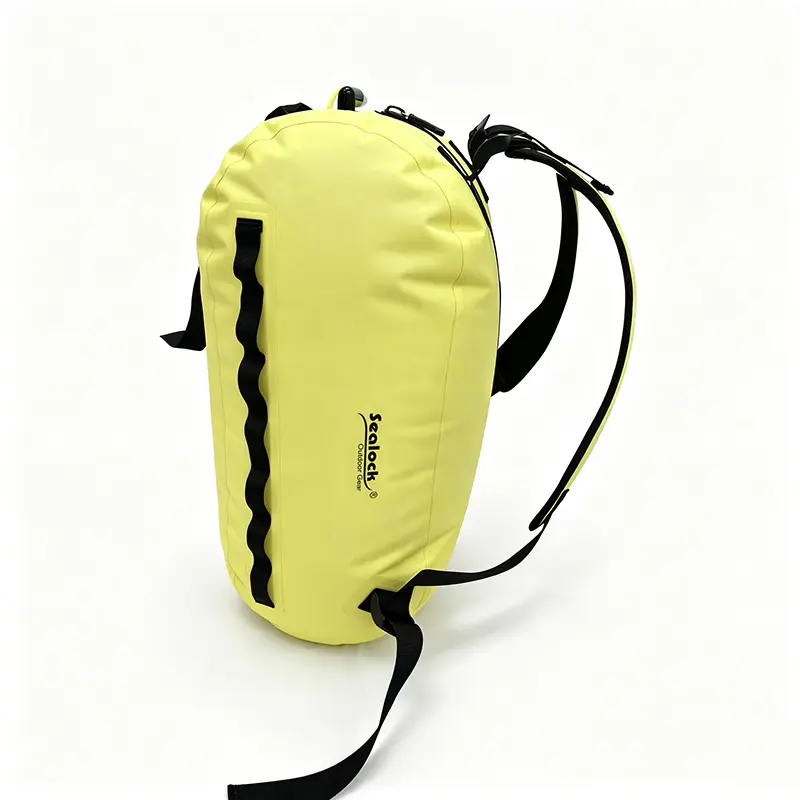
Shape and straps matter too. A duffel with end handles and a removable shoulder strap is easy to slide into the bin with the strap tucked away. A duffel that converts to a backpack frees both hands for a passport and a coffee, and our 50 litre SL-C610 has detachable padded shoulder straps for exactly that, but the straps count in the measured size when they are attached.
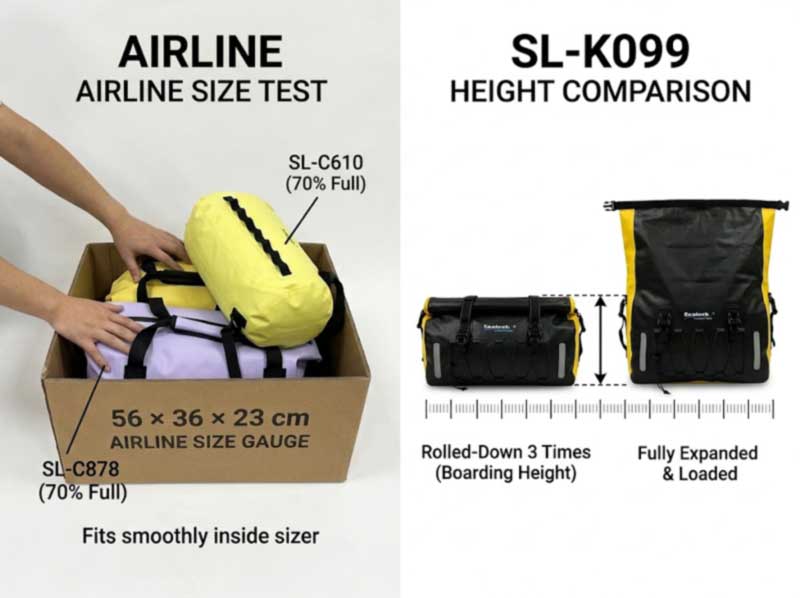
Waterproof Duffels We Make, and Which Limits They Fit
The table below lists five of our waterproof duffels with their measured size. Duffels are measured lying flat, as length × width × height.
| Image | Model | Capacity | Dimensions (L × W × H) | Weight | Construction | Use |
|---|---|---|---|---|---|---|
|
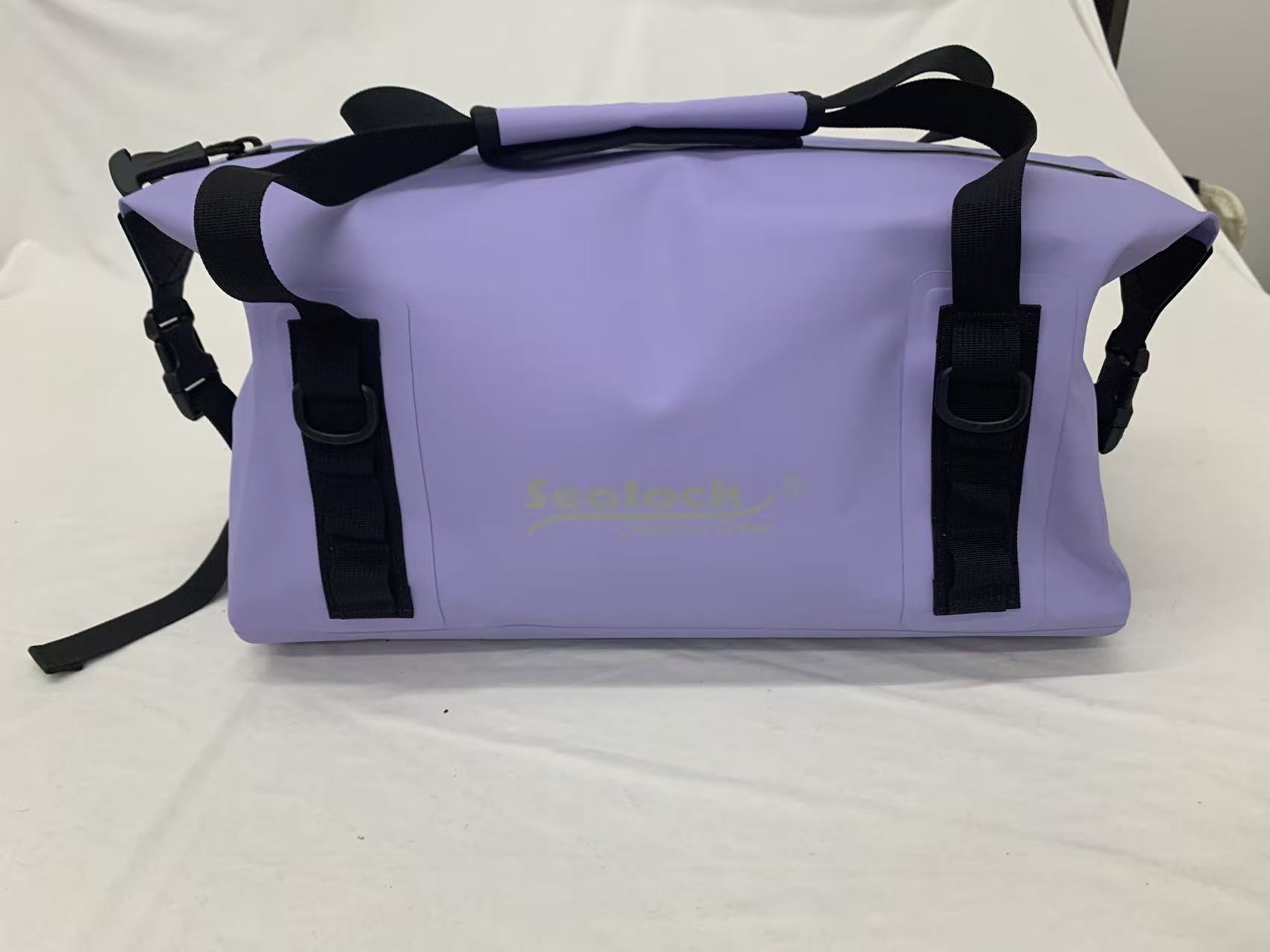
SL-C878 | 20 L |
41.5 × 25 × 19 cm 16.3 × 9.8 × 7.5 in |
0.75 kg | Welded 840D TPU, airtight zipper, IPX7 | Fits most US personal-item limits and every major carry-on limit |

|
SL-K099 | 40 L |
55 × 30 × 30 cm 21.7 × 11.8 × 11.8 in |
1.1 kg | Welded 840D TPU, roll-top, IPX7 | Carry-on when rolled down to about 23 cm high; full, it is a checked bag |
|
SL-C610 | 50 L |
53 × 34 × 29 cm 20.9 × 13.4 × 11.4 in |
0.8 kg | Welded TPU-coated polyester, airtight zipper, valve, IPX7, floats | Length and width fit 22 × 14 in; pack it below full to fit the depth |
|
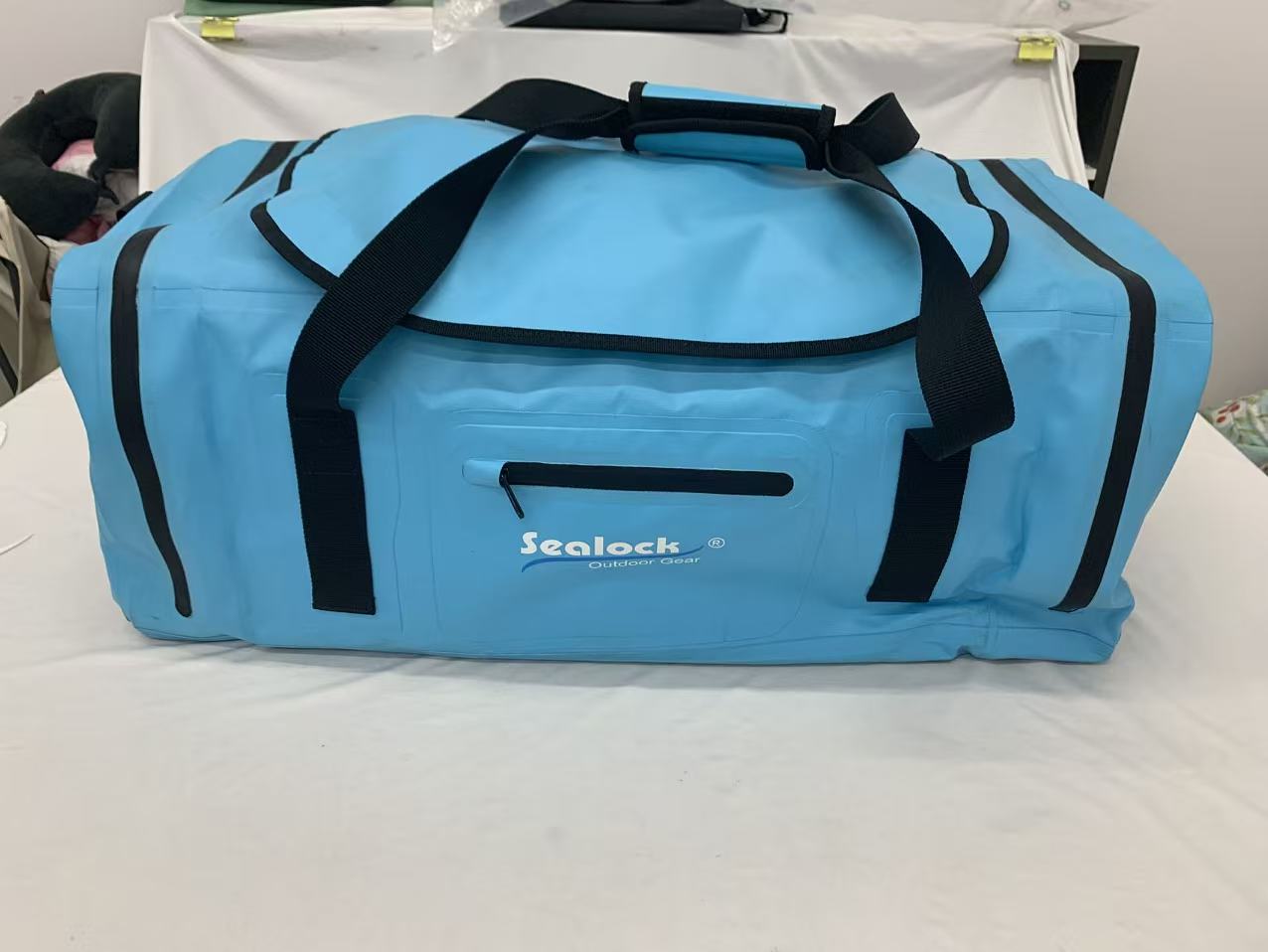
SL-C594 | 55 L |
63.5 × 36 × 25 cm 25 × 14.2 × 9.8 in |
1.2 kg | Welded 500D PVC, three airtight zippers, IPX7 | Checked bag |
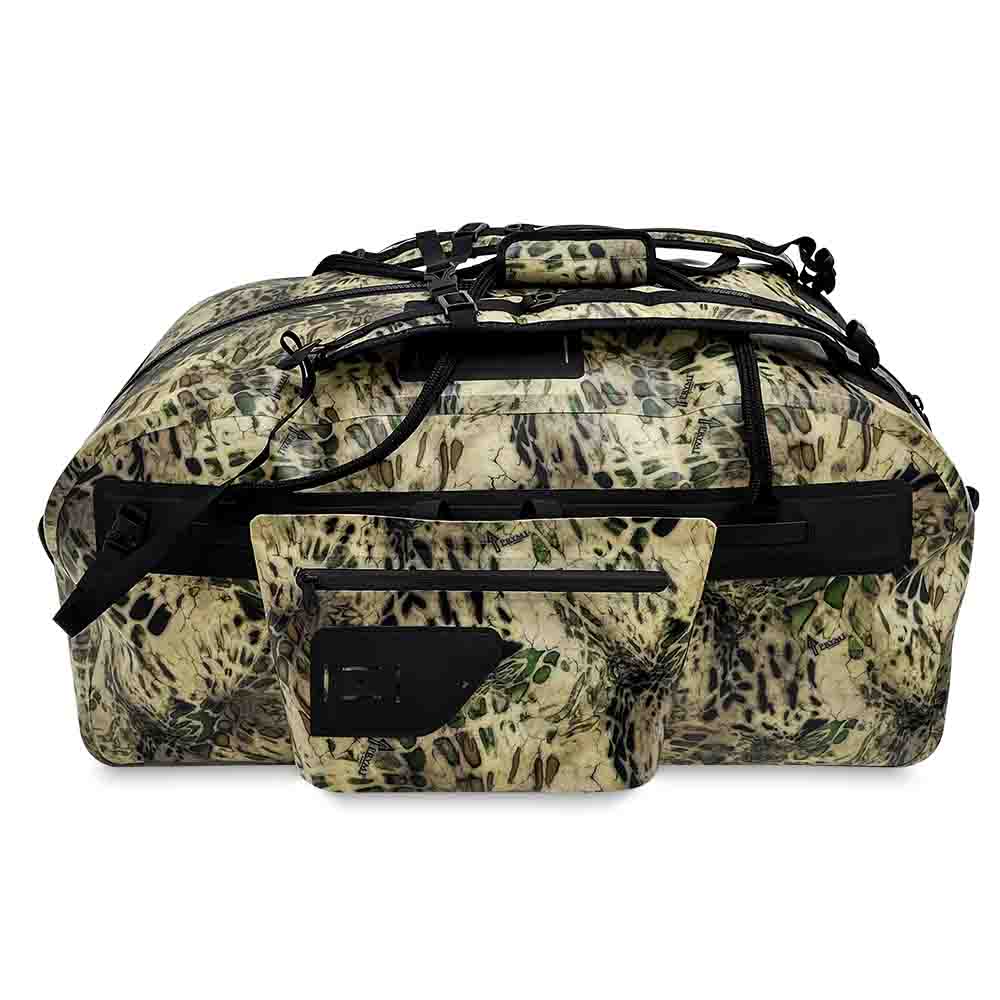
|
SL-C893 | 70 L |
70 × 36 × 33 cm 27.6 × 14.2 × 13 in |
2.0 kg | Welded printed TPU, heavy-duty waterproof zipper, IPX6 | Checked bag for hunting and expedition trips |
Waterproofing is not needed in the cabin, but it matters at either end of the flight: on a wet tarmac, in a boat transfer, on the roof of a jeep or on a ferry deck. That is why travellers heading to islands, rivers and wet climates often choose a welded duffel over a coated nylon one. The ratings are explained in our guide to waterproof ratings for bags.
How Do You Pack a Duffel to Pass the Carry-On Check?
Lay heavy and rigid items flat along the bottom, roll soft clothes and fill the ends, and keep the depth even rather than bulging in the middle. Put liquids, the laptop and anything you will need at security in an outer pocket or on top, so you do not have to unpack at the scanner. Weigh the bag at home if your airline has a weight limit. Clip or remove the shoulder strap before you reach the gate, and if the bag has external pockets, keep them nearly empty, because they add to the depth.
If you regularly fly budget airlines that charge for cabin bags, a 20 litre duffel that fits the free personal-item size is often the most useful bag you can own. Our SL-C878, at 41.5 × 25 × 19 cm, sits within United's and American's personal-item dimensions as well as every standard carry-on limit, but check stricter airlines such as Ryanair, whose free under-seat allowance is 40 × 30 × 20 cm.
What Brands Should Consider When Designing a Carry-On Duffel
For travel brands, the most useful thing a duffel can say on its label is the airline limit it is designed to meet. Design to the packed size, not the empty one: set the length and width a little under the target limit, and give the bag compression straps or a roll-top so the depth can be controlled. Decide whether the bag is a carry-on or a personal item, because that fixes the size more than capacity does. Keep the weight down, since many airlines outside North America have a 7 or 8 kg cabin limit, and a heavy bag leaves little room for contents. And make straps removable or stowable, because they count in the measurement.
We build duffels from 20 to 70 litres in welded TPU and PVC, with roll-top, waterproof zipper and airtight zipper closures, and in sewn constructions for lighter travel bags. The MOQ is 300 pieces per design, samples take 7 to 15 days and bulk production 30 to 45 days, with prices quoted FOB Guangdong and Vietnam origin available. Sealock has over 20 years of experience making waterproof bags for travel and outdoor brands. See the full range in our waterproof duffel bag category, and for road trips by bike, read our guide to the motorcycle duffel bag. If you are choosing between a duffel and a backpack for cabin travel, our article on standard backpack sizes gives the equivalent figures for packs.
Frequently Asked Questions
Can a 40L duffel bag be a carry-on?
Often, if its length and width are within the airline's limit and it is not packed so full that it exceeds the depth. Many 40 litre duffels are around 55 cm long. A roll-top 40 litre bag is easier because it can be rolled down.
Is a duffel bag a personal item or a carry-on?
It depends on the size. A small duffel of around 20 litres can fit many personal-item limits and go under the seat. Larger duffels count as the carry-on that goes in the overhead bin.
Do airlines measure soft bags differently?
No. Soft bags are measured the same way, including handles and pockets. The advantage is that a soft bag can be squeezed into a sizer, provided it is not overpacked.
Do straps and handles count in the measurement?
Yes. Attached shoulder straps, backpack straps and bulging pockets all count. Unclip or stow them before you reach the gate.
What is the best size duffel for carry-on?
About 30 to 40 litres, with a length of no more than 55 cm, suits most airlines. For a personal item, look for around 20 litres and no more than 40 cm long.
Can I bring a waterproof dry bag as a carry-on?
Yes, a dry bag or roll-top duffel is treated like any other soft bag. Roll it down to keep within the size limit.
Request a Quote
Tell us the airline size you want to design to, the capacity, the closure and the quantity, and we will reply within 24 hours with suitable base models, an FOB price and a sample timeline. Contact Sealock, or email info@sealock.com.hk.