
- English
- Español
- Português
- русский
- Français
- 日本語
- Deutsch
- tiếng Việt
- Italiano
- Nederlands
- ภาษาไทย
- Polski
- 한국어
- Svenska
- magyar
- Malay
- বাংলা ভাষার
- Dansk
- Suomi
- हिन्दी
- Pilipino
- Türkçe
- Gaeilge
- العربية
- Indonesia
- Norsk
- تمل
- český
- ελληνικά
- український
- Javanese
- فارسی
- தமிழ்
- తెలుగు
- नेपाली
- Burmese
- български
- ລາວ
- Latine
- Қазақша
- Euskal
- Azərbaycan
- Slovenský jazyk
- Македонски
- Lietuvos
- Eesti Keel
- Română
- Slovenski
- मराठी
- Srpski језик

Is the iPhone Waterproof? What IP68 Really Covers, What Apple Tells You to Avoid, and When a Pouch Still Makes Sense
No iPhone is waterproof. Every iPhone from the iPhone 7 onwards is water-resistant, and every model from the iPhone 12 through the iPhone 17 series is rated IP68 to a depth of 6 metres for up to 30 minutes under laboratory conditions. Apple itself advises against swimming, bathing, showering or water sports with an iPhone, says that water resistance decreases with normal wear, and does not cover liquid damage under its warranty. This guide explains what the rating actually means, which models carry which rating, what to do if an iPhone gets wet, and when a waterproof phone pouch is the sensible extra layer.
The question gets searched thousands of times a month, usually by someone standing at the edge of a pool or planning a boat trip. The honest answer matters, because the gap between "rated to 6 metres" and "safe to swim with" is exactly where phones die.
What Water Resistance Rating Does Each iPhone Have?
Apple publishes the ratings for every model from the iPhone 7 onwards. The figures come from tests under IEC 60529, the standard used for IP ratings on electrical enclosures.
| iPhone models | Rating | Tested depth and time |
|---|---|---|
| iPhone 12, 13, 14, 15, 16 and 17 series, including 16e, 17e and iPhone Air | IP68 | Up to 6 m for 30 minutes |
| iPhone 11 Pro and 11 Pro Max | IP68 | Up to 4 m for 30 minutes |
| iPhone 11, XS and XS Max | IP68 | Up to 2 m for 30 minutes |
| iPhone 7, 7 Plus, 8, 8 Plus, X, XR and SE (2nd and 3rd generation) | IP67 | Up to 1 m for 30 minutes |
So the iPhone 14, 15, 16 and 17 Pro Max all carry the same rating, and an older model such as an iPhone XR is rated to only one metre. The first digit, 6, means the phone is dust-tight. The second digit describes water. A 7 means temporary immersion to one metre, and an 8 means immersion beyond one metre under conditions the manufacturer states, which for current iPhones is six metres for half an hour.
Why Is an IP68 iPhone Still Not Safe to Swim With?
The rating is earned in a laboratory: fresh, still water at a controlled temperature, with a brand new phone, held at a set depth and then removed. Real life is different in almost every way that matters.
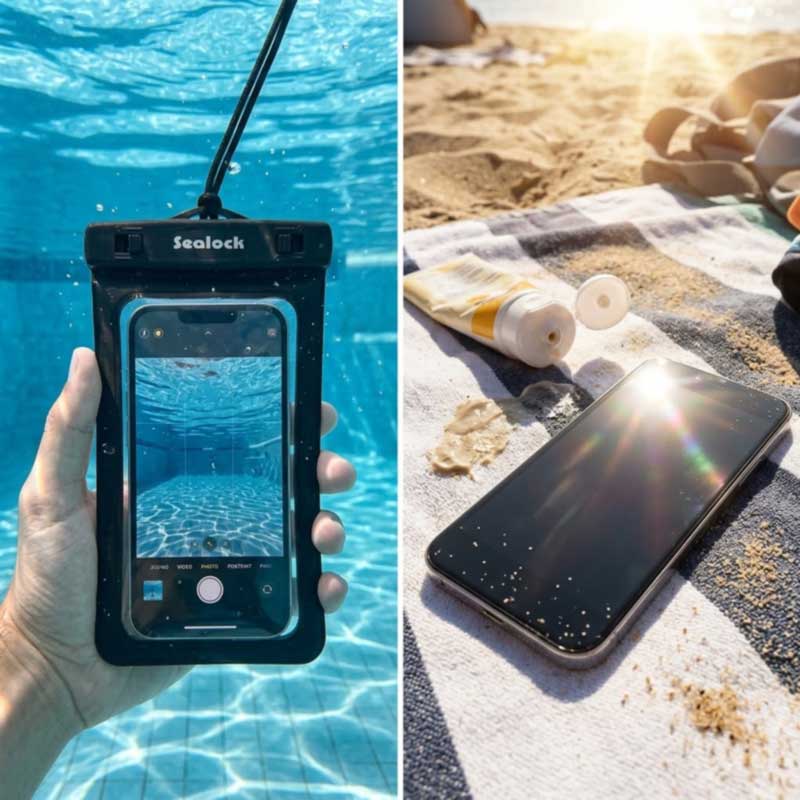
Moving water is the first difference. A swimming stroke, a wave, a jet ski wake or a dive into a pool hits the phone with pressure far above what the still-water test creates. Apple specifically lists showering, water sports and "pressurized or fast-moving water" as things to avoid. Salt and chlorine are the second. They attack the seals and the mesh in the speaker and microphone openings, and Apple advises rinsing the phone after contact with anything other than fresh water. Heat is the third: saunas, steam rooms, hot springs and even a phone left in the sun on a beach towel soften the adhesive seals. Soap, sunscreen, lotion and alcohol are the fourth, because they lower the surface tension of water so it slips through gaps that plain water cannot.
The last factor is age. Apple states that "splash, water, and dust resistance are not permanent conditions and resistance might decrease as a result of normal wear". A phone that has been dropped, had its screen or battery replaced, or simply been carried in a pocket for two years has seals that are no longer what they were when it left the factory. And because liquid damage is not covered by the standard warranty, the owner carries the risk if it fails.
What Should You Do If Your iPhone Gets Wet?
Apple's own advice is short and worth following exactly. Wipe the phone with a soft, lint-free cloth. Tap it gently against your hand with the charging port facing down to shake out water. Leave it in a dry place with some airflow; a fan blowing cool air into the port helps. Do not use a hair dryer or any other heat, and do not push cotton buds or paper into the port. Unplug all cables and wait at least five hours before charging with a cable. If the phone warns that liquid has been detected in the port, wait until the warning clears. Make sure the phone is dry before opening the SIM tray. A muffled speaker usually clears as the water evaporates; laying the phone speaker-side down on a cloth helps it drain.
The rice trick is not recommended. Apple advises against it, because it does not dry the inside of the phone any faster than air and can leave starch and dust in the ports.
When Does a Waterproof Phone Pouch Make Sense?
For an accidental splash or a drop in the sink, an IP68 iPhone is fine on its own. For any activity where the phone will be in or around water on purpose, a pouch is the cheap insurance that makes the rating irrelevant. That covers swimming and snorkelling, kayaking and paddleboarding, boat and jet ski trips, beach days with sand and salt, water parks, and taking photos underwater. It also covers older phones, phones with a replaced screen or battery, and any phone you cannot afford to lose on a trip.
A good pouch does three things. It keeps water out completely, which means a proper locking closure rather than a simple zip-top, and an IPX8 rating with a stated depth. It lets you use the phone, with a clear front window that works with the touchscreen and Face ID. And it floats or attaches to you, through a lanyard or a clip, because the most common way to lose a phone on the water is not a leak but a drop. A pouch with a rear camera window lets you take photos and video without taking the phone out.
Waterproof Phone Pouches We Manufacture
All three pouches below are tested by inflating them, sealing them and holding them under water to check for any bubbles before they are packed. Check the phone fit: Pro Max and Plus models need a pouch rated for up to 6.9 or 7.0 inches, ideally with the phone's case removed.
| Image | Model | Capacity | Dimensions (H × W) | Weight | Construction | Use |
|---|---|---|---|---|---|---|
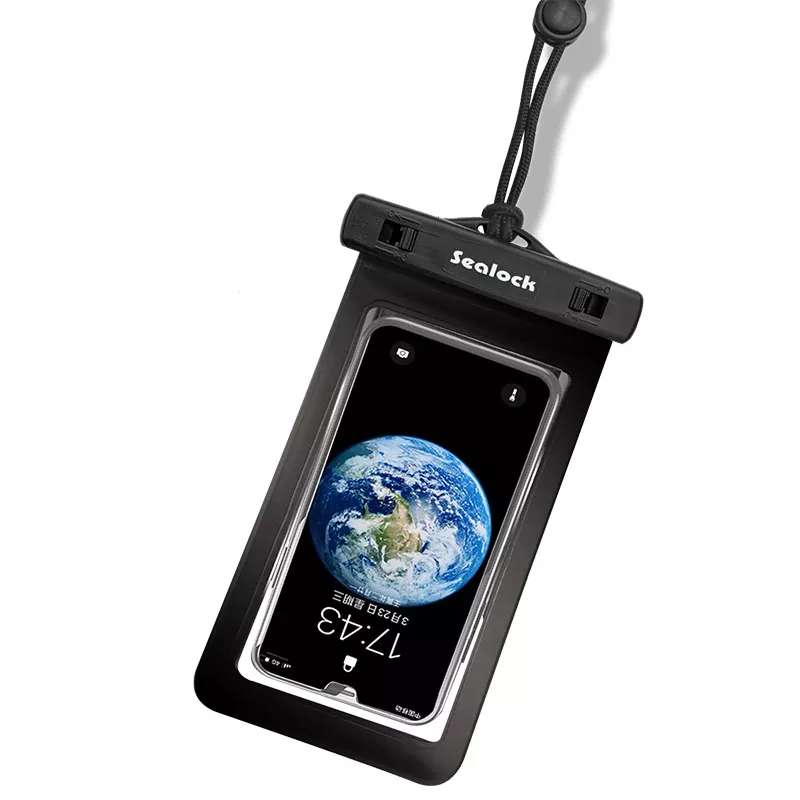
|
SL-A064 | Phones up to 7.0 in (fits 6.9 in Pro Max models) |
22 × 11.5 cm 8.7 × 4.5 in |
60–70 g | PVC with ABS double slide lock and silicone seal, front touch window and rear camera window, IPX8 to 30 m | Swimming, snorkelling, photos underwater without removing the phone |
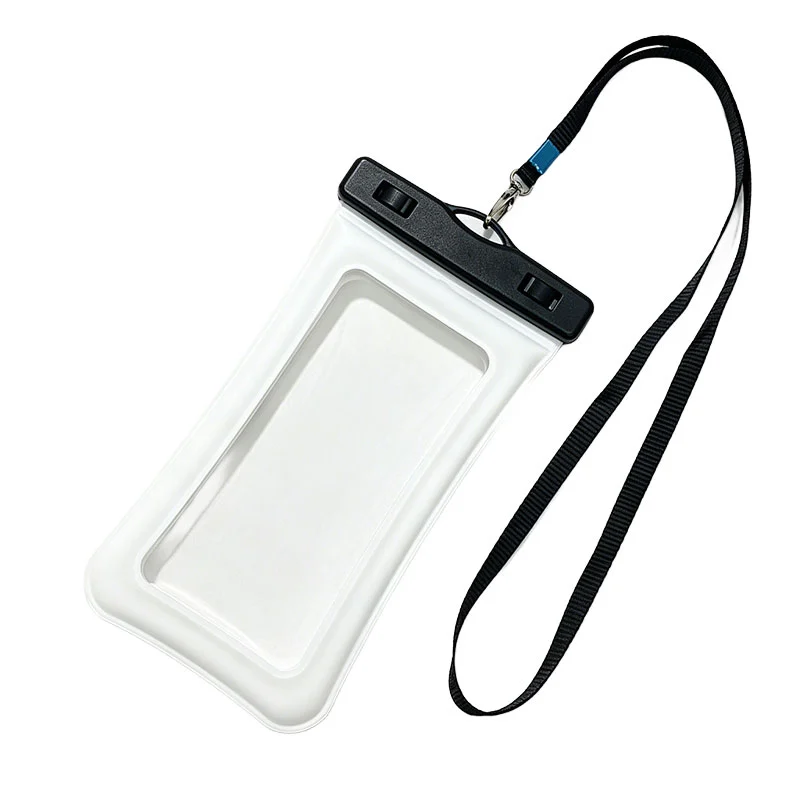
|
SL-A082 / A083 | Phones up to 6.9 in |
Small 19 × 10 cm, large 20.5 × 12 cm 7.5 × 3.9 in and 8.1 × 4.7 in |
55–75 g | PVC with ABS double slide lock and fold seal, touch-sensitive window, IPX8 to 30 m | Kayaking, beach, pool, boat trips; small 19 × 10 cm and large 20.5 × 12 cm |
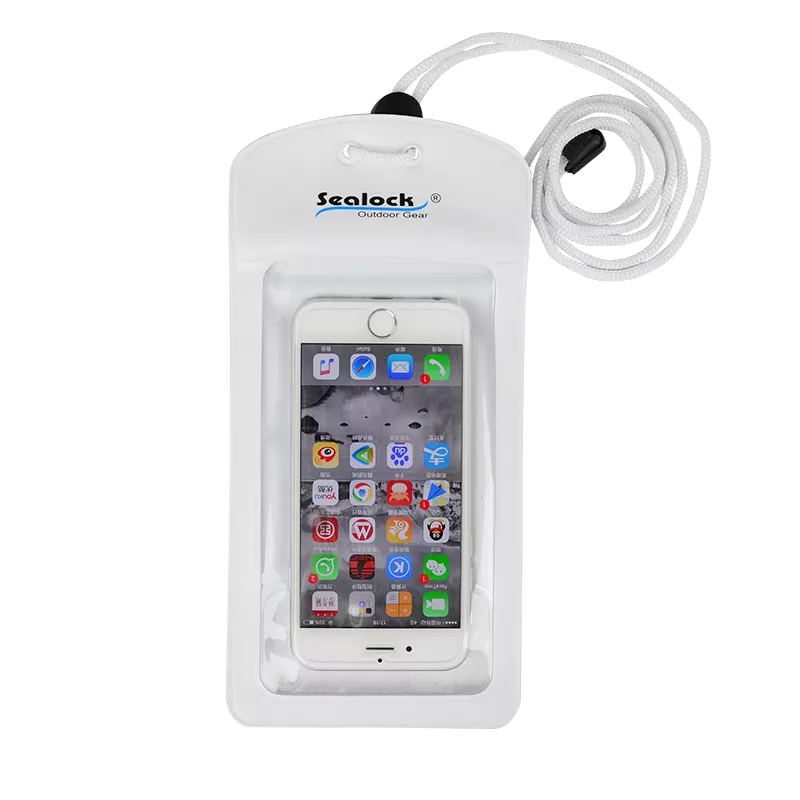
|
SL-A101 | Phones up to 6.5 in |
17.5 × 11 cm 6.9 × 4.3 in |
50–60 g | High-clarity PVC, press seal plus foam-lined flap, rear camera window, IPX8 | Standard-size phones, theme parks, water rides, pool |
The full range is in our waterproof phone pouch category. For wholesale and logo orders, our guide to custom waterproof phone pouches covers printing, MOQ and testing, and rental and tour operators will find fleet specifications in our article on dry bags and phone pouches for kayak rental and tour operators. What the IPX numbers on a pouch mean is explained in waterproof ratings for bags.
For Brands and Retailers
Phone pouches are one of the most popular promotional and resort products we make, because every customer owns a phone and every water trip creates a reason to buy one. Most of the complaints in online reviews come down to three things: the phone did not fit with its case on, the touchscreen did not respond through a thick window, and the closure was hard to seal properly. Stating the maximum phone size clearly, using a thin, high-clarity window and printing a simple three-step sealing instruction on the pouch prevent almost all of them. We print logos by screen or UV printing, with an MOQ of 300 pieces, samples in 7 to 15 days and bulk production in 30 to 45 days, quoted FOB Guangdong with Vietnam origin available. Sealock has over 20 years of experience making waterproof bags and accessories.
Frequently Asked Questions
Is the iPhone 17 Pro Max waterproof?
It is water-resistant, not waterproof. It is rated IP68 to 6 metres for 30 minutes in laboratory tests. Apple advises against swimming or water sports with it, and liquid damage is not covered by the warranty.
Can I take my iPhone in the pool?
An occasional splash or a short drop is unlikely to harm a recent iPhone, but Apple advises against swimming with it, and chlorine can damage the seals over time. Use a waterproof pouch if you want to use the phone in the water.
Can I take my iPhone in the shower?
Apple advises against it. Pressurised water, heat, steam and soap all reduce the effectiveness of the seals.
Does a screen replacement affect water resistance?
It can. Any repair that opens the phone breaks the original seal, and resistance depends on how well it is resealed. Treat a repaired phone as more vulnerable.
Will Face ID and the touchscreen work in a waterproof pouch?
Through a good clear window, yes on dry land. Under water, touchscreens do not respond reliably, so use the volume button as the shutter for photos.
Do waterproof phone pouches float?
Some do with enough trapped air, but many do not with a heavy phone inside. Always use the lanyard or clip, or pair the pouch with a floating strap.
Request a Quote
Tell us the pouch model, the phone sizes you need to fit, the quantity, the colours and your logo, and we will reply within 24 hours with an FOB price and a sample timeline. Contact Sealock, or email info@sealock.com.hk.