
- English
- Español
- Português
- русский
- Français
- 日本語
- Deutsch
- tiếng Việt
- Italiano
- Nederlands
- ภาษาไทย
- Polski
- 한국어
- Svenska
- magyar
- Malay
- বাংলা ভাষার
- Dansk
- Suomi
- हिन्दी
- Pilipino
- Türkçe
- Gaeilge
- العربية
- Indonesia
- Norsk
- تمل
- český
- ελληνικά
- український
- Javanese
- فارسی
- தமிழ்
- తెలుగు
- नेपाली
- Burmese
- български
- ລາວ
- Latine
- Қазақша
- Euskal
- Azərbaycan
- Slovenský jazyk
- Македонски
- Lietuvos
- Eesti Keel
- Română
- Slovenski
- मराठी
- Srpski језик

OEM Waterproof Fishing Bags for Wholesale Buyers
Sealock produces OEM waterproof fishing bags for wholesale buyers, tackle distributors, and private label programmes, with a range spanning a 2.3L waist pack to 120L insulated kill bags. Fishing is unusual among outdoor categories in one commercially useful respect: anglers do not buy one bag. They own a sling for wading, a backpack for hike-in days, and something else again for the boat — which means a well-architected range sells multiple units to the same customer rather than competing with itself.
1. Company and Terms
Sealock (YiFuLong Outdoor Gear Co., Ltd.) has built welded waterproof bags for over 20 years, producing for international outdoor and marine brands including SIMMS, ORVIS, West Marine, and PENN.
- Facilities: Dongguan, China | Ho Chi Minh City, Vietnam — either origin available on any model
- MOQ: 300 pcs on most models; 500 pcs on the 15L and 12L slings and the 20L shoulder bag
- Samples: 7–15 days | Bulk: 30 days for 1–500 pcs on the sling line | Capacity: 15,000 pcs/month
- Certifications: BSCI, ISO 9001, Sedex, plus HIGG, GRS, SCAN | Warranty: one year on most fishing models
- Packing: 1 pc per PP bag, 20 pcs per carton, five-layer export cartons, loading from Shenzhen
2. Format Maps to Fishing Style — Build the Range Accordingly
The single most useful principle for a fishing assortment is that format is not a size preference; it follows how the angler moves. Get this mapping right and each SKU has a distinct buyer:
| Format | Angler | Why this format |
|---|---|---|
| Sling (8–15L) | Wading, bank, jetty, kayak, lure and fly anglers | Rotates to the chest for tackle access without removal — critical when balanced on rocks or standing in current; rides higher than a waist pack so gear stays drier |
| Backpack (15–21L) | Hike-in, multi-species, all-day anglers | Organisation and load carriage; carries several loaded trays plus tools and safety gear |
| Shoulder bag (10–20L) | Boat and shore anglers wanting quick single-strap access | Simple, fast, low-cost entry format |
| Waist / hip (2.3–4.5L) | Minimalist stream and creek anglers | Lightest option; sits lower and is more exposed to water, so waterproofing matters more here, not less |
| Insulated kill bag (30–120L) | Boat and offshore anglers keeping catch | A different buyer entirely, at a higher ticket |
A first range covering a sling, a backpack, and one hip or waist model reaches most of the market; adding a kill bag opens a separate customer.

3. Be Honest About Who Needs Full Waterproofing
Not every angler needs a submersible bag, and pretending otherwise costs a wholesale buyer margin on one side and returns on the other. Independent gear testing makes the point plainly: many anglers are keeping the bag out of the water anyway, and a fully waterproof pack is genuinely worth the investment for those fishing corrosive saltwater or carrying electronics and camera gear on the water. Kayak anglers, waders, and anyone fishing rough water are in that group; a bank angler on a calm summer evening usually is not.
That divide is a two-tier price ladder rather than a problem:
- Premium tier — IPX8 submersible. The 15L and 12L slings are sealed to a 20 m depth on welded 840D double-coated TPU with airtight zippers. This is the specification that protects reels, electronics, and documents through a genuine dunking, and it carries the higher ticket.
- Core tier — IPX7 and water-resistant. The 8L PVC lure sling and the TPU shoulder bags and backpacks cover rain, spray, and brief immersion at accessible price points, which is where volume sits.
4. The Trade-off Wholesale Buyers Should Design Around
Here is the tension experienced testers flag and most suppliers avoid: waterproof bags tend to be limited in organisation features. A fully welded, sealed body cannot be covered in stitched pockets, because every pocket is a potential leak path. Brands that ignore this ship a bag that is dry inside and frustrating to use.
The resolution is structural, and it is worth writing into a specification. Put organisation where it does not compromise the seal: a welded seamless liner with an internal mesh zip pocket keeps small tackle off the bottom of the main compartment, a separately sealed front zip pocket handles phone, licence, and keys, and everything else moves outside the sealed body onto adjustable ladder lash straps, D-rings, hook clips, and lash webbing that carry rods, nets, pliers, and retractors. That layout gives an angler the access they expect without putting a needle through the waterproof shell.
5. Assembling a First Order Around the MOQ
MOQ applies per model, so the assortment decides how workable a first order is. Practical guidance:
- Most models run 300 pcs; the 15L and 12L submersible slings and the 20L shoulder bag run 500 pcs. Building a first order around 300-piece models keeps the entry commitment lower, then adding a 500-piece premium sling once the line proves out.
- Colour multiplies SKUs. Fishing sells on muted, functional palettes — the stock ranges include heather grey, dark green, black, orange, blue, and grey — so concentrate the first order on two colourways rather than five.
- Share the material across models. Several models run on 840D double-coated TPU or 600D TPU on nylon, so one fabric purchase serves multiple SKUs, which is the most effective way to make a multi-format first order viable.
6. Certifications Open Retail Channels
For a wholesale buyer selling into organised retail rather than direct, compliance paperwork is often a gate rather than a nice-to-have. The fishing lines carry BSCI, ISO 9001, and Sedex, alongside HIGG, GRS, and SCAN across the wider range, and factory audit is available. Confirm early which certifications a target retailer's vendor approval requires, since it can affect material choice and documentation rather than only administration. Most fishing models also carry a one-year warranty, which is a position worth settling before launch rather than after a first claim.
7. Fishing Range
Models organized by type rather than priority:
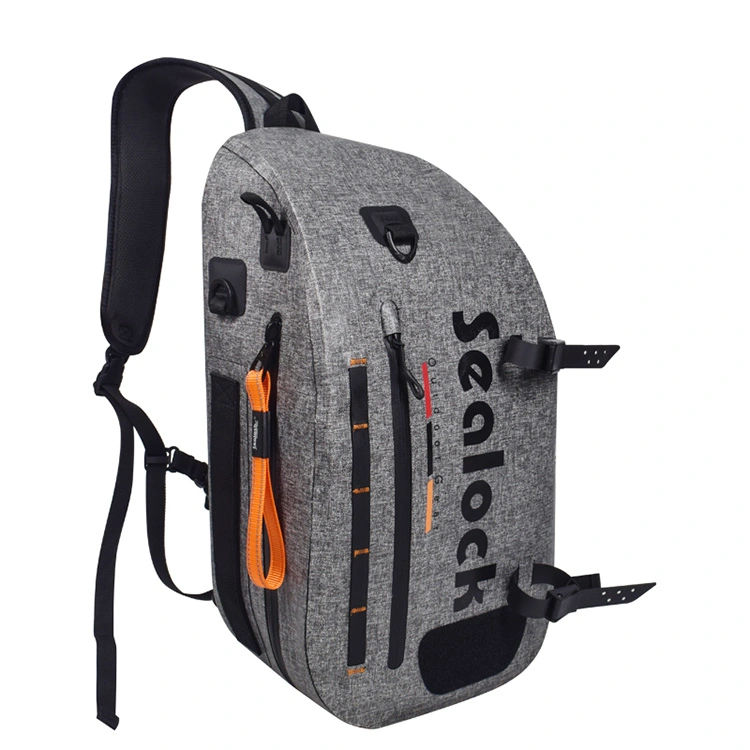
| Image | Model | Capacity | Material | Key specification | MOQ | Product Page |
|---|---|---|---|---|---|---|
|
SL-E589 | 15L | 840D double-coated TPU | IPX8 to 20 m · 27 × 16 × 48 cm · 868 g · waist belt · moulded zipper end cap | 500 | View |
|
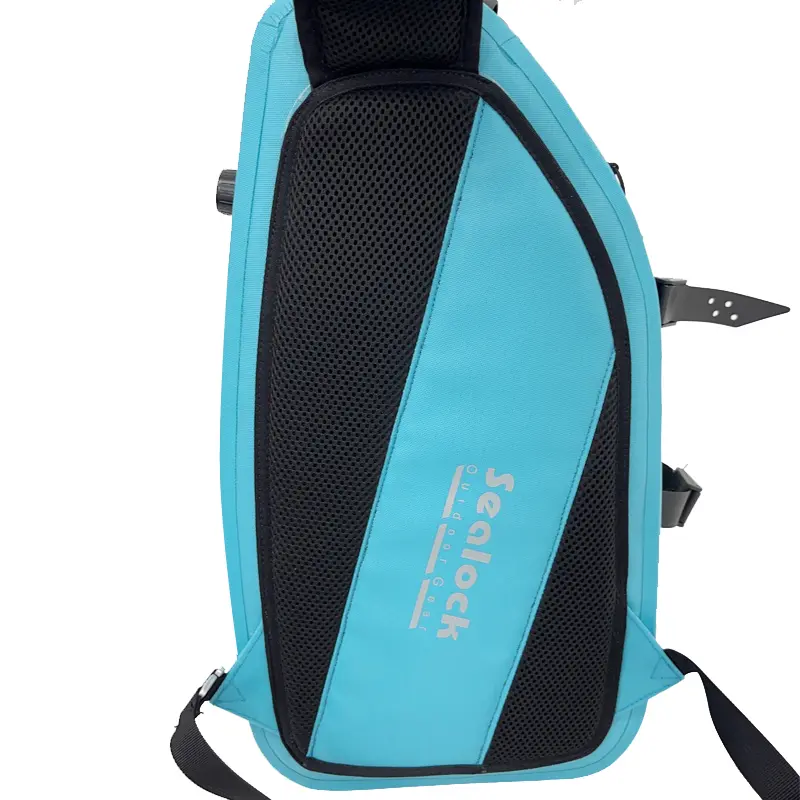
SL-E868A | 12L | 840D double-coated TPU | IPX8 to 20 m · 23 × 15.5 × 45 cm · 800 g · welded one-piece liner · T-grip pull | 500 | View |
|
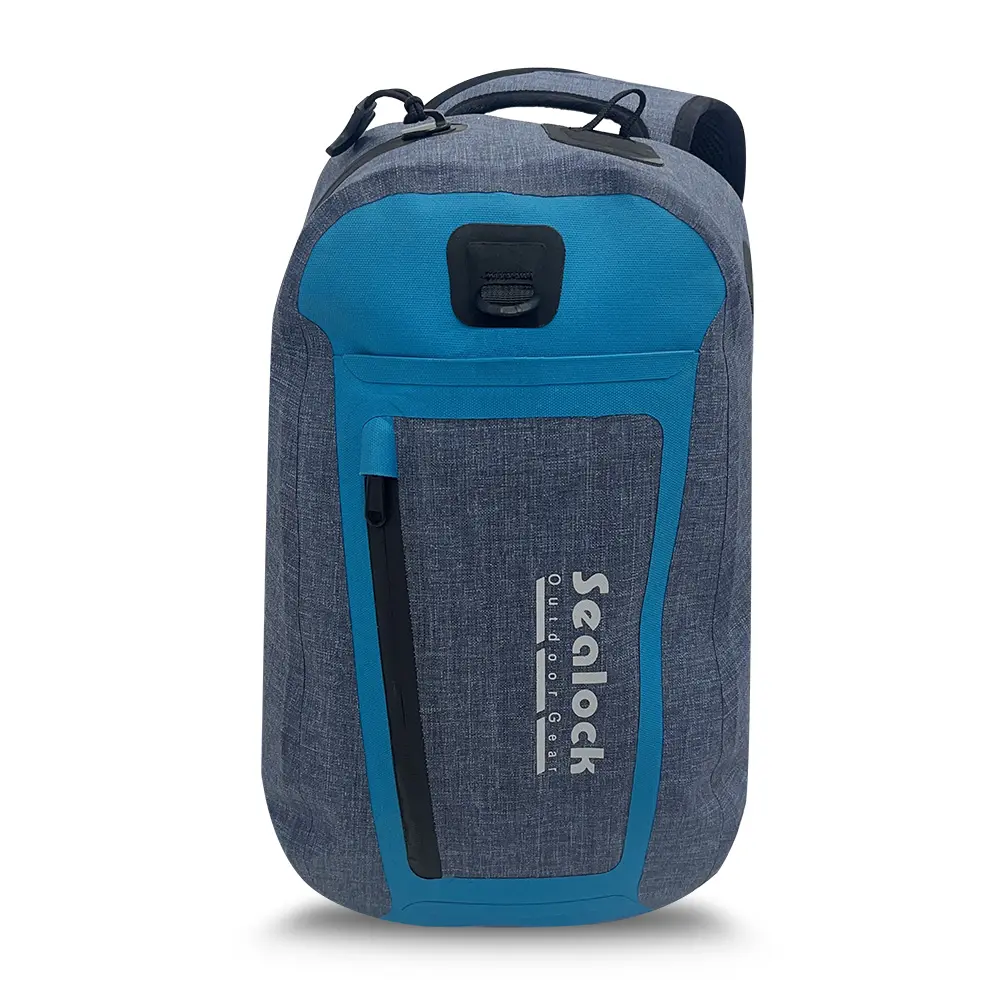
SL-E548 | 8L | 500D PVC laminate | IPX7 · 22 × 9 × 42 cm · 0.6 kg · moulded side attachment plates | 300 | View |
|
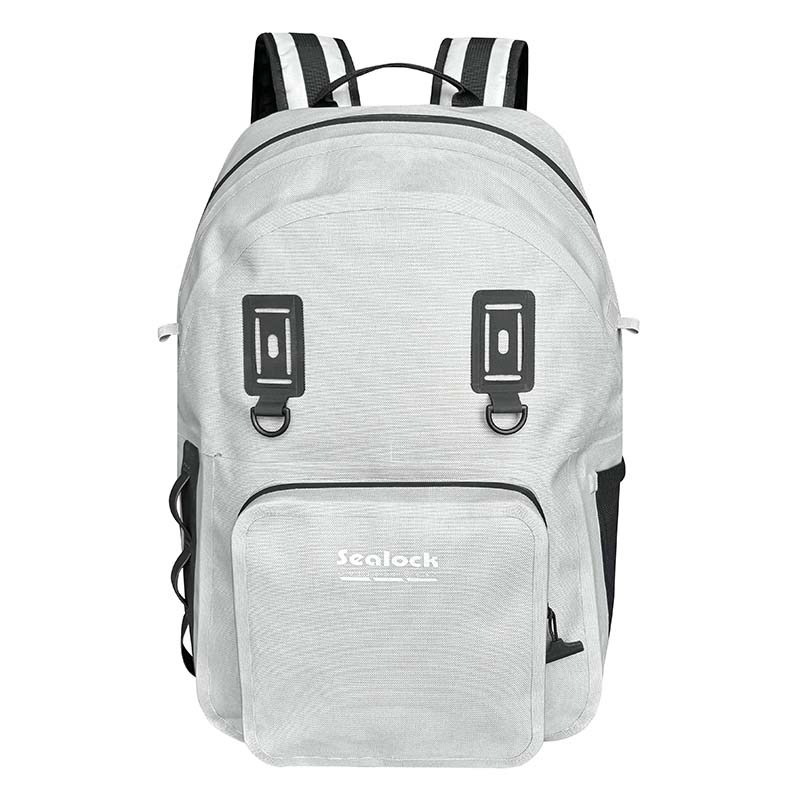
SL-E1144 | 21L (18–20L usable) | Melange TPU laminate | Stitchless RF-welded · 32 × 14.5 × 45.5 cm · EVA vent back · waist belt | 300 | View |
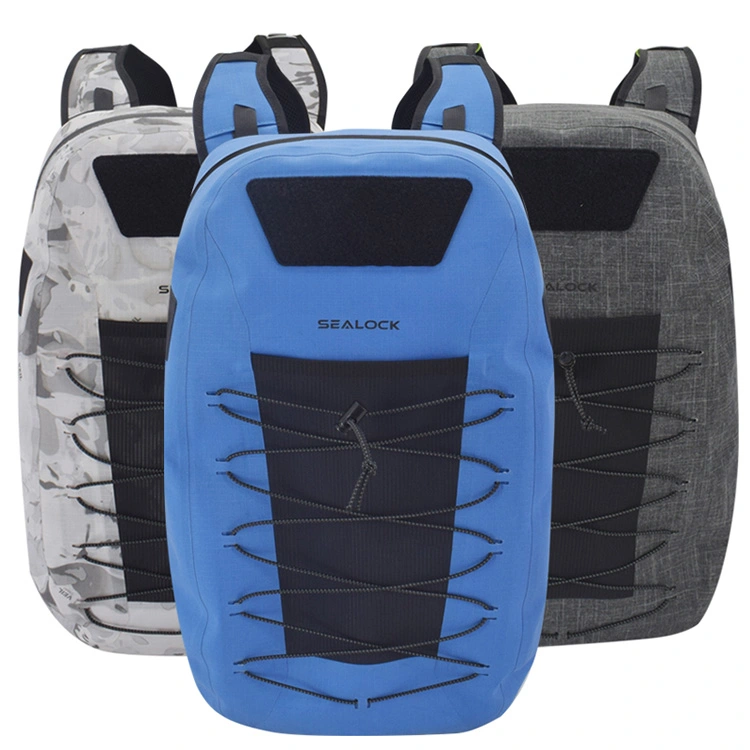
|
SL-E717 | 20L | 840D / 600D TPU | Cross chest pack · bottle holder · blue, grey, green | 300 | View |
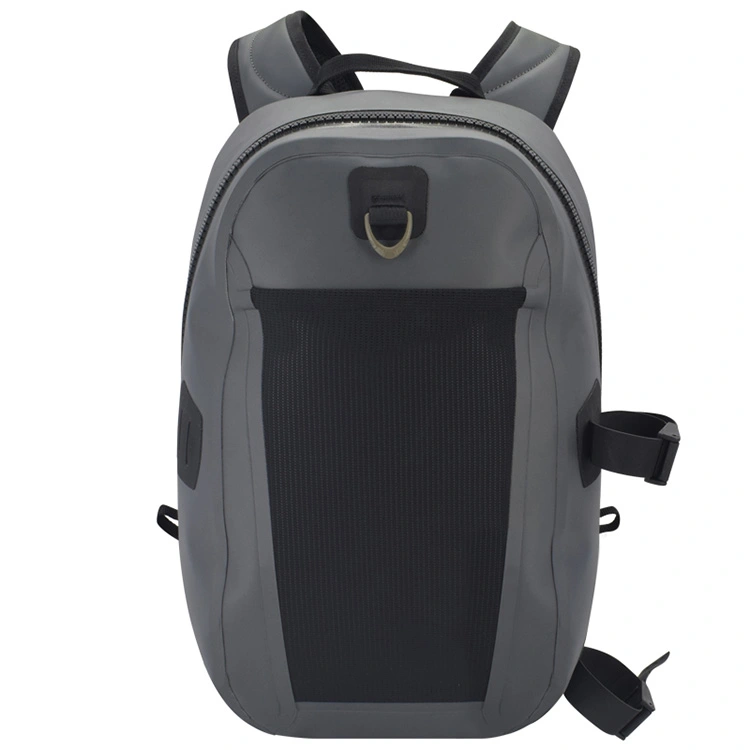
|
SL-E718 | 15L | 600D TPU on nylon | Two-layer construction · one-year warranty | 300 | View |
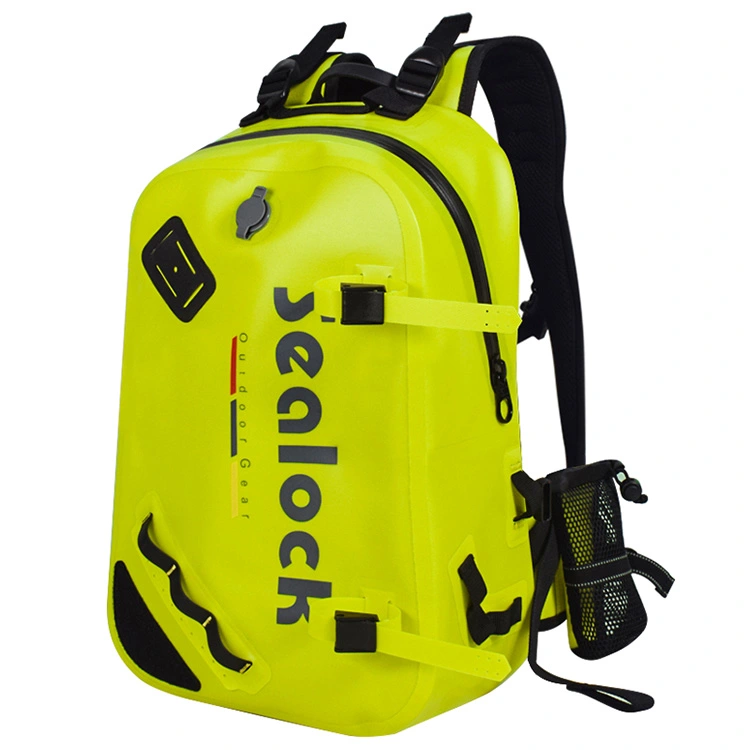
|
SL-E217B | 20L | 840D TPU | 0.7 kg · single-layer · green, dark grey | 500 | View |
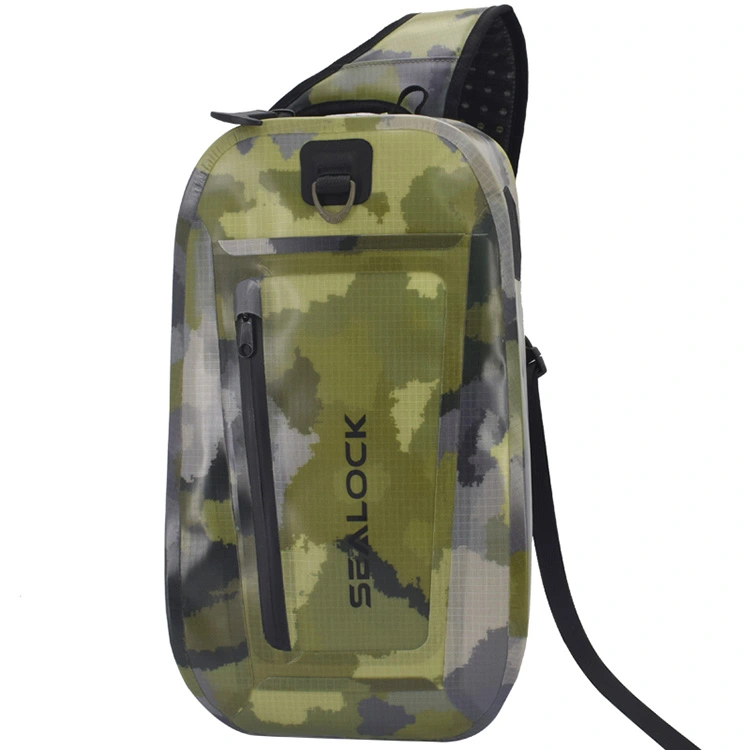
|
SL-E825 | 10L | 600D TPU on nylon | Two-layer · lightweight shoulder carry | 300 | View |
|
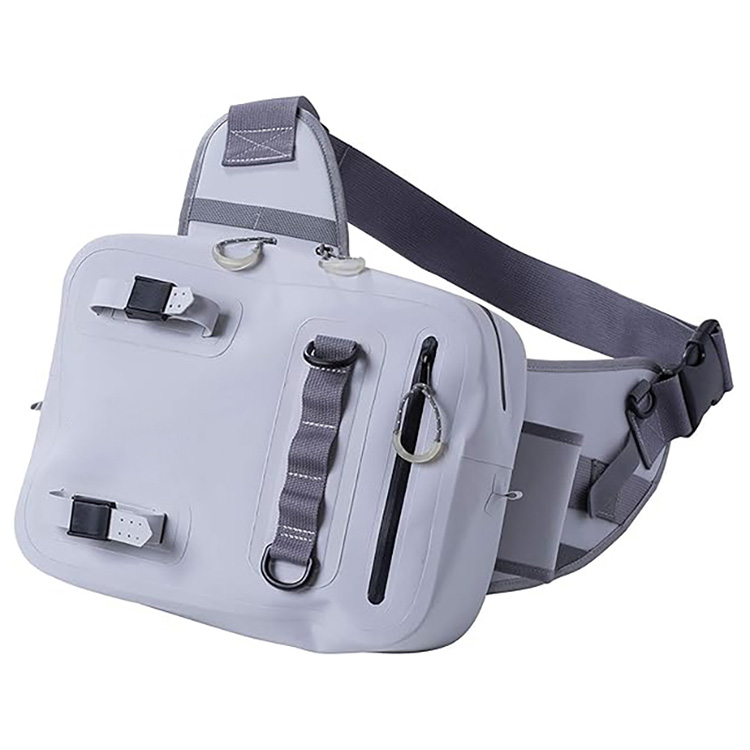
Airtight Zipper Waist Bag | 2.3L | Welded waterproof | IPX8 airtight zipper · waist / shoulder / chest carry · two rod straps | 300 | View |
|
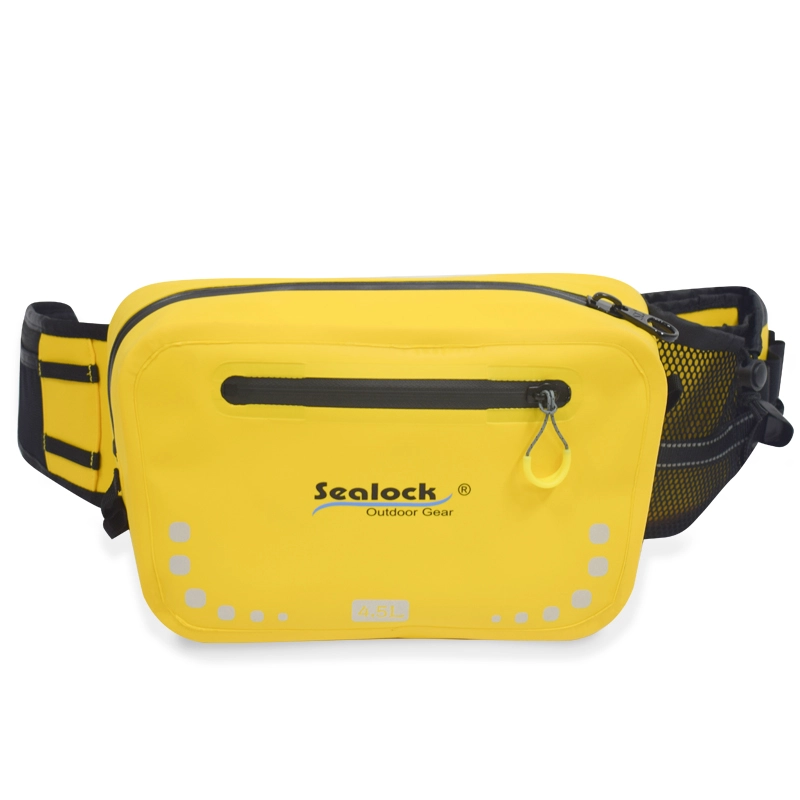
Creek Hip Pack | 4.5L | Coated waterproof fabric | Hip carry for wading · adjustable waist strap | 300 | View |
|
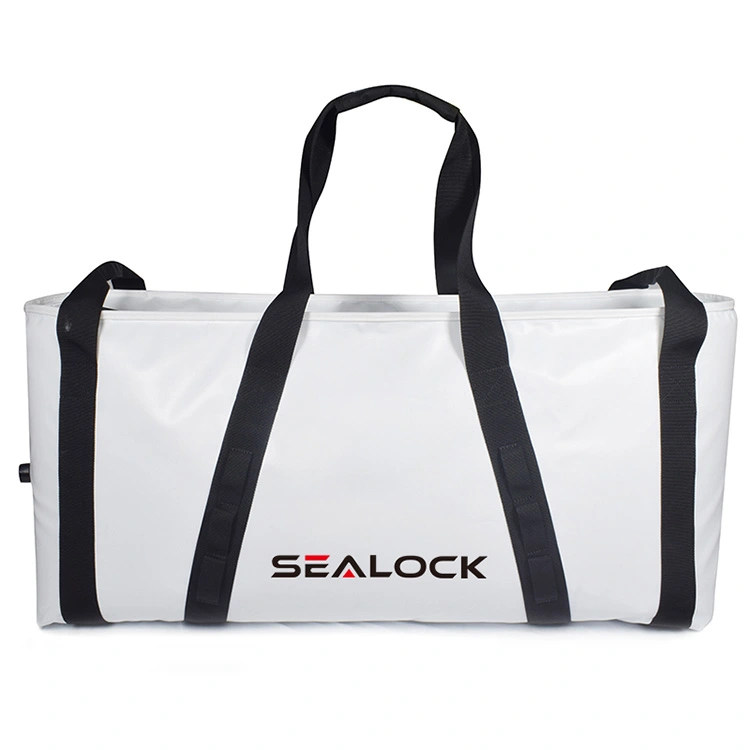
SL-C377 / C379 / C380 | 30 / 90 / 120L | PVC mesh fabric | Insulated · boat fishing, tuna, sea bass | 300 | View |
|
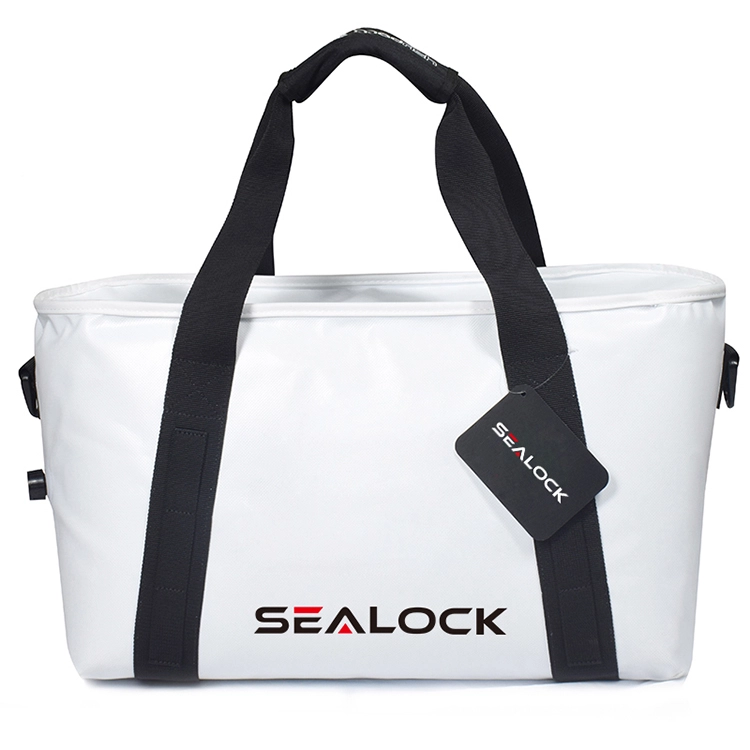
SL-C377 | 50 × 30 × 30 cm | PVC mesh fabric | Insulated · sea and lake fishing · four colours | 300 | View |
Full categories sit under waterproof bags, dry backpacks, and dry bags. The engineering behind these constructions is set out in the guide for fishing bag manufacturing, customization scope in the guide to custom dry bags, and material choice in the TPU material guide.
8. OEM Scope
Beyond logo and colour, a fishing programme can specify capacity and dimensions, waterproof level from splash-rated to IPX8 submersible, fabric and denier in TPU or PVC, closure and zipper grade, carry configuration including left or right sling and convertible dual-strap backpack, internal divider and tackle tray layout, lash strap and MOLLE arrangement, rod holder and plier sheath inclusion, reflective trim, patch panel, and packaging. Logo methods run to welded patch, rubber patch, silkscreen, heat transfer, and embroidery. Ground-up development from a sketch, sample, or target spec is supported, with tooling and lead time scheduled against a launch date.
9. Quality Control
On the fishing lines, fabric inspection, weld seam inspection, airtight zipper testing, colour consistency against the signed sample, appearance, and carton inspection all run at 100%, with a full water immersion test of two hours or more by batch sampling, and strap, buckle, handle, lash strap, and D-ring pull testing by random sampling. Three-stage control applies around that — IQC on incoming fabric, zippers, and hardware; IPQC on welds and zipper installation including peel tests at run start; and OQC with AQL sampling and gold-sample comparison. Salt spray covers hardware destined for marine use. The full customer inspection procedure — unboxing, vacuum extraction, a 24-hour static rest, and air-leak determination — can be witnessed end to end, with SGS or QIMA inspection available. Standards are set out in the quality control standards for waterproof production.
10. FAQ
Q: How many SKUs should a first fishing range contain?
A: Cover formats rather than sizes. A sling, a backpack, and a hip or waist model reach most of the market because each answers a different fishing style, and anglers frequently own more than one. Adding an insulated kill bag opens a separate, higher-ticket buyer.
Q: Should every model be fully submersible?
A: No, and claiming so invites returns. Saltwater, kayak, and electronics-carrying anglers genuinely need submersible protection; many others are keeping the bag out of the water anyway. Run an IPX8 premium tier alongside an IPX7 and water-resistant core tier, and label each accurately.
Q: Waterproof bags seem to have fewer pockets. Is that unavoidable?
A: It is a real trade-off — every stitched pocket on a sealed body is a leak path. The answer is to put organisation in a welded seamless liner with an internal mesh pocket, add a separately sealed front pocket, and move the rest outside onto lash straps and D-rings that carry rods, nets, and tools.
Q: What are the minimums and how do we keep a first order manageable?
A: 300 pcs on most models and 500 on the two submersible slings and the 20L shoulder bag. Build the first order around 300-piece models, limit it to two colourways, and choose models sharing a base fabric so one material purchase serves several SKUs.
Q: Do you have the certifications our retail customers require?
A: The fishing lines carry BSCI, ISO 9001, and Sedex, with HIGG, GRS, and SCAN across the wider range and factory audit available. Confirm your target retailer's vendor approval list early, since requirements can affect material choice as well as documentation.
Q: What lead time should we plan for?
A: Samples in 7–15 days and production in 30 days for 1–500 pcs on the sling line, negotiable above that, with capacity at 15,000 pcs per month. Add sea freight and allow extra time if the programme includes ground-up development rather than a platform modification.
Request a Wholesale Fishing Proposal
For range architecture, MOQ and pricing at your target quantities, samples, or a full OEM proposal, submit an inquiry. Sealock responds to procurement enquiries within 24 hours, with production from Dongguan, China or Ho Chi Minh City, Vietnam.