Most factory photography stops at the welding machine, because that is the part that looks like manufacturing. The part that actually decides whether a container arrives clean is the last three metres of the line — the sewing benches, the finishing tables, the count cards, the poly bags and the carton. This month our Dongguan plant ran a high-visibility roll-top dry bag order through exactly that stretch, and it is worth walking through in detail, because the questions buyers ask us after a bad experience with another supplier are almost always about this stage rather than about seam fusion.
The product is a fluorescent yellow roll-top dry bag with a contrast-bound edge, webbing shoulder straps, side-release buckles and a printed brand mark on the front panel. It ran in two capacities alongside a second colourway on the neighbouring bench.
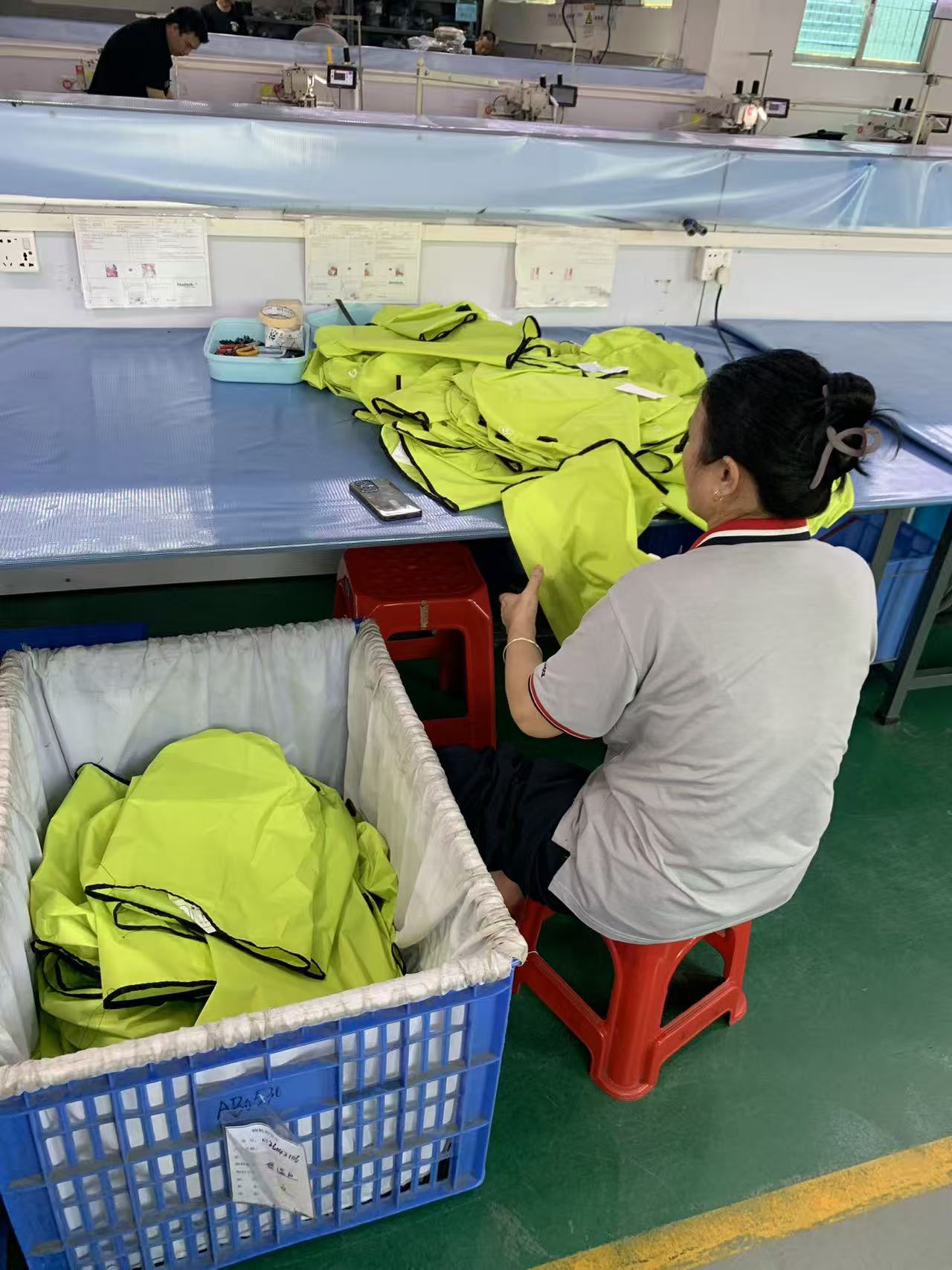
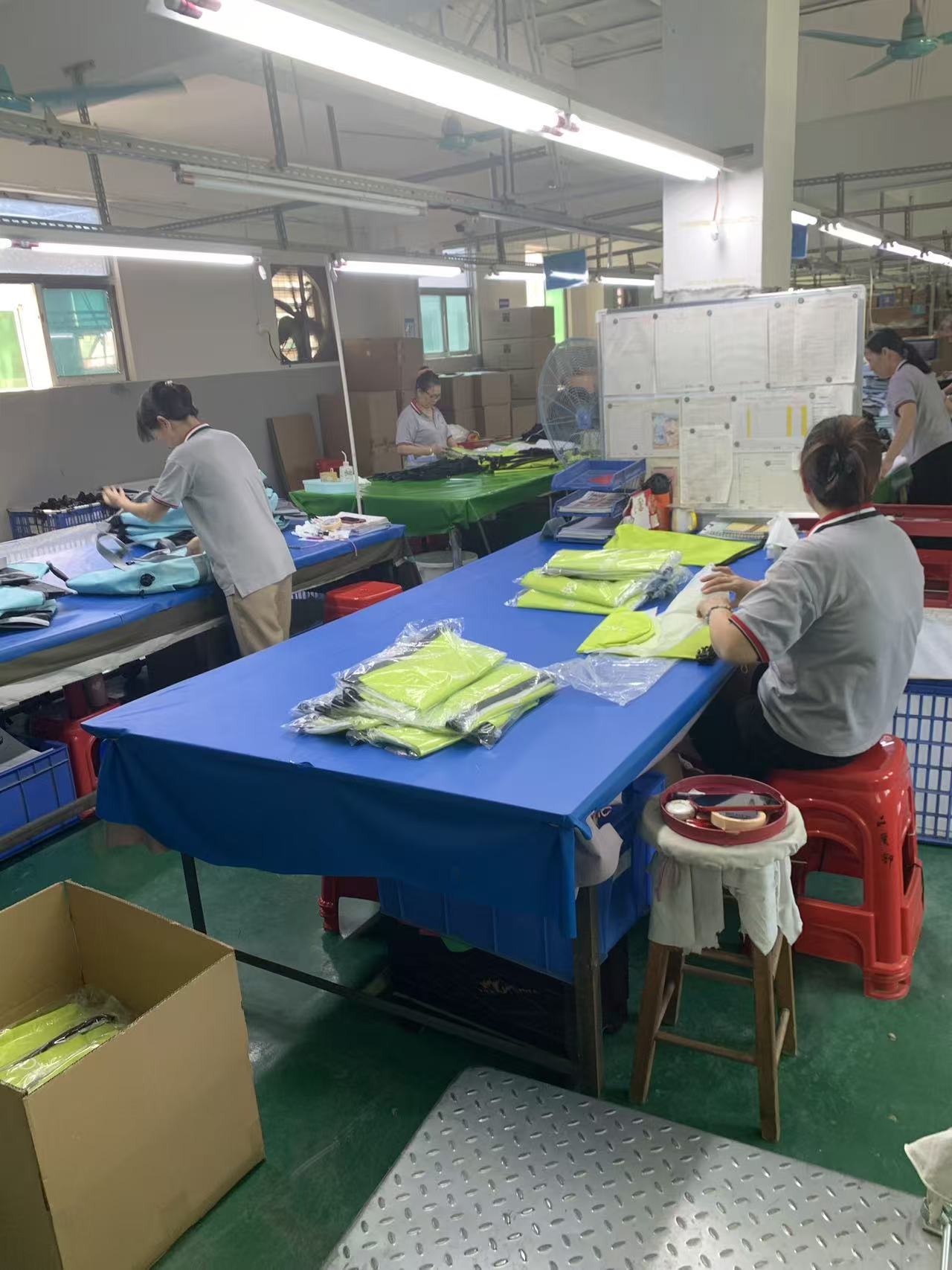
The sewing line. Each station carries its own process card, and the bin at the operator's feet is tagged with the model and capacity.
Sewing is not the fallback — it is a parallel capability
Because we talk so much about high-frequency welding, buyers sometimes arrive assuming that is the only thing we do well, and that anything sewn is something we subcontract or tolerate. That is not the case. Our sewing floor is in-house, staffed by operators who have run this category for years, and it is held to the same process discipline as the welding floor: process cards posted at each station, first-piece approval before a run opens, and inline checks rather than a single inspection at the end.
The reason matters more than the reassurance. Not every waterproof product should be welded, and pretending otherwise produces worse gear. A lightweight coated-fabric dry bag that needs to pack down small, carry a bound edge and take a soft hand does not want the stiffness a fully fused construction gives it. On a product like this one the correct build is a sewn and taped or bound construction, executed cleanly, with the closure doing the waterproofing work — and the honest answer to a buyer asking for "welded everywhere" on a bag like this is that welding would make it heavier and stiffer without making it drier. Where a construction genuinely benefits from fusion — anchor patches, panel seams on a submersible bag, strap bases under high dynamic load — we weld. Where it does not, we sew, and we say why.
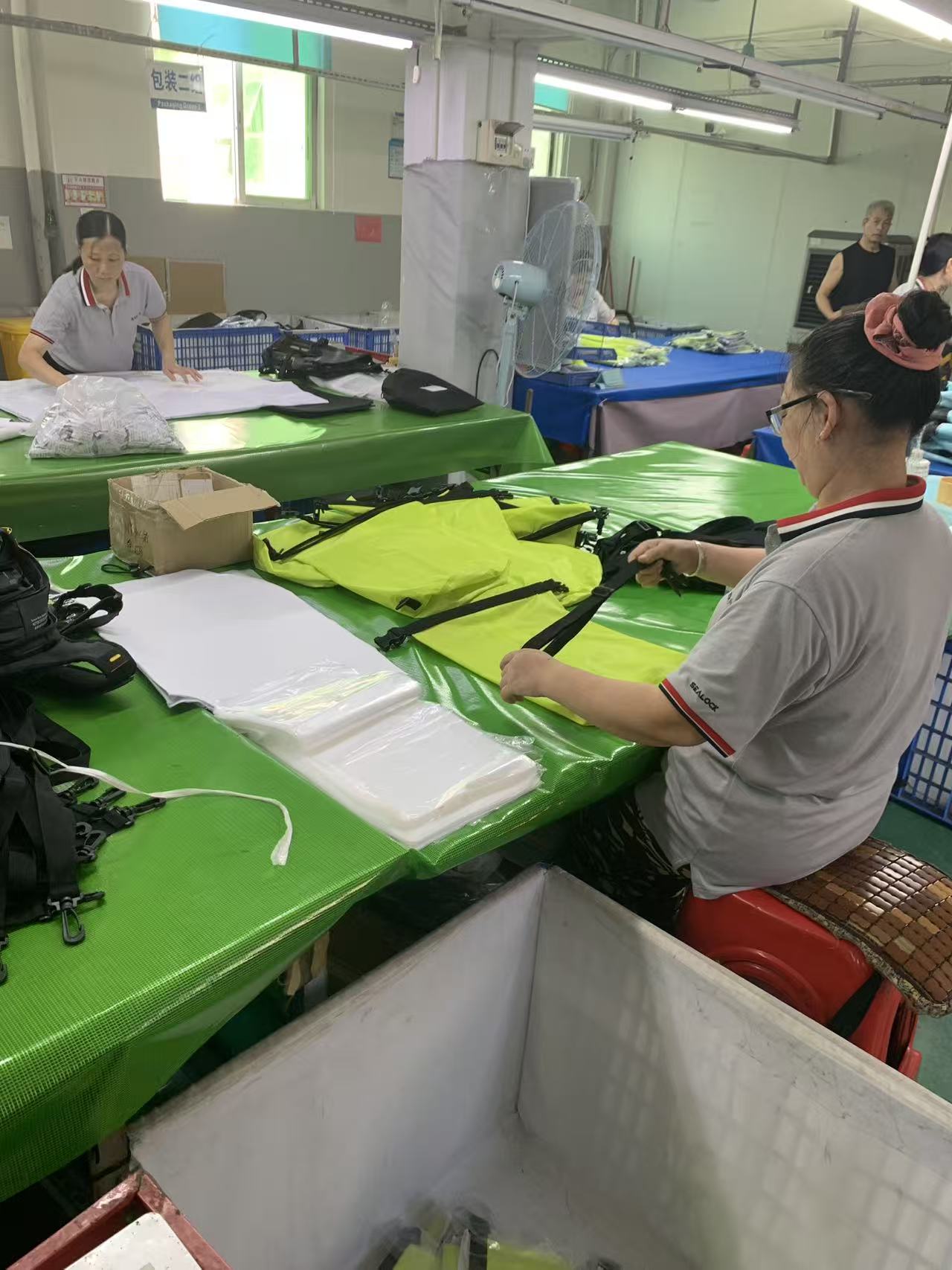
Strap and buckle assembly. Hardware is fitted from pre-counted kits so a run cannot drift into a shortage halfway through.
Hardware kits, not loose hardware
On the finishing benches you will see webbing assemblies laid out in bundles rather than pulled from a bulk bin. Buckles, ladder locks and strap sets are cut, assembled and counted upstream, then issued to the bench as kits matched to the day's output. It is a small discipline with an outsized effect: the classic mid-run failure on this kind of order is a hardware substitution — the original buckle runs short, someone finds a visually similar one in stores, and two hundred pieces ship with a slightly different release action that the buyer notices on receipt. Kitting makes that substitution visible before it happens instead of after the container sails.
The fold is a specification
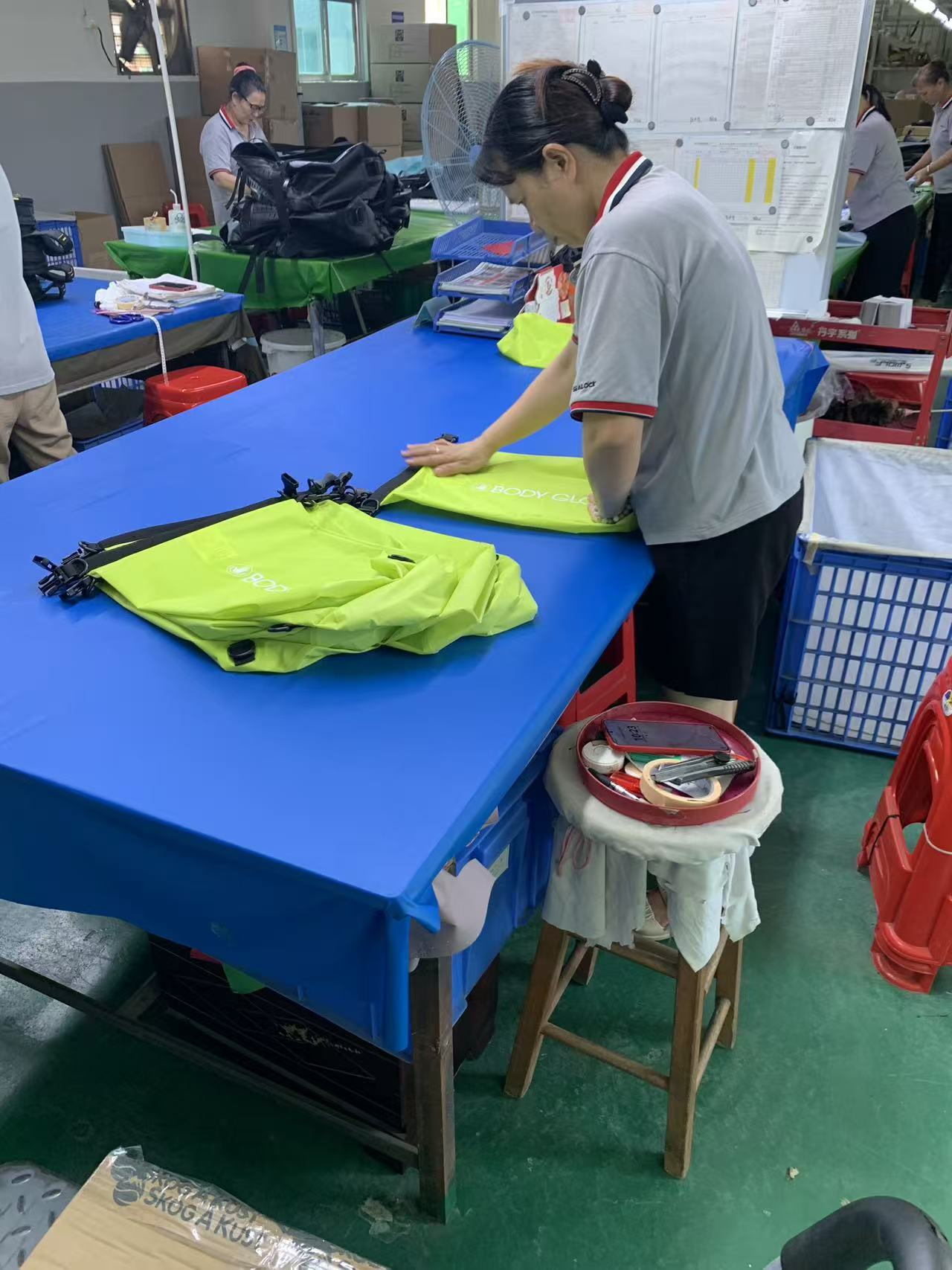
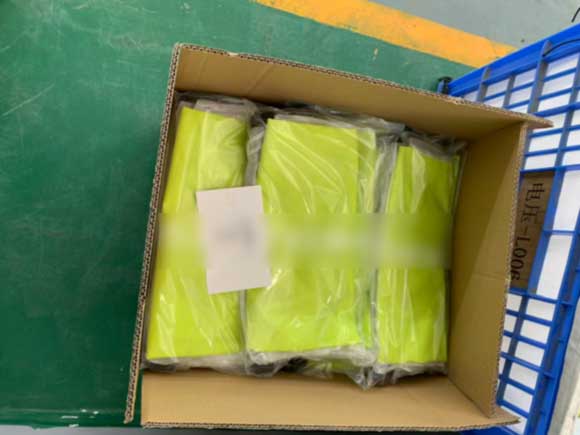
The next bench does something that looks trivial and is not: it folds every bag the same way. Straps are laid flat and squared, the roll-top section is folded to a set number of turns, the buckles are seated so they cannot press into the face fabric, and the bag goes into its poly bag at a size that matches the carton grid.
A consistent fold is what makes the count reliable, what keeps carton dimensions stable enough for the freight quote to hold, and what stops buckle hardware from printing a mark into a coated panel over six weeks in a hot container. On a high-visibility colour that last point is not cosmetic. Fluorescent yellow shows every crease, scuff and pressure mark that a black bag hides, which is why bright colourways generate a disproportionate share of appearance complaints across this whole category. We treat hi-vis runs as the harder job, not the easier one.
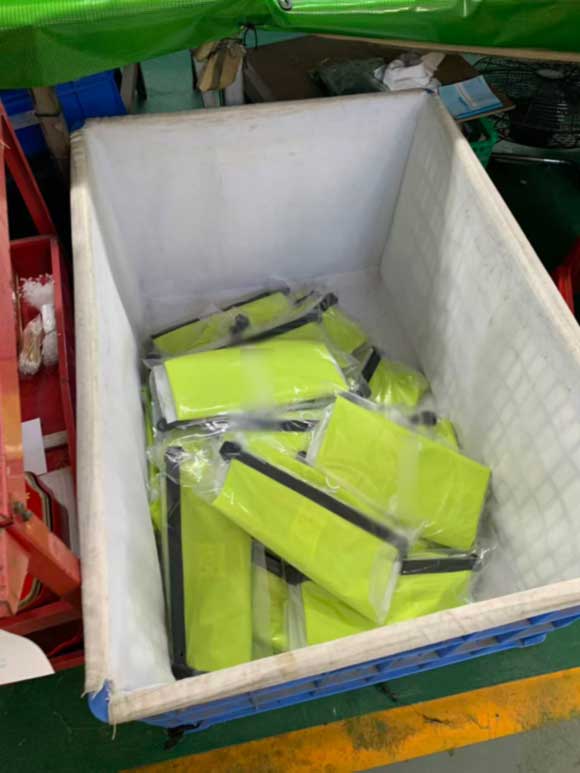
Folded to a fixed standard and individually poly-bagged before they leave the bench.
Cloth-lined bins between every stage
Between stations the work travels in plastic turnover bins that have been lined with white cloth. The lining is there for one reason: a bare bin has moulded ribs and edges, and a stack of finished bags rubbing against those over several handling cycles picks up scuff marks. On a fluorescent panel a scuff reads as a defect at final inspection even when the bag is functionally perfect, and a rejected piece at that stage has already absorbed all of its material and labour cost.
The bins are also labelled by process and model, which is what allows two colourways and two capacities to run on adjacent benches without cross-mixing. Anyone on the floor can look at a bin and tell what is in it and where it is going next.
Cloth-lined turnover bins protect the coated surface between stages and keep models separated.
Count cards, and why they sit on top of the stack
Each carton and each bin carries a hand-written count card sitting face-up on the goods. It is deliberately low-tech. The card is written by the person who counted, it stays with the goods through every subsequent handling step, and it is the thing the OQC inspector reconciles against the packing list before the carton is taped.
Short-shipping is the single most damaging small error in this business. It is rarely theft and almost never a systematic problem — it is one carton counted while someone was talking, or a partial carton topped up from the wrong bin at the end of a shift. A card that travels with the goods means the count exists in a place where a discrepancy has to be resolved by a person rather than discovered by the customer's receiving warehouse.
Every carton and bin carries a count card that stays with the goods until OQC reconciles it.
What gets checked before the carton closes
Inline QC on this run covered closure function on every piece — the roll-top folded and buckled, the buckles cycled — plus strap and hardware security, print position and print adhesion, colour difference against the approved lab dip, and general appearance under the bench lighting. Structural and material verification happened earlier and to sample: bonding strength on taped and bound edges, tensile strength on the base fabric, load cycling on the strap anchors, abrasion, salt spray and colour fastness, alongside a heavy rain and water-jet test appropriate to a roll-top closure. A roll-top bag of this construction is built to shed sustained heavy spray and rain, not to be submerged, and we specify it that way rather than letting an immersion claim ride on a closure that does not support one.
IQC, IPQC and OQC checkpoints run through the order as standard, and third-party inspection by SGS or QIMA can be scheduled on request. Buyers who prefer their own agent are welcome to book one; nothing in our flow depends on the inspection being ours.
Packing area. Two colourways and two capacities running side by side, kept separate by bin labelling.
For buyers sourcing this category
Sealock has built waterproof outdoor gear for over 20 years, with high-frequency welding and in-house sewing running side by side in Dongguan and at our facility in Ho Chi Minh City, so buyers can pick the origin that suits their tariff position without renegotiating the specification. Standard terms are FOB Guangdong, 7–15 days for sampling, 30–45 days for mass production, and MOQ from 300 pieces on most models. We develop from a sketch, a competitor sample or a target spec sheet as a matter of routine, and we will tell you when a construction you have asked for is the wrong one for the product.
We use cookies to offer you a better browsing experience, analyze site traffic and personalize content. By using this site, you agree to our use of cookies.
Privacy Policy