
- English
- Español
- Português
- русский
- Français
- 日本語
- Deutsch
- tiếng Việt
- Italiano
- Nederlands
- ภาษาไทย
- Polski
- 한국어
- Svenska
- magyar
- Malay
- বাংলা ভাষার
- Dansk
- Suomi
- हिन्दी
- Pilipino
- Türkçe
- Gaeilge
- العربية
- Indonesia
- Norsk
- تمل
- český
- ελληνικά
- український
- Javanese
- فارسی
- தமிழ்
- తెలుగు
- नेपाली
- Burmese
- български
- ລາວ
- Latine
- Қазақша
- Euskal
- Azərbaycan
- Slovenský jazyk
- Македонски
- Lietuvos
- Eesti Keel
- Română
- Slovenski
- मराठी
- Srpski језик

Waterproof Fishing Bag Manufacturer for Outdoor Brands
Sealock manufactures waterproof fishing bags for outdoor brands, tackle retailers, and OEM programmes from factories in China and Vietnam, with a range running from a 2.3L hip pack to 120L insulated kill bags. Fishing looks like a subset of outdoor luggage and is not: the hardware faces saltwater that seizes ordinary components, the base meets hooks and wet decks, and a bag that goes over the side of a kayak has to survive genuine submersion rather than a rain shower. This is what a brand entering the category needs to specify.
1. Company and Terms
Sealock (YiFuLong Outdoor Gear Co., Ltd.) has built welded waterproof bags for over 20 years, producing for international outdoor and marine brands including SIMMS, ORVIS, West Marine, and PENN.
- Facilities: Dongguan, China | Ho Chi Minh City, Vietnam — either origin available on any model
- MOQ: 300 pcs on most models; 500 pcs on the 15L and 12L slings and the 20L shoulder bag
- Samples: 7–15 days | Bulk: 30 days for 1–500 pcs on the sling line, negotiable above
- Capacity: 15,000 pcs/month | Warranty: one year on most fishing models
- Certifications: BSCI, ISO 9001, Sedex, plus HIGG, GRS, and SCAN | Loading from Shenzhen
2. Submersible, Not Just Waterproof
The distinction that drives returns in this category is the one most listings blur. Water-resistant means gear survives rain and spray. Submersible means the contents survive going under — which is what actually happens to kayak anglers, wading anglers who slip, and boat anglers in rough water.
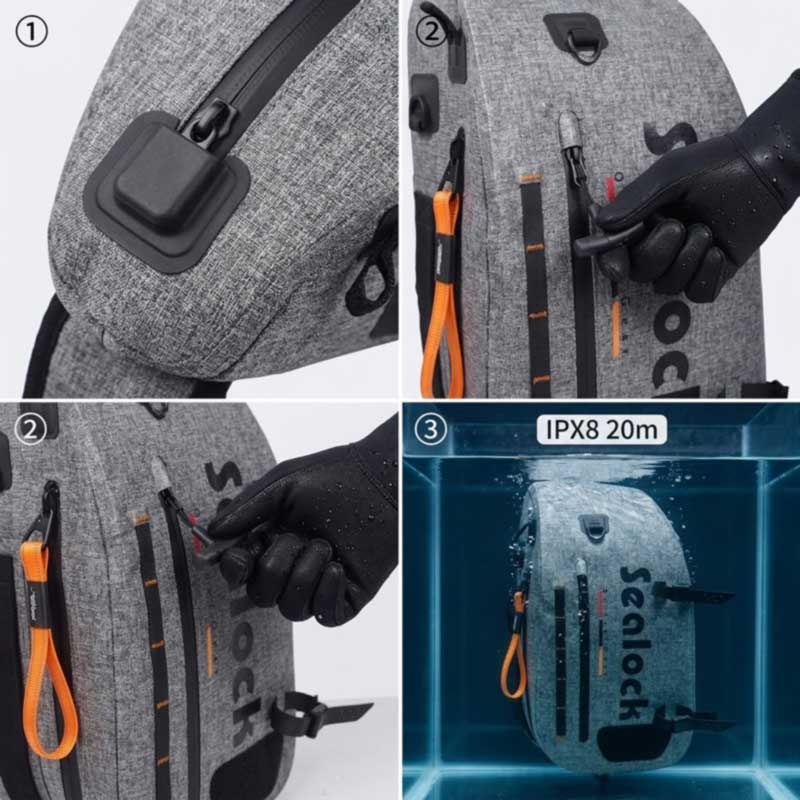
Both specifications are legitimate products at different price points, but they should be built and marketed as what they are. The 15L and 12L slings are rated IPX8 and sealed to a 20 m depth, built on a welded body with an airtight waterproof zipper, so reels, electronics, and documents survive full immersion. The 8L lure sling is IPX7 for brief immersion. A splash-rated pocket on any bag should be labelled as such — the airtight-zipper waist model states plainly that its rear zip pocket is not for prolonged submersion and that valuables belong in the main compartment. That honesty is what keeps a warranty programme manageable.
3. Hardware Is Where Fishing Bags Die
Saltwater attacks fittings before fabric. Standard zippers and metal hardware that survive freshwater seize after a handful of salt trips, and a seized main zipper is a dead bag regardless of how good the body is. Corrosion-resistant components cost a manufacturer meaningfully more, which is exactly why value bags omit them and why the difference appears in the second season rather than the first.
One detail worth carrying into any specification: the zipper end is the usual failure point on a sealed closure, taking grit and impact where the slider parks. The 15L sling addresses it with a moulded waterproof end cap, and both submersible slings add glove-friendly operation — an assist cord on one, a moulded T-grip pull on the other — because an airtight zipper needs real leverage to close properly, and a seal that the angler cannot fully close with cold wet hands is not a seal.
4. Materials for Fishing Duty
- 840D double-coated TPU — the premium specification, used on the submersible slings and the 20L shoulder bag: full waterproofing with abrasion and tear resistance, and it wipes clean of mud, saltwater, and fish slime.
- Melange TPU laminate — a high-end textile texture with a matte finish, used on the 21L backpack where a brand wants a premium look rather than an industrial one.
- 600D TPU on nylon — a lighter two-layer build for shoulder bags and mid-size backpacks.
- 500D PVC laminate — abrasion resistance and structure at a competitive cost, welded cleanly, on the 8L lure sling.
- PVC mesh fabric — the insulated kill bag construction, chosen because it rinses out and survives repeated contact with fish and ice water.
Across the range the bodies are high-frequency welded rather than sewn — the 12L sling uses a welded one-piece TPU liner so the interior wipes out dry, and the 21L backpack is built as a fully stitchless RF-welded panel structure. Material trade-offs are covered in the comparisons of TPU material advantages and PVC cost and performance.
5. Carry Systems Built Around How Anglers Actually Fish
Fishing carry is not general backpack carry, and three format-specific requirements recur:
- Swing-round access. A sling rotates to the chest so the angler works tackle without removing the bag — the reason slings dominate lure and bank fishing.
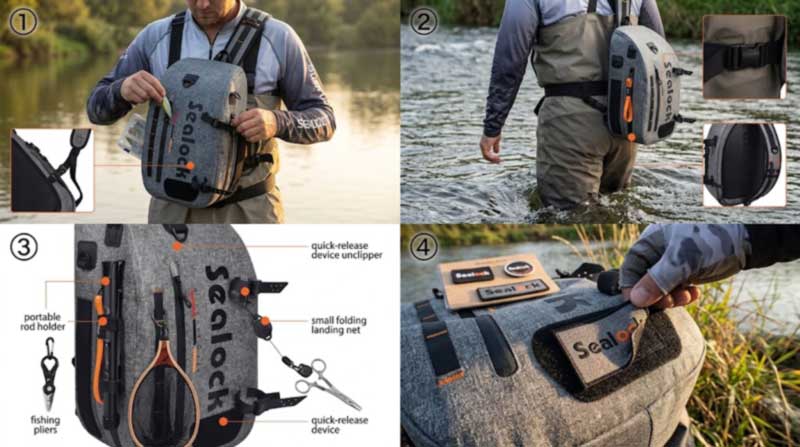
- Body lock for wading. A cross stabiliser strap or waist belt stops the bag swinging while walking, casting, or wading; the 15L sling adds a waist belt specifically to lock the bag to the body in the water.
- Slim depth. The bag must stay clear of the casting arm — 9 cm on the 8L sling and 15.5 cm on the 12L are depth figures chosen for that reason rather than for volume.
On backpacks the requirements shift toward load carriage: the 21L model runs an EVA ventilated back panel with thick padded shoulder straps, an adjustable waist belt, and a sternum clip, and the 15L sling uses a moulded contoured back panel that also keeps the bag upright and self-supporting on a deck or bank.
6. The Attachment Ecosystem Is the Product
Anglers configure rather than merely carry, and a fishing bag that cannot be configured loses to one that can. The range carries adjustable ladder lash straps for mounting a rod holder, net, or spare layer; reinforced welded D-rings and hook clips for pliers, tools, and retractors; front lash webbing; and hook-and-loop patch panels for brand, team, or angler ID patches. Rod straps are integrated on the waist model to secure rods, cups, or an umbrella.
Two commercial points follow. Attachment turns a single SKU into a platform and gives a retailer an accessory line to sell alongside it. And a patch panel invites the owner to personalise the product, which builds attachment to the brand rather than only to the bag. Optional rod holders, plier sheaths, internal dividers, tackle trays, MOLLE or laser-cut webbing, and reflective trim are all specifiable on the sling and backpack platforms.
7. Tackle Trays Set the Interior
Anglers buy around the plastic utility trays they already own, and the industry names bags for the tray size their main compartment accepts. The two standards are roughly 10.5 × 7 × 1.5 inches and 14 × 8.5 × 2 inches, with established tackle ranges built to shelve several trays in the main compartment plus one in a side pocket. For an OEM programme that means internal cavity, divider spacing, and opening width are dimensioned from the chosen tray outward rather than from a marketing litre figure. Internal dividers and tackle trays are specifiable options across the sling and backpack platforms.
8. Fishing Range
Models organized by type rather than priority:
| Image | Model | Capacity | Material | Key specification | Product Page |
|---|---|---|---|---|---|
|
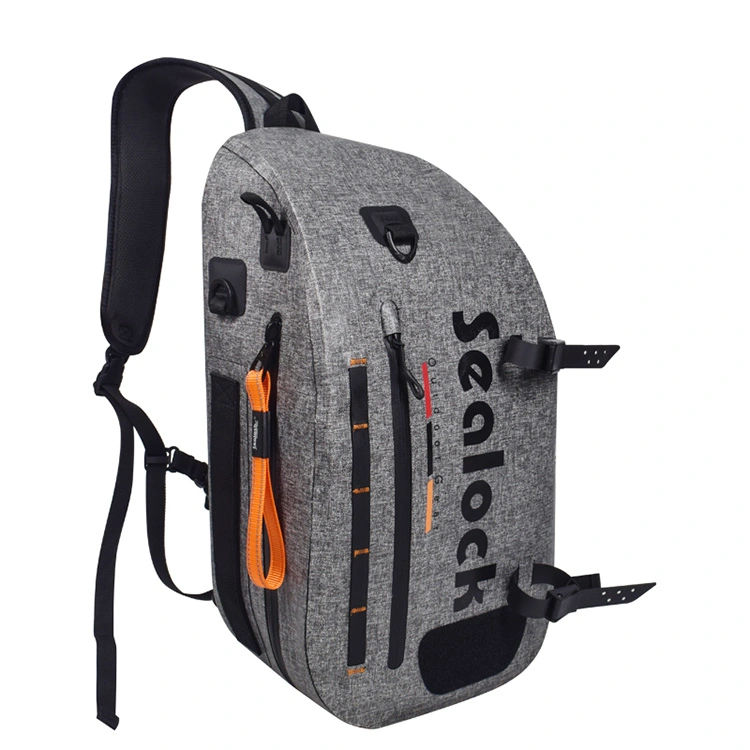
SL-E589 | 15L | 840D double-coated TPU | IPX8 to 20 m · 27 × 16 × 48 cm · 868 g · waist belt · moulded zipper end cap | View |
|
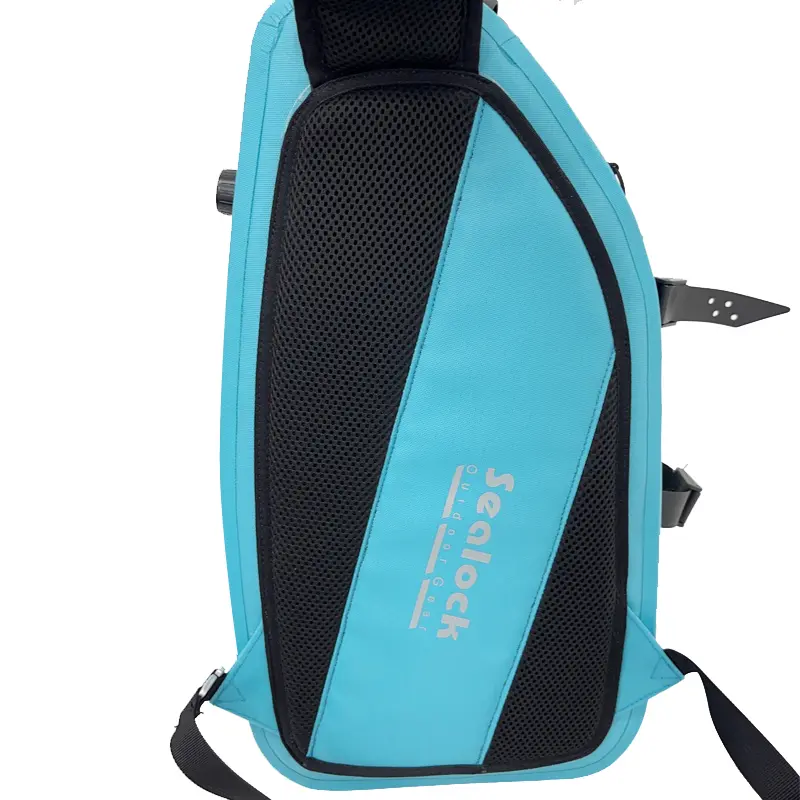
SL-E868A | 12L | 840D double-coated TPU | IPX8 to 20 m · 23 × 15.5 × 45 cm · 800 g · welded one-piece liner · T-grip pull | View |
|
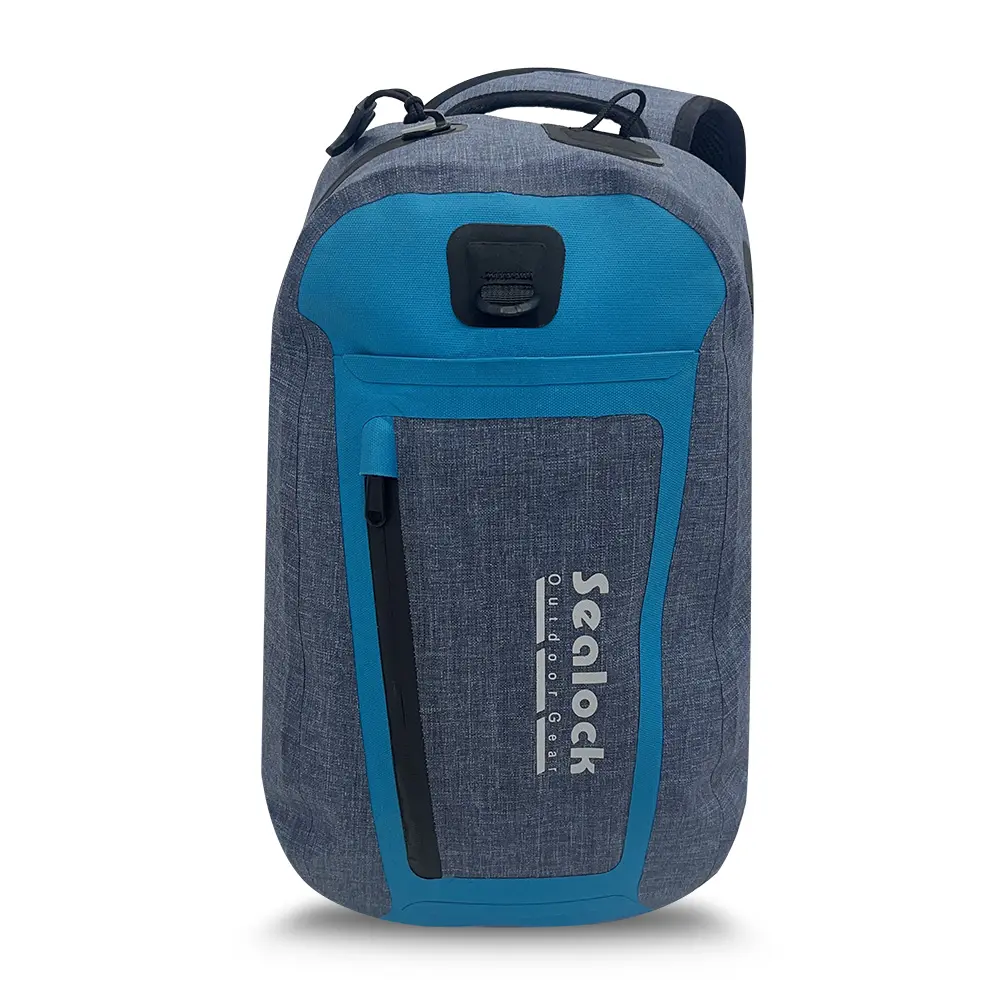
SL-E548 | 8L | 500D PVC laminate | IPX7 · 22 × 9 × 42 cm · 0.6 kg · moulded side attachment plates | View |
|
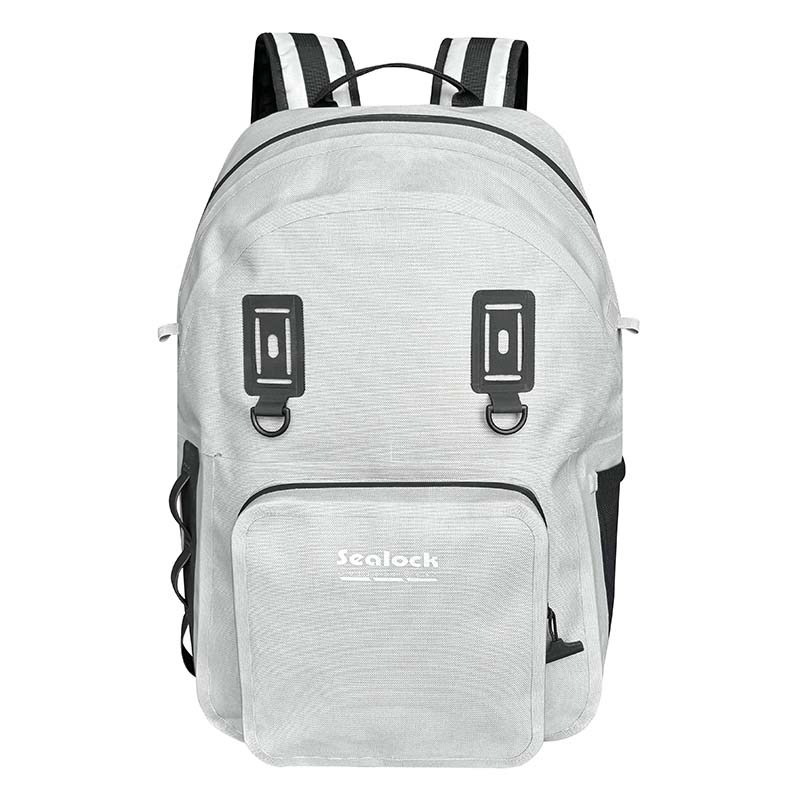
SL-E1144 | 21L (18–20L usable) | Melange TPU laminate | Stitchless RF-welded · 32 × 14.5 × 45.5 cm · EVA vent back · waist belt · D-rings | View |
|
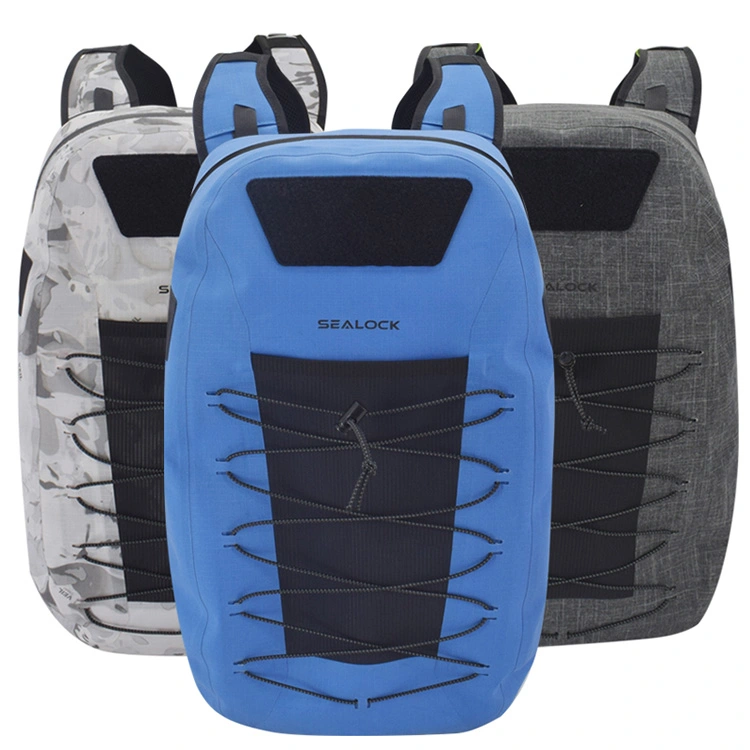
SL-E717 | 20L | 840D TPU / 600D TPU tarpaulin | Cross chest pack · bottle holder · blue, grey, green | View |
|
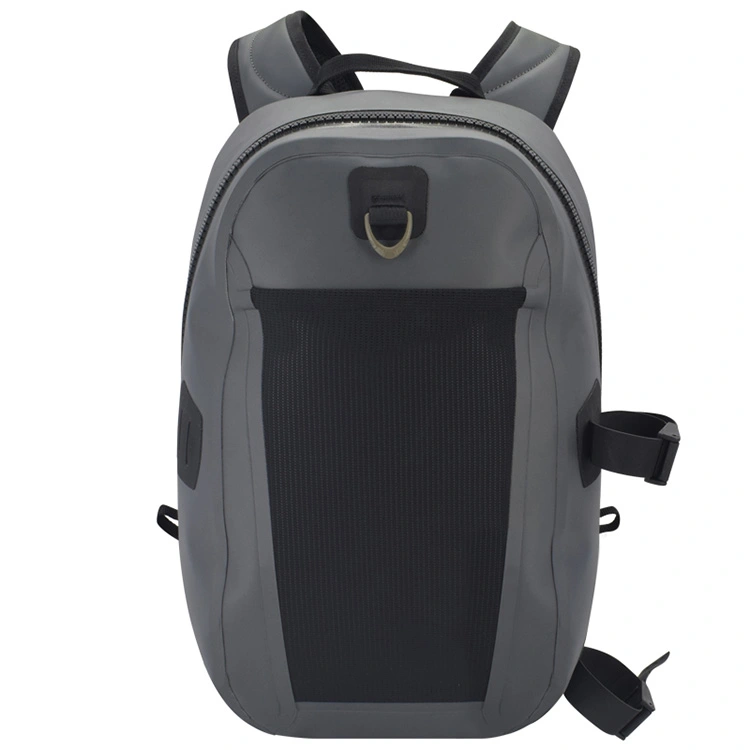
SL-E718 | 15L | 600D TPU on nylon | Two-layer construction · one-year warranty | View |
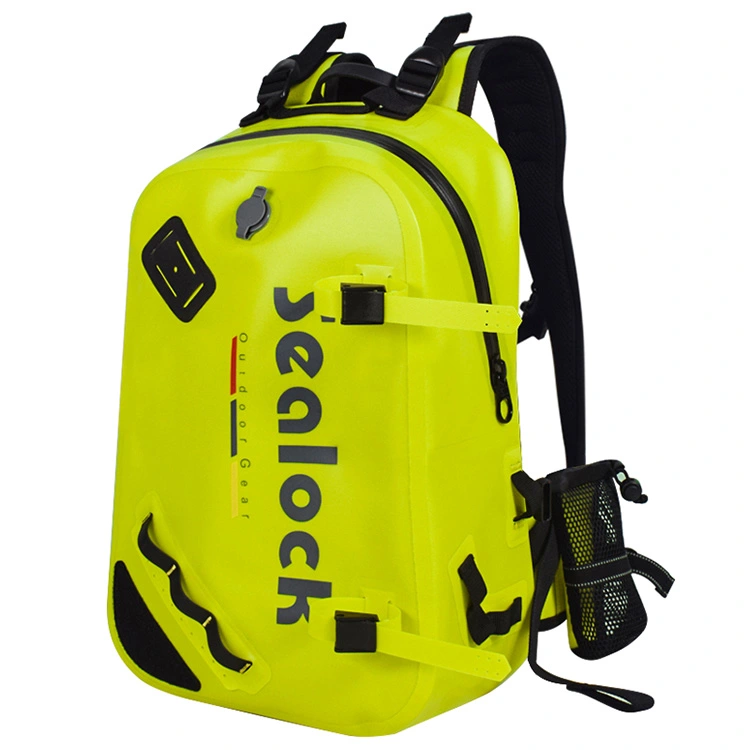
|
SL-E217B | 20L | 840D TPU | 0.7 kg · single-layer · green, dark grey | View |
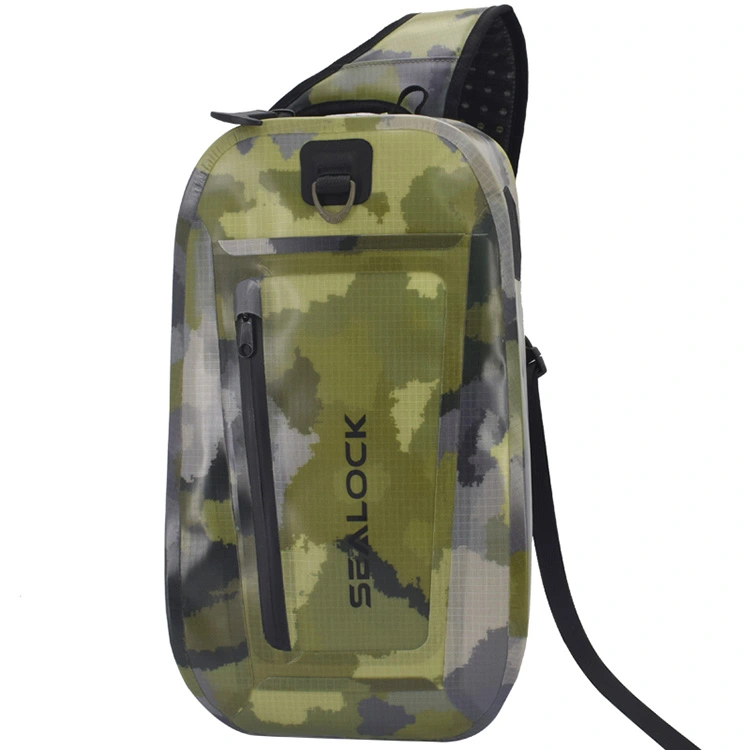
|
SL-E825 | 10L | 600D TPU on nylon | Two-layer · lightweight shoulder carry | View |
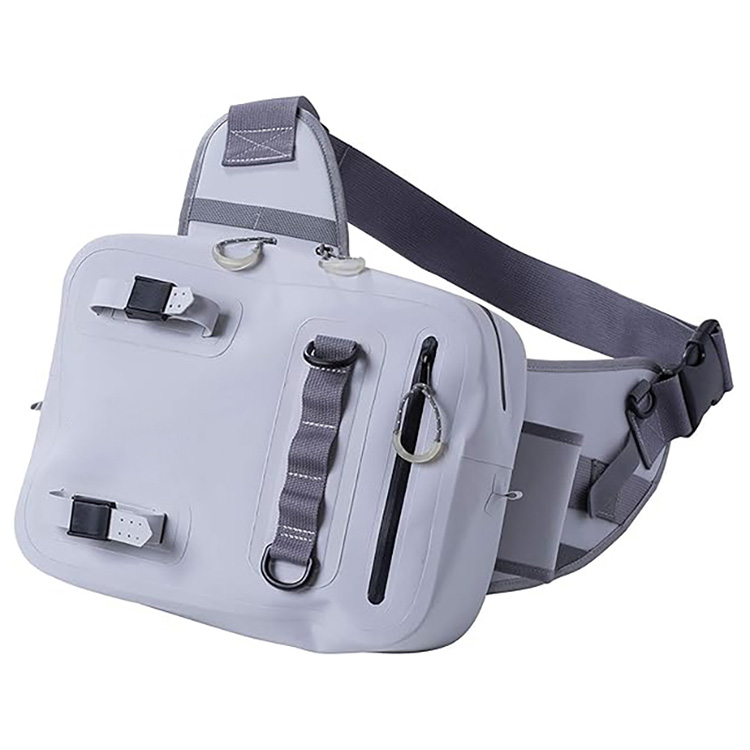
|
Airtight Zipper Waist Bag | 2.3L | Welded waterproof | IPX8 airtight zipper · waist / shoulder / chest carry · two rod straps | View |
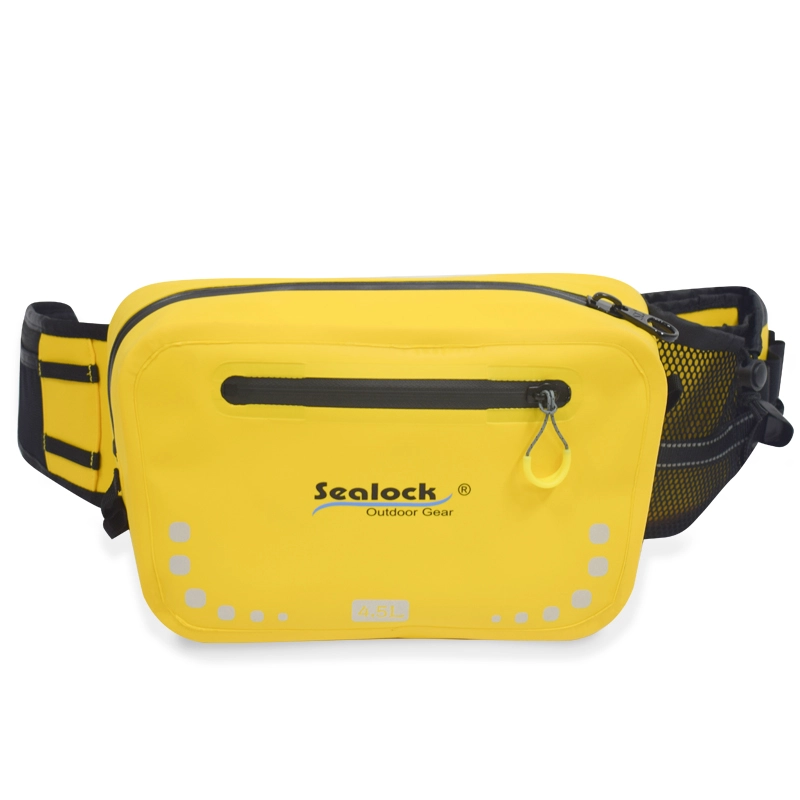
|
Creek Hip Pack | 4.5L | Coated waterproof fabric | Hip carry for wading · adjustable waist strap | View |
|
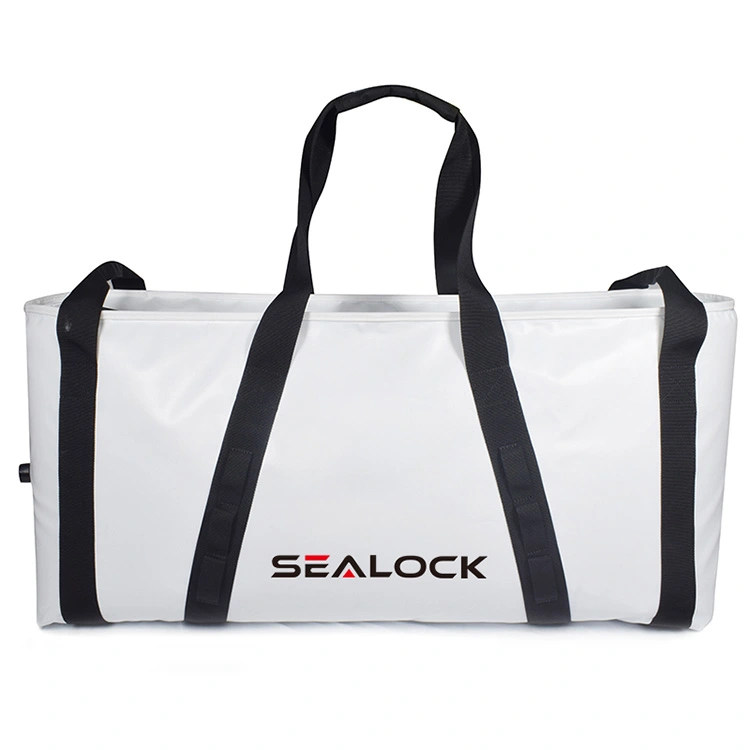
SL-C377 / C379 / C380 | 30 / 90 / 120L | PVC mesh fabric | Insulated · boat fishing, tuna, sea bass · adjustable strap | View |
|
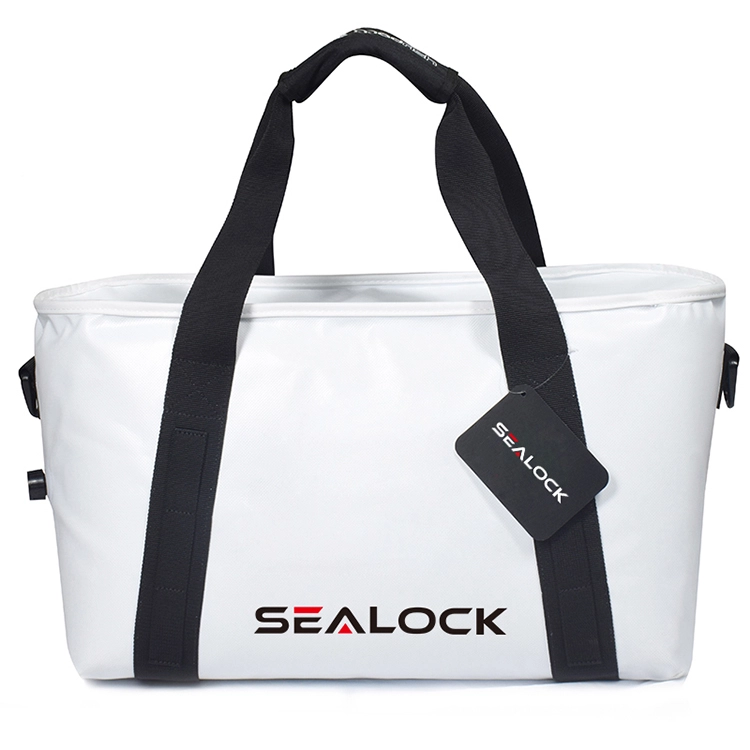
SL-C377 | 50 × 30 × 30 cm | PVC mesh fabric | Insulated · sea and lake fishing · four colours | View |
The ladder runs 2.3L to 21L across hip, sling, shoulder, and backpack formats, plus insulated kill bags to 120L — enough to build a complete fishing range under one logo and colourway in a single production run. Full categories sit under waterproof bags, dry backpacks, and dry bags. Customization scope is covered in the guide to custom dry bags, and harness engineering in the guide for waterproof backpack OEM projects.
9. OEM Scope
Beyond logo and colour, a fishing programme can specify capacity and dimensions, waterproof level from splash-rated to IPX8 submersible, fabric and denier in TPU or PVC, closure type and zipper grade, carry configuration including left or right sling and convertible dual-strap backpack, interior dimensioning to a chosen tray standard, divider and tray layout, lash strap and MOLLE arrangement, rod holder and plier sheath inclusion, reflective trim, patch panel, and packaging. Logo methods run to welded patch, rubber patch, silkscreen, heat transfer, and embroidery. Ground-up development from a sketch, sample, or target spec is supported, with tooling and lead time scheduled against a launch date.
10. Quality Control
On the fishing lines, fabric inspection, weld seam inspection, airtight zipper testing, colour consistency against the signed sample, appearance, and carton inspection all run at 100%, with a full water immersion test of two hours or more by batch sampling, and strap, buckle, handle, lash strap, and D-ring pull testing by random sampling. Around that, three-stage control applies — IQC on incoming fabric, zippers, and hardware; IPQC on welds and zipper installation in process, including peel tests at run start; and OQC with AQL sampling and gold-sample comparison. Salt spray testing covers hardware destined for marine use. The full customer inspection procedure — unboxing, vacuum extraction, a 24-hour static rest, and air-leak determination — can be witnessed end to end, with SGS or QIMA inspection available. Standards are set out in the quality control standards for waterproof production.
11. FAQ
Q: What does IPX8 to 20 m actually mean for an angler?
A: The sealed main compartment protects reels, electronics, and documents through full submersion, not just rain. It matters for kayak anglers, waders who slip, and boat anglers in rough water — the situations where a splash-rated bag loses its contents.
Q: What fails first on a fishing bag?
A: Hardware, in saltwater. Standard zippers and fittings seize after a few salt trips even when the fabric is fine, and the zipper end is the usual failure point on a sealed closure. Specify corrosion-resistant components, a moulded end cap, and salt spray testing.
Q: Why does zipper pull design matter so much?
A: Because an airtight zipper needs real leverage to close fully, and anglers close it with cold, wet, gloved hands. An assist cord or moulded T-grip pull is the difference between a seal that is actually closed and one that looks closed.
Q: How do we size the interior?
A: From the tackle tray outward. Anglers buy around trays they already own, so the cavity, divider spacing, and opening are dimensioned to the chosen tray standard rather than to a litre figure. Internal dividers and trays are specifiable options.
Q: Sling or backpack for a first range?
A: Both, in that order. Slings dominate lure, bank, and wading fishing because they swing round for tackle access without coming off; backpacks serve kayak, hike-in, and full-day anglers. A 12L or 15L sling plus a 20L or 21L backpack covers most of the market.
Q: What are the MOQ and lead times?
A: 300 pcs on most models, 500 on the 15L and 12L slings and the 20L shoulder bag. Samples run 7–15 days and production 30 days for 1–500 pcs on the sling line, negotiable above that, with capacity at 15,000 pcs per month.
Request a Fishing Range Proposal
For tray-standard dimensioning, hardware specification, samples, or a full OEM proposal, submit an inquiry. Sealock responds to procurement enquiries within 24 hours, with production from Dongguan, China or Ho Chi Minh City, Vietnam.