
- English
- Español
- Português
- русский
- Français
- 日本語
- Deutsch
- tiếng Việt
- Italiano
- Nederlands
- ภาษาไทย
- Polski
- 한국어
- Svenska
- magyar
- Malay
- বাংলা ভাষার
- Dansk
- Suomi
- हिन्दी
- Pilipino
- Türkçe
- Gaeilge
- العربية
- Indonesia
- Norsk
- تمل
- český
- ελληνικά
- український
- Javanese
- فارسی
- தமிழ்
- తెలుగు
- नेपाली
- Burmese
- български
- ລາວ
- Latine
- Қазақша
- Euskal
- Azərbaycan
- Slovenský jazyk
- Македонски
- Lietuvos
- Eesti Keel
- Română
- Slovenski
- मराठी
- Srpski језик

Fishing Bag Supplier Selection Guide
Sealock is a waterproof fishing bag supplier and OEM manufacturer serving tackle brands, distributors, and retail buyers from factories in China and Vietnam. Vetting a supplier in this category has one question at its centre that no other outdoor category shares: saltwater destroys zippers, and experienced anglers openly say that a zipper exposed to salt will eventually fail regardless of care. How a supplier answers that determines whether its product survives a second season — and it is the fastest way to separate a real fishing manufacturer from a general bag factory.
1. Start With the Zipper Question
Ask any candidate supplier directly: how does your construction answer saltwater zipper failure? There are three legitimate answers, and a capable supplier can build all three:
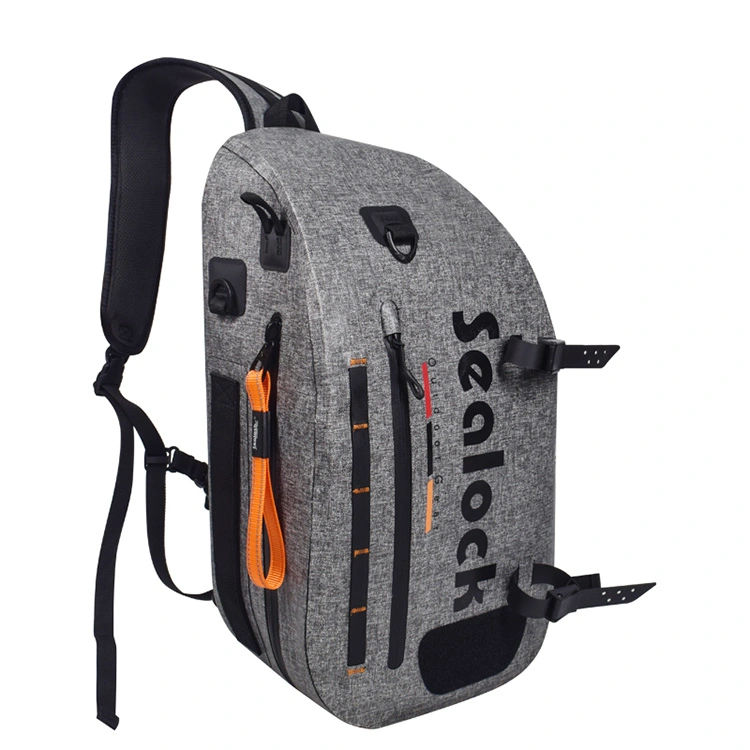
- A rated corrosion-resistant closure, engineered at the failure point. Marine-grade or polymer-tooth zippers survive salt far better than standard metal, but the detail that matters is the zipper end — where the slider parks and grit collects. A moulded waterproof end cap protects it, as on the 15L sling, and an assist cord or moulded T-grip pull ensures the seal actually gets closed with cold, wet, gloved hands.
- A zipperless construction. Roll-top and fold-seal designs remove the failure mode entirely, which is exactly why many saltwater anglers move to them for soft plastics and wet storage.
- A hybrid layout that keeps hard utility boxes inside a simpler sealed body, so the closure carries less duty.
A supplier that offers only one of these, or that answers with marketing language rather than component detail, is telling you how deep its category experience runs.
2. Demand Proof of the Waterproof Claim
Kill bags and tackle bags are notorious for leaking against their listings — anglers routinely report lining bags with contractor sacks or sealing seams themselves after purchase. Any claim above splash resistance should come with a test method, not an adjective.
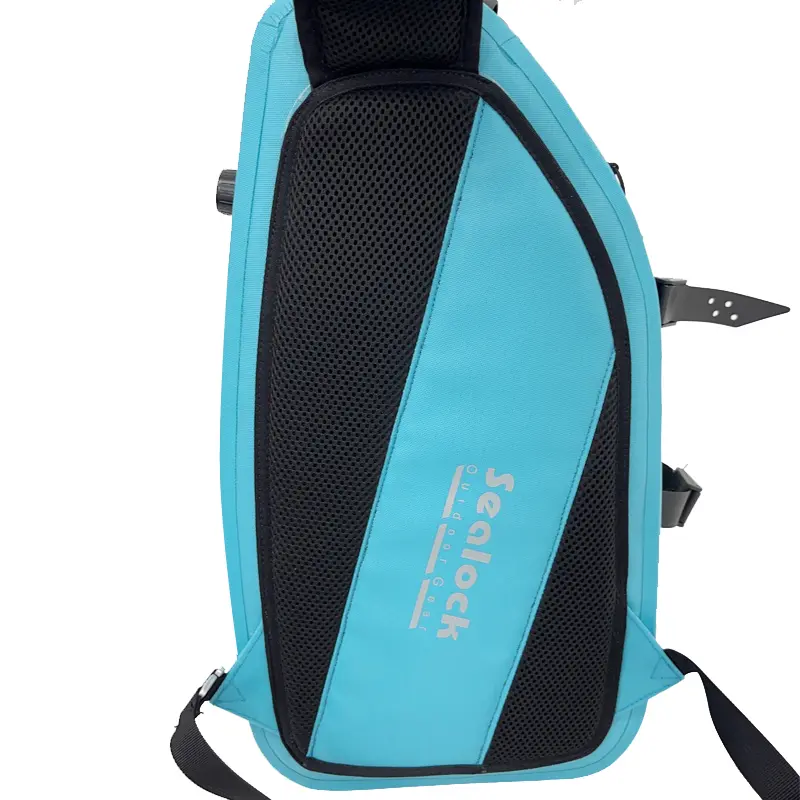
What to request: the IPX level tied to a named test; immersion testing on filled, sealed units rather than empty ones; and the duration. Sealock's fishing lines run a full water immersion test of two hours or more by batch sampling, with 100% inspection on fabric, weld seams, airtight zipper function, colour consistency, appearance, and cartons. The 15L and 12L slings are rated IPX8 and sealed to a 20 m depth; a supplier making a comparable claim should be able to show how it was verified.

3. Welded or Stitched — Ask Where
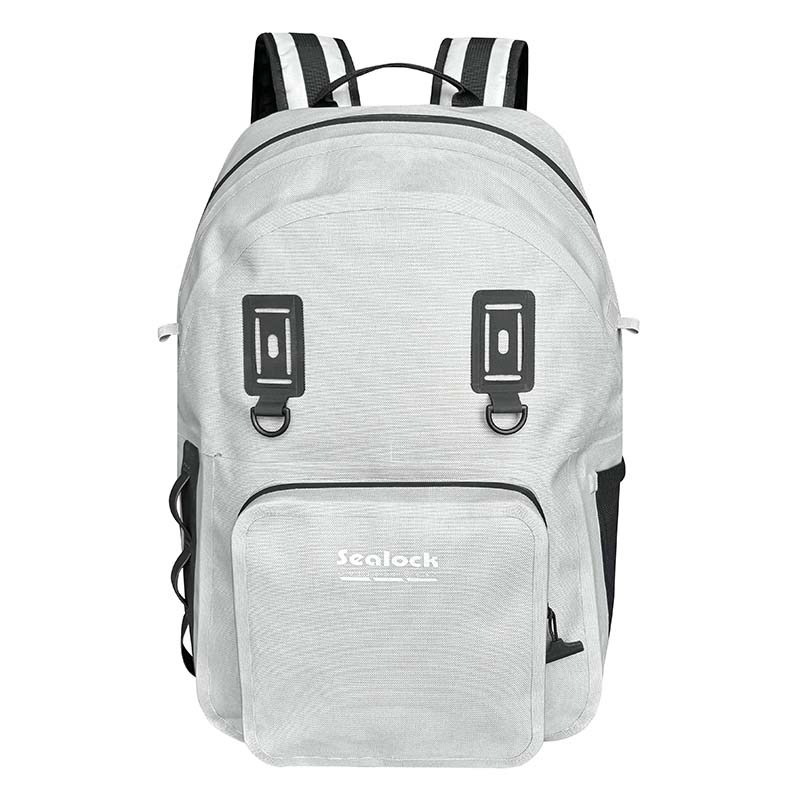
Salt intrusion through stitching corrodes internal metal components and breaks down fabric faster than fresh water does, which is why welded seam construction is preferred over stitching in high-stress areas on serious fishing gear. Ask a supplier which seams are welded, which are stitched, and how anything load-bearing attaches without piercing the waterproof layer. On the compact sling the body and liner are welded as one piece so the interior wipes out dry; on the 21L backpack the panel structure is fully stitchless RF-welded. A supplier that cannot describe its seam strategy in that level of detail is unlikely to have one.
4. Hardware, and the Evidence for It
Salt attacks fittings before fabric, and the components that seize are the ones anglers complain about — straps and buckles deteriorating, zippers freezing, metal rusting from the inside out. Corrosion-resistant hardware costs a manufacturer meaningfully more, which is why value bags omit it and why the difference surfaces in year two rather than year one.
Ask for salt spray test results specifically, not a general durability statement. It is a standard part of the laboratory suite here alongside load cycling at straps, handles, lash straps, and D-rings, tensile and bonding strength, friction resistance, colour fastness, and colour difference.
5. Does the Supplier Know the Tray Standard?
This is a fast competence check. Anglers buy around the plastic utility trays they already own, and established tackle bags are dimensioned and even named for the tray size their compartments accept — the two standards being roughly 10.5 × 7 × 1.5 inches and 14 × 8.5 × 2 inches. A supplier that discusses interiors purely in litres, and cannot talk about tray fit, shelf spacing, or how many trays a main compartment holds, has not built for this category before.
6. Can They Serve Both Tiers?
A fishing range needs a submersible premium tier for kayak, saltwater, and electronics-carrying anglers and a water-resistant core tier where most volume sits. A supplier limited to one construction cannot cover a retail price ladder. Evidence of both looks concrete: IPX8 slings on welded 840D double-coated TPU alongside IPX7 and water-resistant models in PVC laminate and 600D TPU on nylon, with formats running from a 2.3L waist pack to 120L insulated kill bags. Range architecture for a wholesale programme is set out in the guide to OEM fishing bags for wholesale buyers.
7. Test the Sample the Way an Angler Will
Desk inspection tells you almost nothing here. A meaningful sample evaluation:
- Load it and wear it. Swing a sling round to the chest as if changing lures; check the stabiliser strap holds it steady and the depth stays clear of the casting arm.
- Operate it wet and gloved. An airtight zipper needs real leverage — if it cannot be fully closed with cold wet hands, it will not be closed properly in the field.
- Submerge it, filled, and leave it. A brief dunk proves little; a sustained immersion finds pinholes and imperfect closure seating.
- Rinse it. Fish slime, blood, and salt should wipe or hose off a coated surface, which is a large part of why PVC and TPU dominate this category over absorbent fabrics.
- Overload it deliberately. Overloading is what breaks zippers and straps in real use, so it is worth knowing where the sample's limit is before customers find it.
8. Red Flags
- "100% waterproof" with no test method or rating. The category's most common overclaim, and the one that generates returns.
- Vagueness about zipper brand, grade, or end protection. The defining component, answered generically.
- No salt spray data. For a product sold into saltwater use, this is a gap, not an oversight.
- Interior described only in litres. Suggests no tray-standard experience.
- Only flat, empty samples offered. If a supplier resists filled and submerged testing, it knows what that reveals.
- No stated warranty position. Most models here carry a one-year warranty; a supplier unwilling to state any is signalling something.

9. Check the Reorder Before the First Order
A tackle retailer cannot absorb colour drift or a substituted zipper between shipments. Before committing, confirm whether fabric lot, colour, and hardware can be reserved or matched for repeats, whether a signed gold sample is held by both sides, and whether colour-difference testing runs on every batch. It is screenable in advance rather than discovered at replenishment.
10. Sealock Capability Summary
Sealock (YiFuLong Outdoor Gear Co., Ltd.) has built welded waterproof bags for over 20 years, producing for international outdoor and marine brands including SIMMS, ORVIS, West Marine, and PENN. In-house 27.12 MHz high-frequency welding runs alongside industrial sewing lines.
- MOQ: 300 pcs on most models; 500 pcs on the 15L and 12L slings and the 20L shoulder bag
- Samples: 7–15 days | Bulk: 30 days for 1–500 pcs on the sling line | Capacity: 15,000 pcs/month
- Certifications: BSCI, ISO 9001, Sedex, plus HIGG, GRS, SCAN; factory audit available
- Warranty: one year on most fishing models | Packing: 1 pc per PP bag, 20 per carton, loading from Shenzhen
- Origin: Dongguan, China or Ho Chi Minh City, Vietnam on any model
11. Range to Evaluate Against
Models organized by type rather than priority:
| Image | Model | Capacity | Material | Verification points | Product Page |
|---|---|---|---|---|---|
|
SL-E589 | 15L | 840D double-coated TPU | IPX8 to 20 m · moulded zipper end cap · assist cord · waist belt · 868 g | View |
|
SL-E868A | 12L | 840D double-coated TPU | IPX8 to 20 m · welded one-piece liner · T-grip pull · 800 g | View |
|
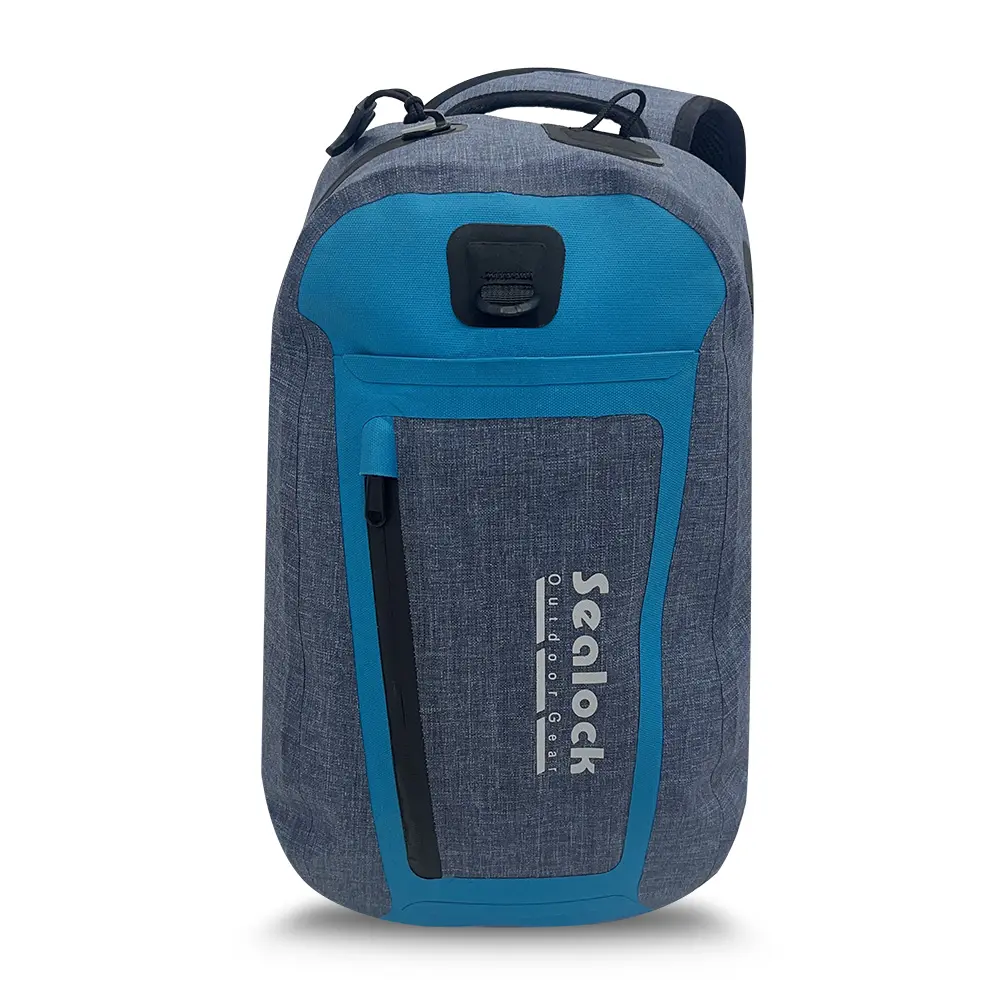
SL-E548 | 8L | 500D PVC laminate | IPX7 · full-curve airtight zipper · moulded side attachment plates | View |
|
SL-E1144 | 21L | Melange TPU laminate | 100% stitchless RF-welded panels · EVA vent back · waist belt · D-rings | View |
|
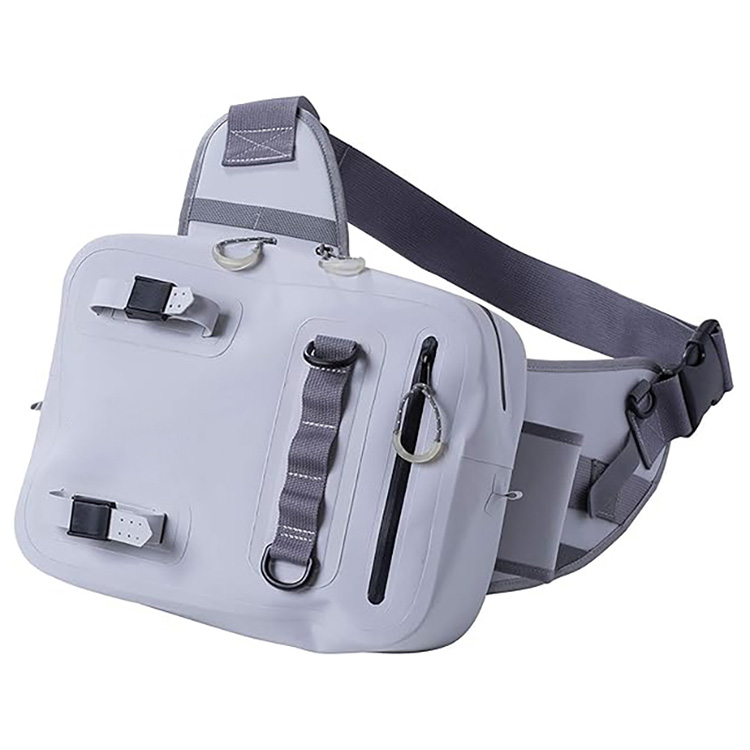
Airtight Zipper Waist Bag | 2.3L | Welded waterproof | IPX8 airtight zipper with safety pull · waist / shoulder / chest carry | View |
|
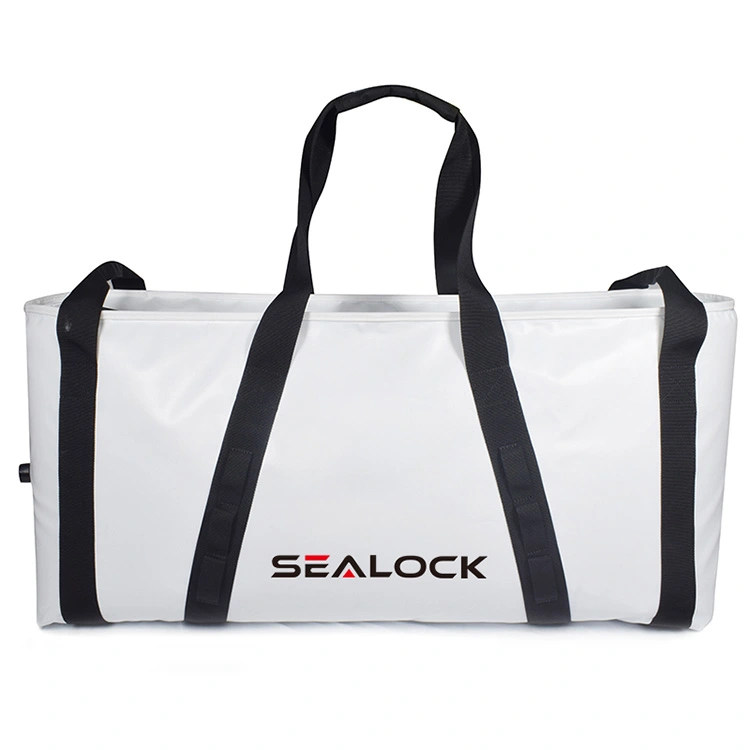
SL-C377 / C379 / C380 | 30 / 90 / 120L | PVC mesh fabric | Insulated · boat fishing, tuna, sea bass · rinse-clean | View |
Full categories sit under waterproof bags, dry backpacks, and dry bags. Category engineering is covered in the guide for fishing bag manufacturing, and material selection in the TPU material guide.
12. Quality Control
Fabric inspection, weld seam inspection, airtight zipper testing, colour consistency against the signed sample, appearance, and carton inspection run at 100%, with full water immersion of two hours or more by batch sampling and strap, buckle, handle, lash strap, and D-ring pull testing by random sampling. Three-stage control applies around that — IQC on incoming fabric, zippers, and hardware; IPQC on welds and zipper installation including peel tests at run start; and OQC with AQL sampling and gold-sample comparison. The full customer inspection procedure — unboxing, vacuum extraction, a 24-hour static rest, and air-leak determination — can be witnessed end to end, with SGS or QIMA inspection available. Standards are set out in the quality control standards for waterproof production.
13. FAQ
Q: Anglers say saltwater kills every zipper eventually. Is that true?
A: It is the category's default outcome with ordinary hardware, which is why the question is the first one to ask a supplier. The answers that work are a rated corrosion-resistant closure with a protected zipper end, a zipperless roll-top or fold-seal construction, or a hybrid layout using hard utility boxes inside a simpler sealed body. A supplier should offer more than one.
Q: How do we verify a waterproof claim rather than accept it?
A: Ask for the IPX level tied to a named test, insist testing is on filled and sealed units, and ask the duration — immersion of two hours or more is a meaningful standard, a brief dunk is not. Kill bags in particular are widely reported as leaking against their listings, so evidence matters more here than in most categories.
Q: What tells me a supplier has genuinely built fishing bags before?
A: Tray-standard fluency. If it discusses interiors only in litres and cannot talk about tray fit, shelf spacing, or how many trays a compartment holds, it has been building general bags. Fishing bags are dimensioned around the trays anglers already own.
Q: Which test results are worth requesting?
A: Salt spray on hardware first, because fittings fail before fabric in this category; then immersion on filled units against the stated rating; then load-cycle and pull testing at straps, handles, lash straps, and D-rings, since overloading is what breaks bags in real use.
Q: How should we evaluate the sample?
A: The way an angler will — loaded and worn, operated with wet gloved hands, submerged for a sustained period, rinsed clean of slime and salt, and deliberately overloaded to find its limit. Anything less tests appearance rather than performance.
Q: How do we prevent the second shipment differing from the first?
A: Confirm before the first order whether fabric lot, colour, and hardware can be reserved or matched, hold a signed gold sample on both sides, and require colour-difference testing on every batch.
Evaluate Sealock as a Supplier
To assess capability the practical way — request immersion and salt spray data, a video walk of the welding line, and a sample built to your specification for loaded, submerged testing — submit an inquiry. Sealock responds to procurement enquiries within 24 hours.