
- English
- Español
- Português
- русский
- Français
- 日本語
- Deutsch
- tiếng Việt
- Italiano
- Nederlands
- ภาษาไทย
- Polski
- 한국어
- Svenska
- magyar
- Malay
- বাংলা ভাষার
- Dansk
- Suomi
- हिन्दी
- Pilipino
- Türkçe
- Gaeilge
- العربية
- Indonesia
- Norsk
- تمل
- český
- ελληνικά
- український
- Javanese
- فارسی
- தமிழ்
- తెలుగు
- नेपाली
- Burmese
- български
- ລາວ
- Latine
- Қазақша
- Euskal
- Azərbaycan
- Slovenský jazyk
- Македонски
- Lietuvos
- Eesti Keel
- Română
- Slovenski
- मराठी
- Srpski језик

Waterproof Bike Bag Supplier from China
Sealock is a waterproof bike bag supplier and OEM manufacturer serving cycling brands, bikepacking labels, and distributors from factories in China and Vietnam. Sourcing bike luggage carries a risk no other bag category has: a bag can be flawlessly manufactured — perfect welds, clean stitching, correct materials — and still be a total loss, because it does not fit the bike. Fit is the failure mode here, and it is what supplier vetting in this category has to be built around.
1. Fit Is the Risk You Are Actually Buying
A duffel fits anyone. A frame bag fits one frame model in one size, a saddle pack has to clear a specific tire under compression, and a handlebar bag has to work around a specific cockpit. That means the usual quality questions — seam strength, fabric grade, zipper quality — are necessary but not sufficient. A supplier can pass all of them and still deliver a container of bags customers cannot mount.
So the vetting sequence for this category starts one step earlier than usual: not "can you build it well" but "can you get the geometry right, and can you prove it before bulk."
2. Ask Whether They Develop Patterns or Only Sew
This is the fastest way to separate a real bike bag supplier from a general bag factory taking cycling orders. Ask directly:
- Can you work from a frame template or calibrated photographs? A capable supplier will tell you exactly what it needs — traced templates or square-on photographs with a scale in the plane of the frame — and what details must be marked on them.
- Can you grade a pattern across a frame family? A brand with three models in four sizes is a twelve-pattern programme. A supplier that treats each as a fresh development will be slow and expensive; one that grades where geometry allows will not.
- Do you keep a template library? Suppliers with real category history hold frames on file, which turns an adjacent model or a new model year into an adjustment rather than a restart.
- How do you handle full-suspension frames? The honest answer is that they are a separate development stream with their own patterns, because a horizontal shock leaves a triangle barely big enough for a bottle. A supplier that says "no problem, same bag" has not built them.
Sample development on frame bags runs 7–10 days here, and the frame bag line carries capacity to 50,000 pieces per month — which is worth knowing because on this category pattern development, not line capacity, is normally the constraint on how fast a range can launch.

3. Ask Whether They Weld and Sew, or Only One
Bike bags need both disciplines in a way few categories do, and a supplier limited to one will compromise the half it cannot do. Welding produces the sealed, needle-hole-free body that keeps rain and tire spray out of a bag mounted inches above a wet wheel. Sewing produces the strap systems, repositionable hook-and-loop anchors, internal stiffeners and anti-sway structure, bartacked reinforcement at every mounting point, frame-contact protection panels, and the harness on cycling backpacks.
A sewing-only shop cannot seal a body properly. A welding-only shop cannot build the mounting architecture that makes a bike bag stay put. Ask which processes are in house and which are subcontracted — subcontracting either one adds a handoff exactly where fit and durability are decided. Sealock runs 27.12 MHz high-frequency welding and industrial sewing as separate workshops on the same production floor, so a bag moves between them inside one facility.
4. Ask for Honest Ratings on Small Parts
This category is full of small bags marketed as "100% waterproof" that should never be submerged, and the overclaim lands on whoever imports it. A supplier willing to distinguish between ratings is more trustworthy than one that applies the highest claim to everything:
- Small frame, top tube, and under-saddle bags are built for rain and road spray. The 0.8L top tube platform in 800D TPU is scratch-resistant and sealed against weather, and its own specification states it should not be immersed.
- Saddle packs and cycling backpacks carry higher ratings — the bikepacking saddle pack is IPX6–7, the commuter backpacks IPX6.
Ask a candidate supplier to state the rating per model and the test behind it. Testing should match the claim too: rain and spray testing for weather-rated small parts rather than immersion protocols borrowed from submersible products, which is a sign a supplier understands its own range rather than reciting a template.
5. Ask for Real Weights
Weight matters more in cycling than in any other bag category, and it is easy to verify. Ask for actual measured weights per model rather than nominal figures — on products where a competitive item weighs 80 grams, a 30-gram difference is a genuine objection at retail. A supplier that publishes weights across its range is one that measures them; a supplier that has to go and check is one that has not been asked by serious buyers before.
6. Ask What One Supplier Can Cover
Bike accessory programmes fragment easily — frames, packs, and packaging often end up with different vendors across different provinces, which multiplies quality checks, shipping schedules, and points of failure. Consolidation is worth real money here, so ask what a single supplier can carry:
- Positions — frame, top tube, handlebar, saddle, under-saddle, rear rack, and cycling backpacks, so a coordinated system ships under one logo and colourway in one run.
- Both constructions — welded sealed bodies and sewn structures, as above.
- Both origins — production from Dongguan, China or Ho Chi Minh City, Vietnam on any model, so country of origin can follow a buyer's tariff position.
7. The Sample Must Be Tested on the Bike
The single most common vetting failure in this category is approving a sample from photographs or a table inspection. It proves nothing about the only thing that matters. A meaningful evaluation:
- Mount it on the actual frames the range is intended for, in each size, not just the sample bike.
- Load it and compress the suspension — clearance changes under load and travel, and a saddle pack that clears the tire empty may not when packed.
- Check for conflicts with bottle cages, top tube bags, and cables — strap positions that work in isolation often clash once the whole system is fitted.
- Ride it. Sway, rattle, squeak, and knee contact only appear in motion, and a bag that makes noise is one riders stop using.
- Weigh it against the stated figure.
Watch how the supplier behaves during this stage too. One that asks which frames the bag is for, and raises bottle mount or shock clearance before you do, understands the product. One that treats it as a generic bag with straps does not. The full development sequence is set out in the guide to OEM bike bags with custom design.
8. Red Flags
- No question about which bikes the bag is for. The most telling omission in this category.
- "100% waterproof" applied to every model. Small frame and saddle bags are weather-rated products; a supplier that will not say so is transferring a returns problem to you.
- Only one construction process in house. Either the seal or the mounting architecture will be compromised.
- Resistance to on-bike sample testing. If a supplier prefers you approve from photographs, it knows what mounting reveals.
- No published weights. Suggests nobody serious has asked.
- Vagueness on pattern grading and template handling. Indicates the category experience is not there.
9. Sealock Capability Summary
Sealock (YiFuLong Outdoor Gear Co., Ltd.) has built waterproof bags for over 20 years, producing for international outdoor and cycling brands including KAILAS, OSPREY, Helly Hansen, and CHUMS.
- Production: in-house 27.12 MHz high-frequency welding and industrial sewing, separate workshops on the same production floor
- MOQ: 300 pcs on most models; 500 pcs on the rear rack tail bag and the 8L commuter backpack
- Samples: 7–10 days on frame bags, 7–15 days across the range | Bulk: 30–45 days
- Capacity: up to 50,000 pcs/month on the frame bag line; 15,000 pcs/month on under-saddle and tail bag lines
- Certifications: ISO 9001, BSCI, SMETA, HIGG, GRS, SCAN; factory audit available
- Origin: Dongguan, China or Ho Chi Minh City, Vietnam on any model
10. Range to Evaluate Against
Models organized by type rather than priority:
| Image | Model / type | Capacity | Material | Rating / features | Product Page |
|---|---|---|---|---|---|
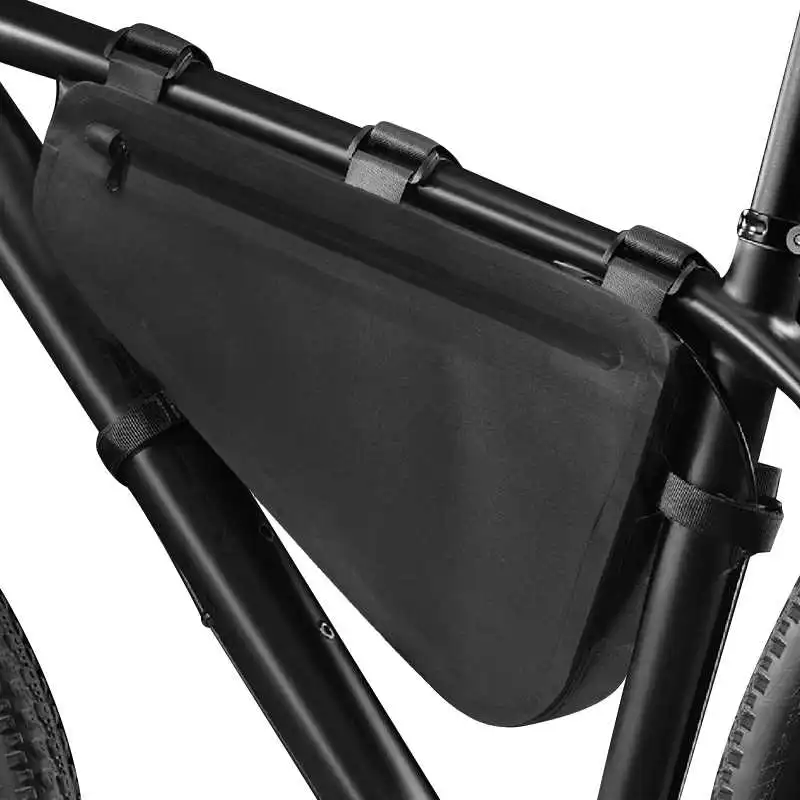
|
SL-K089-A Frame Bag | Cut to specification | 600D TPU | Sizes to buyer spec · four stock colours · line capacity 50,000 pcs/month | View |
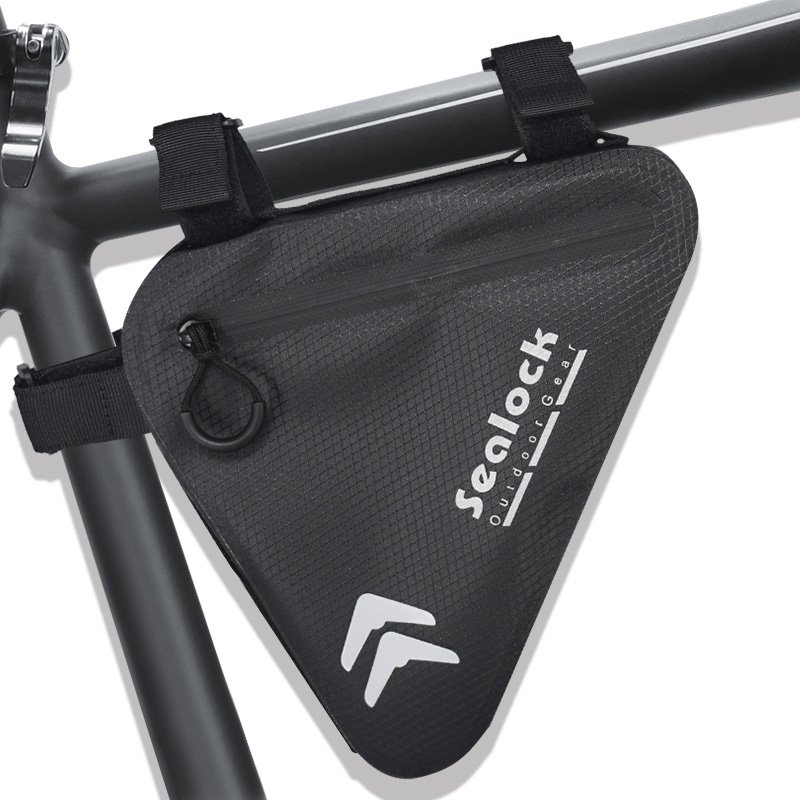
|
Top Tube Frame Bag | 0.8L · 80 g | 800D TPU | Rain and spray rated · three repositionable straps · waterproof zip | View |
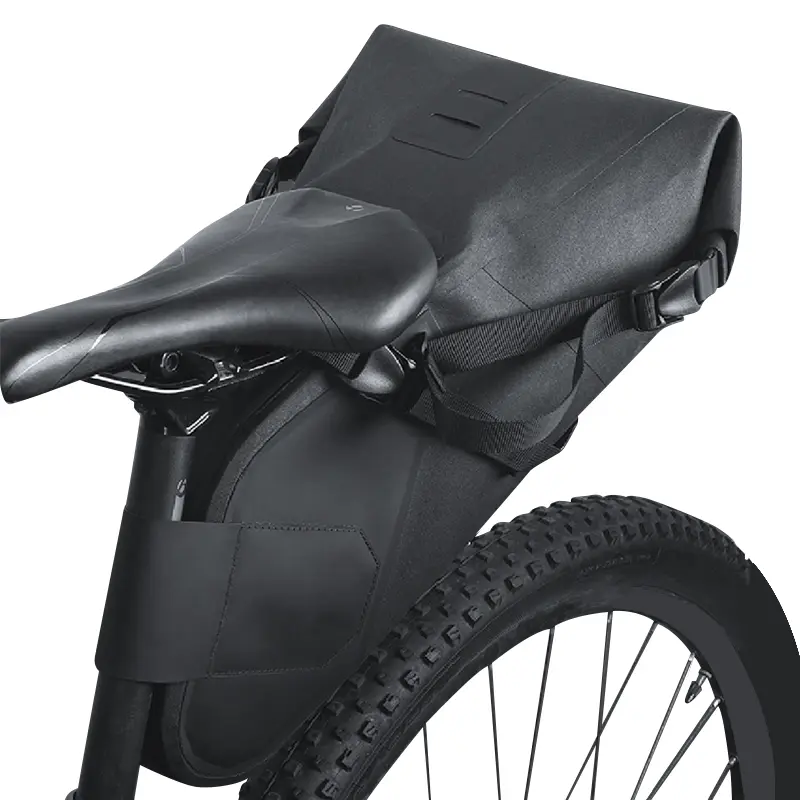
|
SL-K022 Saddle Bag | 10–14L | 420D + 600D TPU | IPX6–7 · roll-top · seat rails + seatpost · UTX/Duraflex buckles | View |
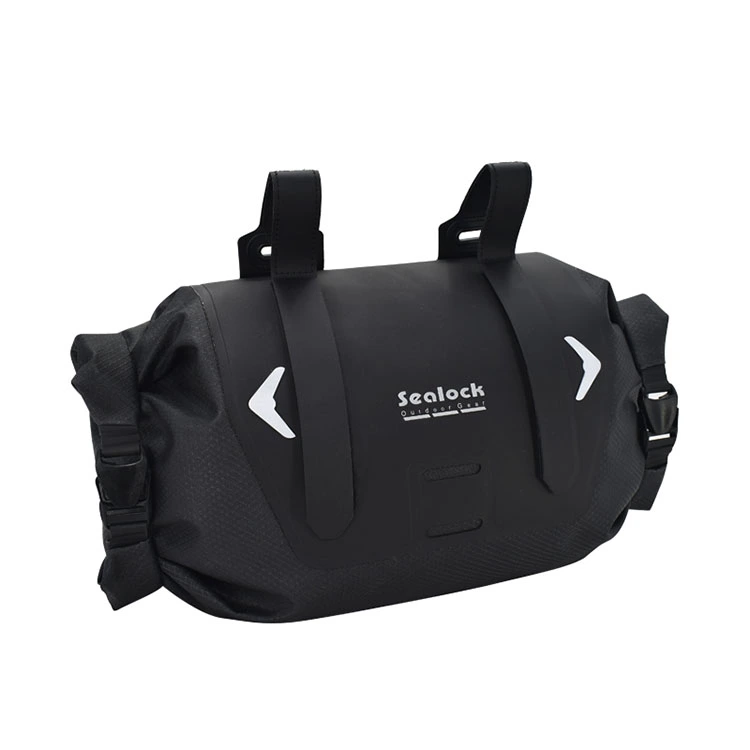
|
SL-K060B Handlebar Bag | 7L | TPU | Mountain and road cockpits · black, grey | View |
|
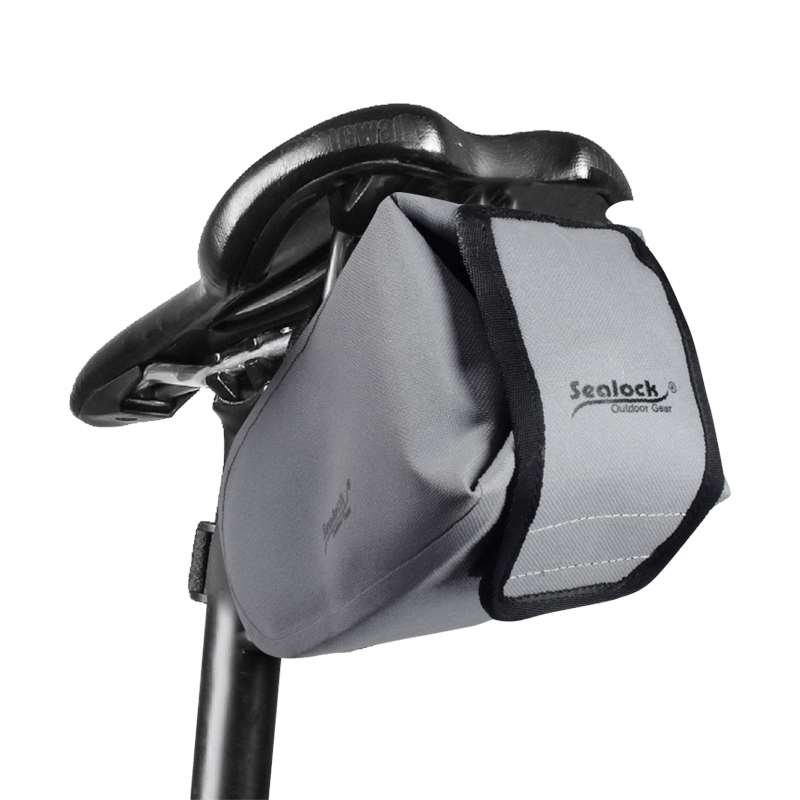
K055 Under-Seat Bag | 22.5 × 10.5 × 7 cm | 600D TPU | Under-saddle · BSCI / ISO · 15,000 pcs/month | View |
|
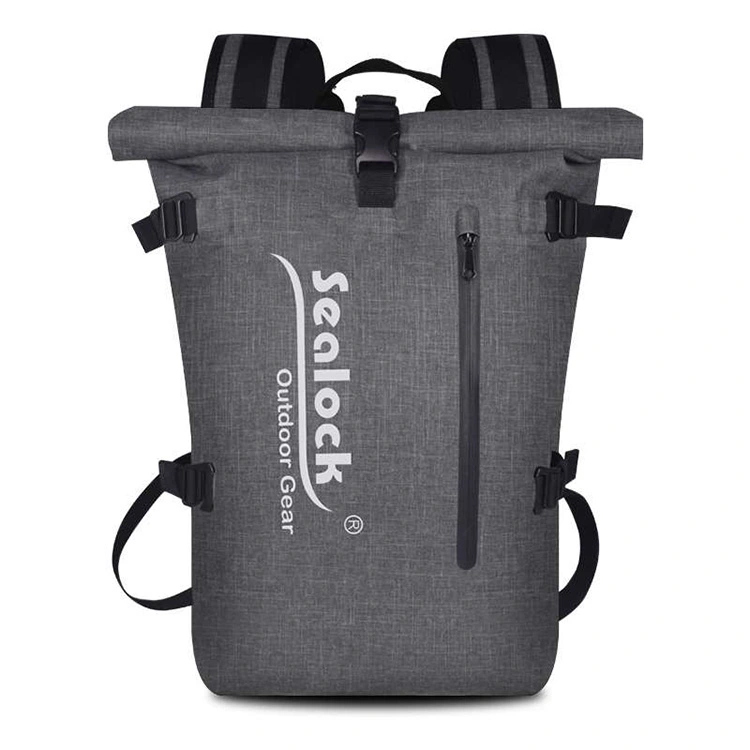
SL-E980 Commuter Backpack | 22L | 600D TPU laminate | IPX6 · roll-top · detachable 15.6" laptop sleeve · 0.95 kg | View |
Full categories sit under waterproof bags, dry backpacks, and dry bags. Category engineering is covered in the guide for cycling brands, and frame bag architecture in the guide for bikepacking brands.
11. Quality Control
Every batch runs IQC on incoming fabric, zippers, buckles, and webbing; IPQC on welds, stitch density and tension, and mounting-point construction in process, including peel tests on sample welds at run start; and OQC with AQL sampling, dimensional checks against the approved pattern, and signed gold-sample comparison. Dimensional control carries unusual weight in this category, because a frame bag a few millimetres out of pattern no longer fits the frame it was cut for. Load cycling over 1,500 cycles targets straps and anchors, alongside tensile and bonding strength, friction resistance for panels contacting frame and knees, colour fastness, and colour difference, with waterproof testing matched to each model's stated rating. Third-party inspection through SGS or QIMA is available, and buyers are welcome to send their own inspector. Standards are set out in the quality control standards for waterproof production.
12. FAQ
Q: What should we ask a bike bag supplier that we would not ask a general bag factory?
A: Whether they develop patterns from frame geometry, whether they can grade across frame sizes, whether they keep a template library, and how they handle full-suspension frames. Manufacturing quality is table stakes here; geometry capability is what determines whether the goods are sellable.
Q: Why does it matter whether a supplier both welds and sews?
A: Because bike bags need both. Welding builds the sealed body that keeps out rain and tire spray; sewing builds the strap systems, stiffeners, bartacked anchors, and frame-protection panels that make it stay put. A supplier with only one will compromise the other or subcontract it, adding a handoff exactly where fit and durability are decided.
Q: A supplier says every model is 100% waterproof. Is that plausible?
A: Rarely. Small frame, top tube, and under-saddle bags are built for rain and road spray, not immersion — our own 0.8L top tube bag is specified as not for submersion — while saddle packs and cycling backpacks carry higher ratings. A supplier that rates models individually is describing its range; one that applies the top claim everywhere is describing its marketing.
Q: How should we evaluate the sample?
A: On the bike, in each intended frame size, loaded and with the suspension compressed, alongside the bottle cages and other bags it will share the frame with — then ridden. Sway, rattle, and knee contact do not appear on a table, and clearance changes under load.
Q: Is capacity or pattern development the real bottleneck?
A: Usually pattern development. Line capacity on frame bags runs to 50,000 pieces per month, but a programme covering several frame models across sizes needs a pattern for each. Building a template library early and grading where geometry allows is what shortens the timeline.
Q: Should we consolidate the whole cycling range with one supplier?
A: Where the supplier genuinely covers the positions, yes. Splitting frame, saddle, handlebar, and backpack production across vendors multiplies inspections, shipping schedules, and colour-matching risk. One supplier covering all positions ships a coordinated system in a single run under one colourway.
Evaluate Sealock as a Supplier
To assess capability the practical way — send a frame template or calibrated photographs, request a video walk of the welding and sewing workshops, and take a sample built to your geometry for on-bike testing — submit an inquiry. Sealock responds to procurement enquiries within 24 hours.