
- English
- Español
- Português
- русский
- Français
- 日本語
- Deutsch
- tiếng Việt
- Italiano
- Nederlands
- ภาษาไทย
- Polski
- 한국어
- Svenska
- magyar
- Malay
- বাংলা ভাষার
- Dansk
- Suomi
- हिन्दी
- Pilipino
- Türkçe
- Gaeilge
- العربية
- Indonesia
- Norsk
- تمل
- český
- ελληνικά
- український
- Javanese
- فارسی
- தமிழ்
- తెలుగు
- नेपाली
- Burmese
- български
- ລາວ
- Latine
- Қазақша
- Euskal
- Azərbaycan
- Slovenský jazyk
- Македонски
- Lietuvos
- Eesti Keel
- Română
- Slovenski
- मराठी
- Srpski језик

TPU Waterproof Duffel Bag Advantages Over Traditional PVC Designs
1. Company Overview
Sealock (YiFuLong Outdoor Gear Co., Ltd.) has designed and produced welded waterproof bags for over 20 years, operating two facilities in Dongguan, China and Ho Chi Minh City, Vietnam, and produces for international outdoor and marine brands including OSPREY, Helly Hansen, West Marine, and CHUMS. Production is held to international compliance and social-audit standards.
- Established: 2003 (20+ years in waterproof bag manufacturing)
- Facilities: Dongguan, China | Ho Chi Minh City, Vietnam
- Certifications: ISO9001, BSCI, SMETA, HIGG, GRS, SCAN, CSR
- Services: OEM / ODM, custom logo, color, and capacity
2. Two Ways to Make a Fabric Waterproof
Both materials start from a woven base — usually nylon or polyester — and both are welded rather than sewn at the seams. The difference is how the waterproof layer is applied. PVC is a thick coating pressed onto the fabric, which makes a rugged, rigid, low-cost shell. TPU is a thin film laminated to the fabric, which stays lighter and more flexible for the same waterproofing. That single distinction drives every practical difference below.
3. TPU vs PVC at a Glance
A direct comparison of the two materials on a duffel, holding construction and denier roughly equal:
| Property | TPU laminate | Traditional PVC coating |
|---|---|---|
| Weight | Lighter for the same protection | Heavier coating |
| Cold-weather behavior | Stays flexible, resists cracking | Stiffens; can crease and crack in the cold |
| Odor | Low, near-odorless | Plasticizer smell, especially when new |
| Flex / fold fatigue | High flex resistance over many cycles | Fatigues at fold lines over time |
| Service life | Longer under UV and flex | Shorter, but tough against abrasion |
| Rigidity | Soft, packs flat | Holds shape, stands up on its own |
| Cost | Higher material cost | Lower material cost |
| Environmental profile | No plasticizers, more recyclable | Contains plasticizers |
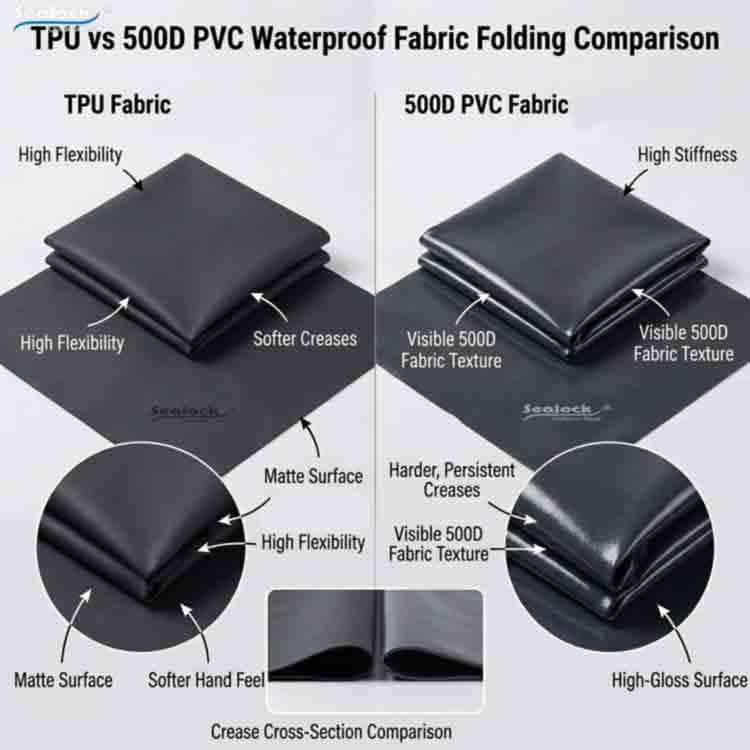
4. Where TPU Pulls Ahead on a Duffel
On a bag that gets carried, folded, and left in the sun, the TPU duffel advantages compound over a season of use:
- Lighter to carry: the thin laminate cuts dead weight, which matters on a 40–60L bag that is already heavy when full
- Reliable in the cold: TPU stays pliable on an alpine morning or a winter dock, where PVC can stiffen and crease at the fold
- Longer life under folding: a roll-top folded daily accumulates thousands of cycles, and TPU's flex resistance resists the hairline cracks PVC develops at the crease
- Cleaner to store and ship: the low odor avoids the plasticizer smell that PVC gives off in an enclosed bag, a frequent end-user complaint
- Better UV endurance: TPU holds up longer under the sun exposure that ages any waterproof bag left on deck or roof
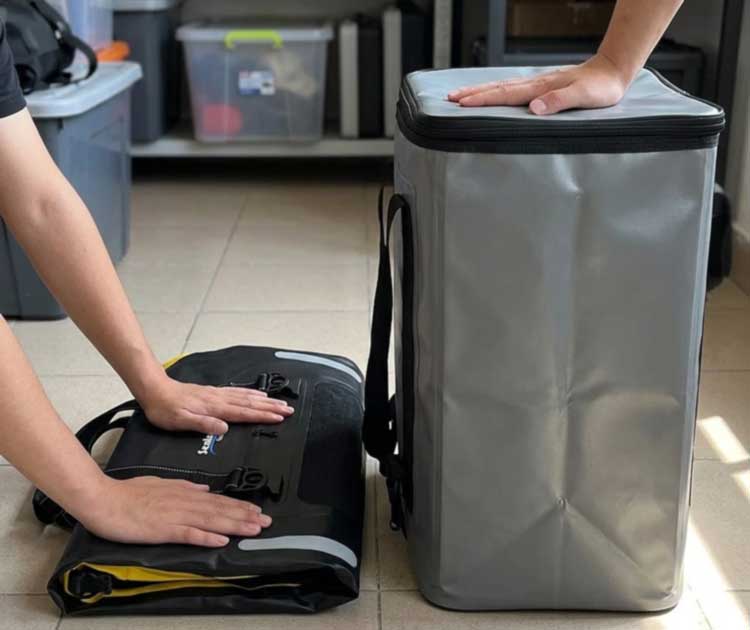
- Packs flat when empty: the softer shell folds down for storage and travel, where a rigid PVC body stays bulky
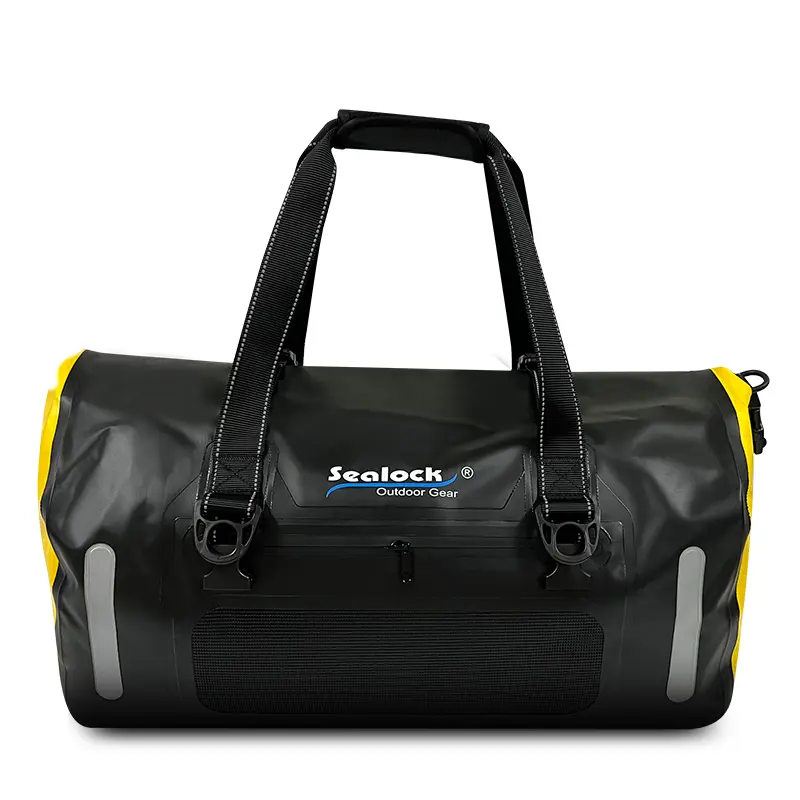
The 840D TPU used on the Sealock SL-K099 duffel is a heavy-denier laminate specifically, so it keeps TPU's weight and flexibility advantages while matching the abrasion resistance buyers expect from a rugged travel bag.
5. Where Traditional PVC Still Fits
TPU is not the answer to everything, and Sealock specifies PVC where it genuinely wins. PVC's thicker coating gives excellent abrasion resistance and a rigid body that holds its shape, which suits bags that need to stand up on their own or take constant scraping — motorcycle luggage, tarpaulin-grade dry bags, and value-priced lines where the lower material cost matters more than grams. The right answer is the material that fits the use, which is why the range carries both. For a lightweight, cold-tolerant, long-folding travel and outdoor duffel, TPU is the stronger choice; for a rugged, rigid, cost-driven workhorse, PVC still holds up.
6. Sealock TPU Duffel Range
The range below leads with the 840D TPU SL-K099 and covers related Sealock TPU duffels, with verified specifications and product pages.
| Image | Model / Series | Capacity | Material | Closure | Best for | Product Page |
|---|---|---|---|---|---|---|
|
40L / 60L Roll-Top Waterproof Duffel (SL-K099) | 40L / 60L | 840D TPU | Roll-top, IPX7 | Weekend to multi-day travel | View |

|
Waterproof Duffle Bag for Kayaking | Multiple | TPU composite | IPX8 zipper | Water travel, quick access | View |

|
Duffle Bag Waterproof Backpack (convertible) | Multiple | TPU (HF welded) | Roll-top / zipper | Hands-free transfers | View |
|
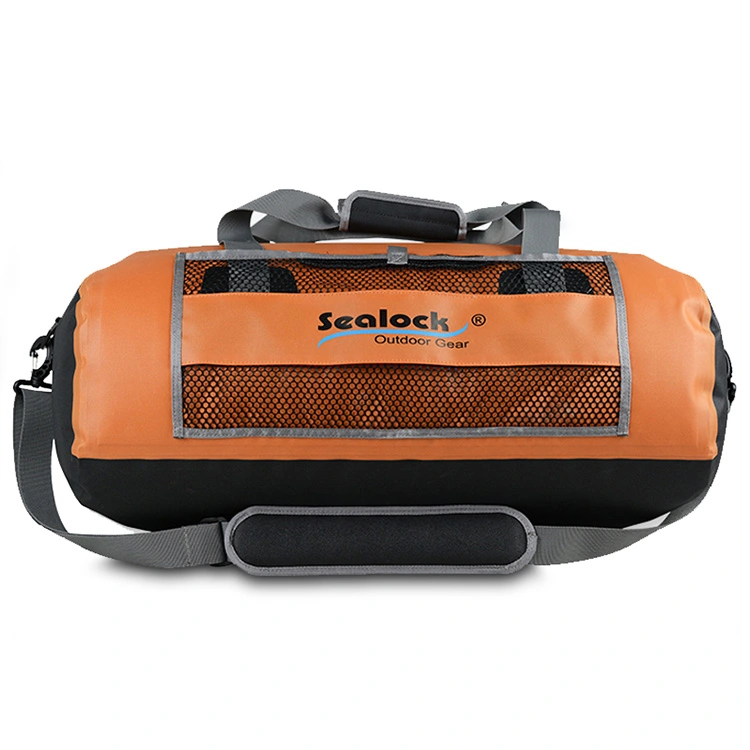
Camouflage Waterproof Duffel Bag 40L | 40L | 420D TPU | Roll-top | Lighter carry, hunting | View |
7. Quality Control
Sealock applies a three-stage control to every batch before shipment. The laboratory test suite covers a load test of over 1,500 cycles, tensile strength, bonding strength, salt spray, friction resistance, color fastness, and color difference, plus a full water immersion test to confirm the welded TPU body and roll-top keep the interior dry. Because TPU's advantage depends on weld and lamination quality, bonding strength is checked closely at the seams. Inspection runs in three stages: IQC checks incoming TPU-laminated fabric and hardware, IPQC samples welds and lamination in line, and OQC performs AQL sampling, batch immersion testing, and signed gold-sample comparison, with optional SGS/QIMA third-party inspection on request.
8. OEM / ODM Customization and Cooperation
Sealock supports full customization for brand and distributor orders, including specifying TPU or PVC against a target weight, cost, and durability. Options run from logo and color through to ground-up development of an original duffel against a buyer's sketch or sample. Standard terms:
- MOQ: 300 pcs per model
- Customization: material (840D / 420D TPU or 500D PVC), capacity, color (standard high-visibility red, green, orange, plus camo), carry system, and logo
- Sampling: 7–15 working days
- Bulk lead time: 30–45 days, confirmed at quotation by quantity
- Trade terms: FOB Guangdong; other terms negotiable
Workflow: (1) inquiry and specification confirmation, including material choice; (2) quotation and trade terms; (3) sampling and approval; (4) bulk production under the three-stage QC; (5) final inspection and shipment. See the OEM / ODM services page.
9. FAQ
Q: Is a TPU waterproof duffel bag better than a PVC one?
A: For weight, cold-weather flexibility, low odor, fold life, and UV endurance, TPU is the stronger material. PVC still wins on abrasion resistance, rigidity, and cost, so the better choice depends on the use.
Q: Is TPU as tough as PVC?
A: In a heavy denier such as 840D, TPU matches the abrasion resistance most travel and outdoor use needs, while keeping its weight and flexibility advantages. PVC still edges ahead for the most rigid, high-scrape applications.
Q: Why does TPU cost more?
A: The laminated film and its processing cost more than a PVC coating, which is the trade for lower weight, better cold behavior, longer fold life, and a cleaner environmental profile.
Q: What is the minimum order quantity and lead time?
A: MOQ is 300 pcs per model, samples in 7–15 days, and bulk production in 30–45 days depending on quantity and customization.
Request a Quotation
For specifications, samples, or pricing on the TPU duffel or any model in the range, submit an inquiry. Sealock responds to procurement enquiries within 24 hours.