- English
- Español
- Português
- русский
- Français
- 日本語
- Deutsch
- tiếng Việt
- Italiano
- Nederlands
- ภาษาไทย
- Polski
- 한국어
- Svenska
- magyar
- Malay
- বাংলা ভাষার
- Dansk
- Suomi
- हिन्दी
- Pilipino
- Türkçe
- Gaeilge
- العربية
- Indonesia
- Norsk
- تمل
- český
- ελληνικά
- український
- Javanese
- فارسی
- தமிழ்
- తెలుగు
- नेपाली
- Burmese
- български
- ລາວ
- Latine
- Қазақша
- Euskal
- Azərbaycan
- Slovenský jazyk
- Македонски
- Lietuvos
- Eesti Keel
- Română
- Slovenski
- मराठी
- Srpski језик

OEM Waterproof Backpacks: Custom Manufacturing Solutions
Sealock provides OEM waterproof backpack manufacturing for outdoor brands, importers, and private label programmes, building each pack to a brand's specification rather than selling a fixed catalogue item. An OEM waterproof backpack is engineered across seven core processes, and true customization means a brand can specify at every one of them — not just apply a logo to a stock bag. This sets out what is customizable at each level, how a project runs from brief to bulk, and what to lock before production.
1. What "OEM" Means for a Waterproof Backpack
OEM is often confused with a logo service. On a waterproof backpack the distinction is real, because the pack's performance is built into its construction, not added at the end. Full OEM means the brand controls the fabric, the closure architecture, the harness, the internal layout, the hardware, and the branding — a pack developed from a sketch, reference sample, or performance target and engineered to be production-ready. Private label, by contrast, starts from a proven Sealock construction and adjusts branding, colour, and details around it: faster and lower-cost, and a common way to launch before committing to ground-up development. Both are supported; the right one depends on how much a brand needs to differentiate versus how fast it needs to ship.
2. Customizing the Seven Core Processes
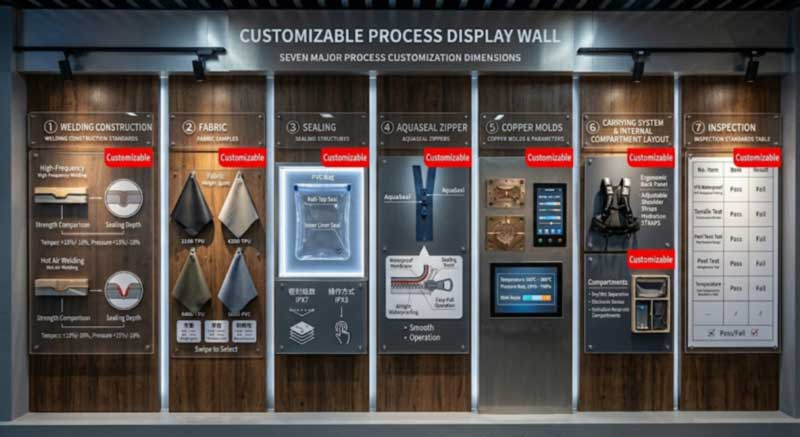
A waterproof backpack's performance rests on seven processes. OEM customization is the ability to specify each one, so the list below is both how the pack is built and where a brand makes its decisions:
2.1 RF Seamless Welding (the waterproof foundation)
The body is welded at 27.12 MHz into a continuous, needle-hole-free skin. What a brand specifies here is the construction standard itself — fully welded for genuine submersion, versus welded body with taped detailing for rain-resistance — which sets the pack's waterproof ceiling before any other choice.
2.2 TPU / PVC Composite Fabric
The material is chosen against weight, cold flexibility, abrasion, and market compliance: 210D TPU for ultralight lines, 420D TPU as the balanced performance choice, 840D TPU for heavy-duty, or 500D PVC tarpaulin for rugged, structured, cost-effective programmes. Two deniers can be combined — a lighter body with a reinforced base. This choice, covered in depth in the comparison of TPU material advantages and PVC cost and performance, sets both the waterproofing and the whole construction method.
2.3 Sealing Structure
The closure is specified to the use: a roll-top collar with a stiffening strip, a patented inner membrane for a second seal, or a rated closure system. This determines how the opening actually holds water out, and it is configured around how often the user needs access — the balance between sealing performance and storage flexibility.
2.4 Waterproof Zipper
Where the design needs zippered access, a rated airtight zipper — YKK AquaSeal or equivalent — is specified to the right level (IPX7 immersion, IPX8 continuous) and welded into the panel. Zipper grade, placement, and whether it seals the main compartment or only a pocket are all brand decisions, and getting the rating right is what prevents the most common leak point on a zippered pack.
2.5 Die and Welding Parameters
A custom shape needs its own machined die, and the welding parameters — power, dwell, pressure, cooling — are qualified to the chosen material and thickness. For a brand, this is what makes a genuinely new silhouette possible rather than a restyled stock pack; new geometry means new tooling, which is a normal step in ground-up development. The full sequence is covered in the manufacturing process from cutting to RF welding.
2.6 Structural and Harness Design
This is where most OEM backpack decisions live, because it carries both load and comfort. Customizable elements: shoulder strap geometry and foam density, back panel type (moulded EVA with airflow channels, or mesh over padding), sternum strap and hip belt, torso length, reinforced strap anchors and base panel, and the internal layout — laptop sleeve position and padding, tablet pocket, cable and charger organisation, document section, and pocket configuration. On a welded body these attach without piercing the membrane, so load-bearing parts are pre-assembled onto panels or welded onto reinforcement patches.
2.7 Finished-Product Inspection
The inspection standard is itself part of the specification: the AQL level, defect classification, and the tests applied — immersion, weld peel, load cycling, and dimensional checks against a signed sample. A brand should define these before production, as covered in the quality control standards for waterproof production.
3. Branding and Finishing Customization
On top of the construction, the brand-facing layer is fully configurable: logo by silkscreen, heat transfer, welded emboss, woven label, silicone patch, or metal badge; colour matched to a Pantone standard across the range; reflective detailing; branded zipper pulls and webbing colours; and packaging from polybag-and-carton for wholesale through to hangtags, care cards, barcodes, and retail boxes. Packaging is specified to the sales channel and confirmed at the sample stage, since it affects cost and presentation.
4. The Development Process, Brief to Bulk
An OEM backpack runs as a controlled project, and sampling is where it succeeds or fails:
- 1. Brief / tech pack. Target capacity and dimensions, use and market, closure preference, material or weight target, harness requirements, laptop and pocket layout, hardware, logo, colourway, packaging, quantity, and launch date. A reference sample or sketch shortens development.
- 2. Quotation. Unit price, sample and tooling cost, MOQ, lead time, and Incoterms.
- 3. Sampling — the critical step. A drawing or reference photo does not reflect real sewing and welding conditions, especially around compartments, padding, and load-bearing areas. Strap attachment points, zipper curves, and pocket layout are checked and adjusted here, and the sample should be tested under realistic weight before approval. The approved sample becomes the production standard for material, construction, accessories, and packaging — skip this rigour and sample-to-bulk differences appear in colour, structure, and finishing.
- 4. Pre-production sign-off. Final material, colour, hardware, and logo confirmed against the gold sample.
- 5. Bulk production under QC. IQC on materials and hardware, IPQC on welds in line, OQC with AQL sampling and immersion testing.
- 6. Pre-shipment inspection. Inspection photos or third-party SGS/QIMA audit before balance payment.
Sealock quotes MOQ at 300 pcs per model, samples in 7–15 days, and bulk in 30–45 days. MOQ moves with customization depth — standard fabric and colour support the base minimum, while custom Pantone dye runs, special hardware, or exclusive structures raise it. A practical route is to launch on standard material and size, then upgrade once reorders stabilise, as set out in the guide to private label programmes for outdoor brands.
5. Sealock Waterproof Backpack Platforms
OEM projects can start from a proven platform and be modified, or be built ground-up. Base models across closures, materials, and capacities, organized by type rather than priority:
| Image | Model | Capacity | Material | Closure / feature | Product Page |
|---|---|---|---|---|---|
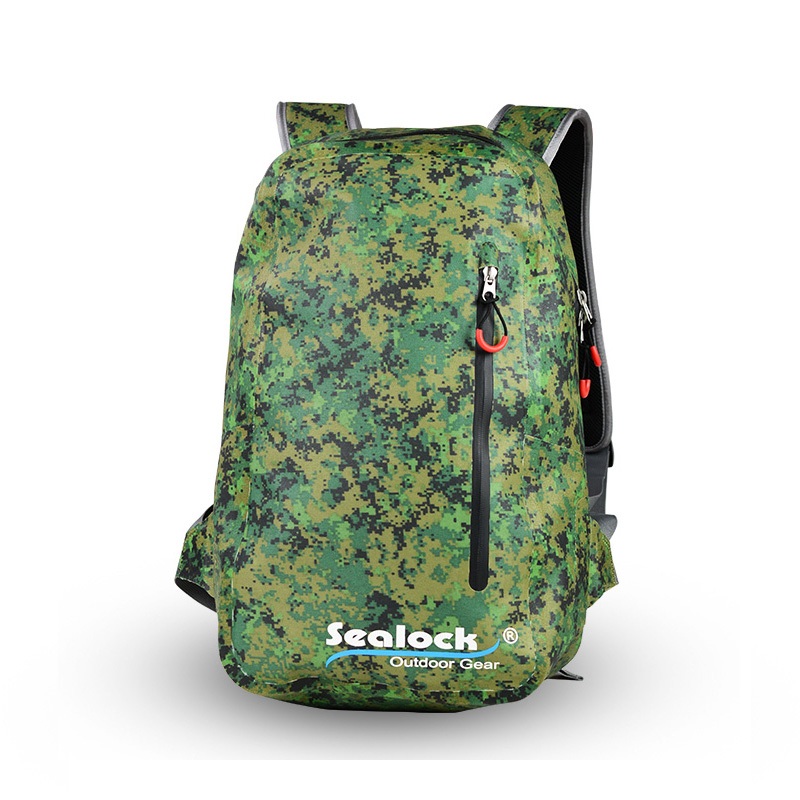
|
SL-E061 | 15L | 420D TPU | Airtight zipper · IPX6 | View |
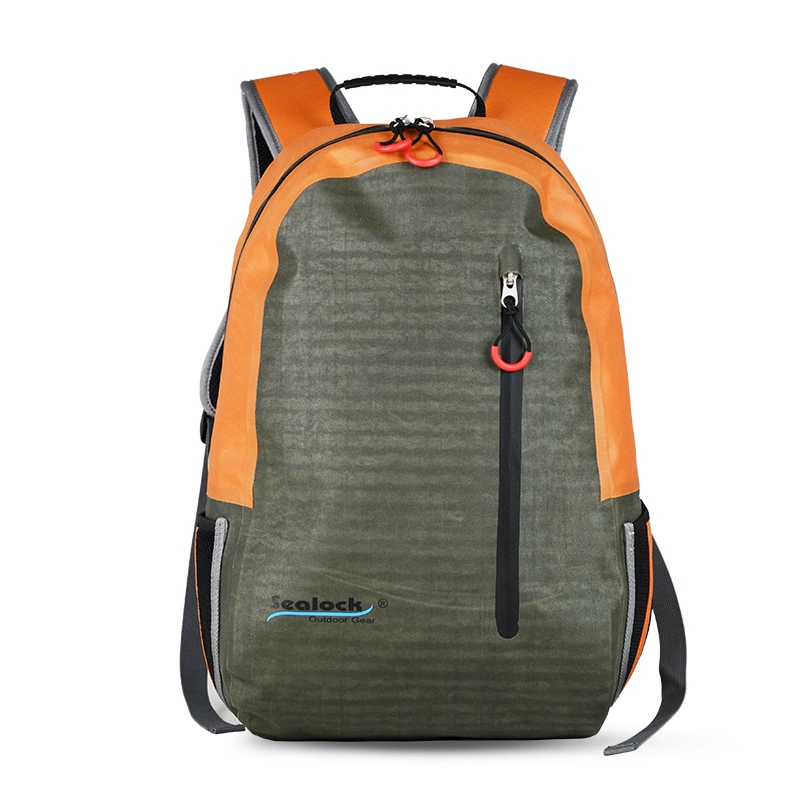
|
SL-E071 | 22L | 420D TPU | Zipper · IPX6 · 15.6" sleeve, mesh back | View |
|
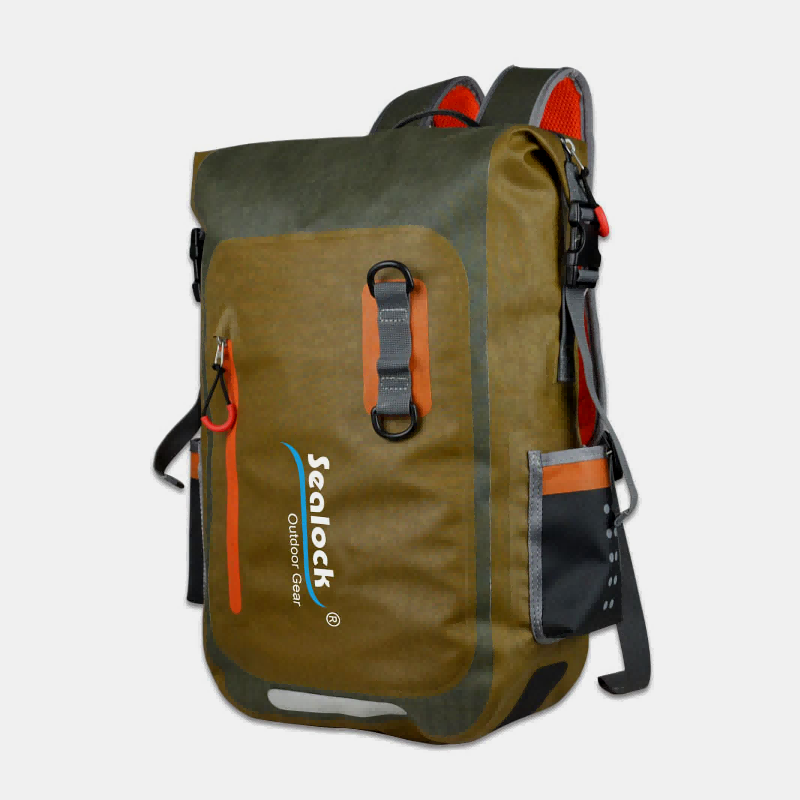
SL-E029 | 20L | 500D PVC | Roll-top · IPX6 · laptop sleeve | View |
|
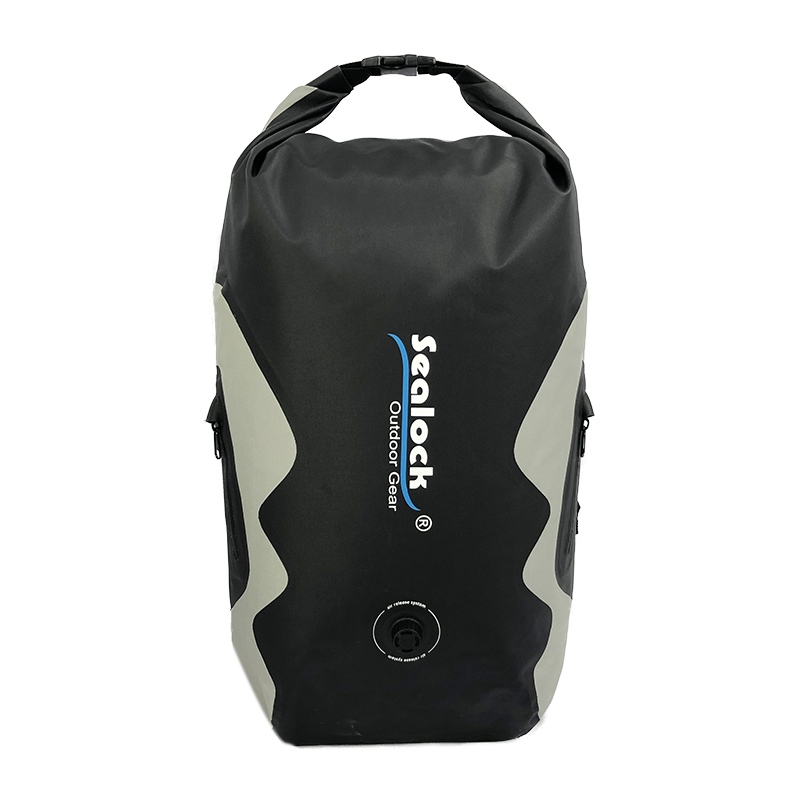
SL-E070 | 25L | 420D TPU | Roll-top · IPX8 · purge valve | View |
|
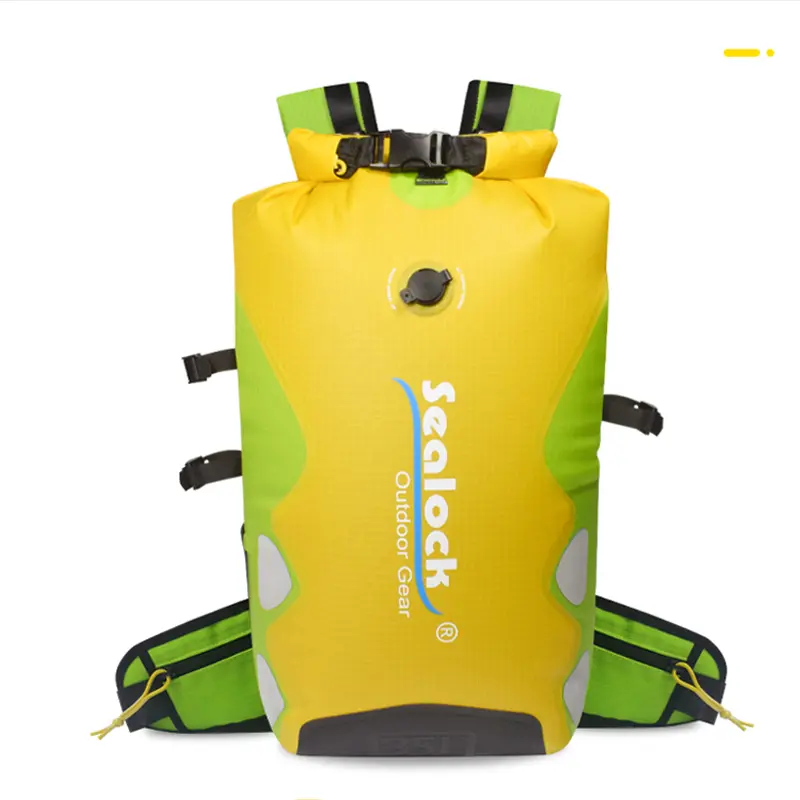
SL-E801 | 35L | 420D TPU | Roll-top · IPX7 · air valve, ergonomic | View |
|
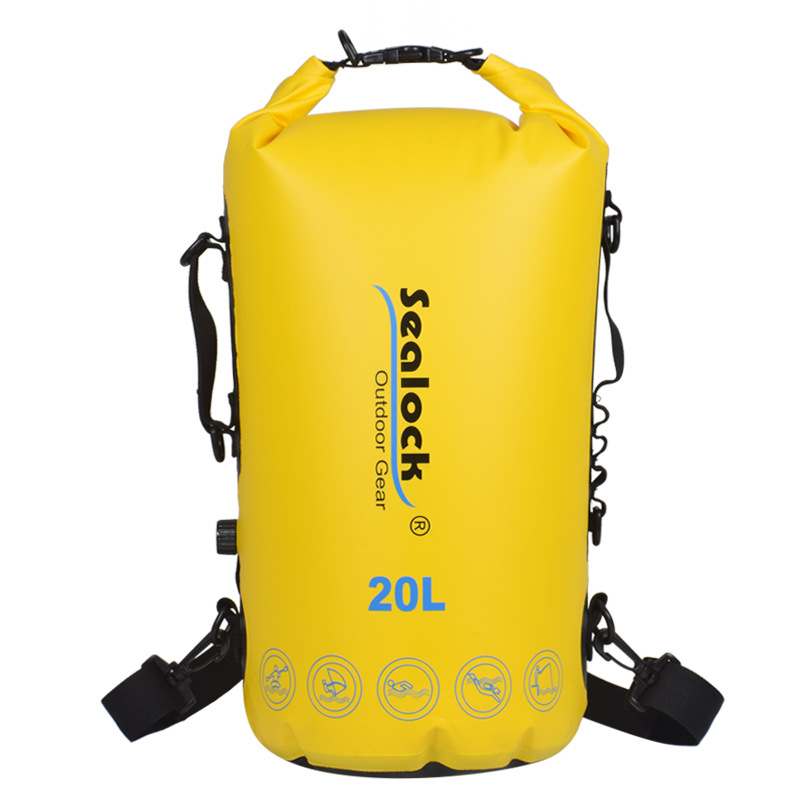
SL-E102 | 15 / 20L | 500D PVC | Roll-top · IPX7 · dual seal | View |
The platform range spans 15L to 65L across roll-top and zipper closures in PVC and TPU, so most OEM briefs start close to an existing construction. Full categories sit under dry backpacks, dry bags, and duffels. For evaluating a supplier before briefing, see the guide to selecting a waterproof backpack manufacturer.
6. Manufacturing and Quality Control
Bodies are welded at 27.12 MHz with load-bearing components pre-assembled before sealing so the membrane is never pierced. Every batch runs three-stage control: IQC on incoming fabric, zippers, and hardware; IPQC on welds in line including peel tests at run start; and OQC with AQL sampling, batch immersion testing, and signed gold-sample comparison, with SGS or QIMA inspection available. Backpack-specific testing centres on load cycling over 1,500 cycles at the strap anchors and handles, alongside 3,000 sealed-zipper cycles, tensile and bonding strength, salt spray, friction resistance, colour fastness, and colour difference. Compliance is backed by ISO 9001, BSCI, SMETA, HIGG, GRS, and SCAN, with production from Dongguan, China or Ho Chi Minh City, Vietnam.
7. FAQ
Q: What can I actually customize on an OEM waterproof backpack?
A: Every layer — welding construction standard, fabric and denier, closure type, waterproof zipper grade, die-cut shape, harness geometry and foam density, back panel, internal laptop and pocket layout, hardware, reflective detailing, logo method, colour, and packaging. It is engineered to your brief, not a logo on a stock pack.
Q: What's the difference between OEM and private label here?
A: OEM builds to your design from a sketch, sample, or target spec, with full control and the highest differentiation. Private label starts from a proven Sealock construction and adjusts branding, colour, and details — faster and lower-cost. Many brands launch private label, then move to full OEM for a hero model.
Q: Why is sampling so important, and can it be skipped to save time?
A: It should never be skipped. A drawing does not reflect real sewing and welding conditions, especially around compartments, padding, and strap anchors, and the sample is where those are corrected. It also sets the standard for bulk — skip it and colour, structure, and finishing drift between sample and production. Always load-test the sample before approving it.
Q: What MOQ should I expect, and can it be lowered?
A: MOQ is 300 pcs per model here, and it moves with customization depth. Standard fabric and colour support the base minimum; custom dye runs, special hardware, and exclusive structures raise it. Launching on standard material and size, then upgrading once reorders stabilise, keeps the first order accessible.
Q: Can you develop a completely new backpack shape, not just modify an existing one?
A: Yes. A new silhouette needs its own machined die and qualified welding parameters, which is a normal part of ground-up development from a sketch, sample, or performance target. It carries more lead time than modifying a platform, so share the launch date early.
Q: Can I customize the laptop compartment and internal layout?
A: Yes — laptop sleeve position and padding thickness, tablet pocket, cable and charger organisation, document section, and overall pocket configuration are all specifiable, on a waterproof internal structure that keeps electronics protected.
Request an OEM Backpack Proposal
For structural development, harness specification, samples, or a full OEM/private label proposal, submit an inquiry. Sealock responds to procurement enquiries within 24 hours, with production from Dongguan, China or Ho Chi Minh City, Vietnam.