- English
- Español
- Português
- русский
- Français
- 日本語
- Deutsch
- tiếng Việt
- Italiano
- Nederlands
- ภาษาไทย
- Polski
- 한국어
- Svenska
- magyar
- Malay
- বাংলা ভাষার
- Dansk
- Suomi
- हिन्दी
- Pilipino
- Türkçe
- Gaeilge
- العربية
- Indonesia
- Norsk
- تمل
- český
- ελληνικά
- український
- Javanese
- فارسی
- தமிழ்
- తెలుగు
- नेपाली
- Burmese
- български
- ລາວ
- Latine
- Қазақша
- Euskal
- Azərbaycan
- Slovenský jazyk
- Македонски
- Lietuvos
- Eesti Keel
- Română
- Slovenski
- मराठी
- Srpski језик

Custom Waterproof Backpacks for Outdoor Brands
Sealock builds custom waterproof backpacks for outdoor brands, importers, and private label programmes — packs designed around a brand's market rather than pulled from a catalogue. A custom waterproof backpack is worth the investment only if it does something a generic pack does not: fit a defined customer, solve a real problem, and carry the brand's identity. This is how an outdoor brand turns customization into a product that actually differentiates, from defining the buyer to locking the specification.
1. Start With the Customer, Not the Features
The most common mistake in a custom backpack brief is starting from a feature list instead of a customer. Market position decides material, structure, price point, and packaging, and different outdoor buyers need genuinely different packs:
| Target buyer | What the pack must prioritise |
|---|---|
| Commuters and urban cyclists | Slim profile, padded laptop protection, fast zip access, reflective detail |
| Day hikers and trekkers | Ventilated back, comfortable harness, hydration and layering room |
| Paddlers and water-sports users | Full submersible sealing, buoyancy, sand and salt tolerance |
| Travellers | Larger capacity, wipe-clean shell, organised layout, carry versatility |
| Anglers and specialists | Task-specific layout — rod mounts, tackle organisation, swing-round access |
Defining the buyer first is what keeps a custom project from overbuilding the pack in one area and underbuilding it in another. It also fixes the honest waterproof claim: a commuter pack rated for heavy rain should not be marketed like a submersible paddling pack, and the reverse wastes cost on a buyer who will never immerse it.
2. Customization That Actually Differentiates
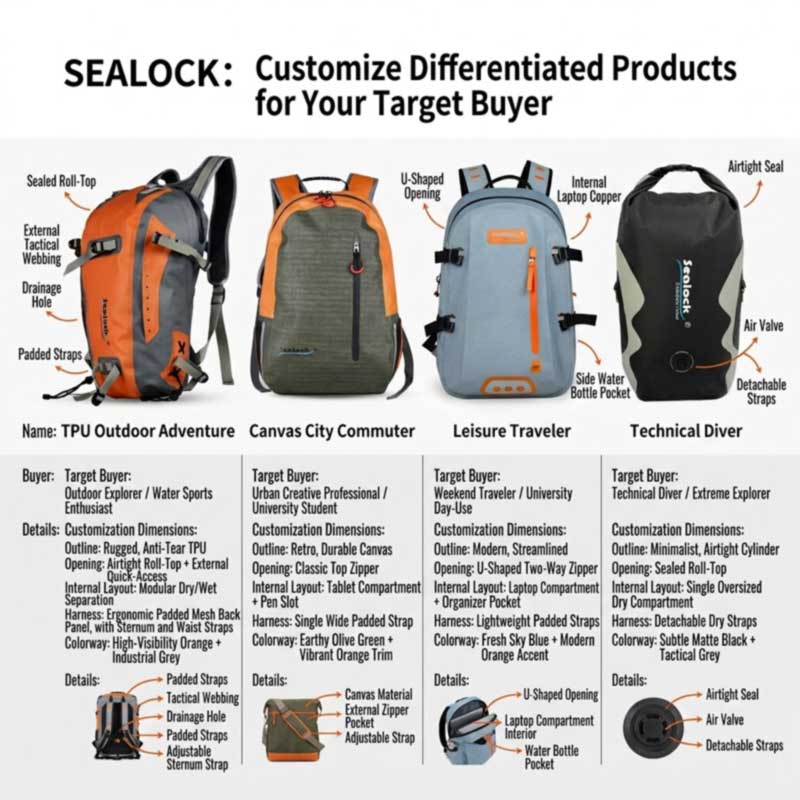
Customization is not limited to a logo. On a waterproof backpack, the elements that make a brand's product recognisably different fall into four groups:
- Structure and silhouette — capacity, proportions, closure architecture (roll-top, waterproof zipper, or hybrid), and overall shape. A distinctive silhouette is what makes a pack recognisable on a shelf before the logo is even read.
- Internal layout — laptop and tablet sleeves, cable and charger organisation, tackle trays, hydration routing, and compartment depths tuned to what the target buyer actually carries.
- Carry system — shoulder strap geometry and foam density, back panel type (moulded EVA, channelled foam, or suspended ventilated panel), sternum strap, and hip belt matched to load.
- Material and finish — fabric type and denier, colourway, two-tone panelling, reflective placement, and surface finish (matte, gloss, textured), which together carry the brand's aesthetic as much as its function.
The point of each is differentiation with a purpose. Features added because a competitor has them add cost without adding sales; features chosen because the target buyer needs them are what justify a premium and earn a repeat purchase.
3. Material and Waterproof Level: Match the Claim to the Use
The material and the sealing method set both the waterproof rating and the product's cost, so they are specified to the use case rather than maxed out by default:
- 420D TPU laminate — the balanced performance choice for hiking, commuter, and cycling packs: light, flexible in cold, low odour against the back.
- 500D PVC tarpaulin — rugged, structured, cost-effective for value lines and packs that benefit from a body that holds its shape.
- 840D–900D TPU — heavy-duty and rugged daypacks where abrasion is constant.
- Cationic-dyed TPU composite — for premium, deep-immersion packs where a refined finish and an IPX8 rating both matter.
The sealing method is the other half. A roll-top or a rated airtight zipper welded into the body delivers genuine submersion; a welded body with laminated water-resistant zippers handles heavy rain at lower cost. A brand should decide the honest rating — from IPX6 rain protection to IPX8 deep immersion — and match both the construction and the marketing to it. The trade-offs are covered in the comparison of TPU material advantages and PVC cost and performance.
4. The Warranty Traps to Design Out
Custom packs generate returns in predictable places, and the time to prevent them is at the specification stage. The recurring failures reported across the category:
- Weak shoulder strap stitching and inferior zippers — a common cause of warranty spikes for rising brands, and both are specification choices, not bad luck. Specify strap anchor reinforcement, foam density, and a rated zipper rather than the cheapest available.
- A sweaty back — inevitable on a sealed shell without an engineered ventilated panel, and impossible to retrofit after production.
- Straps that go flat — low-density foam compresses within a season; specify density, not just thickness.
- A leaking front pocket — an exterior pocket is a hole in a sealed body unless it is separately sealed with a welded, rated construction. Decide whether it is water-resistant or waterproof, and label it accordingly.
These map directly to the way waterproof packs fail, and designing against them up front is far cheaper than absorbing returns after launch.
5. Sampling: The Step That Protects the Brand
Sampling is where a custom pack becomes real, and it is the most costly step to rush. A drawing or a competitor reference does not reflect actual sewing and welding conditions, particularly around compartments, padding, and load-bearing anchors — the sample is where those are corrected. It should be evaluated under realistic load, not just inspected on a table, and checked for weld or seam consistency, closure function, strap strength, logo adhesion, colour accuracy, packaging, and water resistance against the agreed claim. The approved sample then becomes the production standard, held as a signed gold sample by each side, so bulk does not drift from what was approved — the same discipline that protects a private label programme across reorders.
6. Platforms to Customize From
Most custom briefs start close to a proven construction and are modified, which is faster and lower-risk than ground-up development. Representative platforms across closures, back systems, and capacities, organized by type rather than priority:
| Image | Model | Capacity | Material | Closure / back system | Product Page |
|---|---|---|---|---|---|

|
SL-E144 | 15L | TPU | Zipper · floating ventilated back | View |
|
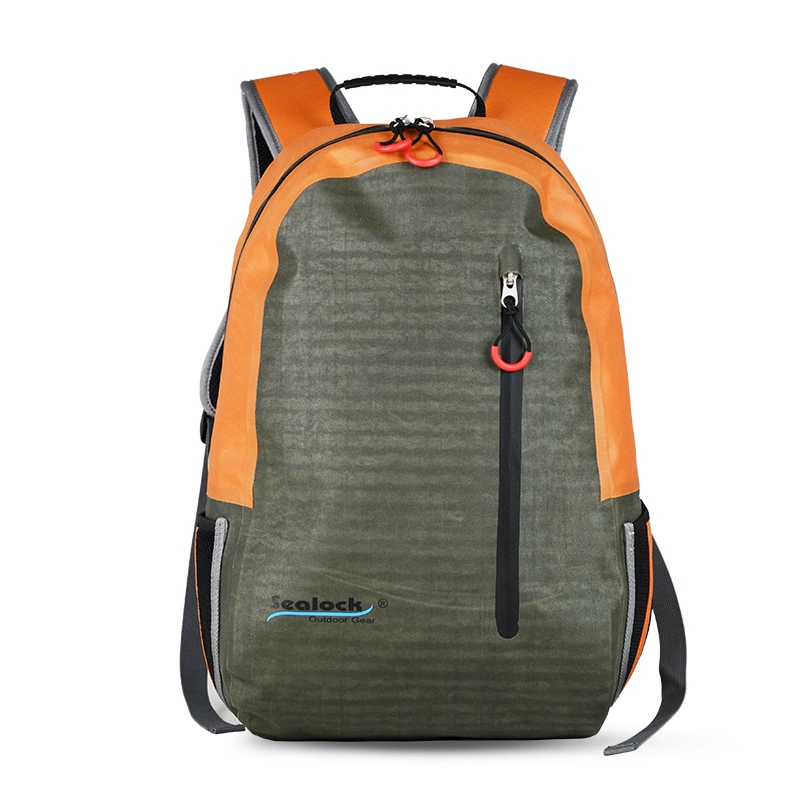
SL-E071 | 22L | 420D TPU | Zipper · mesh back · 15.6" sleeve | View |

|
SL-E119 | 20L | Cationic TPU composite | Airtight zipper · IPX8 · laptop | View |
|
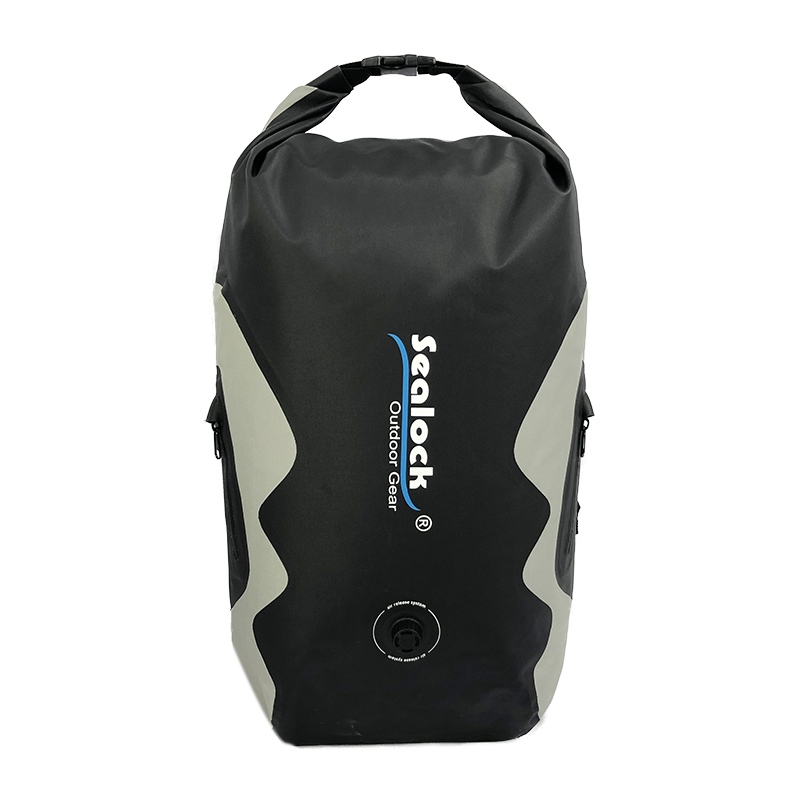
SL-E070 | 25L | 420D TPU | Roll-top · IPX8 · purge valve | View |

|
SL-E282 | 35L | Coated poly + welded TPU panels | Roll-top · suspended ventilated back · hip belt | View |
|
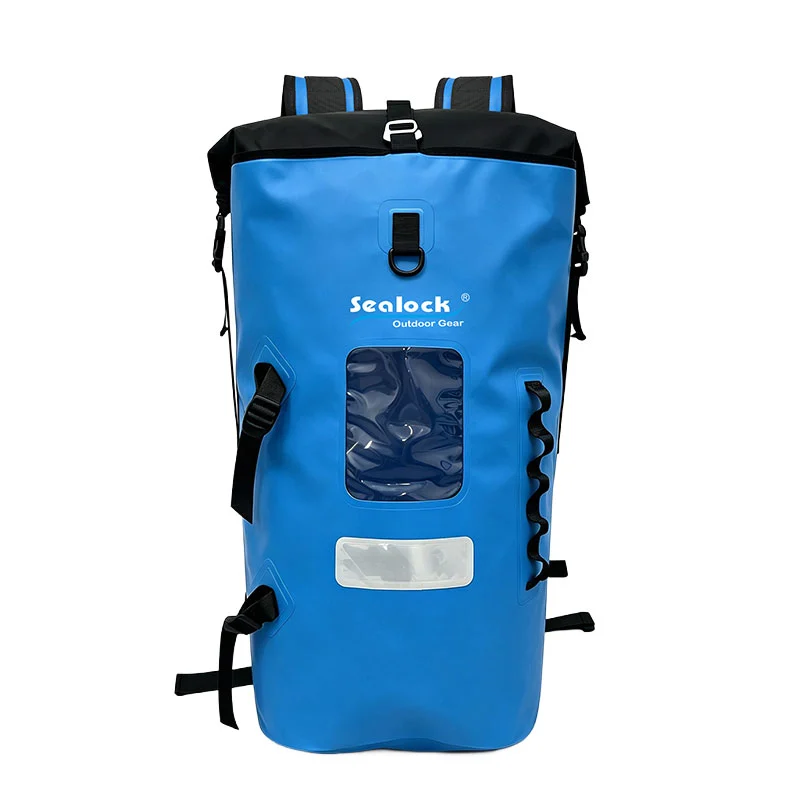
SL-E273A | 45L | 500D PVC (TPU option) | Roll-top · window pocket · full harness | View |
The platform range spans 15L to 65L across roll-top, zipper, and hybrid closures in PVC and TPU, so a brand can build a coherent multi-model line under one identity. Full categories sit under dry backpacks, dry bags, and duffels. Ground-up development from a sketch, sample, or target spec is supported for a genuinely original silhouette.
7. Branding and the Path to Market
The brand-facing layer completes the product: logo by silkscreen, heat transfer, embroidery, welded emboss, rubber or metal patch, or woven label; colour matched to a Pantone standard; branded pulls and webbing; and packaging from wholesale polybag-and-carton through to retail hangtags, care labels, barcodes, and boxes — with labelling compliance for the destination market the brand's responsibility. On timing, a first custom order realistically runs the development, sampling, and production sequence before freight, so a brand should plan against its launch date rather than a single lead-time number. Standard terms: MOQ 300 pcs per model (a small number of models run 500), samples in 7–15 days, bulk in 30–45 days, with production from Dongguan, China or Ho Chi Minh City, Vietnam to suit a tariff position. The full sequence is set out in the guide to OEM waterproof backpack manufacturing.
8. Quality Control
Every custom pack runs three-stage control: IQC on incoming fabric, zippers, and hardware; IPQC on welds in line including peel tests at run start; and OQC with AQL sampling, batch immersion testing, and signed gold-sample comparison, with SGS or QIMA inspection available. Backpack-specific testing centres on load cycling over 1,500 cycles at strap anchors and handles — where packs fail first — alongside 3,000 sealed-zipper cycles, tensile and bonding strength, salt spray, friction resistance, colour fastness, and colour difference, under the quality control standards for waterproof production. Compliance is backed by ISO 9001, BSCI, SMETA, HIGG, GRS, and SCAN.
9. FAQ
Q: How is a custom waterproof backpack different from adding my logo to a stock pack?
A: A logo on a stock pack is white label — the same product sells under other names. Custom means the structure, layout, carry system, material, and finish are specified to your buyer, so the pack is recognisably yours. That is what builds brand equity and justifies a premium.
Q: Where should I spend the customization budget for the most differentiation?
A: On the elements the target buyer actually notices and uses — silhouette, internal layout, and carry comfort — not on features a competitor happens to have. Define the buyer first; features chosen to match a rival add cost without adding sales.
Q: My last supplier's packs had warranty problems — how do I avoid that?
A: Most warranty spikes trace to two specification choices: weak strap stitching and cheap zippers. Specify reinforced strap anchors, foam density, a rated zipper, an engineered ventilated back panel, and properly sealed pockets — and put each into the inspection criteria. These are decisions, not luck.
Q: Can I customize the internal layout for a specific activity?
A: Yes — laptop and tablet sleeves, cable organisation, tackle trays, hydration routing, and compartment depths are all specifiable, tuned to what your buyer carries. A fishing pack, a commuter pack, and a paddling pack can share a construction but differ entirely inside.
Q: What waterproof rating should I specify?
A: Match it to the use and market it honestly. IPX6 covers heavy rain for commuter and hiking lines; IPX7 and IPX8 with a roll-top or rated airtight zipper cover immersion for water sports. Over-rating wastes cost; under-rating generates returns. State the claim and match construction and marketing to it.
Q: How long does a first custom order take?
A: Plan for the full sequence — spec development, sampling and approval, then bulk production — before sea freight, rather than a single number. Rushing the sampling phase is the most common and most expensive shortcut, so build the timeline around a proper sample approval.
Start a Custom Backpack Project
For structural development, harness and layout specification, samples, or a full custom proposal for your outdoor brand, submit an inquiry. Sealock responds to procurement enquiries within 24 hours, with production from Dongguan, China or Ho Chi Minh City, Vietnam.