
- English
- Español
- Português
- русский
- Français
- 日本語
- Deutsch
- tiếng Việt
- Italiano
- Nederlands
- ภาษาไทย
- Polski
- 한국어
- Svenska
- magyar
- Malay
- বাংলা ভাষার
- Dansk
- Suomi
- हिन्दी
- Pilipino
- Türkçe
- Gaeilge
- العربية
- Indonesia
- Norsk
- تمل
- český
- ελληνικά
- український
- Javanese
- فارسی
- தமிழ்
- తెలుగు
- नेपाली
- Burmese
- български
- ລາວ
- Latine
- Қазақша
- Euskal
- Azərbaycan
- Slovenský jazyk
- Македонски
- Lietuvos
- Eesti Keel
- Română
- Slovenski
- मराठी
- Srpski језик

Motorcycle Waterproof Bag Manufacturer for Adventure Brands
Sealock manufactures motorcycle waterproof bags for adventure and touring brands, importers, and OEM programmes from factories in China and Vietnam. Motorcycle luggage is the hardest category in the waterproof range to specify correctly, because the bag is not simply carried — it is mounted to a vibrating machine, driven through rain at highway speed, positioned near an exhaust hot enough to melt fabric, and it changes how the motorcycle handles. This sets out what an ADV programme has to get right and how those requirements translate into construction.
1. Company and Production Base
Sealock (YiFuLong Outdoor Gear Co., Ltd.) has built welded waterproof bags for over 20 years, producing for international outdoor and motorcycle brands including Benelli, Helly Hansen, OSPREY, and CHUMS.
- Established: 2003
- Facilities: Dongguan, China | Ho Chi Minh City, Vietnam — either origin available on any model
- Certifications: ISO 9001, BSCI, SMETA, HIGG, GRS, SCAN
- Terms: MOQ 300 pcs per model, samples 7–15 days, bulk 30–45 days, FOB Guangdong
2. Four Conditions No Other Bag Category Faces
- Rain driven under pressure. At highway speed water does not fall on a bag, it is forced at it. A stitched-and-taped seam that survives a rainstorm on foot will seep in an hour of motorway riding.
- Continuous vibration. Hours of engine and road buzz work at every mounting strap, D-ring, and anchor point. Anchors, not fabric, are what fail on motorcycle luggage.
- Radiant and contact heat. A stock exhaust on most adventure bikes runs close enough to scorch a bag that touches it, and almost no soft luggage is designed to clear a stock exhaust by geometry alone. Heat is a design constraint, not an edge case.
- Handling consequences. Luggage changes the machine. Weight carried high or unevenly makes a bike wander in ruts and unsettles it in crosswinds, which is why load placement is part of the product specification rather than a user problem.
3. The Mounting Decision Comes First
Before capacity or material, an ADV programme has to choose a mounting philosophy, because it determines the entire product architecture:
|
|
Rackless / universal | Rack-mounted |
|---|---|---|
| Fitment | Nylon straps and buckles fit almost any bike; moves between machines easily | Attaches to a rigid frame at multiple points |
| Security | Depends on strap tension and positioning | Far less likely to shift in service |
| Heat risk | Higher — a bag that slides can reach the exhaust | Lower — held clear of the pipe by the frame |
| Weight and cost | Lighter, no rack purchase | Rack adds weight and cost to the customer |
| Best for | Broad-market retail, multi-bike households, lightweight dual-sport | Touring and heavy-load programmes |
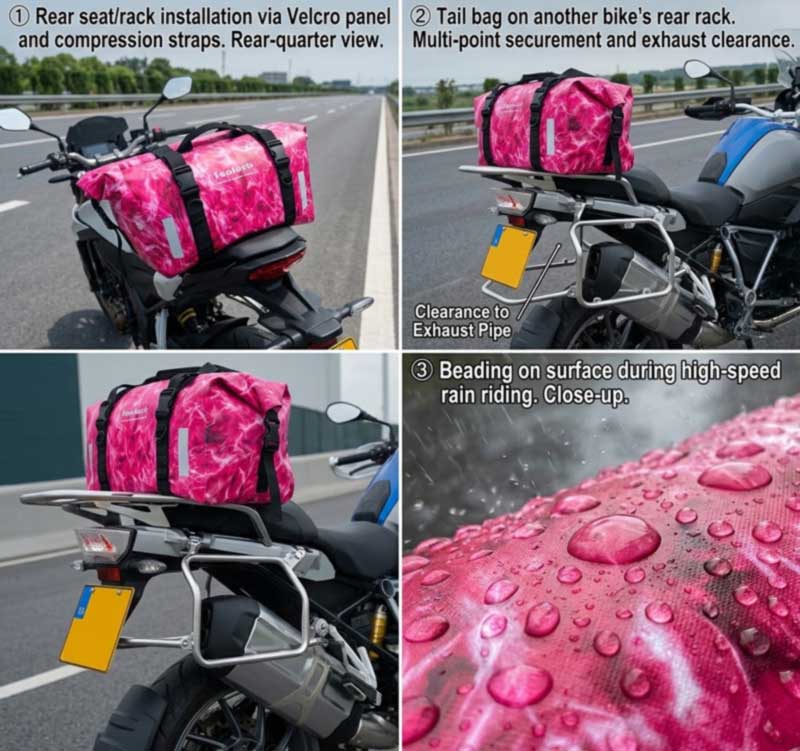
Most brands serve both. Sealock builds rear-rack mounted luggage such as the SL-C619 and universal hook-and-loop-plus-compression-strap systems such as the SL-C807 tail bag, and mounting hardware — including custom moulded nylon or CNC-aluminium backing plates cut to a brand's existing rack pattern — is developed to specification.
4. Heat: The Requirement Most Specifications Miss
On most adventure bikes the stock exhaust runs close enough to damage soft luggage that contacts it, and this is where warranty claims and brand damage originate. A responsible product answer has three parts: geometry that positions the bag away from the pipe, mounting that prevents lateral slide under braking and vibration, and clear guidance to the end user that heat shielding may be required on some machines. Adventure brands selling universally-fitting luggage should treat this as a documentation obligation as much as a design one — the bag is only half the answer, and the other half is the specific motorcycle it is fitted to.
5. Load Ratings and Balance Are Product Specifications
Two numbers belong in an ADV luggage specification and are usually absent:
- The bag's recommended load. Sealock states this per model — the SL-C807 45L tail bag is rated at 8–12 kg — so a brand's marketing and the end user's packing decisions rest on a real figure rather than an assumption.
- The bike's rack rating, which is separate. Published rear rack ratings on adventure bikes commonly fall in a low single-digit to high single-digit kilogram range, and that figure describes what the rack may carry, not what the motorcycle can carry. Soft luggage that transfers its load to the seat rather than the rack is not bound by that rating — a distinction worth stating in customer-facing material, because it is widely misunderstood.
On paired panniers, balance is a specification issue too. A stated system capacity is a total across both sides, not per side, and left and right loads should stay within a couple of kilograms of each other or the bike becomes unsettled in ruts. Brands can design this in by matching pannier volumes precisely and printing packing guidance on the hangtag.
6. Closure: Why Roll-Top Dominates Motorcycle Luggage
Experienced ADV riders consistently prefer roll-top closures over zippers for genuine weather, and the manufacturing logic supports it. A roll-top has no track for grit to destroy and no seal to degrade, it tolerates the dust and mud of gravel roads, it adjusts volume as a load changes across a trip, and it costs less to produce than a rated airtight zipper. The trade-off is slower access — acceptable on luggage that is opened at fuel stops rather than continuously. The construction case is set out in the guide to why roll-tops dominate waterproof storage.
The same rider consensus holds that external straps, daisy chains, and lash points matter more than an extra litre of capacity — a design priority worth carrying into a specification.
7. Materials for Motorcycle Duty
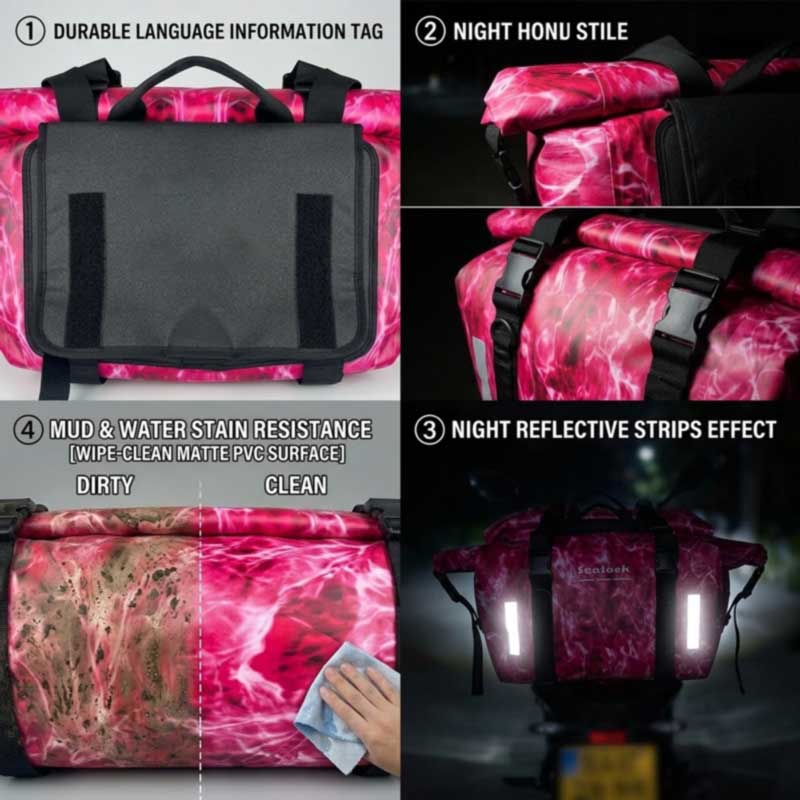
PVC tarpaulin is the workhorse for motorcycle luggage: it is tough against road spray, grit, and UV, holds a structured shape when strapped down, wipes clean of road film and mud, welds cleanly, and keeps the price point competitive — the reason both the SL-C619 and the standard SL-C807 build use 500D PVC. TPU is specified where lower weight and cold flexibility matter, and the SL-C807 is offered in a 420D TPU version for that reason. A matte finish is standard on the tail bag, since gloss reads as inexpensive on a motorcycle. Reflective printing or webbing on both sides is a safety requirement rather than a styling choice on rear-mounted luggage. The material trade-offs are covered in the PVC cost and performance guide.
8. Building a Full ADV Luggage System
Adventure riders do not buy one bag; they build a system, typically panniers or saddlebags for bulk, a tail or top bag for the rear rack, and smaller bags for fast-access items. A brand launching in this category benefits from covering the positions rather than offering one hero product, because the positions are complementary and each solves a different packing problem — bulk storage low and to the sides, top-rack capacity that mounts without side racks, and small-volume bags that keep weight low and central near the engine. Sealock produces across these positions on the same welded lines, so a coordinated system ships under one logo and colourway in a single run.
9. Motorcycle Range
Models organized by type rather than priority:
| Image | Model | Capacity | Material | Mounting / features | Product Page |
|---|---|---|---|---|---|
|
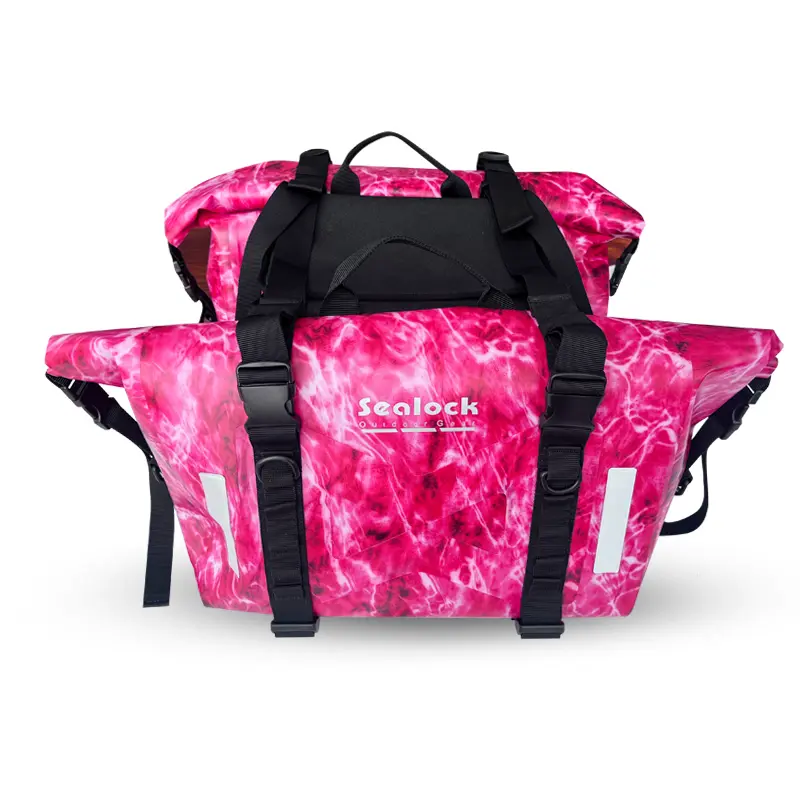
SL-C807 | 45L | 500D PVC / 420D TPU | Hook-and-loop panel + compression straps · IPX6 · 8–12 kg rated · dual-side reflective | View |
|
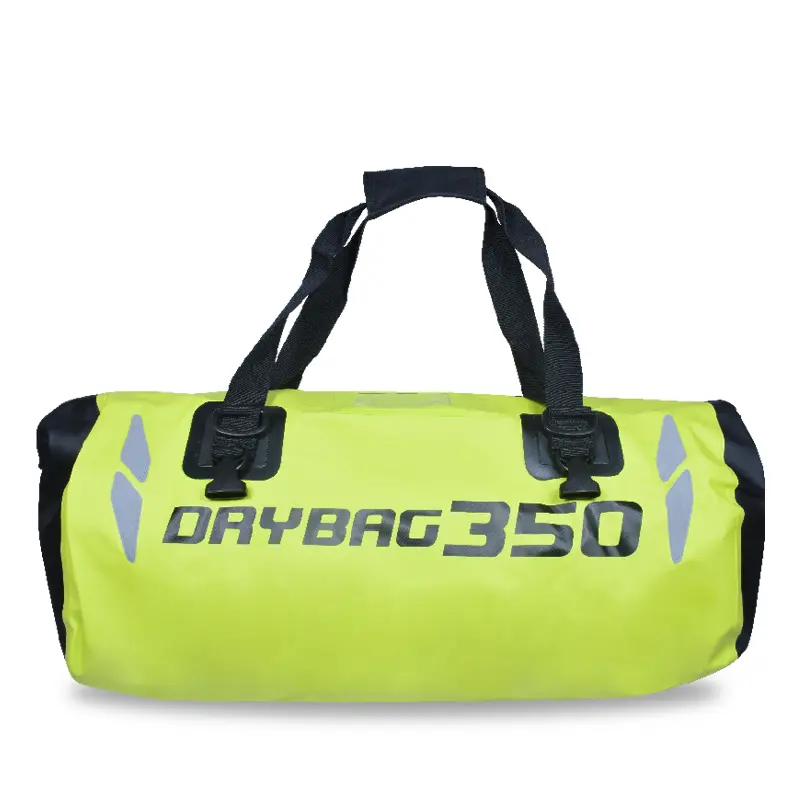
SL-C619 | 35 / 50L | 500D PVC tarpaulin | Rear rack mount · roll-top · IPX6 · reflective print · POM buckles | View |
|
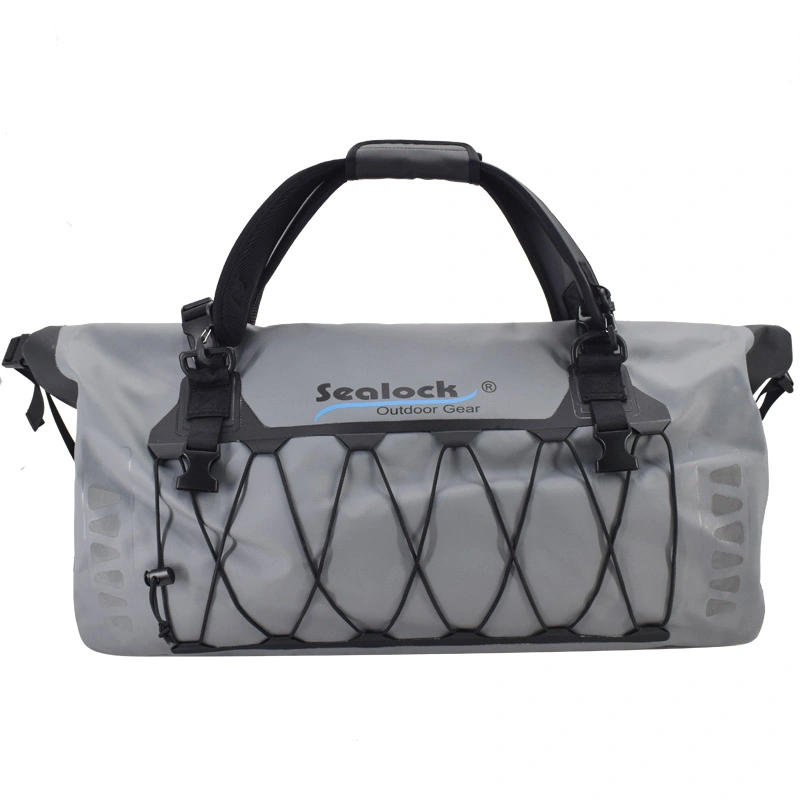
SL-C629 | 40 / 60 / 90L | 500D PVC tarpaulin | Backseat / tail rack · 56 × 32 × 50 cm | View |

|
SL-C624-A | 45 / 60L | PVC tarpaulin | Backseat mount · five stock colours | View |
|
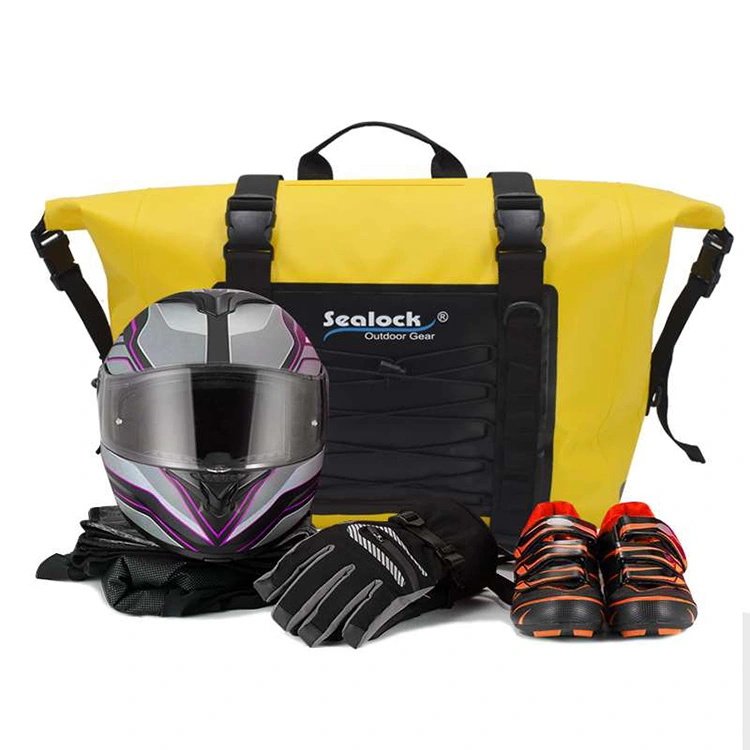
80L Saddlebags | 80L (40L × 2) | Welded PVC | Hook-and-loop + two adjustable straps · 50 kg · dual-side reflective | View |
|
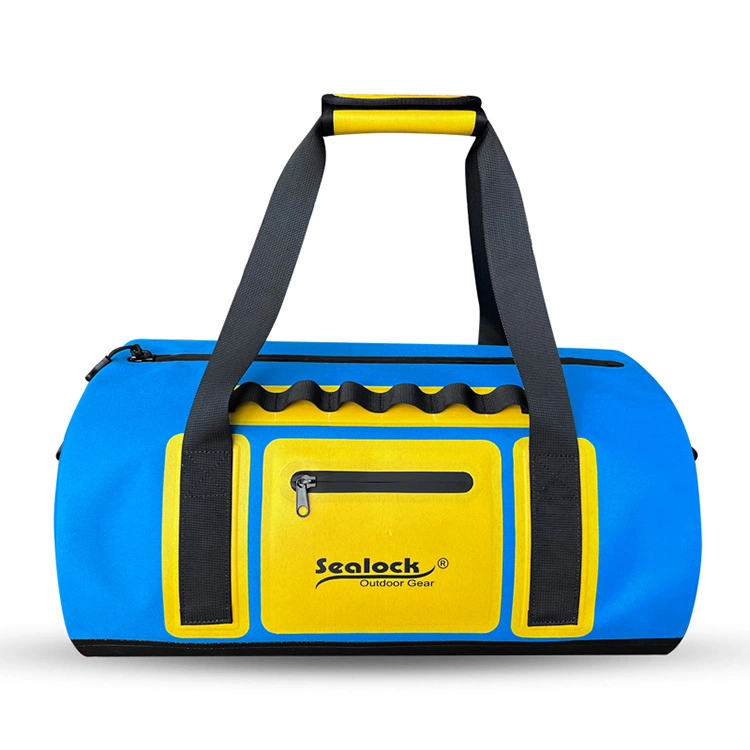
SL-C759 | 25L | TPU composite | Waterproof zipper · multi-sport including motorcycling | View |
Full categories sit under waterproof bags, duffels, and dry bags. Capacity planning for the most common rear-mounted size is covered in the 40L tail bag guide.
10. OEM Scope for Adventure Brands
Beyond logo and colour, a motorcycle programme can specify capacity and proportions, mounting system including custom backing plates cut to an existing rack pattern, closure type, fabric and denier, reflective placement and coverage, lash points and daisy chains, compression strap layout, matte or gloss finish, rated load, and packaging. Ground-up development from a sketch, sample, or target spec is supported, with tooling and lead time scheduled against a launch date. Production capacity on the motorcycle line runs up to 30,000 pcs per month, and either origin is available to suit a tariff position.
11. Quality Control
Every batch runs IQC on incoming tarpaulin, hardware, and reflective materials; IPQC on welds and mounting-point construction in process, including peel tests on sample welds at run start; and OQC with AQL sampling, batch immersion testing, and signed gold-sample comparison. Load cycling over 1,500 cycles targets mounting straps, D-rings, and handles — the components that vibration attacks — alongside tensile and bonding strength, salt spray, friction resistance, colour fastness, and colour difference. The full customer inspection procedure — unboxing, vacuum extraction, a 24-hour static rest, and air-leak determination — can be witnessed end to end, and third-party inspection through SGS or QIMA is available. Standards are set out in the quality control standards for waterproof production.
12. FAQ
Q: Should our range be rackless or rack-mounted?
A: Rackless universal systems reach the widest market — they fit almost any bike, move between machines, and add no rack cost. Rack-mounted holds more securely, sits lower, and keeps luggage clear of the exhaust, which suits heavy touring loads. Most brands cover both, and mounting hardware can be cut to an existing rack pattern.
Q: How do we handle the exhaust heat problem?
A: With geometry that positions the bag away from the pipe, mounting that stops lateral slide under braking and vibration, and explicit customer guidance that some machines need heat shielding. On most adventure bikes a stock exhaust runs close enough to damage soft luggage on contact, so it should be documented rather than assumed away.
Q: What load should we advertise?
A: State the bag's own rated load — ours are specified per model, such as 8–12 kg on the 45L tail bag — and explain separately that a motorcycle's rack rating is a different figure describing what the rack may carry. Soft luggage loading onto the seat rather than the rack is not bound by that rating.
Q: Roll-top or waterproof zipper for motorcycle luggage?
A: Roll-top for most of the range. It has no track for grit to jam, no seal to degrade, adjusts volume as a load changes, and costs less. Zippers suit smaller fast-access bags where the rider opens them frequently.
Q: Why do motorcycle bags fail at the straps rather than the fabric?
A: Continuous vibration concentrates at anchor points across hours of riding, and the bag is re-strapped hard at every stop. Reinforced anchors backed by welded patches, load cycling over 1,500 cycles, and heavy-duty D-rings are what address it.
Q: Can we launch a full luggage system rather than a single bag?
A: Yes, and it is the stronger route in this category. Panniers, a tail or top bag, and smaller fast-access bags are complementary rather than competing, and building them on the same lines means one logo, one colourway, and one production run.
Request an ADV Luggage Proposal
For mounting development, rated load confirmation, samples, or a full OEM proposal for an adventure range, submit an inquiry. Sealock responds to procurement enquiries within 24 hours, with production from Dongguan, China or Ho Chi Minh City, Vietnam.