- English
- Español
- Português
- русский
- Français
- 日本語
- Deutsch
- tiếng Việt
- Italiano
- Nederlands
- ภาษาไทย
- Polski
- 한국어
- Svenska
- magyar
- Malay
- বাংলা ভাষার
- Dansk
- Suomi
- हिन्दी
- Pilipino
- Türkçe
- Gaeilge
- العربية
- Indonesia
- Norsk
- تمل
- český
- ελληνικά
- український
- Javanese
- فارسی
- தமிழ்
- తెలుగు
- नेपाली
- Burmese
- български
- ລາວ
- Latine
- Қазақша
- Euskal
- Azərbaycan
- Slovenský jazyk
- Македонски
- Lietuvos
- Eesti Keel
- Română
- Slovenski
- मराठी
- Srpski језик

Waterproof Backpack Supplier Selection Guide
Sealock is a waterproof backpack supplier and OEM manufacturer serving outdoor brands, importers, and private label programmes from factories in China and Vietnam. Choosing a waterproof backpack supplier is a different evaluation from sourcing a simple bag, because a waterproof backpack is a load-bearing textile system — fabric, structure, hardware, and ergonomics — that also has to stay sealed. A supplier can be excellent at one half of that and weak at the other. This guide is the framework professional buyers use to evaluate the capability that actually matters, and the red flags that end a shortlist early.
1. Evaluate the Product as a System, Not a Look
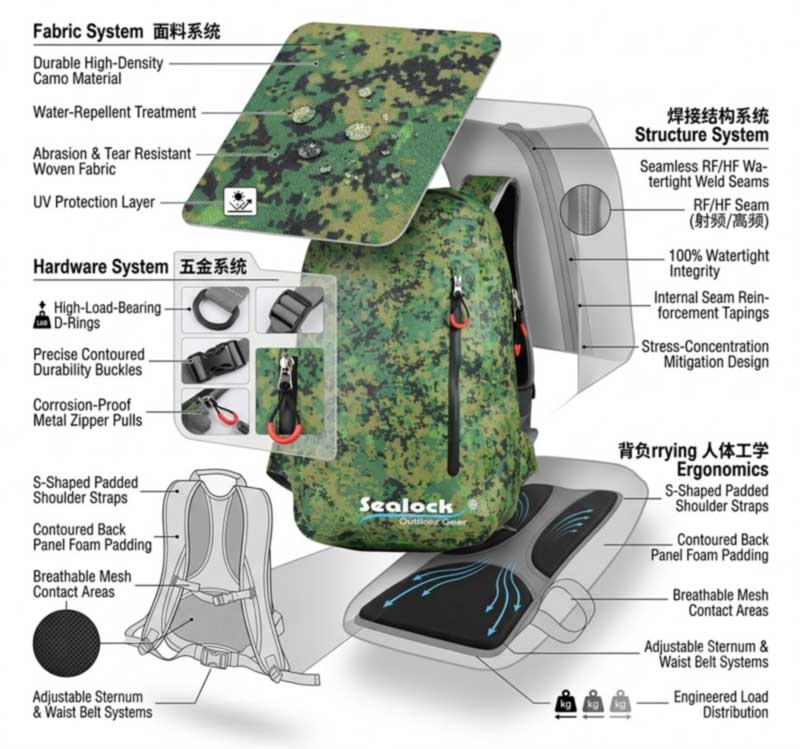
The most common sourcing mistake is judging a backpack on appearance and price. From a manufacturing perspective a backpack is a load-bearing system, and suppliers who understand that evaluate it on structure and load distribution, not styling. A capable waterproof backpack supplier has to combine two disciplines that do not always come together: waterproof construction — welded seams, roll-top or rated zipper, sealed closures — and backpack ergonomics — harness geometry, back panel, load transfer. A supplier strong in dry bags but inexperienced in harness design produces a pack that stays dry and hurts to carry; a good backpack maker with weak welding produces a comfortable pack that leaks. The first screening question is whether the supplier demonstrably does both, covered in depth in the guide to selecting a waterproof backpack manufacturer.
2. The Capability Checklist
A shortlist is built by assessing capability against a fixed list rather than a sales pitch. For a waterproof backpack supplier, evaluate:
- Waterproof construction method — in-house high-frequency welding and its frequency; whether seams are welded or seam-taped; how the IPX rating is tested rather than claimed.
- Backpack structure experience — real harness systems in the existing range, not dry bags with straps added; how strap anchors attach without piercing the waterproof body.
- Closure design range — roll-top, rated waterproof zipper, and hybrid, so the supplier can match the closure to the use rather than pushing its one house method.
- Sampling ability — a professional sample chain (a stock sample for initial evaluation, a pre-production sample for final approval) and willingness to revise.
- Material sourcing options — a real choice of TPU and PVC in multiple deniers, and stable relationships with fabric and hardware suppliers so quality and supply hold across reorders.
- Quality control system — documented incoming, in-line, and outgoing control, not a single final look.
- OEM and ODM flexibility — the ability to modify an existing platform or develop ground-up, matched to the buyer's stage.
- Capacity and origin — throughput that fits the forecast, and origin options for tariff exposure.
3. The Sample Chain: Two Samples, Not One
Sampling is where a supplier's real capability shows, and a professional one offers a two-stage chain. A stock or reference sample allows initial evaluation of pattern quality, stitching, welding, material, and closure function. A pre-production sample (PPS) — built to the buyer's final specification — is what gets approved and becomes the production standard. Skipping the PPS is one of the most costly shortcuts in backpack sourcing, because without it the bulk run has no approved physical reference and can differ from what was agreed.
Test the sample, don't just look at it: stitching and weld consistency, fabric quality, zipper durability, waterproofing against the claimed rating, load-bearing capacity under realistic weight, and customization accuracy. How a supplier handles the sample stage is itself diagnostic — one that asks clarifying questions, flags spec conflicts, and proposes engineering fixes is a partner; one that silently guesses and keeps moving will do the same in bulk.
4. Red Flags That End a Shortlist
Certain supplier behaviours reliably predict trouble and should eliminate a candidate:
- Pushing bulk production before sample testing is complete — the clearest warning sign on a waterproof backpack, because it skips the one step that proves the pack works.
- Vague answers to technical questions — a supplier that cannot explain its welding, IPX testing, or harness construction in detail either does not manufacture or does not understand the product.
- Competing on price alone — the lowest FOB price often hides high defect rates, weak strap stitching, cheap zippers, and hidden costs that surface as returns.
- Reluctance to allow inspection — evasion around a factory audit, a video walk of the line, or third-party pre-shipment inspection is an answer in itself.
- No client references or catalogue — an established supplier can show a catalogue of styles and reference customers to contact.
5. Prove It With a Trial Order
Documentation and samples establish capability; a trial order proves consistency. Sample quality and production quality are different problems — a supplier can build one perfect sample and struggle to repeat it across a run. A first production order at MOQ, inspected against the approved sample, is what verifies the partnership before scaling. Sealock's MOQ of 300 pcs per model (a small number at 500) keeps a controlled trial order practical rather than a leap, and every batch runs three-stage control — IQC on incoming fabric and hardware, IPQC on welds in line including peel tests at run start, and OQC with AQL sampling, immersion testing, and signed gold-sample comparison — under the quality control standards for waterproof production.
6. Evaluate the Reorder, Not Just the First Order
The measure of a supplier is the fifth order matching the first. Before the first batch even sells out, a buyer should confirm the supplier can hold consistency: whether the same fabric colour, zipper, lining, and logo components can be reserved or matched for the reorder, whether spare material is held, and whether capacity exists for the repeat. Colour drift, a substituted zipper, or a discontinued fabric between orders is what breaks a private label line — and it is a supplier-capability question, not bad luck. A supplier that holds a signed gold sample and runs colour-difference testing against a fixed Pantone standard is built to keep reorders matching, the discipline that protects a private label programme across reorders.
7. Capability Range to Evaluate Against
A supplier's real range is worth checking against a brand's roadmap — one that covers several closures, back systems, and capacities in the same workshops lets a brand add models without re-qualifying a new factory. Representative range, organized by type rather than priority:
| Image | Model | Capacity | Material | Closure / back system | Product Page |
|---|---|---|---|---|---|
|
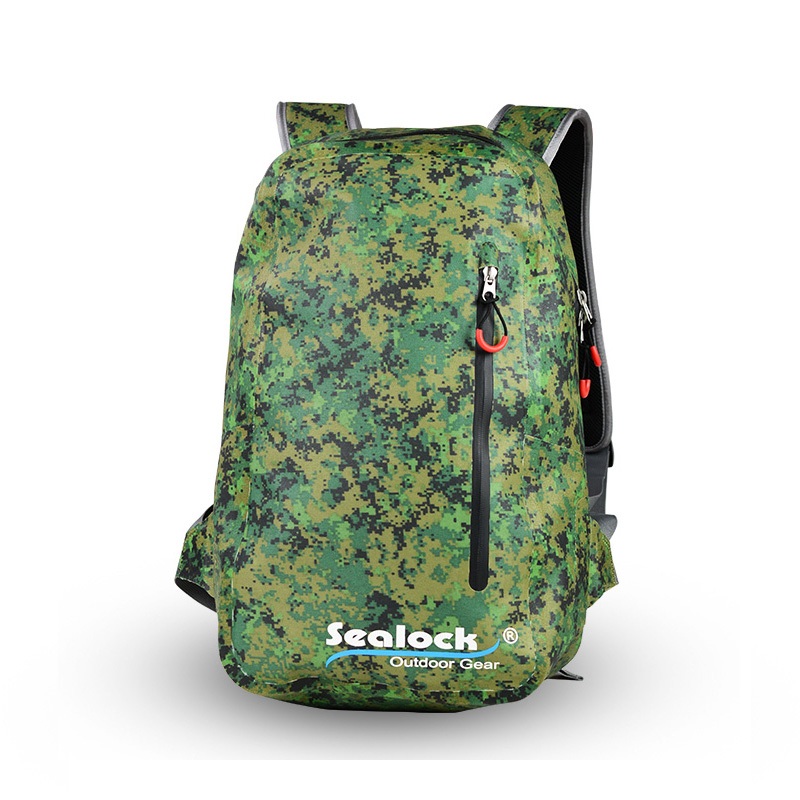
SL-E061 | 15L | 420D TPU | Airtight zipper · IPX6 | View |

|
SL-E119 | 20L | Cationic TPU composite | Airtight zipper · IPX8 · laptop | View |
|
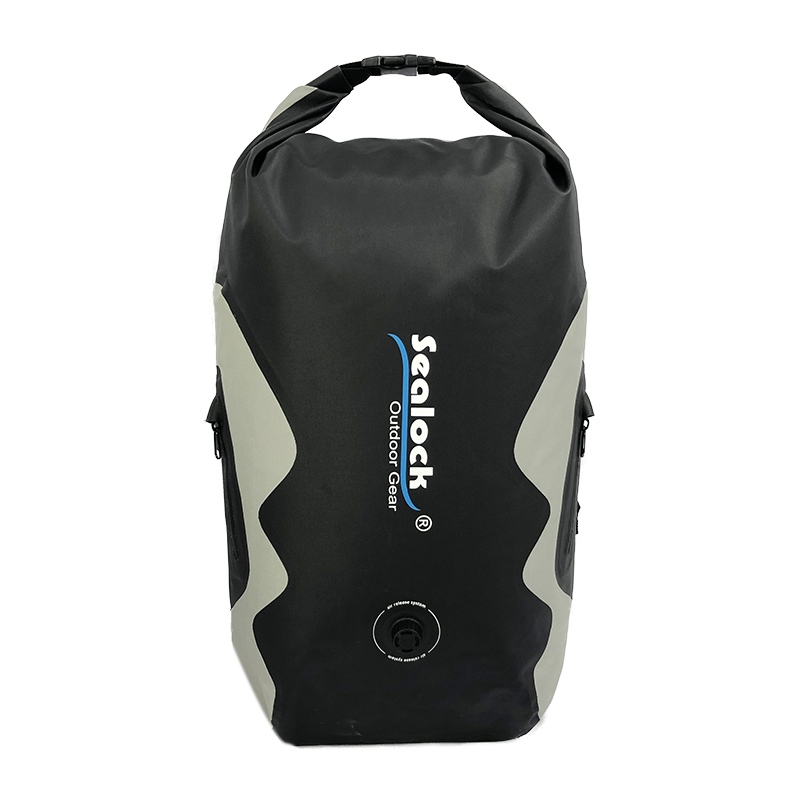
SL-E070 | 25L | 420D TPU | Roll-top · IPX8 · purge valve | View |

|
SL-E328 | 25L | PVC laminate | Curved-top zipper · ventilated back · hip strap | View |

|
SL-E282 | 35L | Coated poly + welded TPU | Roll-top · suspended back · hip belt | View |
|
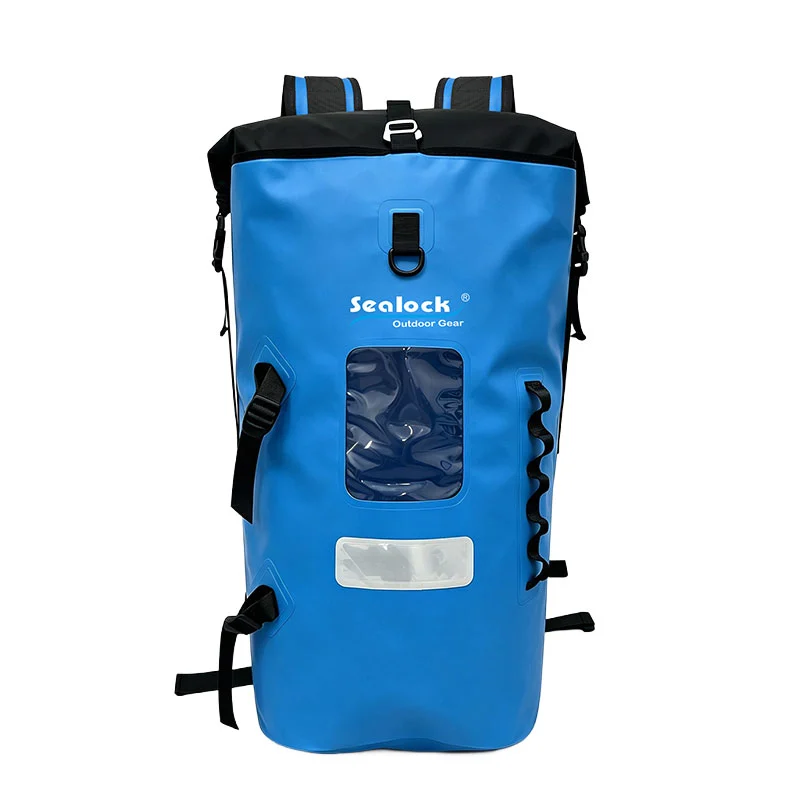
SL-E273A | 45L | 500D PVC (TPU option) | Roll-top · window · full harness | View |
The range spans 15L to 65L across roll-top, zipper, and hybrid closures in PVC and TPU, in commuter, hiking, water-sports, and fishing configurations. Full categories sit under dry backpacks, dry bags, and duffels. Ground-up development from a sketch, sample, or target spec is supported.
8. Standard Terms and Compliance
MOQ 300 pcs per model (a small number at 500), samples in 7–15 days, bulk in 30–45 days, FOB Guangdong, with production from Dongguan, China or Ho Chi Minh City, Vietnam to suit a tariff position. Payment is 30% deposit with the 70% balance against a passed pre-shipment inspection. Compliance is backed by ISO 9001, BSCI, SMETA, HIGG, GRS, and SCAN, with test documentation available for vendor approval, and buyers are welcome to send their own or a third-party inspector.
9. FAQ
Q: How do I tell whether a supplier can actually make a good waterproof backpack, not just a dry bag?
A: Ask to see real harness systems in the existing range and how strap anchors attach without piercing the waterproof body, and ask it to explain both its welding method and its back-panel construction. A supplier that only shows dry bags with straps added, or deflects on ergonomics, has one half of the capability, not both.
Q: What's the single biggest red flag?
A: Pushing bulk production before sample testing is complete. On a waterproof backpack that skips the one step that proves the pack seals and carries. Close behind are vague technical answers and competing on price alone, which usually hides weak strap stitching and cheap zippers.
Q: Why do I need two samples?
A: A stock or reference sample lets you evaluate baseline quality; a pre-production sample built to your final spec becomes the approved standard for bulk. Skip the pre-production sample and the run has no physical reference to match, which is where sample-to-bulk differences come from.
Q: How do I protect against the reorder not matching the first order?
A: Confirm before the first batch sells out whether the same fabric colour, zipper, lining, and logo can be reserved or matched, whether spare material is held, and whether the supplier holds a signed gold sample with colour-difference testing. Reorder drift is a capability question you can screen for up front.
Q: Should I choose the supplier with the lowest FOB price?
A: No. On backpacks the lowest price often hides high defect rates and hidden costs that surface as warranty returns. Evaluate sample accuracy, production consistency, communication speed, and after-sales handling alongside price, and prove the partnership with a trial order before scaling.
Q: Do I need to visit the factory?
A: For a large order, an in-person or video audit of the production line, QC process, and warehouse is worth it; for a first small order, license verification, a video walk, and a tested sample may be enough. Either way, a supplier confident in its process welcomes inspection.
Evaluate Sealock as a Supplier
To assess capability the practical way — request the range catalogue, a video walk of the welding line, and a sample against your own specification — submit an inquiry. Sealock responds to procurement enquiries within 24 hours, with production from Dongguan, China or Ho Chi Minh City, Vietnam.