
- English
- Español
- Português
- русский
- Français
- 日本語
- Deutsch
- tiếng Việt
- Italiano
- Nederlands
- ภาษาไทย
- Polski
- 한국어
- Svenska
- magyar
- Malay
- বাংলা ভাষার
- Dansk
- Suomi
- हिन्दी
- Pilipino
- Türkçe
- Gaeilge
- العربية
- Indonesia
- Norsk
- تمل
- český
- ελληνικά
- український
- Javanese
- فارسی
- தமிழ்
- తెలుగు
- नेपाली
- Burmese
- български
- ລາວ
- Latine
- Қазақша
- Euskal
- Azərbaycan
- Slovenský jazyk
- Македонски
- Lietuvos
- Eesti Keel
- Română
- Slovenski
- मराठी
- Srpski језик

How to Close and Use a Roll-Top Dry Bag
Listen to this article
Sealock has manufactured roll-top dry bags for outdoor brands and retailers for over 20 years, and the single most common cause of a "leaking" dry bag we see in returns is not the bag. It is the way it was closed. This guide explains how to close a roll-top dry bag properly, how to pack and use it, how to clean and store it, and how big a 5 litre dry bag really is. The last section is for brands and retailers, and covers the instruction card that turns these steps into fewer returns and better reviews.
How Do You Close a Roll-Top Dry Bag?
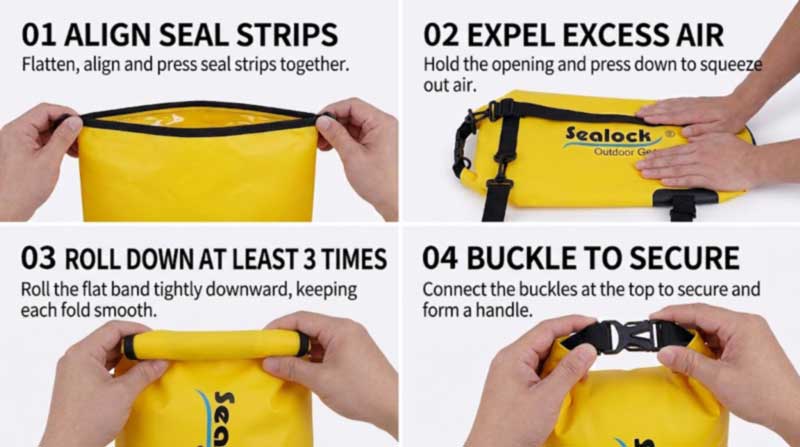
A roll-top closure works by folding the opening over on itself until water has no straight path inside. Every fold adds another barrier, and the buckle only holds the folds in place. It is not the buckle that keeps water out. Here is the method our quality team uses when testing bags.
First, clear the opening. Shake out sand, grit and water drops from the top few centimetres, because a single grain of sand on the sealing strip holds the layers apart and creates a channel for water.
Second, line up the sealing strip. Most roll-top bags have a stiffened strip across the opening. Straighten it and press the two sides together along their full length, so the top is flat and even before the first fold.
Third, push out excess air. Hold the top closed and press down on the bag to squeeze out most of the air. Leave a little air inside if you want the bag to float. Squeeze out more if you need it compact for packing inside a kayak hatch or a backpack.
Fourth, fold at least three times. Fold the top over tightly, keeping each fold crisp and flat rather than loosely rolled. Three folds is the minimum recommended across the industry. Four or more is better if the bag has room. Fewer than three is the most common reason water gets in.
Fifth, buckle it. Either bring the two buckle ends together over the top to form a carry handle, or, if the bag has side D-rings or side buckles, clip each end down to the side of the bag, which pulls the folds tighter and holds them flatter. Then stow the bag with the folded top facing away from waves or spray where you can.
How Do You Check That a Dry Bag Is Sealed?
The quickest field check takes ten seconds. Close the bag with some air inside, then squeeze it firmly. If the bag stays firm and you cannot hear or feel air escaping from the top, the closure is sealed. If it slowly goes soft, open it, clean the sealing strip and fold again. Before an important trip, a home check is worth doing too. Close the bag with air inside, hold it underwater in a bath or sink and watch for a stream of bubbles. A steady stream points to a seam or pinhole that needs attention, and our guide on how to fix a leaking dry bag explains what to do next.
How Should You Pack and Use a Dry Bag?
Leave enough space at the top for three full folds. The easiest way to judge this is to keep roughly a hand's width of empty fabric above the contents. An overfilled bag cannot be folded properly, and it is the second most common cause of leaks after too few folds.
Put heavy, dense items at the bottom and soft items such as clothing around anything hard or sharp. Keys, tent pegs, knives and fishing hooks can wear through the bag from the inside over time, so wrap them or keep them in a separate small pouch. For phones, cameras and power banks, a second layer of protection, such as a phone pouch inside the dry bag, is sensible on long trips or in rough water.
When tying a dry bag to a kayak, paddleboard or boat, attach it through the D-ring or a webbing loop rather than through the buckle, so that a hard pull does not open the closure. Remember that a sealed bag holds air and can float, but only if its contents are lighter than the water its volume displaces. Heavy, tightly packed bags can sink. Our article on floating dry bags and buoyancy explains why.
How Big Is a 5 Litre Dry Bag?
A 5 litre dry bag is a small personal bag. Our SL-D002 in 5 litres stands about 22 centimetres tall with a base about 17 centimetres across when rolled closed, and measures about 37 by 20 centimetres when laid flat. That is roughly the size of a large water bottle laid on its side.
In practice, a 5 litre bag holds a phone, a wallet, keys, sunscreen, a snack and a thin rain shell, or a compact first aid kit. It is the size most people use for a paddleboard, a beach day or as an organiser inside a larger bag. If you need to carry a change of clothes or a small towel, a 10 litre bag is the next step. Our dry bag size guide covers the full range of capacities.
How Do You Clean a Dry Bag?
After every trip in salt water, sand or mud, rinse the bag inside and out with fresh water. Salt crystals and sand left on the fabric and in the sealing strip are abrasive, and over time they wear the coating and stop the strip from closing cleanly.
For a deeper clean, use lukewarm water and a mild soap with a soft cloth or sponge. Avoid bleach, solvents, alcohol and strong detergents, which can attack PVC and TPU coatings and the welded seams. Never put a dry bag in a washing machine or tumble dryer, as the heat and mechanical stress can damage the seams and stiffen the material.
Dry the bag fully open, turned inside out if it is flexible enough, in the shade rather than in direct sun. A bag closed while still damp inside develops mildew and smells. If a new PVC bag has a plastic smell when first unpacked, leave it open in a ventilated space for a day or two and it will fade. A light dusting of baking soda inside overnight, rinsed out afterwards, helps with stubborn odours.
How Should You Store a Dry Bag?
Store the bag clean, completely dry and unrolled, in a cool place out of direct sunlight. Long exposure to ultraviolet light is one of the main things that ages a dry bag, making the coating stiff and eventually brittle. Avoid storing it folded tightly in the same place for months, because a permanent sharp crease can weaken the material along the fold line. Hanging it loosely, or storing it flat and lightly folded, keeps it in good condition for many seasons.
For Brands and Retailers: The Instruction Card That Prevents Returns
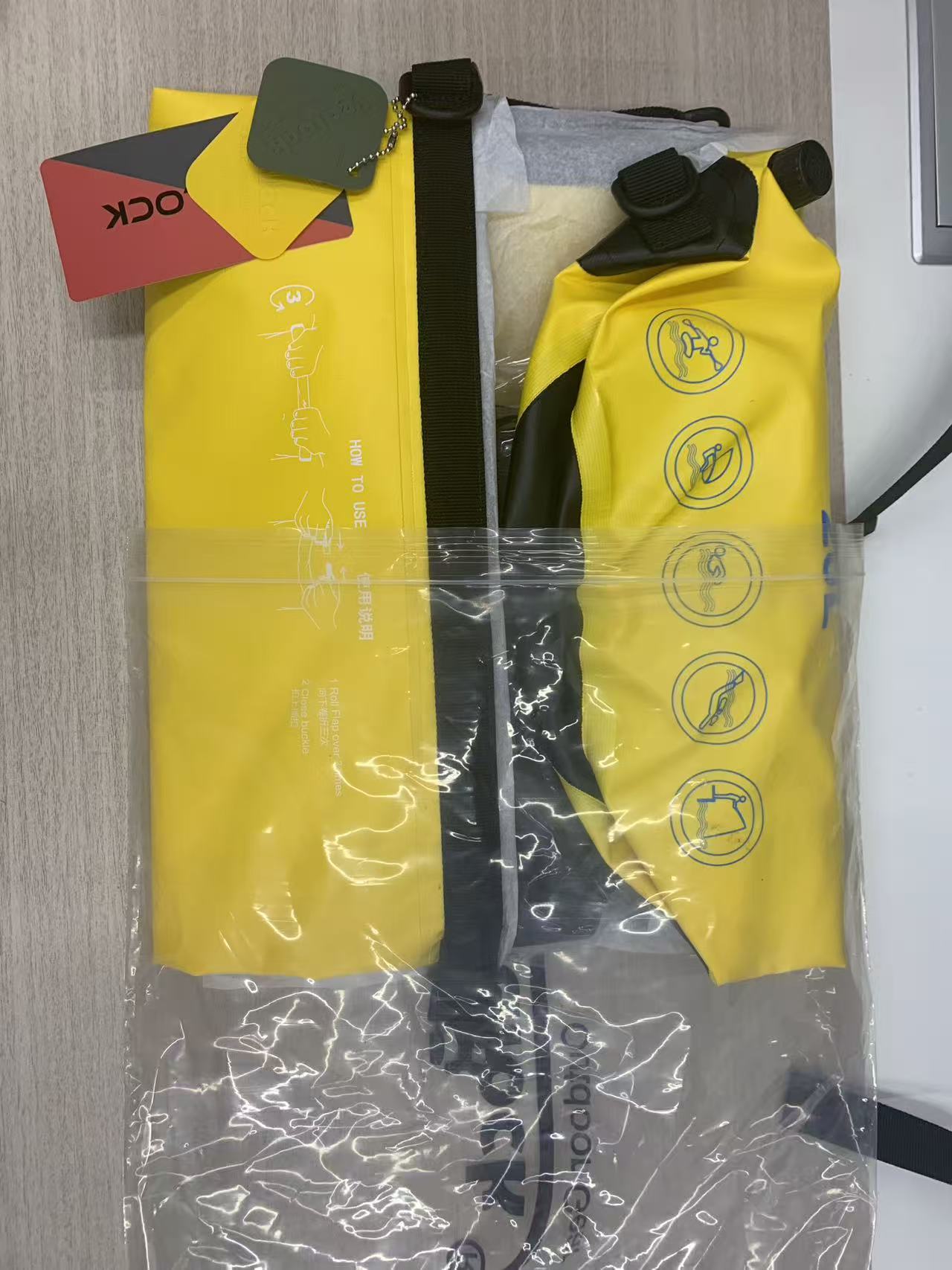
Everything above fits on one small card, and that card is worth more than most product features. When a customer claims a dry bag leaked, our experience is that the cause is far more often a closure with one or two folds, an overfilled bag, or sand on the sealing strip, than a failed seam. A clear instruction card, printed swing tag or a small pictogram on the bag body heads off most of these complaints before they become returns or one-star reviews.
We design and print these as part of an order. A typical card shows the five closing steps as simple pictures, a fill line, the cleaning and storage icons, and a short note that the bag floats only when sealed with air inside. Pictograms work across languages, and text versions can be supplied in several languages for European and multi-market retail. A small closing icon can also be printed on the bag body, positioned below the fold zone so it does not crack when the top is rolled. For marketplace sellers, the same artwork can be supplied as listing images.
Card and swing tag printing is available from the standard MOQ of 300 pieces, together with your logo on the bag. Our guide to promotional dry bags with custom logo covers print placement on the bag itself.
Roll-Top Dry Bags Available with Custom Instruction Cards
The models below are organised by type rather than priority. Each can be supplied with your logo, your colours and a printed care and closing card.
| Image | Model | Type | Sizes | Closure and Rating |
|---|---|---|---|---|
|
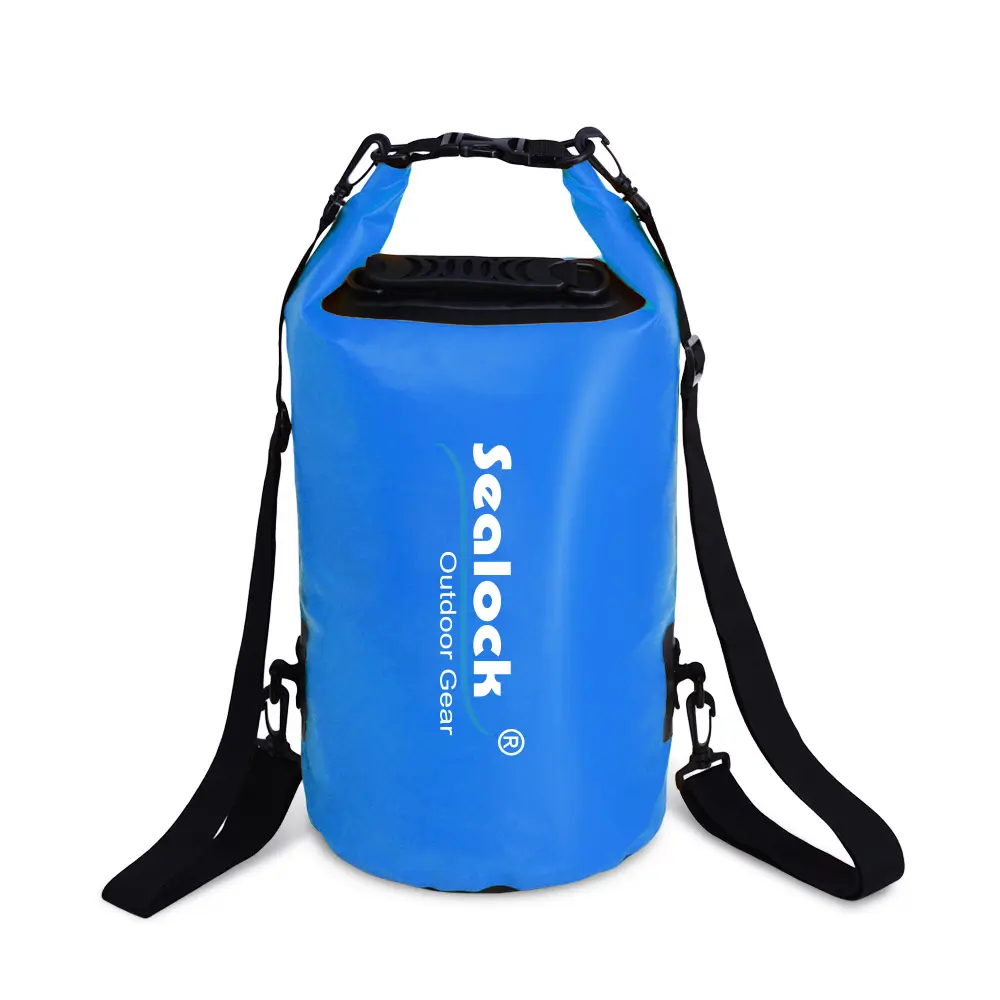
SL-D002 | Classic roll-top dry bag | 5, 10, 15, 20 and 63 litres | Roll-top with inner PVC sealing film and UTX buckles, IPX7 |
|
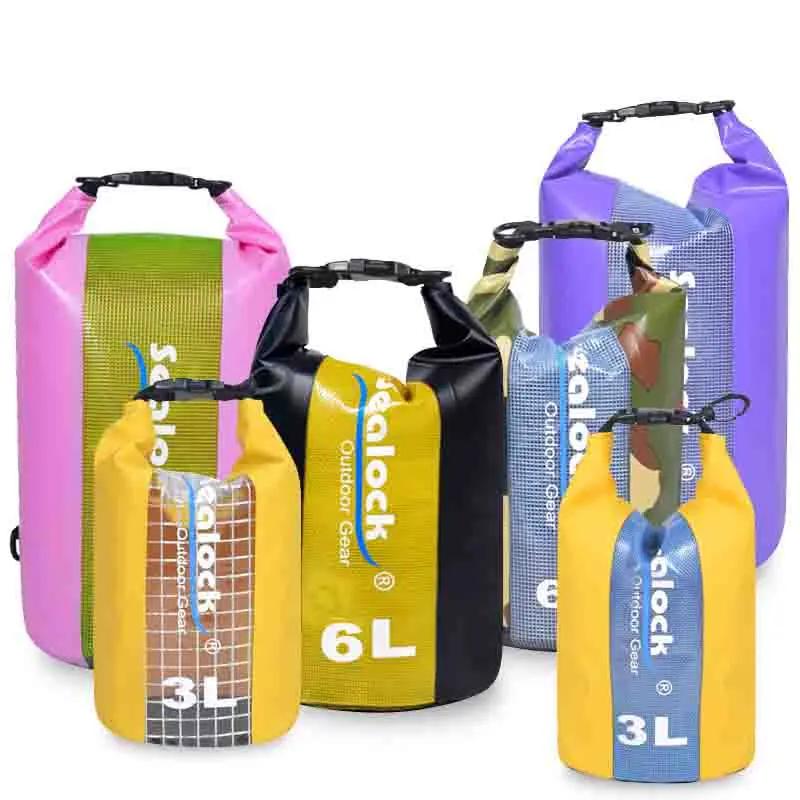
Clear Window Dry Bag | Small roll-top bag with transparent window | 3, 6 and 10 litres | Roll-top with quick-release strap, high-frequency welded seams |
|
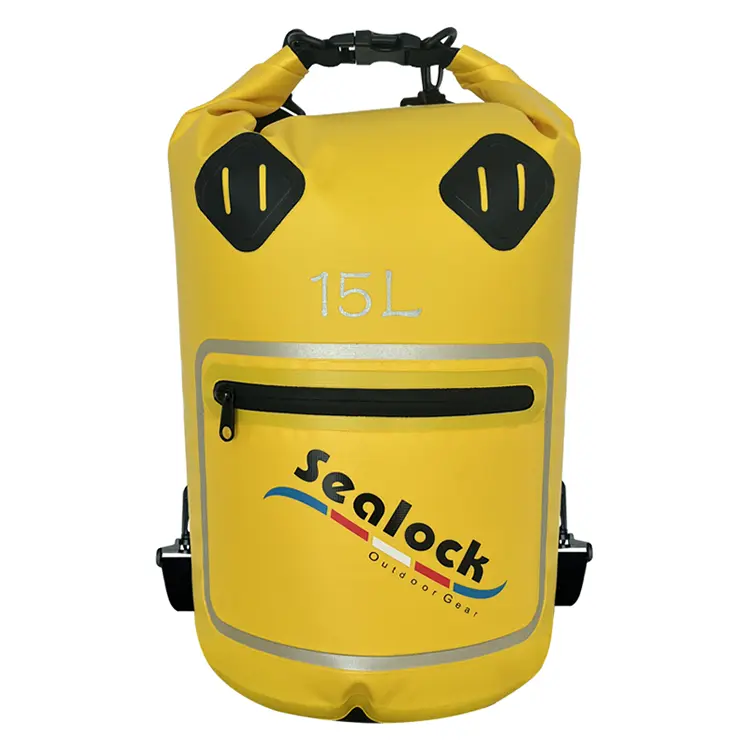
SL-D693 | Window dry bag with dry-wet separation | 15 and 20 litres | Roll-top with PVC closure reinforcement, IPX7 |
|
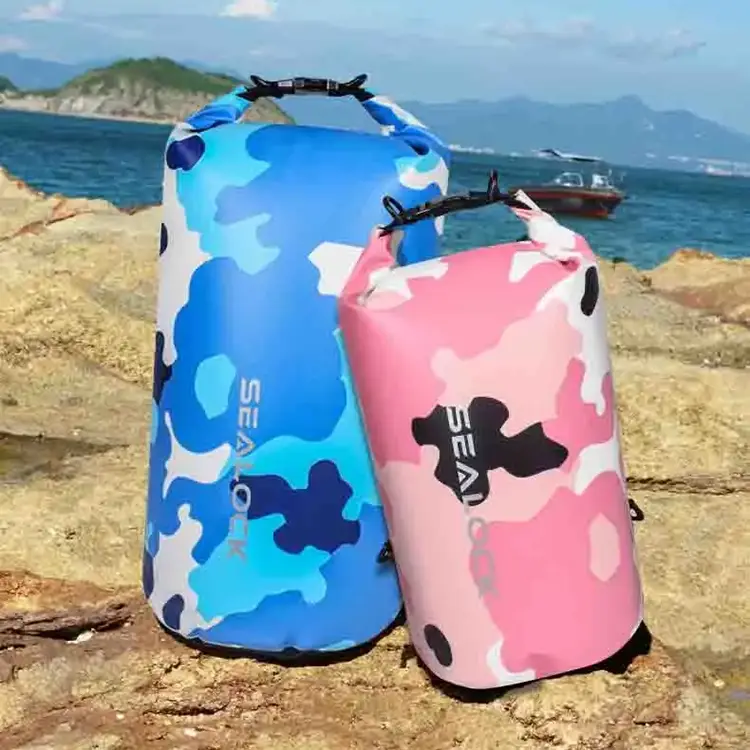
Dry-Wet Separation Dry Bag | Roll-top dry bag with removable inner pouch | 10 and 20 litres | Roll-top with inner sealing film, IPX7 |

|
SL-E978 | Roll-top dry backpack with window and valve | 38 litres | Three-roll closure with inner sealing strip, purge valve, IPX7 |
How We Test Every Roll-Top Closure
Roll-top bags rated IPX7 go through a full water-immersion test of two hours or more on sampled units from every batch, closed exactly as the instruction card describes, with three folds. Weld peel tests run at the start of each production run, and buckles and webbing are pull-tested. When customers inspect a shipment, we follow the full leak procedure: unboxing, vacuum extraction, a 24-hour static rest, and then the air-leak determination. For background on how the closure itself works, see our article What Is a Dry Bag and How Does It Work.
Frequently Asked Questions
How many times should I roll a dry bag?
At least three tight folds. Four or more gives an extra margin if the bag has room.
Should I roll or fold the top?
Fold. Crisp, flat folds create sharper barriers than a loose roll, and they hold better under the buckle.
Can I put a dry bag in the washing machine?
No. Hand wash with mild soap and lukewarm water, rinse and air dry in the shade.
Why does my dry bag go soft after I close it?
Air is escaping through the closure, usually because of sand on the sealing strip, a crooked first fold or too few folds. Clean the strip and fold again.
Can a dry bag be fully submerged?
A bag rated IPX7 is tested for immersion, but no roll-top is designed for long periods deep underwater. For extended submersion, use a bag with an airtight zipper rated IPX8.
Why does a new dry bag smell?
New PVC often has a mild odour straight from the carton. Air it out for a day or two, and it fades.
Need Dry Bags with Your Own Instruction Card?
Send us the model, quantity, logo file and the languages you need, and we will reply within 24 hours with an FOB price, a card design proposal and a sample timeline. Contact Sealock, or email info@sealock.com.hk.