

1. What PVC Tarpaulin Is
PVC (polyvinyl chloride) dry bags are made from PVC-coated polyester or nylon tarpaulin — a base scrim with PVC applied as a thick coating, usually on both sides, to form a continuous impermeable barrier. The coating, not the weave, carries the waterproofing: PVC is inherently impermeable, so water does not penetrate the fabric even under pressure. Tarpaulin is built in layers — commonly a two-layer film-and-scrim for light duty and three- or four-layer structures for heavy duty — and the base fabric is typically 500D to 1200D, with coating thickness around 0.45–0.9 mm. Those two numbers, denier and coating thickness, are what a buyer reads to judge a PVC bag, alongside the seam method.
2. The Cost Advantage
Cost is the first practical reason PVC dominates the category. At the material level, PVC coated fabric runs roughly $2–4 per square meter against TPU's $4–7 — a difference that compounds across a bulk run and lands directly in the retail price point. PVC is also more forgiving to process at volume, which keeps unit cost and reject rates down on large orders. For a value or mid-tier line, a promotional program, or any product where the shelf price decides the sale, PVC is what makes the margin work. It delivers the core function buyers actually need — reliable waterproofing and structural strength — at a price the volume segment will pay.
3. The Performance PVC Is Actually Good At
PVC's reputation as the "budget" option undersells what it does well. Its genuine performance strengths:
- Abrasion resistance: the thick coating withstands dragging, contact with rough surfaces, and repeated handling without significant wear — a real advantage on bags that get set down on rock, decks, and gravel.
- Structural rigidity: PVC is stiffer and holds its shape, so a bag stands up on its own and keeps a structured form — a positive for organized storage and for a rugged, protective look that fishing, boating, and camping lines actively want.
- Load strength: high-denier PVC tarpaulin (1000D scrim, 0.45–0.65 mm) is rated for demanding loads — heavy-duty tool and gear bags in this material carry 20–50 kg — which is why the same fabric is used for truck covers and industrial tarps.
- Weldability: PVC welds cleanly by high-frequency sealing, which is what allows seamless, needle-hole-free waterproof construction at production speed.
- Cleanability: the smooth surface wipes clean of mud, salt, and sand in seconds.
- UV and fire options: PVC can be compounded with UV stabilizers for sun exposure and, where a market requires it, flame-retardant grades (B1/B2/M1/M2) that TPU lines do not typically offer.
The honest trade-off, stated plainly: PVC is heavier and less flexible than TPU, that stiffness increases over time and in cold, and it carries a plasticizer odor when new. A buyer choosing PVC is trading those for cost, ruggedness, structure, and specialty grades.
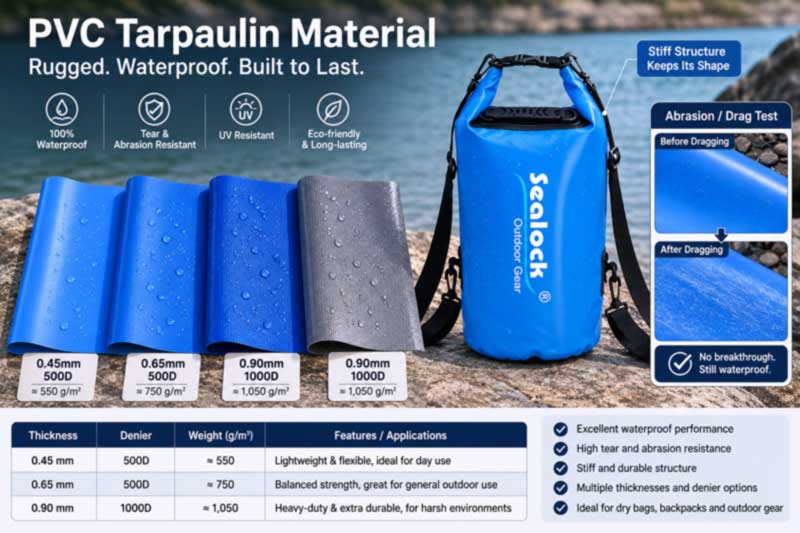
4. Reading a PVC Spec Sheet
"PVC" alone tells a buyer little; four numbers decide the bag:
| Spec | What it means | Practical guide |
|---|---|---|
| Base denier | Scrim strength — tear and puncture resistance | 500D general use; 800–1200D heavy-duty |
| Coating thickness | Waterproofing and abrasion depth | ~0.45 mm light; 0.7–0.9 mm heavy-duty |
| Layer structure | 2-layer light; 3–4-layer heavy-duty | More layers = more tear resistance, more weight |
| Seam method | Welded vs stitched-and-taped | Welded only, for true submersion |
Two bags both labeled "PVC" can perform completely differently based on these. The seam is the one that overrides the rest: stitched-and-taped seams leak as the thread holes and tape fail, so genuine waterproofing requires welded seams regardless of how good the coating is.
5. Manufacturing Applications Suited to PVC
PVC's properties map to specific product programs where it is the correct choice rather than a compromise:
- Heavy-duty roll-top dry bags and sacks for kayaking, rafting, boating, and camping, where ruggedness and cost lead.
- Motorcycle and marine luggage that takes abrasion, road spray, and rough handling, and benefits from a structured, protective body.
- Window and dry/wet-separation bags where a transparent PVC film panel is welded into the body.
- Commuter and value backpacks where a tarpaulin body gives a durable, wipe-clean, cost-effective product.
- Promotional and large-volume programs where the price point and consistent, forgiving production at scale decide the order.
- Specialty grades — UV-stabilized for tropical markets, flame-retardant where regulations require it.
6. Sealock PVC Range
PVC models across capacities and use cases, organized by type rather than priority:
| Image | Model | Capacity | PVC spec | Rating / feature | Product Page |
|---|---|---|---|---|---|
|
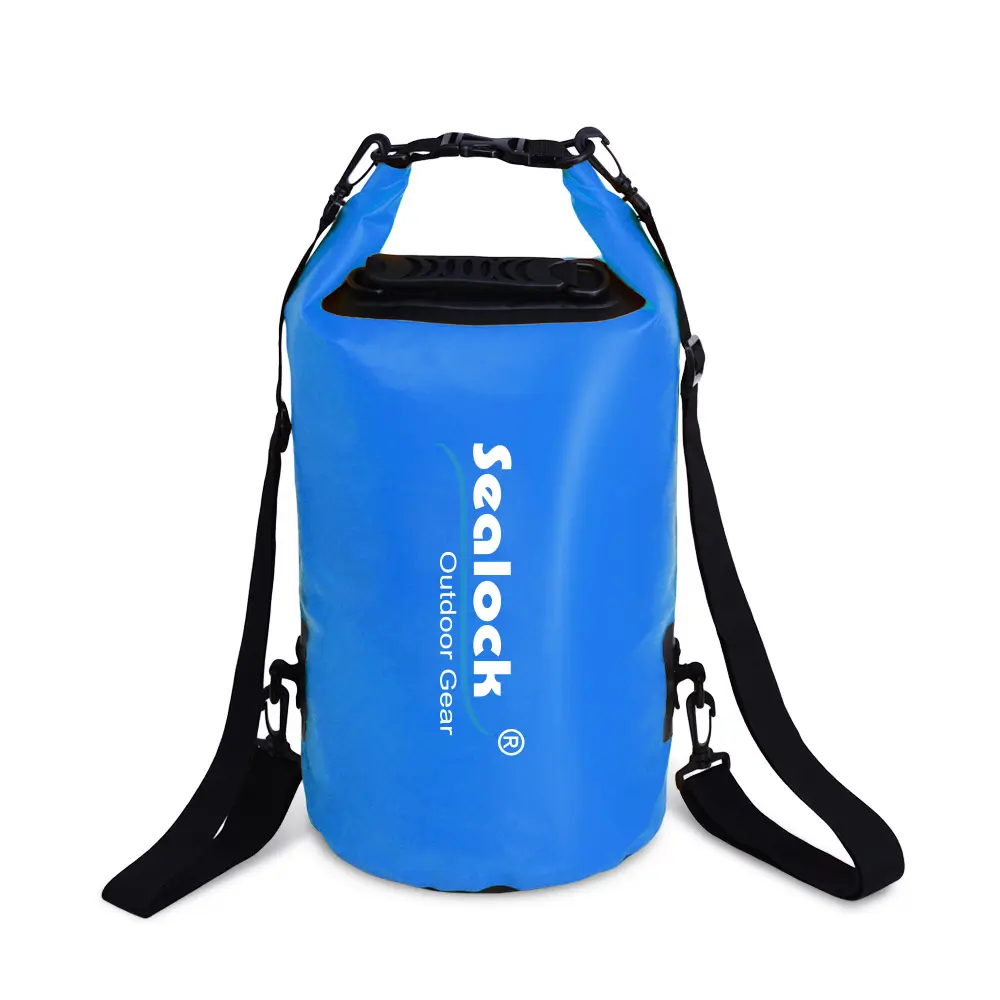
SL-D002 Dry Bag | 5–63L | 0.5 mm 500D PVC | IPX7, UTX buckles, floats | View |
|
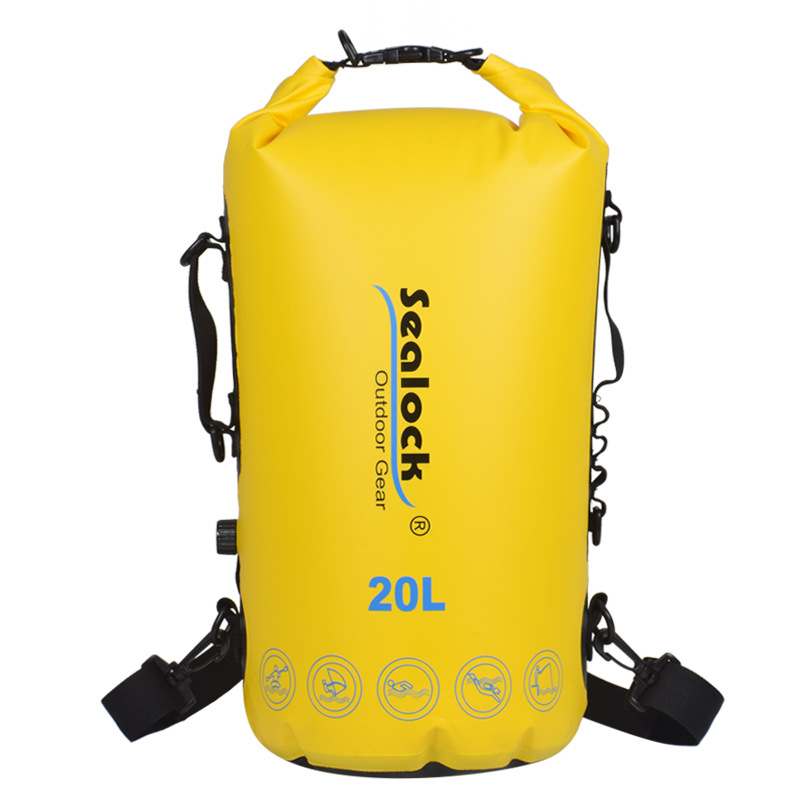
SL-E102 Backpack Dry Bag | 15 / 20L | 0.5 mm 500D PVC (patented dual seal) | IPX7, backpack straps | View |
|
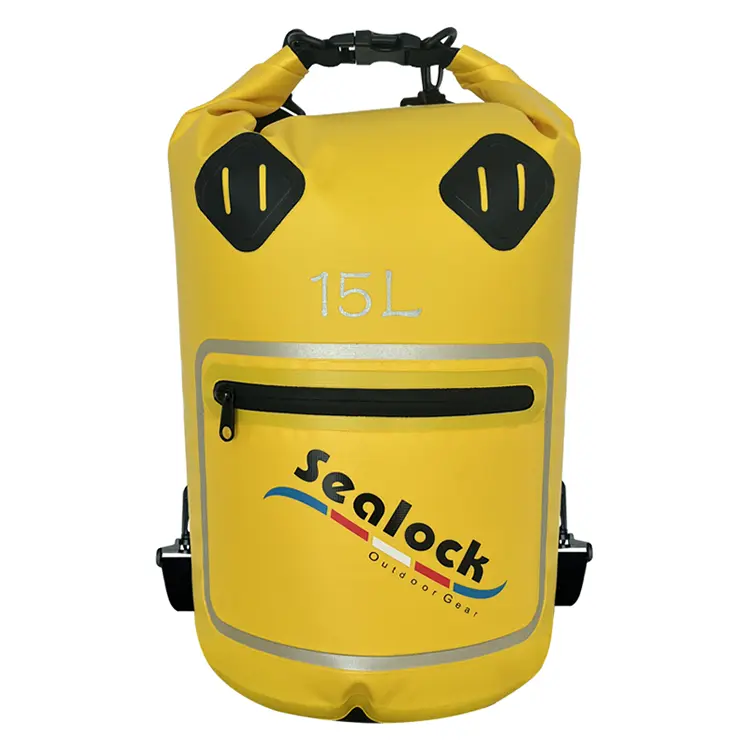
SL-D693 Window Dry Bag | 15 / 20L | 500D PVC tarpaulin | IPX7, window, dry/wet split | View |
|
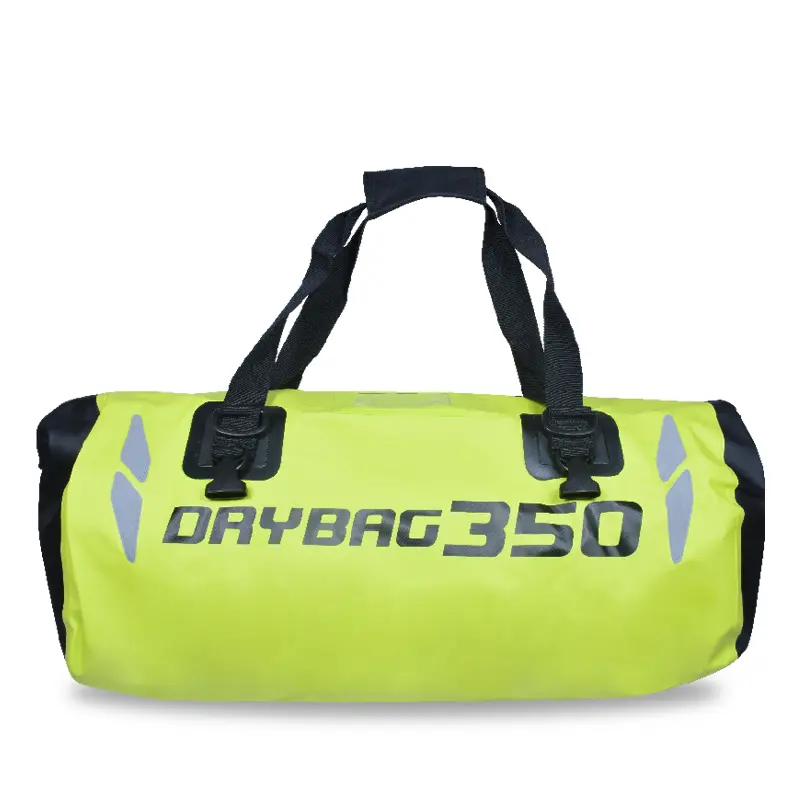
SL-C619 Motorcycle Bag | 35 / 50L | 500D PVC tarpaulin | IPX6, rack mount, reflective | View |
|
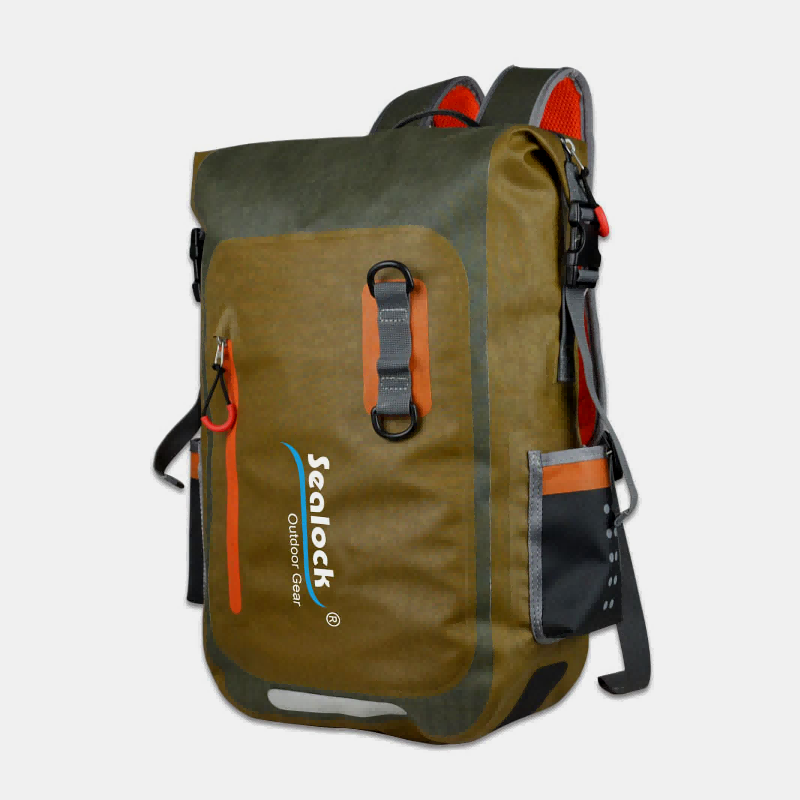
SL-E029 Commuter Backpack | 20L | 500D PVC tarpaulin | IPX6, laptop sleeve | View |
|
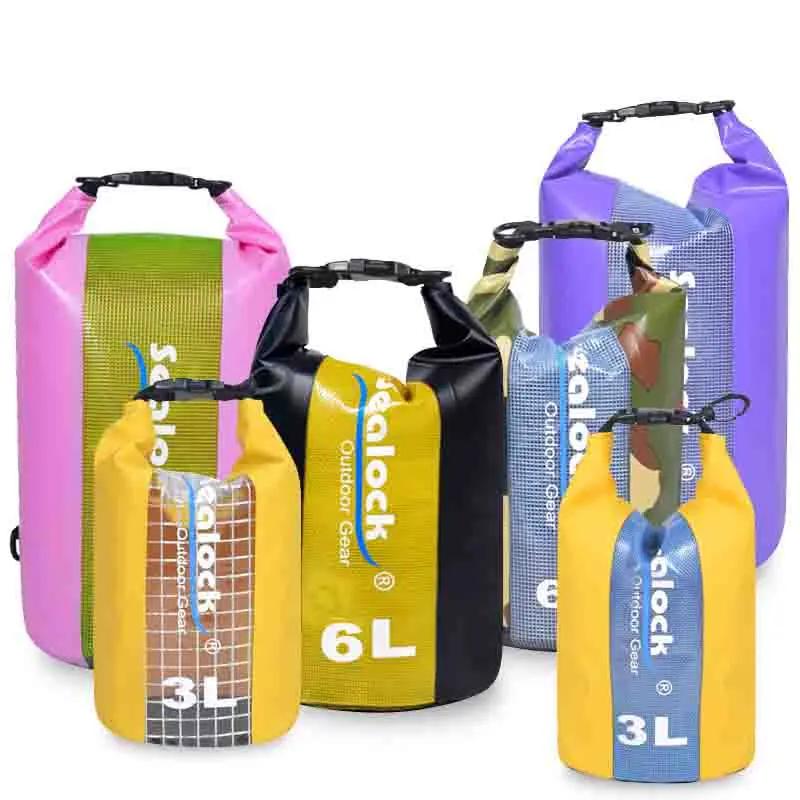
Clear Window Dry Bag | 3–10L | PVC | Window, quick-release strap | View |
Beyond the catalog, Sealock develops ground-up from a sketch, sample, or target spec — capacity, PVC denier and coating thickness, hardware, and structure to the buyer's requirement. Full ranges sit under dry bags, dry backpacks, and duffels.
7. Manufacturing PVC Correctly
PVC's cost advantage only holds if the welding and QC are right, since a badly welded seam wastes the material's durability. Sealock welds PVC by 27.12 MHz high-frequency welding into seamless, needle-hole-free seams, then verifies each batch through three-stage control: IQC on incoming PVC tarpaulin and hardware; IPQC on welds in line, including peel tests on sample welds at run start; and OQC with AQL sampling, batch immersion testing, and signed gold-sample comparison. The laboratory suite covers full water immersion, a load test of over 1,500 cycles, tensile and bonding strength, salt spray, friction resistance, color fastness, and color difference. Compliance is backed by ISO 9001, BSCI, SMETA, HIGG, GRS, and SCAN, with production from Dongguan, China or Ho Chi Minh City, Vietnam. MOQ is 300 pcs, samples in 7–15 days, and bulk in 30–45 days.
8. FAQ
Q: Is a PVC dry bag as waterproof as a TPU one?
A: Yes, when both are welded. Waterproofing comes from the seamless welded construction and a mechanical closure, not from the coating type — PVC's thick coating is inherently impermeable. The differences between PVC and TPU are weight, flexibility, cold behavior, odor, and service life, not the waterproof rating itself.
Q: Why choose PVC over TPU?
A: Cost, ruggedness, and structure. PVC runs roughly $2–4 per square meter against TPU's $4–7, resists abrasion strongly, holds a rigid protective shape, welds easily at volume, and offers UV and flame-retardant grades. For value and mid-tier lines, promotional programs, and rugged outdoor products, PVC is the sensible choice.
Q: What denier and thickness should I specify?
A: 500D with around 0.45–0.5 mm coating covers general dry bags; step up to 800–1200D and 0.7–0.9 mm for heavy-duty, high-load, or industrial-grade bags. Match the numbers to the load and abrasion the bag will actually see, rather than over- or under-building.
Q: Does PVC get stiff or smell?
A: It can — PVC is stiffer than TPU and stiffens further over time and in cold, and it carries a plasticizer "vinyl" odor when new that fades with airing. These are the trade-offs for its cost and ruggedness; for cold-climate or odor-sensitive premium lines, TPU is the better fit, and Sealock builds both.
Q: Can PVC be made UV- or fire-resistant for my market?
A: Yes. PVC can be compounded with UV stabilizers for sun-heavy markets and produced in flame-retardant grades (B1/B2/M1/M2) where regulations require it — options that are a genuine PVC advantage. Confirm the specific standard your market needs.
Q: Is the seam or the material more important for waterproofing?
A: The seam. A premium coating with stitched-and-taped seams still leaks as the needle holes and tape fail. Insist on high-frequency welded seams; that is what makes a PVC bag genuinely submersible.
Request PVC Material Specs and Samples
For PVC denier and thickness options, material data, samples, or a full OEM/ODM proposal, submit an inquiry. Sealock responds to procurement enquiries within 24 hours, with production available from Dongguan, China or Ho Chi Minh City, Vietnam.