
- English
- Español
- Português
- русский
- Français
- 日本語
- Deutsch
- tiếng Việt
- Italiano
- Nederlands
- ภาษาไทย
- Polski
- 한국어
- Svenska
- magyar
- Malay
- বাংলা ভাষার
- Dansk
- Suomi
- हिन्दी
- Pilipino
- Türkçe
- Gaeilge
- العربية
- Indonesia
- Norsk
- تمل
- český
- ελληνικά
- український
- Javanese
- فارسی
- தமிழ்
- తెలుగు
- नेपाली
- Burmese
- български
- ລາວ
- Latine
- Қазақша
- Euskal
- Azərbaycan
- Slovenský jazyk
- Македонски
- Lietuvos
- Eesti Keel
- Română
- Slovenski
- मराठी
- Srpski језик

Custom Motorcycle Waterproof Bags with Private Label Services
Sealock provides custom motorcycle waterproof bags and private label services for brands, distributors, and dealer networks from factories in China and Vietnam. Branding a motorcycle bag is a harder problem than branding most products, because the finished item spends its life in road film, fuel vapour, sustained UV, and — routinely — under a pressure washer. On this category the logo method is a durability decision before it is an aesthetic one. This covers how identity is applied, what survives, and what a private label programme actually includes.
1. Company and Terms
Sealock (YiFuLong Outdoor Gear Co., Ltd.) has built welded waterproof bags for over 20 years, producing for international outdoor and motorcycle brands including Benelli, Helly Hansen, OSPREY, and CHUMS.
- Facilities: Dongguan, China | Ho Chi Minh City, Vietnam — either origin available on any model
- MOQ: 300 pcs per model (500 on the single-side saddle bag) | Samples: 7–15 days | Bulk: 30–45 days
- Terms: FOB Guangdong from Shenzhen, T/T 30% deposit and 70% balance against inspection
- Certifications: ISO 9001, BSCI, SMETA, HIGG, GRS, SCAN
2. Two Levels of Customization
Private label starts from a proven platform and applies a brand's identity — logo, colourway, trims, packaging, and documentation. It is faster, avoids new die tooling, and suits a first range or a catalogue extension. Full custom development builds from a sketch, sample, or target spec: capacity, closure, mounting system, cut geometry, rated load, and hardware. It needs its own machined dies, quoted separately and built before sampling, and gives a brand a silhouette competitors cannot buy. Most programmes begin with the first and graduate to the second once the line proves out.
3. Branding Methods and What Actually Survives
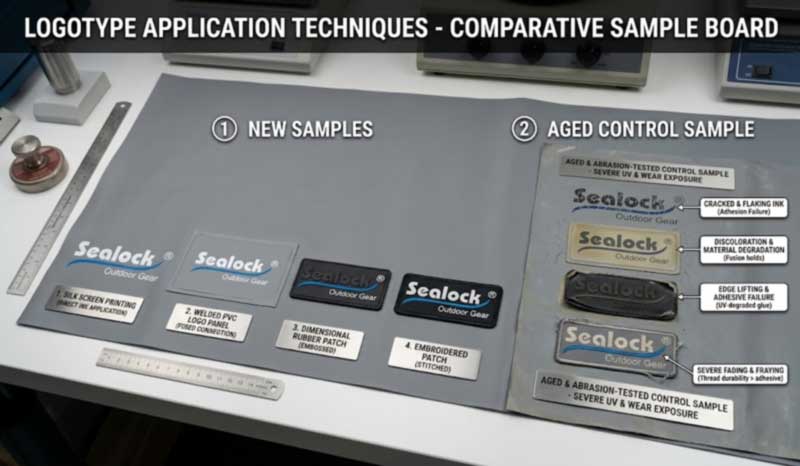
Applying a logo to welded PVC tarpaulin or TPU laminate is a technical process, not a print job, and the wrong method fails within a season on a bike:
- Silkscreen printing — the workhorse for this category. Screen ink lays down far thicker than digital, giving vivid colour that holds on dark surfaces and stands up to prolonged outdoor exposure. Best for bold, solid, one- to three-colour marks; each colour needs its own screen, so complex artwork becomes impractical.
- Welded logo panels — for complex or photographic artwork the graphic is printed on a print-friendly material and then welded into the bag, so the branding becomes part of the sealed skin rather than sitting on top of it.
- Rubber or welded patches and embossing — a premium, texture-led look with no printed layer to abrade off.
- Embroidery — extremely durable where it can be applied, but it perforates the material, so on a waterproof body it belongs on a separate patch rather than the shell.
- Heat transfer — good for gradients and fine detail on suitable fabrics, but it needs care on PVC, which is heat-sensitive. Method and substrate are confirmed together at sampling rather than assumed.
Two technical points decide whether a print lasts. Coated waterproof fabrics have low surface energy, so adhesion depends on proper pre-treatment and correctly formulated inks with a bonding catalyst that bites through the coating — a print that peels usually traces to a skipped catalyst rather than a bad design. And print position matters: surfaces near zips, seams, buckles, and roll-top folds flex or sit uneven, so the logo is placed on a flat, stable panel where it will not be creased or abraded by mounting straps.
4. Colour: Matching a Brand, or Matching a Bike
Colour is available as stock shades — black, yellow, grey, blue, green, and fluorescent yellow across the range — or as custom Pantone-matched fabric. Two motorcycle-specific uses are worth planning for. A brand colourway carried consistently across tail bags and saddlebags makes a range read as a system on the shop floor. And a colourway matched to a particular motorcycle livery gives a dealer a strong attachment sale at the point of bike delivery, which is a route to volume that generic luggage cannot reach.
Colour is held to the approved standard by colour-fastness and colour-difference testing against a signed reference on every batch, which is what stops the fourth production run drifting from the first — the failure that breaks a dealer network's confidence in an own-brand line.
5. Reflective Does Double Duty
On rear-mounted motorcycle luggage, reflective material sits exactly where a following driver's headlights fall, so it is a safety specification. It is also the most legible branding surface on the product at night. Reflective printing, film panels, and piping are all specifiable, and a brand mark executed in reflective earns its place twice — the current range carries dual-side reflective on the saddlebags and tail bags, and reflective panels with piping on the 55L three-way model.
6. Patch Panels: Customization the Rider Does
Hook-and-loop patch panels let the end customer add club, team, or ID patches, and the 55L platform includes a number-plate patch panel. For a brand this is a low-cost feature with a disproportionate effect: it invites the owner to personalise the product, which builds attachment to the brand rather than to the bag alone, and it gives dealers a small accessory line to sell alongside.
7. What a Private Label Programme Includes
The service extends past the bag itself, and on motorcycle luggage the paperwork is part of the product:
- Fitting instructions. Mounting is where support enquiries and returns originate, so clear illustrated instructions — strap routing, mounting positions, and exhaust clearance guidance — belong in the box under the brand's name.
- Rated load labelling. A stated figure on the product and in the documentation, such as 8–12 kg on the 45L tail bag or a 50 kg carrying capacity on the paired saddlebags.
- Care instructions. Cleaning guidance matters where owners pressure-wash bikes with luggage still fitted.
- Retail presentation. Hangtags, care labels, barcode placement, colour boxes, and OEM carton printing, or plain PP bag and carton marks for dealer distribution. Standard packing is one piece per PP bag with 20 per carton on tail bag lines.
- Warranty position. Several models carry a one-year warranty, and the terms a brand chooses to publish should be settled before launch rather than after the first claim.
8. Verify the Branding Before Bulk
Print durability is testable, and a buyer should ask for evidence rather than take a sample's appearance at face value. Reasonable requests: a tape or cross-hatch adhesion check on the actual production material, accelerated weathering for UV and colour retention, abrasion testing where straps or racks contact the printed area, and colour matching signed off against the approved Pantone reference. Critically, all of this should be run on the final production fabric rather than a similar swatch — adhesion behaves differently on a different coating batch.
9. Platforms Available for Customization
Models organized by type rather than priority:
| Image | Model | Capacity | Material | Position / features | Product Page |
|---|---|---|---|---|---|
|
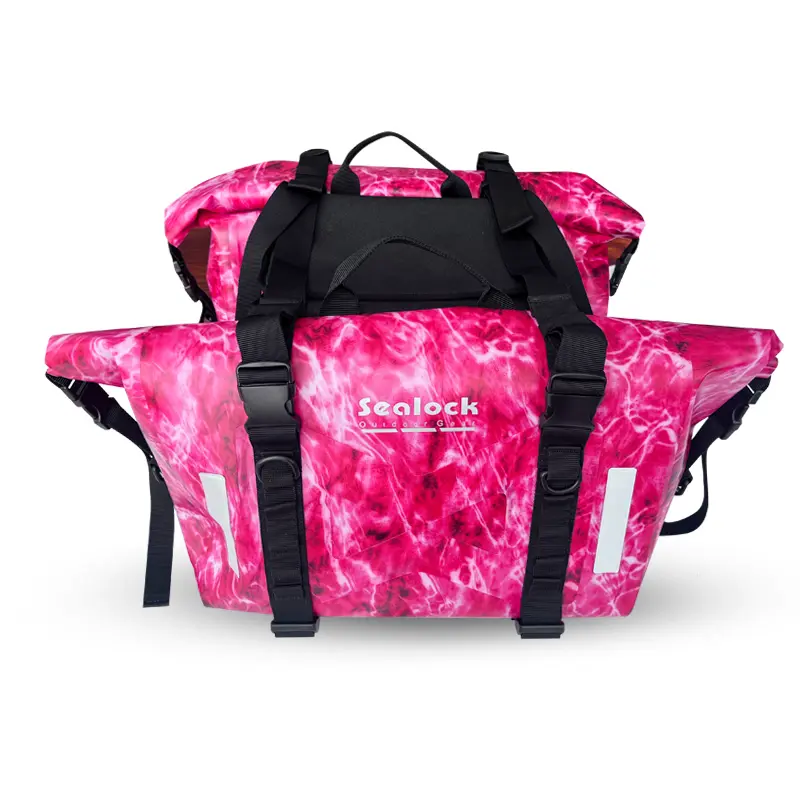
SL-C807 | 45L | 500D PVC / 420D TPU | Tail · roll-top · IPX6 · rated 8–12 kg · matte finish | View |
|
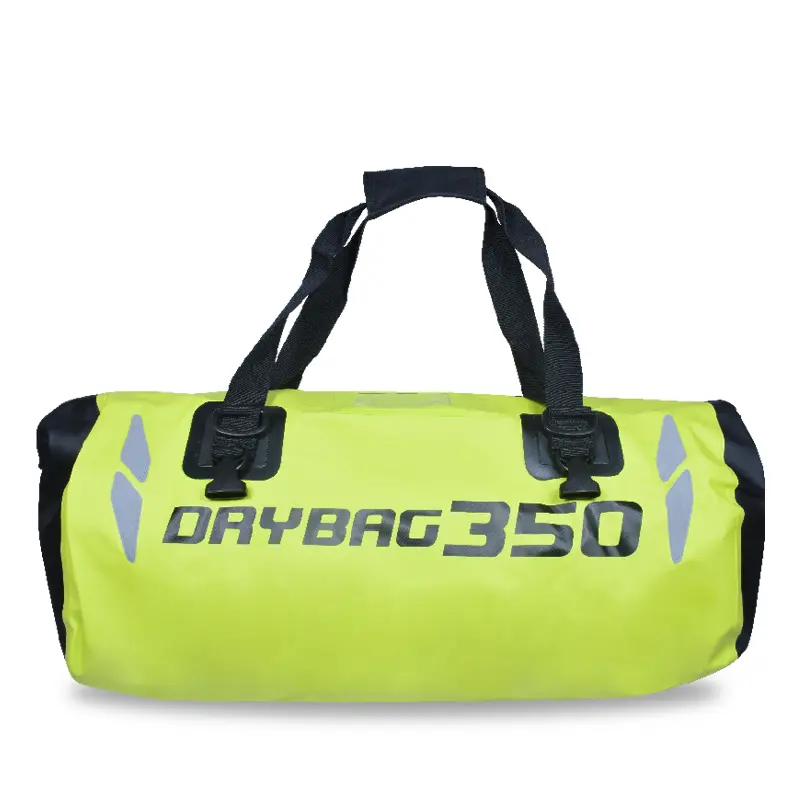
SL-C619 | 35 / 50L | 500D PVC tarpaulin | Rear rack · roll-top · IPX6 · reflective print | View |
|
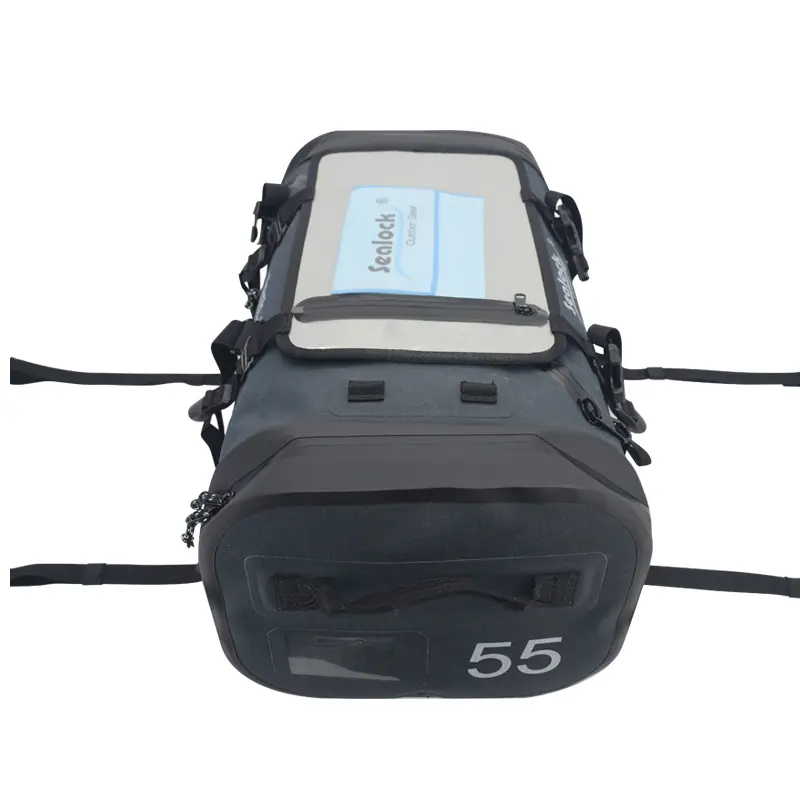
SL-E984 | 55L | Ripstop TPU | Three-way carry · airtight zipper · IPX7 · patch panel | View |

|
SL-C624-A | 45 / 60L | PVC tarpaulin | Backseat · five stock colours | View |
|
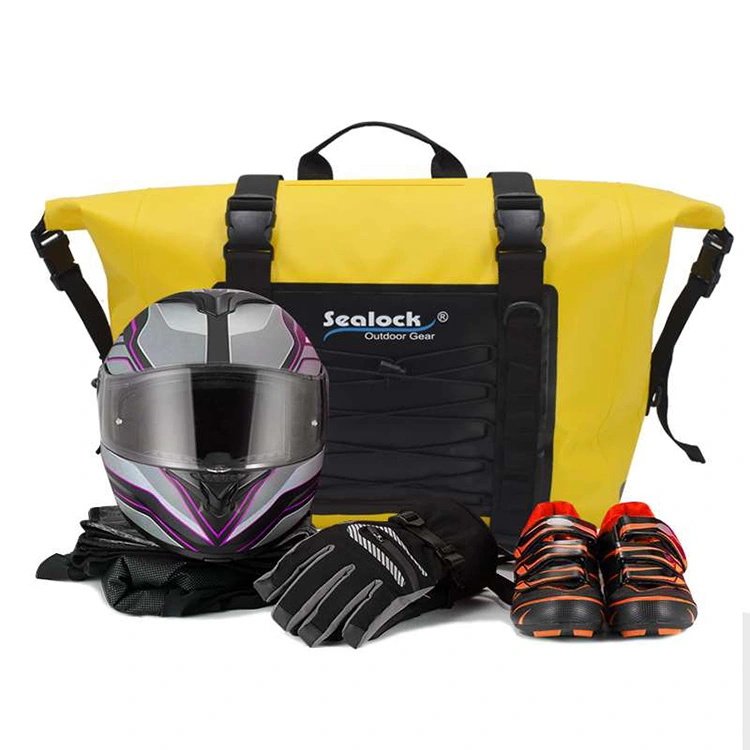
80L Saddlebags | 80L (40L × 2) | Welded PVC | Both sides detachable · 50 kg · dual-side reflective | View |
|
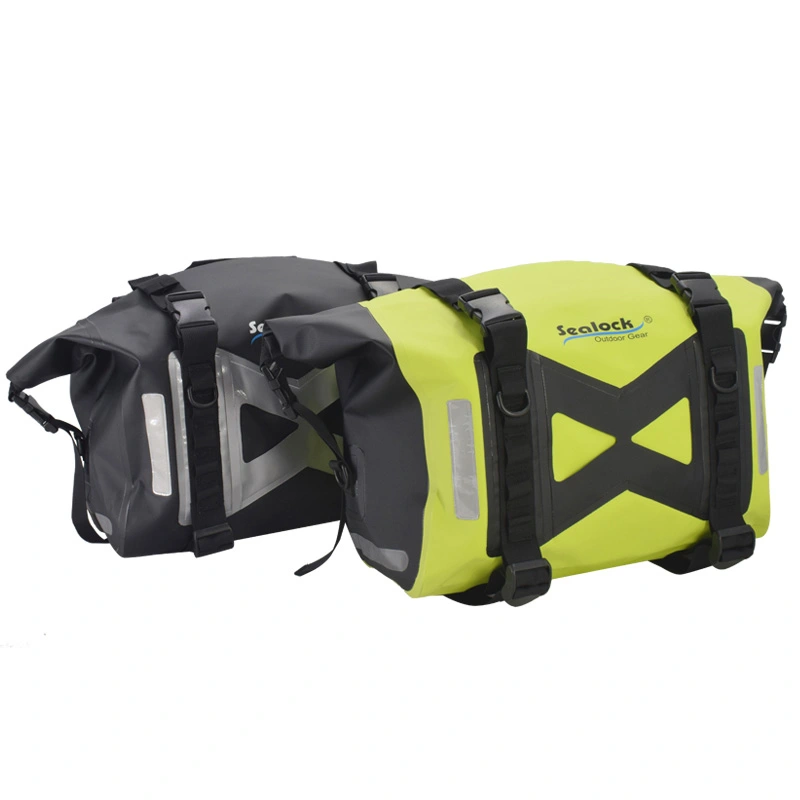
60L Saddlebags | 60L | Welded PVC | Both sides detachable · 50 kg | View |
A range covering both the tail and pannier positions under one logo and colourway ships in a single production run. Position-specific guidance is in the tail bag OEM guide and the saddlebag guide, and programme structure for resellers in the guide for global distributors. Full categories sit under waterproof bags and dry bags.
10. Quality Control
Every batch runs IQC on incoming tarpaulin, hardware, and reflective materials; IPQC on welds, mounting-point construction, and logo application in process, including peel tests on sample welds at run start; and OQC with AQL sampling, batch testing, signed gold-sample comparison, and colour-difference checks. Load cycling over 1,500 cycles targets mounting straps, D-rings, and handles, alongside tensile and bonding strength, salt spray, friction resistance, and colour fastness. The full customer inspection procedure — unboxing, vacuum extraction, a 24-hour static rest, and air-leak determination — can be witnessed end to end, with SGS or QIMA inspection available. Standards are set out in the quality control standards for waterproof production.
11. FAQ
Q: Which logo method lasts longest on a motorcycle bag?
A: Silkscreen for bold solid marks, because screen ink lays down thick and holds colour under prolonged outdoor exposure; welded logo panels for complex artwork, since the graphic becomes part of the sealed skin; rubber or welded patches where a premium texture is wanted with no printed layer to abrade.
Q: Our last supplier's prints peeled. Why does that happen?
A: Usually adhesion, not artwork. Coated waterproof fabrics have low surface energy, so the print needs proper pre-treatment and ink formulated with a bonding catalyst that penetrates the coating. Skipping that step is the common cause. Ask for an adhesion test on the actual production material, not a lookalike swatch.
Q: Can you match our brand's exact colour?
A: Yes, through custom Pantone-matched fabric, with colour-fastness and colour-difference testing against a signed reference on every batch so repeat orders stay matched. Matching a specific motorcycle livery is also possible and works well as a dealer attachment sale at bike delivery.
Q: Where should the logo be placed?
A: On a flat, stable panel away from zips, seams, buckles, and roll-top fold zones, and clear of where mounting straps cross. A logo placed in a flex or abrasion path will wear regardless of the method used.
Q: What comes in the box besides the bag?
A: Whatever the programme specifies — illustrated fitting instructions, a rated load label, care guidance, hangtags and care labels, barcode, and retail or dealer packaging. On motorcycle luggage the fitting instructions matter commercially, because mounting is where support enquiries and returns come from.
Q: Can we start with private label and move to a custom design later?
A: Yes, and it is the usual route. Private label on an existing platform gets a branded range to market quickly; a custom silhouette needs its own machined dies quoted separately and built before sampling, so it is planned once the line proves out. Share launch dates at enquiry either way.
Request a Private Label Proposal
For branding options, Pantone matching, packaging and documentation scope, or a full custom development proposal, submit an inquiry. Sealock responds to procurement enquiries within 24 hours, with production from Dongguan, China or Ho Chi Minh City, Vietnam.