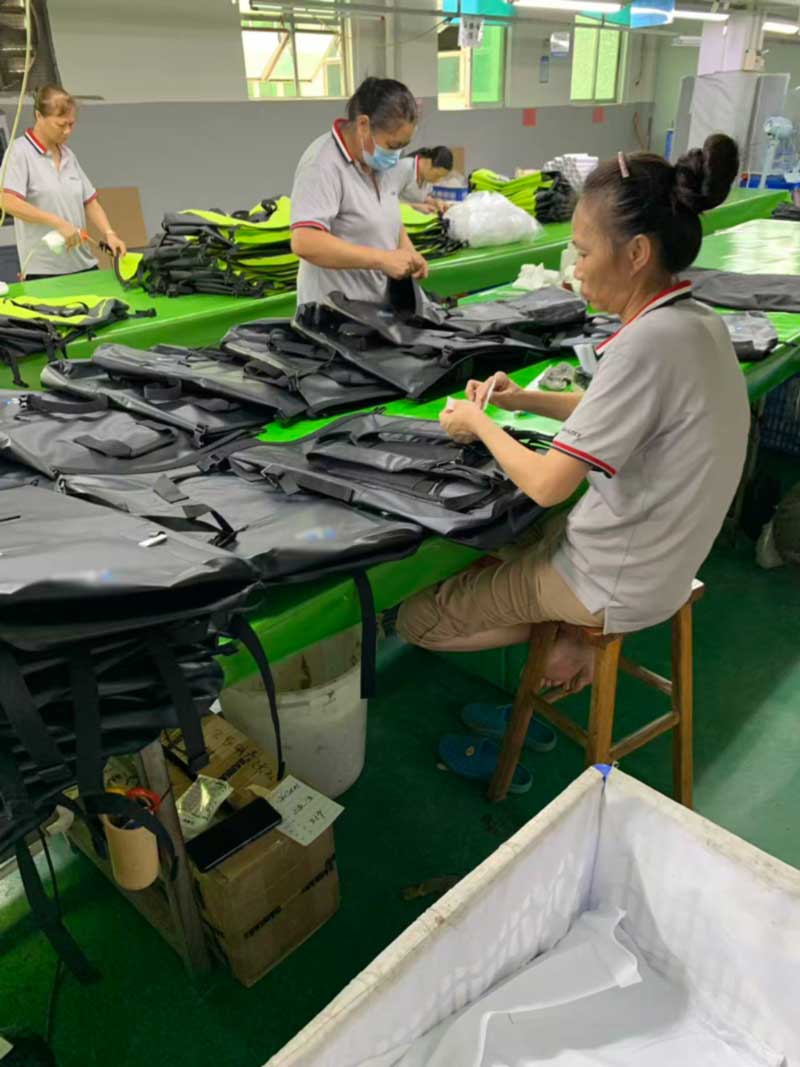
There is a gap between a bag being made and a bag being ready to sit on a shelf, and most of the cost of getting that gap wrong lands on the brand rather than on the factory. This month our Dongguan finishing floor ran a black welded roll-top backpack and duffel program through that gap in full: hangtag application, barcode labelling, zipper-pull and hardware protection, surface cleaning, model separation and pack-out — with a high-visibility order running on the adjacent benches at the same time.
It is worth describing in detail, because "we can do retail packaging" is a sentence every supplier says and very few can back with a process.
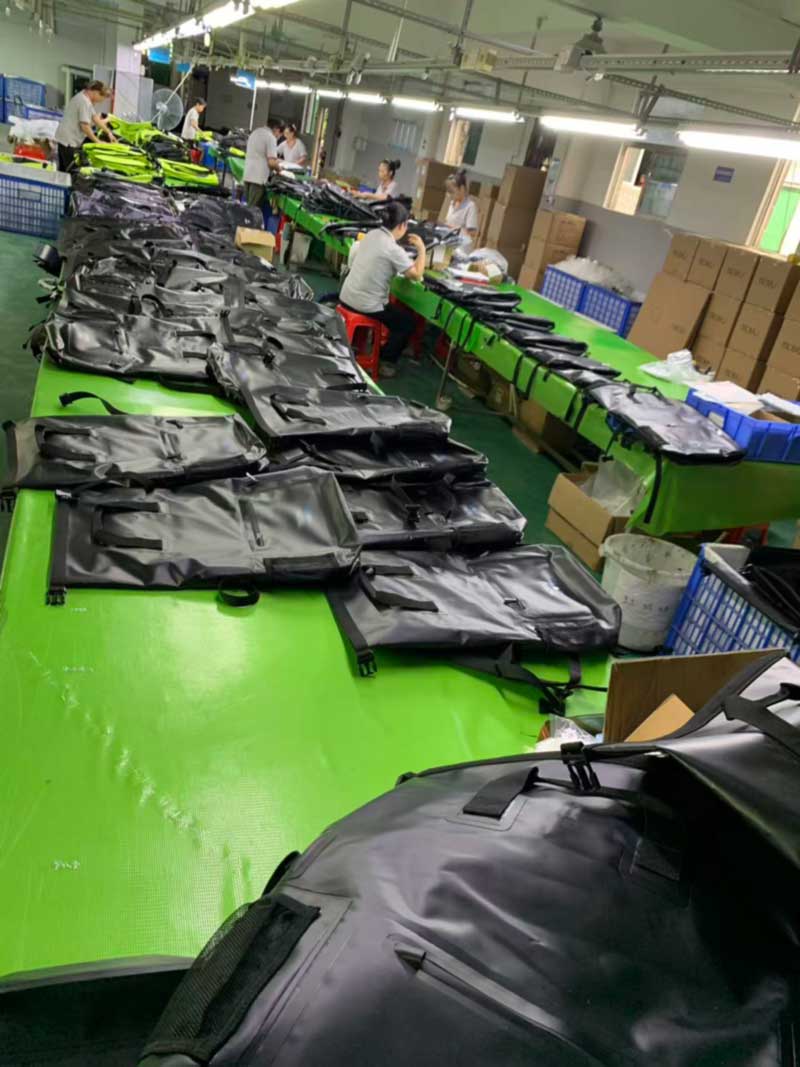
The finishing line at full width. Bags are laid flat rather than stacked so every face is visible before tagging.
The product: welded body, sewn detail, and why both are correct
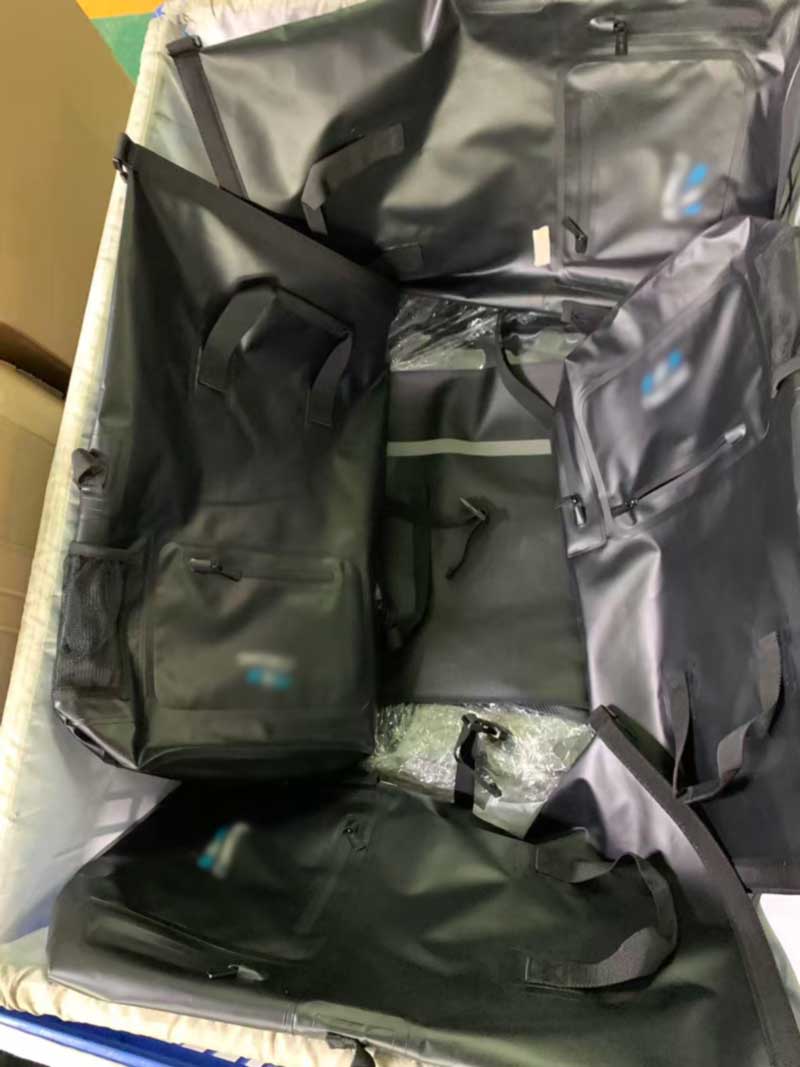
The bags in this run are a family rather than a single item — roll-top backpacks in two sizes, a zip-top holdall, and a smaller shoulder bag, all in the same coated black shell with a matching material palette. The main body is high-frequency welded. The front pocket runs a water-resistant zipper, the side pockets are stretch mesh, and the edges and mesh pocket mouths are sewn and bound.
That mix is deliberate, and it is worth being blunt about it, because buyers sometimes arrive believing that anything not welded is a compromise. It is not. Welding is the right answer for the shell, the base and the strap anchor patches, where a needle hole is a leak path and a wear point under load. It is the wrong answer for a stretch mesh pocket, a bound edge or a zipper tape, where sewing gives a cleaner, more durable and more repairable result and adds no water ingress risk that the closure design was not already handling. Our sewing floor is in-house and held to the same process discipline as the welding floor — process cards at each station, first-piece approval, inline checks — and on a product like this the two run as one build sequence, not as a main process with a fallback bolted on.
On waterproof performance we are specific rather than generous. A roll-top closure with a zippered external pocket is built to shed sustained heavy rain and pressurised spray, and we test it that way, with a heavy rain and water-jet protocol. It is not a submersion product, and we do not let an immersion claim ride on a closure that cannot support one. Where a buyer needs true immersion capability, that is a different closure architecture and we will quote it as one.
Welded shell, sewn bound edges, water-resistant front zipper, stretch mesh side pocket — three processes on one product.
Hangtags are a data operation, not a decoration
Every piece in this run receives a printed retail hangtag carrying the brand mark, model name, colourway name and a barcode, attached at a fixed point with a fixed loop. That sounds like the simplest task on the floor. It is actually the one with the highest downstream cost of error.
A barcode is the product's master identifier across the buyer's entire chain — receiving, inventory, replenishment, sales reporting. Every variant, every size and every colourway needs its own code, and retailers validate what arrives against their own records. A tag applied to the wrong colourway does not fail at the factory or at the port. It fails at the retailer's distribution centre, where a scan mismatch turns into a receiving exception, and from there into rework charges, held inventory, or a compliance deduction taken straight out of the invoice. Large retail programs commonly run separate penalty schemes for delivery performance and for labelling execution, and a single shipment can draw both.
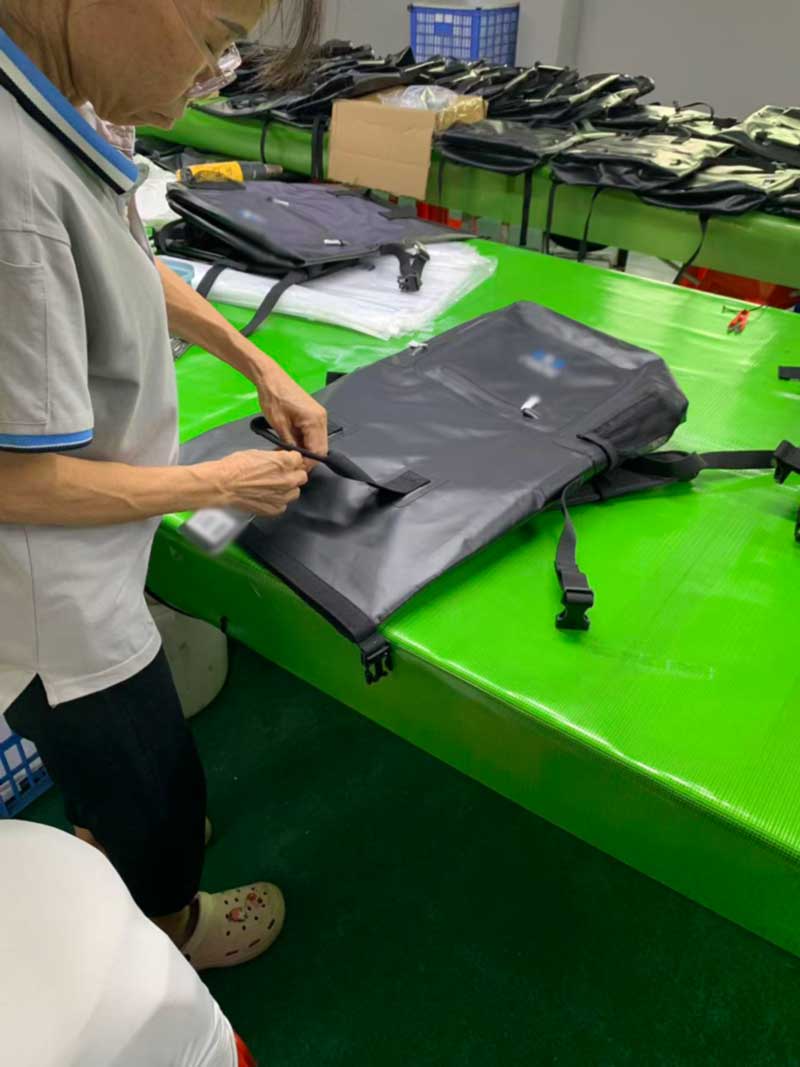
So we treat tagging as a controlled step. Tags are issued to the bench by model and colourway in counted batches rather than kept as a loose pile; the bench runs one model at a time; the tag stock physically changes when the model changes; and the OQC check reconciles tag data against the piece before the poly bag is sealed. It is deliberately boring. Boring is what you want at the step where a two-cent card decides whether a container clears receiving.
Tagging bench. One model at a time, tags issued in counted batches matched to the colourway on the table.
Protecting a gloss black surface
Black coated fabric photographs beautifully and marks like nothing else. Fingerprints show. Scuffs show. A buckle pressed against a panel for six weeks in a hot container leaves a witness mark that a customer will read as damage. So a meaningful share of the labour on this run goes into surface protection rather than assembly:
Zipper pulls get white protective sleeves so the metal cannot rub the panel it sits against. Buckles and hardware clusters are wrapped before the bag is folded. Light non-woven covers are laid over bags in the bins during transfer. Each piece is wiped down at the bench before bagging — the finishing tables carry cloths and a spray bottle for exactly this — because a welded and handled bag picks up handling residue that is invisible under workshop light and obvious under retail light. And the turnover bins are lined with white cloth, so the bags never touch the moulded ribs and edges of a bare plastic crate.
None of this shows up on a spec sheet. All of it shows up in the arrival inspection report, which is the document that actually determines whether a buyer reorders.
Zipper pulls sleeved, hardware wrapped, bins cloth-lined. Most of the visible defects on a gloss black bag are handling damage, not build defects.
Running four models and two programs at once without mixing them
The genuinely difficult thing about this week's floor was not any single product. It was that four models of one program and a completely separate high-visibility program were in finishing simultaneously, sharing the same benches, the same aisle and the same bin fleet.
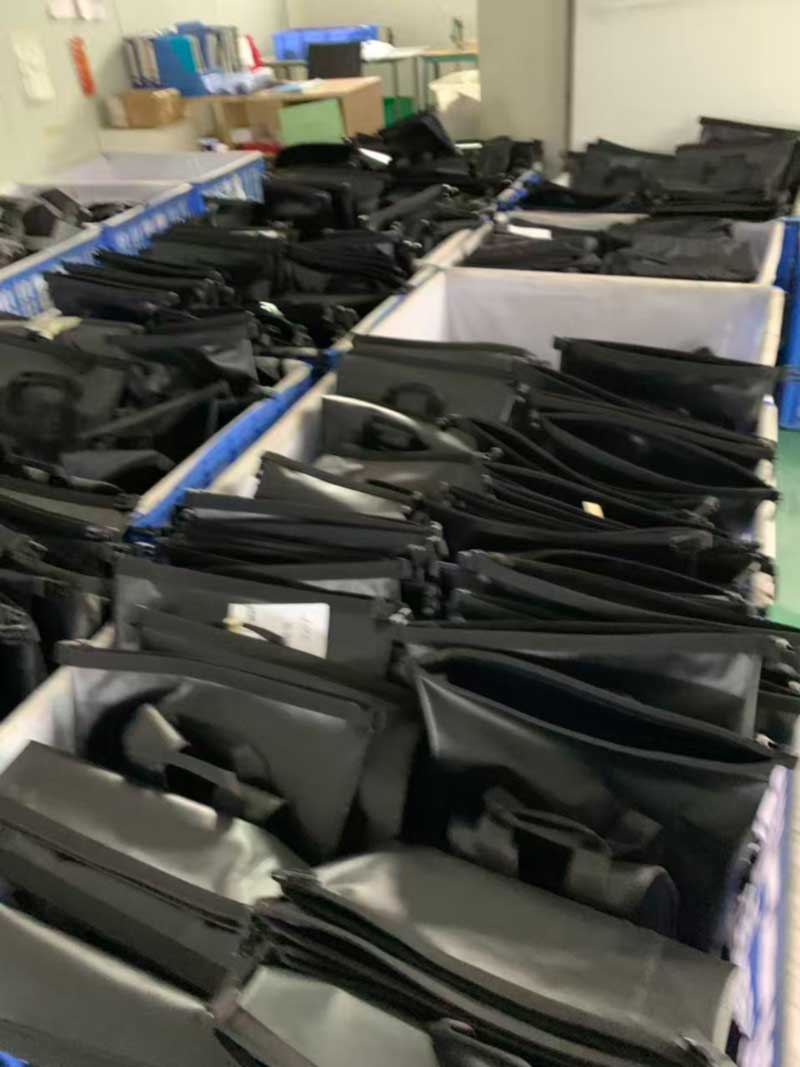
Mixing is prevented structurally rather than by attention. Finished goods are segregated into cloth-lined bins one model to a bin, each bin carrying its own process and model card, and staged in aisle rows so that a supervisor can read the whole floor's status by walking it once. Component and tag kits are issued per model and returned at the end of the run so leftovers cannot drift onto the next bench. Counts are written on cards that sit face-up on the goods and travel with them to OQC, where they are reconciled before cartons close.
The failure mode this design targets is specific: a model that looks similar to its sibling — same colour, same fabric, different capacity or different pocket layout — ending up in the wrong carton. It is one of the few errors that neither the factory nor the buyer catches until the goods are on a shelf, and it is entirely a process problem rather than a skill problem.
One model to a bin, each with its own card, staged in rows so the floor's status is readable at a glance.
What gets verified before the carton is taped
Inline and outgoing checks on this order covered closure function on every piece — roll-top folded and buckled, zippers cycled full travel — plus strap and buckle security, mesh pocket attachment, print position and adhesion, hangtag data against the piece, colour difference against the approved standard, and general appearance under bench lighting.
Material and structural verification sits upstream and runs to sample: bonding strength on welded seams, tensile strength on the base fabric, load cycling on strap anchors, zipper fatigue, abrasion, salt spray and colour fastness, plus the heavy rain and water-jet test described above. IQC, IPQC and OQC checkpoints run through the order as standard, and third-party inspection through SGS or QIMA can be booked on request — as can the buyer's own agent, since nothing in the flow depends on the inspection being ours.
Final bench: wipe-down, tag check, poly bag, count card.
For buyers sourcing this category
Sealock has built waterproof outdoor gear for over 20 years, with high-frequency welding and in-house sewing running side by side in Dongguan and at our facility in Ho Chi Minh City, so buyers can select the origin that suits their tariff position without renegotiating the specification. Standard terms are FOB Guangdong, 7–15 days for sampling, 30–45 days for mass production, and MOQ from 300 pieces on most models. Retail-ready pack-out — hangtags, barcode labels, market-specific artwork, individual poly bags and carton marking to the buyer's vendor guide — is handled in-house rather than farmed out, which is why the tag data and the goods stay under one set of counts.
We develop from a sketch, a competitor sample or a target spec sheet as routine work, and we will tell you when the construction you asked for is the wrong one for the product. For drawings, samples or a quotation, contact us at info@sealock.com.hk.
We use cookies to offer you a better browsing experience, analyze site traffic and personalize content. By using this site, you agree to our use of cookies.
Privacy Policy