This month our Dongguan high-frequency welding workshop moved a waterproof bicycle frame bag program from sample confirmation into first production. The bag is a full-triangle frame pack built for gravel and bikepacking use: a diamond-ripstop TPU-faced shell, welded gusset, welded hook-and-loop anchor tabs at the top tube, down tube and seat tube, and a water-resistant closure at the top edge. Two closure versions were run side by side during sampling — a zippered version and a roll-top version — because the buyer wanted to see how each behaved under load before locking the tooling.
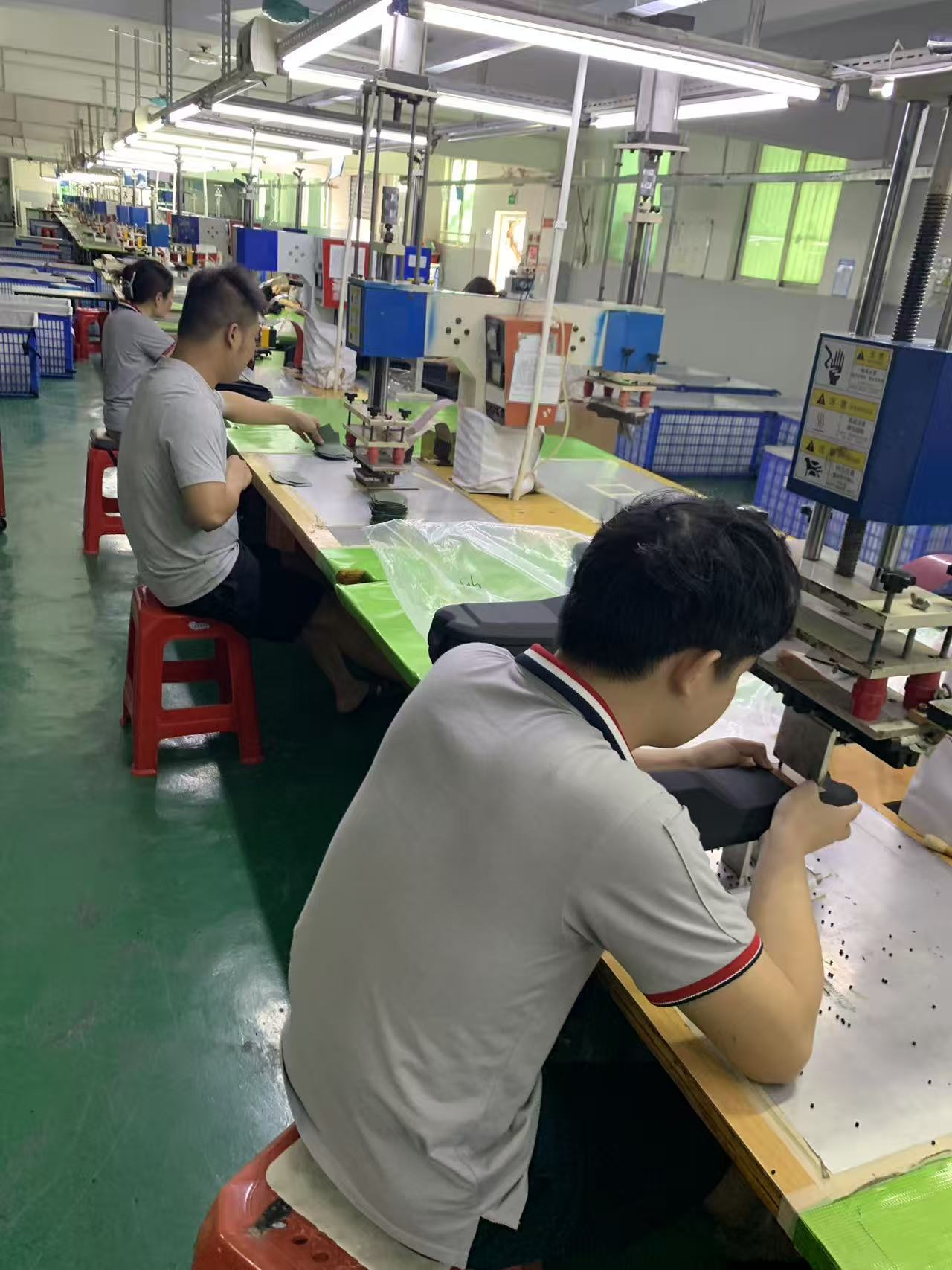
The high-frequency welding floor during the frame bag run. Each station carries its own die set.
Why a frame triangle is harder to weld than a duffel
A dry bag is a tube. A frame bag is not. The triangle is defined by the bicycle it hangs inside, which means every panel edge is a different length and most of them are curved, and the gusset that gives the bag its volume has to taper from roughly full depth at the down tube to almost nothing at the forward apex. That taper is where welded construction earns its keep and also where it goes wrong if the process is sloppy. The electrode has to deliver even pressure and even dwell along a seam whose geometry changes continuously, and a die that fits the wide end will under-weld the narrow end unless it is cut for that specific panel.
Practically, that means a frame bag is not a product you quote from a photo. Each size and each frame profile needs its own die set, and the die is the reason sampling on this category runs at the longer end of our normal 7–15 day window. Once the die exists, though, output is fast and repeatable — the welding station is doing the same fusion cycle every time rather than relying on an operator's seam allowance judgement.
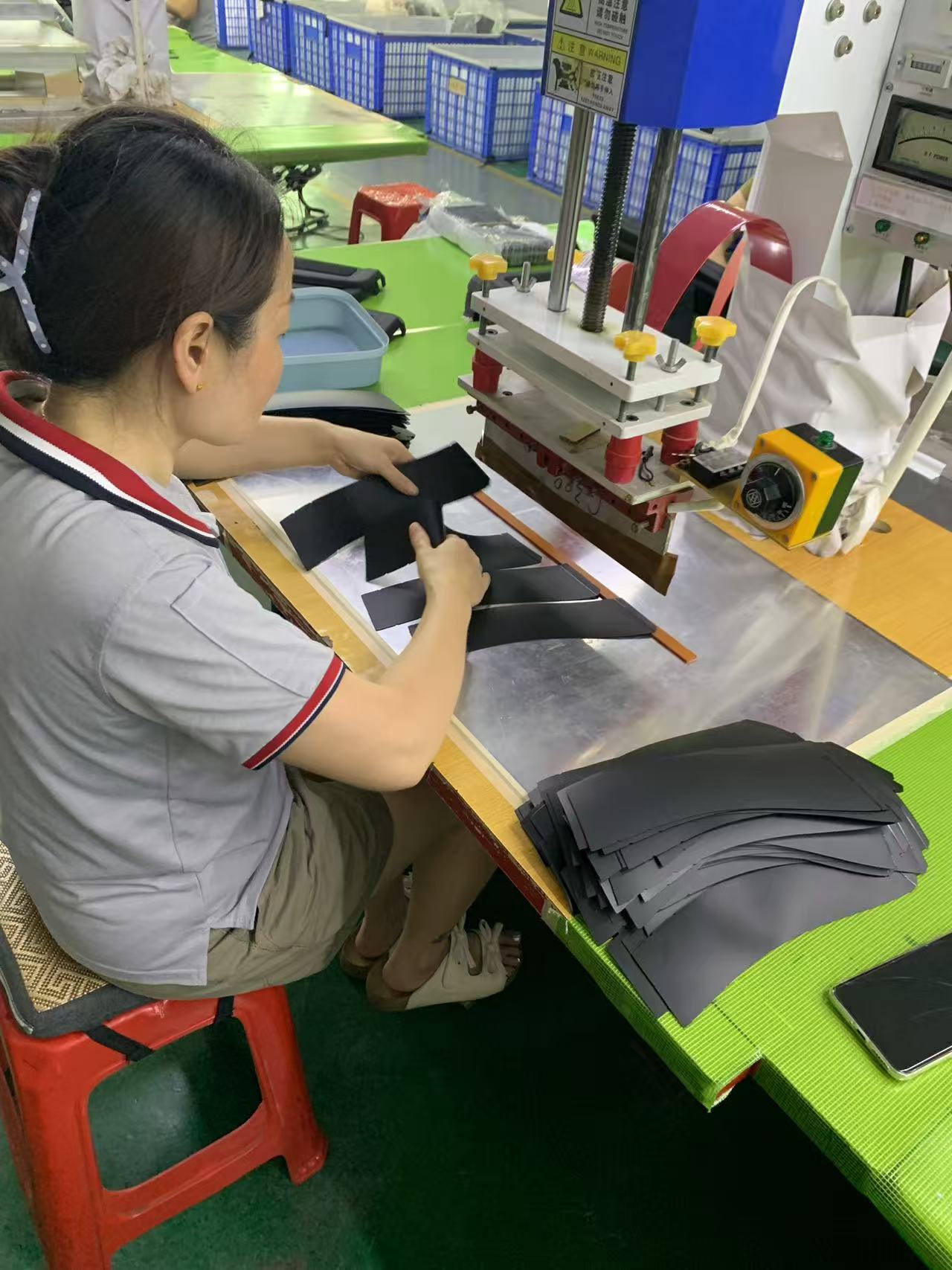
Cut panels are located against the die by hand; the fixture, not the operator's eye, sets the seam line.
The strap anchors are welded, not sewn
Ask any bike shop mechanic where frame bags fail and the answer is rarely the main seam. It is the anchor point. A loaded frame bag is under constant asymmetric tension — the straps pull the shell upward against the tubes while the contents push outward, and every washboard section of gravel adds a shock cycle to that. A sewn hook-and-loop tab puts a line of needle perforations straight through the base fabric at exactly the point carrying that load. Those perforations do two things over a season: they let water track along the thread, and they act as a tear line when the bag is over-stuffed.
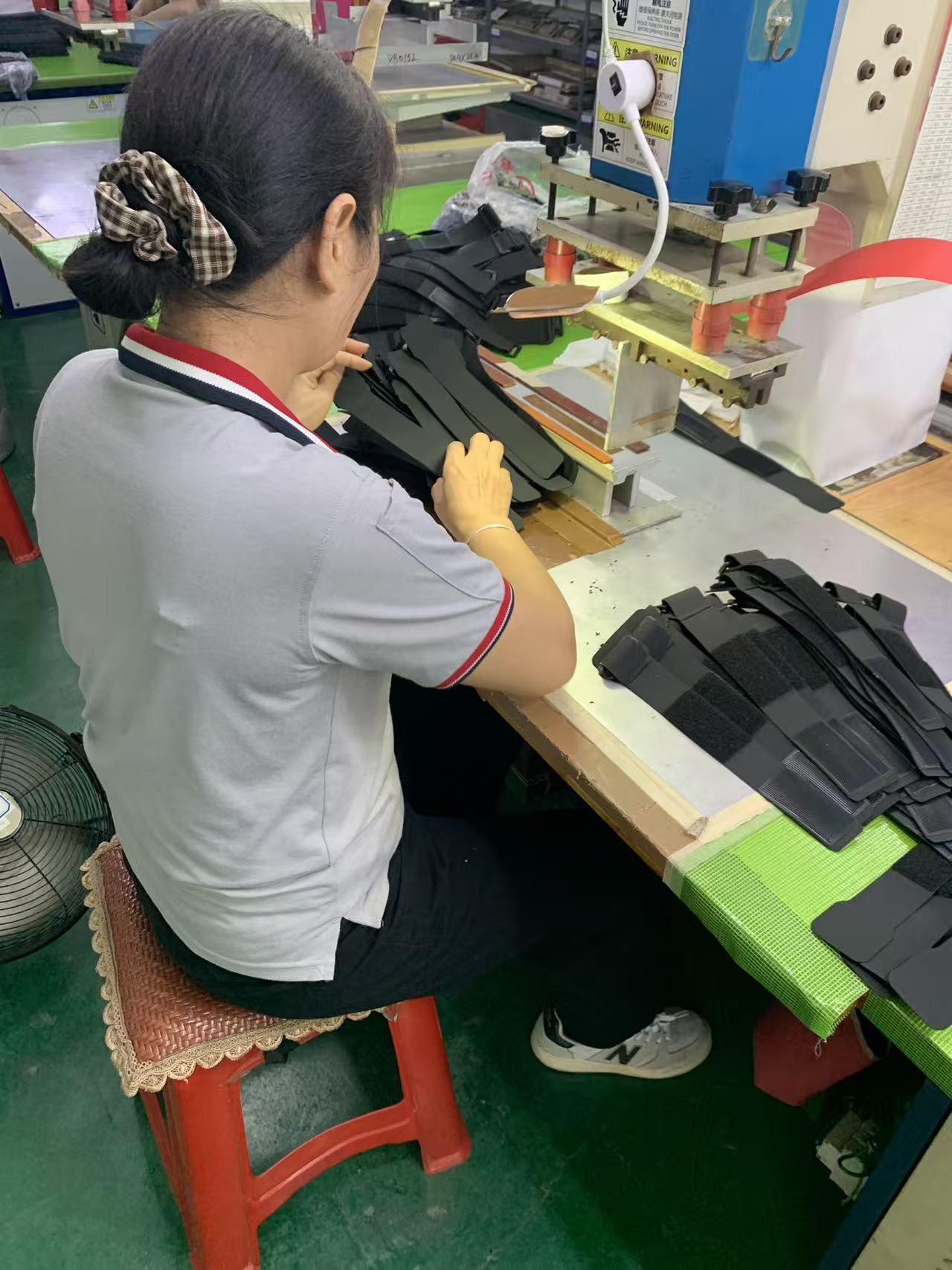
On this program the hook-and-loop tabs and the reinforcement patches are high-frequency welded directly to the shell, so the anchor and the base fabric become one fused layer with no punctures at all. Our operators weld the tab stacks in batches before the shell is closed, which is the sequence you can see in the workshop photos — trays of welded strap assemblies waiting beside the machine, then the shell closure run afterwards.
Strap and hook-and-loop assemblies are welded in batches ahead of shell closure.
What sample confirmation actually looks like
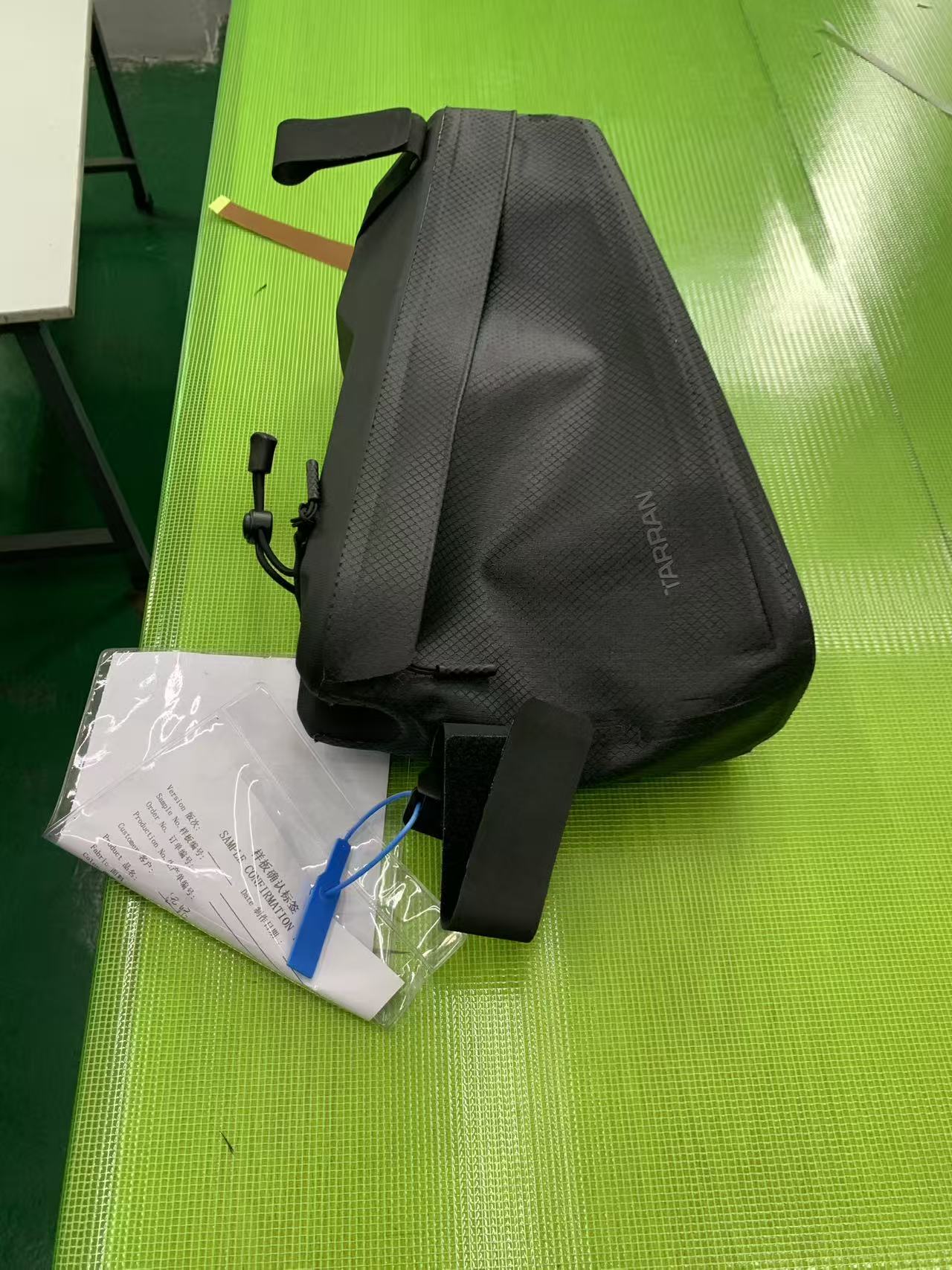
The sample confirmation tag attached to the finished bag carries version, sample number, order number, production number, customer, product name, fabric and colour. It is a small card and it is the single most useful document in the whole program, because it is what the production floor compares against when the order runs three months later. Nothing goes into mass production against a photograph or a chat message.
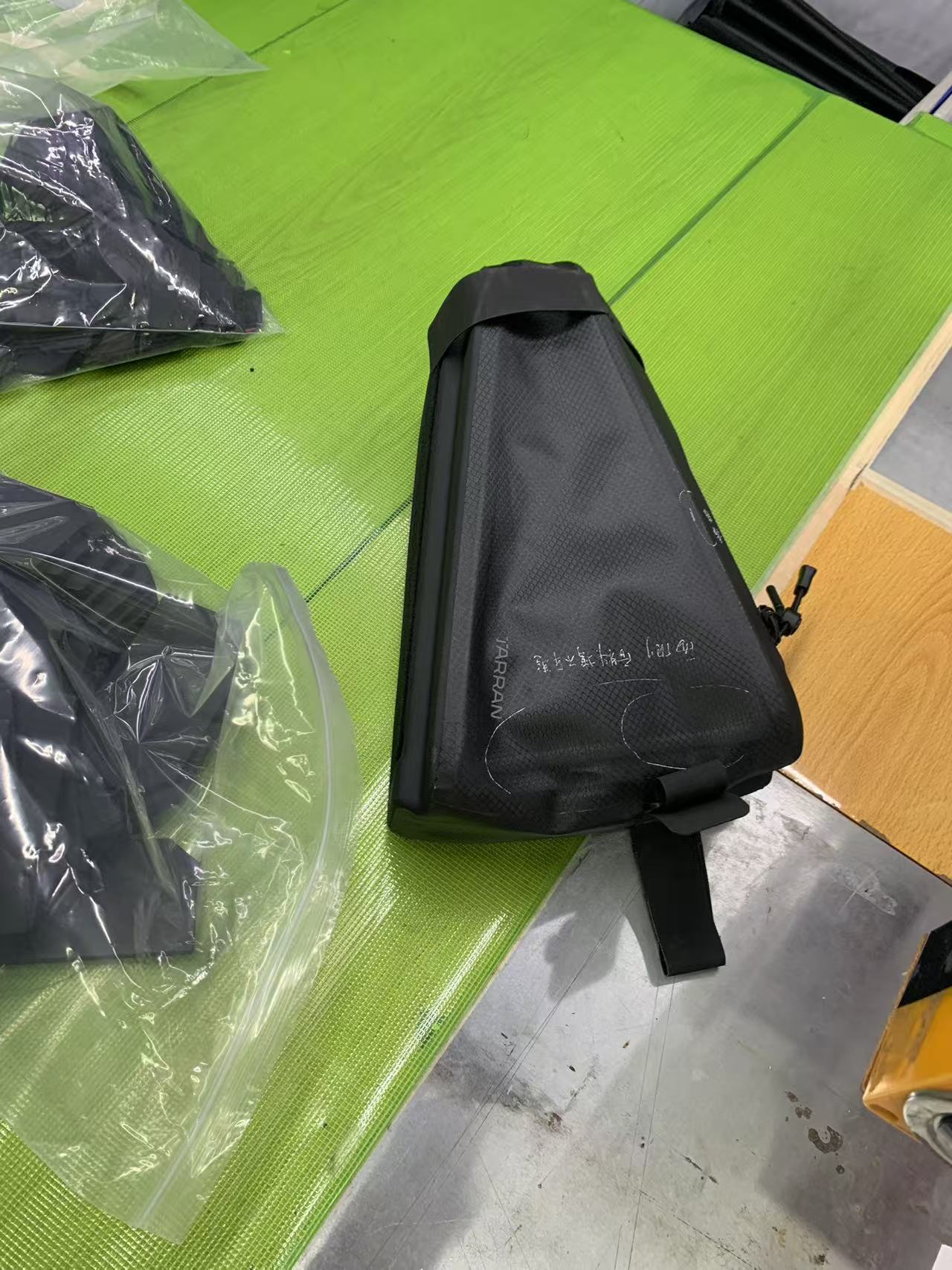
The other item in the photos is less tidy: a confirmed sample marked up in chalk. Those lines are the pattern room's revision notes written directly on the part — where a seam moves, where a curve gets softened, where a strap position shifts by a few millimetres to clear a bottle cage boss. Marking the sample rather than annotating a drawing keeps the correction physical and unambiguous, and it is how the second sample round gets closed out quickly instead of turning into three more weeks of email.
Confirmed sample with its sample confirmation tag — version, order, production number, fabric and colour.
The right waterproof standard for a frame bag
We test this category against a heavy rain and water-jet protocol rather than a submersion protocol, and we say so plainly to buyers who ask for an immersion claim. A frame bag lives about half a metre off the ground behind a spinning front wheel. What it actually faces is continuous pressurised spray carrying grit, road salt and mud — hours of it — not a dunking. A water-jet test reproduces that. It also exposes the failure mode that matters here, which is spray driven sideways into a closure or into an anchor patch edge, and it does so without letting anyone claim a rating the closure hardware cannot support. Where a buyer genuinely needs a submersible bag on a bicycle, that is a different construction with an airtight closure, and we will quote it as one.
Beyond the waterproof test, the run went through our standard suite: bonding strength on welded seams, tensile strength on the base fabric, load cycling on the anchor tabs, zipper fatigue on the zippered version, abrasion, salt spray, colour fastness and colour difference, with IQC, IPQC and OQC checkpoints through the line and third-party SGS or QIMA inspection available on request.
Sealock has been building high-frequency welded waterproof gear for over 20 years, from our Dongguan plant and our facility in Ho Chi Minh City, and buyers can choose the origin that suits their tariff position without changing the specification. Standard terms on this category are FOB Guangdong, 7–15 days for sampling, 30–45 days for mass production, and MOQ from 300 pieces on most models. Ground-up development from a sketch, a competitor sample or a target spec sheet is normal work for us rather than an exception, though genuinely new structures carry a longer sampling cycle for the reasons described above.
We use cookies to offer you a better browsing experience, analyze site traffic and personalize content. By using this site, you agree to our use of cookies.
Privacy Policy